

Loss of plasticity in deep continual learning
Open accessPublished version of a preprint
The DOI matches its Crossref record; 114 of the 114 references it cites were found in a registry or an index; 17 of the 36 sources its claims cite were checked for support.
Abstract
Artificial neural networks, deep-learning methods and the backpropagation algorithm 1 form the foundation of modern machine learning and artificial intelligence. These methods are almost always used in two phases, one in which the weights of the network are updated and one in which the weights are held constant while the network is used or evaluated. This contrasts with natural learning and many applications, which require continual learning. It has been unclear whether or not deep learning methods work in continual learning settings. Here we show that they do not—that standard deep-learning methods gradually lose plasticity in continual-learning settings until they learn no better than a shallow network. We show such loss of plasticity using the classic ImageNet dataset and reinforcement-learning problems across a wide range of variations in the network and the learning algorithm. Plasticity is maintained indefinitely only by algorithms that continually inject diversity into the network, such as our continual backpropagation algorithm, a variation of backpropagation in which a small fraction of less-used units are continually and randomly reinitialized. Our results indicate that methods based on gradient descent are not enough—that sustained deep learning requires a random, non-gradient component to maintain variability and plasticity.
Overview
CoChat Summary
TL;DR
Standard deep-learning methods gradually lose plasticity in continual-learning settings, eventually learning no better than shallow or linear networks across supervised and reinforcement-learning tasks. Continual backpropagation, which selectively reinitializes a small fraction of least-used units, maintains plasticity apparently indefinitely in these experiments.
Key findings
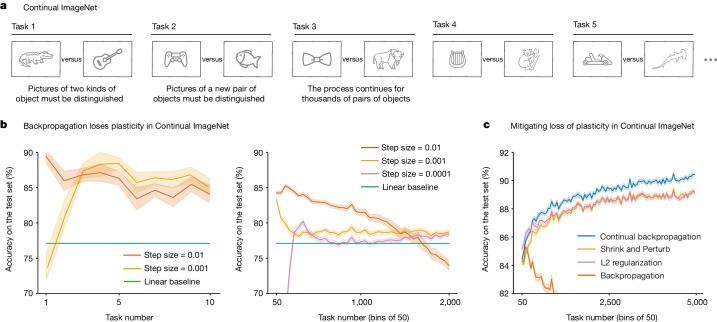
- In Continual ImageNet, unmodified backpropagation learned up to 88% correct on early tasks but by the 2,000th task had lost substantial plasticity for all tested step sizes, ending near or below a linear baseline; L2 regularization, Shrink and Perturb, and continual backpropagation maintained plasticity, with continual backpropagation best.
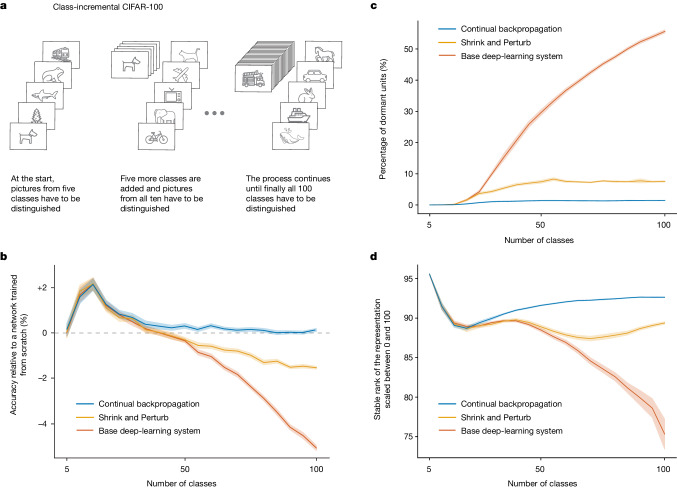
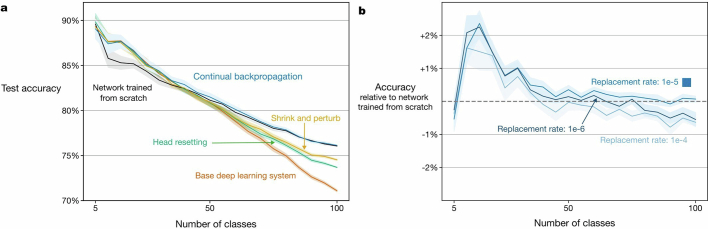
- In class-incremental CIFAR-100, the base deep-learning system was initially better than retraining from scratch but after 40 classes showed increasing loss of plasticity; by 100 classes its accuracy was 5% lower than the retrained network. Continual backpropagation eliminated this loss and reached 76.13% final accuracy on all 100 classes.
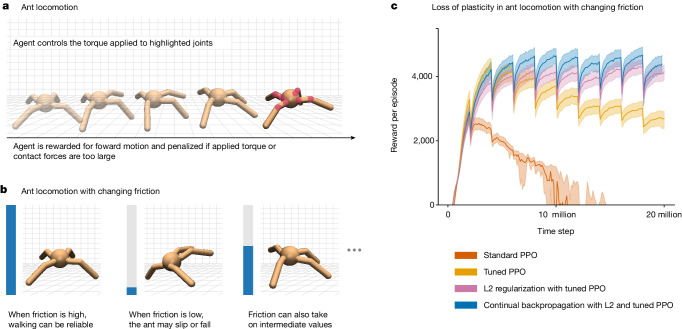
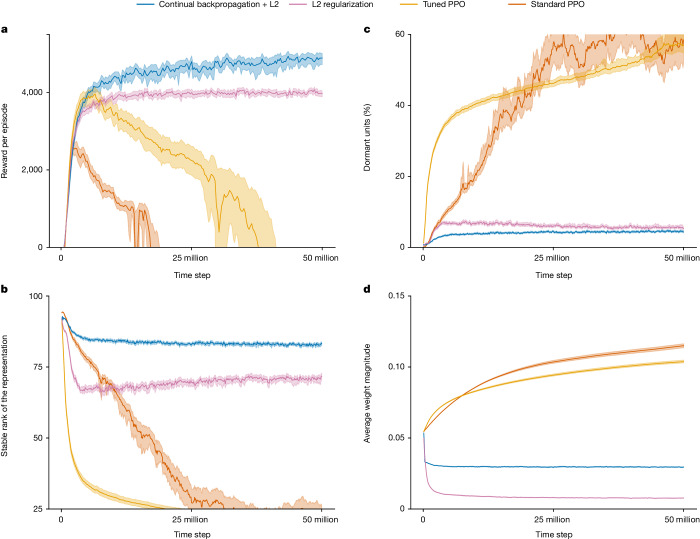
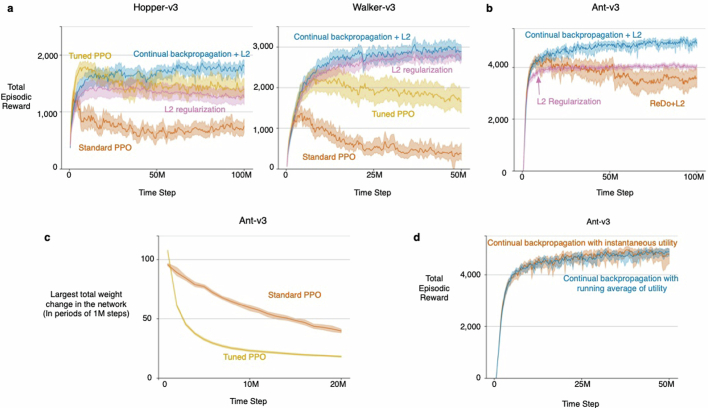
- In reinforcement learning, standard PPO on the non-stationary ant performed well for the first 2 million steps but worsened after friction changes; on the stationary ant, PPO improved for about 3 million steps then collapsed, failing every episode after 20 million steps. PPO with continual backpropagation plus L2 regularization maintained or improved performance.
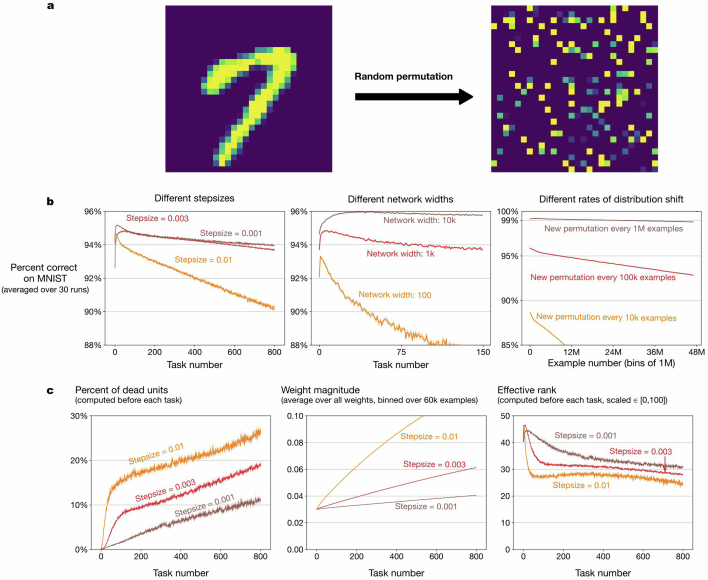
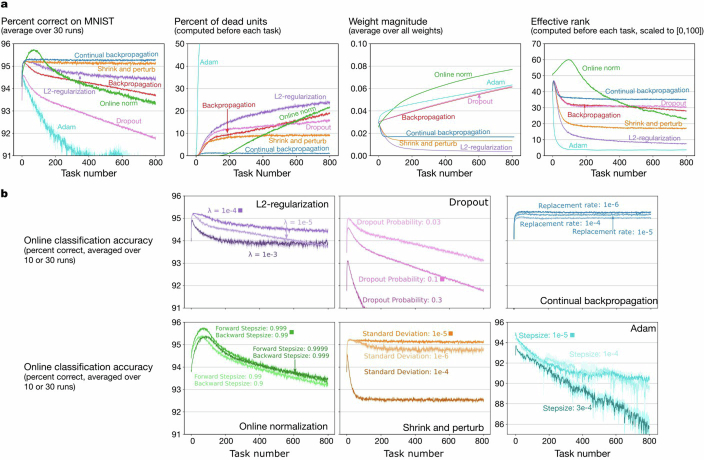
- Loss of plasticity correlated with more dead/dormant units, growing average weight magnitude, and lower effective rank; Adam, Dropout, and normalization often worsened plasticity, whereas L2 regularization and Shrink and Perturb reduced it.
Methods
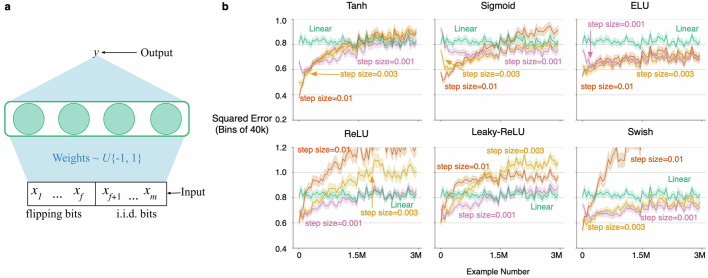
- Supervised continual-learning experiments included Continual ImageNet (1,000 classes, 700 images each, 600 train/100 test, binary class pairs, downsampled 32×32 images, convolutional network, SGD with momentum 0.9, 250 epochs per task, mini-batch 100, 30 runs), class-incremental CIFAR-100 (100 classes, 600 images each, 450/50/100 train/validation/test split, increments of 5 classes, 18-layer ResNet, 200 epochs per increment, 30 runs), Online Permuted MNIST (60,000 28×28 images, 800 tasks, three-hidden-layer feed-forward networks with 2,000 units per layer, single pass), and Slowly-Changing Regression (six activation functions, 3 million examples, 100 runs).
- Reinforcement-learning experiments used PPO on Ant-v3, Hopper-v3, and Walker-v3; the non-stationary ant changed friction every 2 million time steps, the stationary ant ran for 50 million steps, and some experiments ran up to 100 million steps. Policy and value networks each had two hidden layers of 256 units and were trained with Adam; non-stationary results averaged 100 runs and stationary results 30 runs.
- Continual backpropagation combines standard backpropagation with selective reinitialization of low-contribution-utility mature units. Utility is a running average with decay rate η = 0.99; outgoing weights of reinitialized units are set to zero; replacement rate ρ and maturity threshold m control reinitialization. For example, CIFAR-100 used ρ = 10⁻⁵ and m = 1,000; ImageNet used m = 100; reinforcement learning used ρ = 10⁻⁴, m = 10⁴, and weight decay 10⁻⁴.
Limitations
- Stated: reinforcement-learning demonstrations are less definitive than supervised ones because of greater stochasticity, algorithm and setting variety, and confounding between an algorithm’s learning ability and its ability to generate informative data; more runs and experimental work are needed.
- Stated: continual backpropagation’s utility measure is heuristic and not global, it does not address forgetting, and benchmarks focus on plasticity rather than forgetting or speed of learning; L2 regularization and Shrink and Perturb are sensitive to hyperparameters, and the ReDo comparison is preliminary.
- Evident from the text: Continual ImageNet resets output heads at task changes, giving privileged information about task boundaries and not used in other experiments; a systematic study with large language models was not possible because a single training run would cost millions of dollars.
Model-written summary. Check it against the paper before relying on it.
Integrity signals
Registry
Cites
Statistics
Figures
Verification
Claims the paper makes
9 Valid · 7 Not valid · 6 Not checked · 167 Own results and interpretations
Every source the paper cites for this claim was checked and supports it.
In the paper
“Another existing method that reduced loss of plasticity is Shrink and Perturb11 (orange line in Figs. 1 and 2).”
§ Loss of plasticity in deep continual learning > Maintaining plasticity
What the sources say
- Supportedcites [11] Ash, J. & Adams, R. P. On warm-starting neural network training. Adv. Neural Inf. Process. Syst. 33, 3884–3894 (2020). source
Section 4 (p. 6) reports that Shrink and Perturb remedies the warm-start problem when a network is trained on newly supplied samples: it closes the generalization gap while speeding training. This supports the citing sentence’s characterization of the method as reducing loss of plasticity. (LLM, conf=0.88)
plainstates a cause- Asserted: passes — The authors put it forward as true.
- Checkable: passes — It can be checked against evidence.
- Load-bearing: passes — The paper’s conclusions depend on it.
- Based: passes — The paper gives a reason why it holds.
- Supported
Every source the paper cites for this claim was checked and supports it.
In the paper
“This is different from the type of loss of plasticity in which the system can keep optimizing new objectives but lose the ability to generalize11,12.”
§ Loss of plasticity in deep continual learning > Methods > Extended discussion
What the sources say
- Supportedcites [11] Ash, J. & Adams, R. P. On warm-starting neural network training. Adv. Neural Inf. Process. Syst. 33, 3884–3894 (2020). source
The Introduction (p. 1) says warm-starting does not damage training accuracy, yet the model performs worse on test samples. This supports the cited type of loss of plasticity: the network can fit the updated training objective while generalizing less well. (LLM, conf=0.90)
- Supportedcites [12] Berariu, T. et al. A study on the plasticity of neural networks. Preprint at https://arxiv.org/abs/2106.00042 (2021). source
The Introduction (p. 1) distinguishes two forms of loss of plasticity: one in which a model can still reduce training error but generalizes worse, and another in which it cannot optimize the new task. That directly supports the distinction attributed to this paper. (LLM, conf=0.94)
plain- Asserted: passes — The authors put it forward as true.
- Checkable: passes — It can be checked against evidence.
- Load-bearing: unclear — It is unclear whether the paper’s conclusions depend on it.
- Based: passes — The paper gives a reason why it holds.
- Supported
The cited sources that could be checked couldn’t confirm or dispute this claim.
In the paper
“Lyle et al.24 showed that the standard values of β1 and β2 cause a large loss of plasticity.”
§ Loss of plasticity in deep continual learning > Methods > Details and further analysis in reinforcement learning
What the sources say
- Could not verifycites Lyle et al.24 Lyle, C. et al. Understanding plasticity in neural networks. In Proc. 40th International Conference on Machine Learning 23190–23211 (PMLR, 2023). sourceExperimental — accuracy not yet measured
Section 3.2 discusses mechanisms of plasticity loss, and the Additional information section reports using Adam, but neither attributes a large loss of plasticity to Adam’s standard β1 and β2 values. Searches for β1, β2, their typical values, and optimizer momentum found no passage testing or making that claim. The indexed passages provide no page numbers. (LLM, conf=0.72)
plainstates a cause- Asserted: passes — The authors put it forward as true.
- Checkable: passes — It can be checked against evidence.
- Load-bearing: passes — The paper’s conclusions depend on it.
- Based: passes — The paper gives a reason why it holds.
- Could not verify
The cited sources support only part of this claim — read each source’s verdict below.
In the paper
“However, the problem settings in these papers were offline as they had two separate phases, one for learning and the other for evaluation.”
§ Loss of plasticity in deep continual learning > Methods > Extended discussion
What the sources say
- Could not verifycites [120] Finn, C., Abbeel, P. & Levine, S. Model-agnostic meta-learning for fast adaptation of deep networks. In Proc. 34th International Conference on Machine Learning 1126–1135 (PMLR, 2017). sourceExperimental — accuracy not yet measured
Our copy of MAML contains no passage characterizing prior fast-adaptation works as 'offline' with two separate learning and evaluation phases, and it never frames the topic as adapting to changes in a data stream. Its Related Work (Sec. 4, p. 4-5) distinguishes prior methods on other grounds entirely — learned update rules/extra parameters (Andrychowicz et al., 2016; Ravi & Larochelle, 2017), architecture constraints such as recurrent or Siamese networks (Santoro et al., 2016; Koch, 2015), test-time nonparametric components (Vinyals et al., 2016), and pretrained-initialization approaches — while the two-stage meta-training/then-adaptation structure appears only as the paper's own problem set-up (Sec. 2.1, p. 2), not as a critique of other papers. Searched: 'offline problem setting / separate learning and evaluation phases', 'data stream / online continual adaptation', 'quickly adapting to changes'. Since our copy neither states nor contradicts the attributed point, it cannot be verified. (LLM, conf=0.68)
- Not checked yetcites [121] Wang, Y.-X., Ramanan, D. & Hebert, M. Growing a brain: fine-tuning by increasing model capacity. In Proc. IEEE Conference on Computer Vision and Pattern Recognition (CVPR) 2471–2480 (IEEE, 2017). source
Checked before — its earlier verdict is held back until a new check runs.
- Partly supportedcites [122] Nagabandi, A. et al. Learning to adapt in dynamic, real-world environments through meta-reinforcement learning. In Proc. 7th International Conference on Learning Representations (ICLR, 2019). sourceExperimental — accuracy not yet measured
Section 4 (p. 5) distinguishes a train-time algorithm from a test-time algorithm, supporting the claim that there are separate phases. But the test-time algorithm adapts the model at every timestep, and Section 6.4 (p. 9) explicitly describes this as online adaptation. Calling the paper's problem setting offline is therefore not supported. (LLM, conf=0.88)
plain- Asserted: passes — The authors put it forward as true.
- Checkable: passes — It can be checked against evidence.
- Load-bearing: passes — The paper’s conclusions depend on it.
- Based: passes — The paper gives a reason why it holds.
- Could not verify
The cited sources support only part of this claim — read each source’s verdict below.
In the paper
“These works focused on deep reinforcement learning systems that use large replay buffers.”
§ Loss of plasticity in deep continual learning > Methods > Details and further analysis in reinforcement learning
What the sources say
- Not checked yetcites [25] Sokar, G., Agarwal, R., Castro, P. S. & Evci, U. The dormant neuron phenomenon in deep reinforcement learning. In Proc. 40th International Conference on Machine Learning 32145–32168 (PMLR, 2023). source
- Supportedcites [83] Nikishin, E. et al. Deep reinforcement learning with plasticity injection. Adv. Neural Inf. Process. Syst. 36, 1–18 (2023). source
The Experimental Setup describes experiments with a Double DQN agent trained on 57 Atari games. The Additional information section says that the Atari 200M setting uses a replay buffer holding 4 million frames, supporting the description of the systems studied. The paper distinguishes this from the plasticity-injection method itself, which does not rely on a buffer. (LLM, conf=0.90)
- Not matchedcites [84] D’Oro, P. et al. Sample-efficient reinforcement learning by breaking the replay ratio barrier. In Proc. 11th International Conference on Learning Representations (ICLR, 2023).
Its entry has no title and year that we can search by.
- Partly supportedcites [85] Schwarzer, M. et al. Bigger, better, faster: human-level Atari with human-level efficiency. In Proc. 40th International Conference on Machine Learning 30365–30380 (PMLR, 2023). sourceExperimental — accuracy not yet measured
The Background and Method sections describe deep reinforcement learning agents that use replay buffers and periodic resets; the Discussion links resets to network plasticity. But the paper emphasizes large replay ratios—the number of learning updates relative to new experience—not large replay buffers. Our copy does not establish that the buffers themselves are large. (LLM, conf=0.88)
- Supportedcites [86] Lee, H. et al. PLASTIC: improving input and label plasticity for sample efficient reinforcement learning. Adv. Neural Inf. Process. Syst. 36, 1–26 (2023). source
Section 4.3 describes PLASTIC as a plasticity-preserving approach for off-policy reinforcement learning. The hyperparameter tables in “D Broader Impact” and “Additional information” list replay-buffer capacities of 100,000 for Atari and 1,000,000 for DMC, supporting the description of these systems as using large replay buffers. (LLM, conf=0.88)
- Not matchedcites [87] Delfosse, Q., Schramowski, P., Mundt, M., Molina, A. & Kersting, K. Adaptive rational activations to boost deep reinforcement learning. In Proc. 12th International Conference on Learning Representations (ICLR, 2024).
Its entry has no title and year that we can search by.
plain- Asserted: passes — The authors put it forward as true.
- Checkable: passes — It can be checked against evidence.
- Load-bearing: passes — The paper’s conclusions depend on it.
- Based: passes — The paper gives a reason why it holds.
88 more claims
Create a free account to see all 189 claims and to verify the 8 references still open.
- The quote only partly states this claim. 1
- It may state two separate claims as one. 67
- Probably not a substantial claim. 39
Self-check
Percentages, sums and reported differences re-computed from the paper’s own numbers.
Each contradiction between two passages listed here was confirmed by an independent check.
Rated major: it would touch a result — a value a result rests on, reported and recomputed p-values on opposite sides of the significance level, two passages that conflict with no sign which is right, or a cited work retracted before this paper was published.
In the paper
§ Loss of plasticity in deep continual learning > Abstract
“Plasticity is maintained indefinitely only by algorithms that continually inject diversity into the network, such as our continual backpropagation algorithm, a variation of backpropagation in which a small fraction of less-used units are continually and randomly reinitialized.”
§ Loss of plasticity in deep continual learning > Plasticity loss in supervised learning
“the continual backpropagation, L2 regularization and Shrink and Perturb algorithms maintain plasticity, apparently indefinitely (c).”
Rated minor: it would not touch a result — a value no result rests on, a p-value that stays on the same side of the significance level, or a conflict that is clerical, resolved elsewhere in the paper, or outside its own findings.
In the paper
§ Loss of plasticity in deep continual learning > Methods > Class-incremental CIFAR-100
“In Fig. 2d, we plot the stable rank of the representation in the penultimate layer of the network and the percentage of dead units in the full network.”
§ Loss of plasticity in deep continual learning > Plasticity loss in supervised learning
“c, The number of network units that are active less than 1% of the time increases rapidly for the base deep-learning system, but less so for Shrink and Perturb and continual backpropagation systems. d, A low stable rank means that the units of a network do not provide much diversity;”
Rated minor: it would not touch a result — a value no result rests on, a p-value that stays on the same side of the significance level, or a conflict that is clerical, resolved elsewhere in the paper, or outside its own findings.
In the paper
§ Loss of plasticity in deep continual learning > Main
“continual backpropagation is inspired by a long history of methods for automatically generating and testing features, starting with Selfridge’s Pandemonium in 1959 (refs. 19,20,31–35).”
§ Loss of plasticity in deep continual learning > References
“31. Selfridge, O. G. Pandemonium: a paradigm for learning. In Mechanization of Thought Processes: Proceedings of a Symposium Held at the National Physical Laboratory 511–531 (Her Majesty’s Stationary Office, 1958).”
Citations
Cites
Deep Residual Learning for Image Recognition
He, K., Zhang, X., Ren, S., & Sun, J. (2016) · 2016 IEEE Conference on Computer Vision and Pattern Recognition (CVPR) · doi:10.1109/cvpr.2016.90 · Cited by 235,474 · cited 2×
“The residual networks of today are more widely used and produce better results than strictly layered networks 38 .”
ImageNet: A large-scale hierarchical image database
Deng, J., Dong, W., Socher, R., Li, L.-J., Li, K., & Fei-Fei, L. (2009) · 2009 IEEE Conference on Computer Vision and Pattern Recognition · doi:10.1109/cvpr.2009.5206848 · Cited by 65,333 · cited 1×
“For example, a systematic study with large language models would not be possible today because just a single training run with one of these networks would require computation costing millions of dollars.”
Gradient-based learning applied to document recognition
Lecun, Y., Bottou, L., Bengio, Y., & Haffner, P. (1998) · Proceedings of the IEEE · doi:10.1109/5.726791 · Cited by 58,805 · cited 1×
“We now use a computationally cheap problem based on the MNIST dataset 56 to test the generality of loss of plasticity across various conditions.”
Boyd, S., & Vandenberghe, L. (2004) · doi:10.1017/cbo9780511804441 · Cited by 56,601
Holland, J. H. (1992) · The MIT Press eBooks · doi:10.7551/mitpress/1090.001.0001 · Cited by 47,002 · cited 1×
“The variation and selection is reminiscent of trial-and-error processes in evolution and behaviour 44–47 and has precursors in many earlier ideas, including Keifer–Wolfowitz methods 48 and restart methods 49 in engineering and feature-search methods in machine learning 31–35 , 50 .”
Highly accurate protein structure prediction with AlphaFold
Jumper, J., Evans, R., Pritzel, A., Green, T., Figurnov, M., Ronneberger, O., Tunyasuvunakool, K., Bates, R., Žídek, A., Potapenko, A., et al. (2021) · Nature · doi:10.1038/s41586-021-03819-2 · Cited by 43,764 · cited 6×
“The details of the specific instance of the Slowly-Changing Regression problem we use in this paper and the learning network used to predict its output are listed in Extended Data Table 4.”
InfluentialProximal Policy Optimization Algorithms
Schulman, J., Wolski, F., Dhariwal, P., Radford, A., & Klimov, O. (2017) · arXiv · doi:10.48550/arxiv.1707.06347 · Cited by 40,403
ImageNet Large Scale Visual Recognition Challenge
Russakovsky, O., Deng, J., Su, H., Krause, J., Satheesh, S., Ma, S., Huang, Z., Karpathy, A., Khosla, A., Bernstein, M., et al. (2015) · International Journal of Computer Vision · doi:10.1007/s11263-015-0816-y · Cited by 39,380 · cited 1×
“Here we use ImageNet, a classic object-recognition test bed 36 , which played a pivotal role in the rise of deep learning 37 and is still influential today.”
Learning representations by back-propagating errors
Rumelhart, D. E., Hinton, G. E., & Williams, R. J. (1986) · Nature · doi:10.1038/323533a0 · Cited by 31,892 · cited 1×
“Artificial neural networks, deep-learning methods and the backpropagation algorithm 1 form the foundation of modern machine learning and artificial intelligence.”
Human-level control through deep reinforcement learning
Mnih, V., Kavukcuoglu, K., Silver, D., Rusu, A. A., Veness, J., Bellemare, M. G., Graves, A., Riedmiller, M., Fidjeland, A. K., Ostrovski, G., et al. (2015) · Nature · doi:10.1038/nature14236 · Cited by 30,357 · cited 1×
“Machine learning and artificial intelligence have made remarkable progress in the past decade, with landmark successes in natural-language processing 2,3 , biology 4 , game playing 5–8 and robotics 9,10 .”
Research works printed but not linked: 35
- Bahdanau, D., Cho, K. & Bengio, Y. Neural machine translation by jointly learning to align and translate. In Proc. 3rd International Conference on Learning Representations (eds Bengio, Y. & LeCun, Y.) (ICLR, 2015).
- Achille, A., Rovere, M. & Soatto, S. Critical learning periods in deep networks. In Proc. 6th International Conference on Learning Representations (eds Murray, I., Ranzato, M. & Vinyals, O.) (ICLR, 2018).
- Nikishin, E., Schwarzer, M., D’Oro, P., Bacon, P.-L. & Courville, A. The primacy bias in deep reinforcement learning. In Proc. 39th International Conference on Machine Learning 16828–16847 (PMLR, 2022).
- Dohare, S. The Interplay of Search and Gradient Descent in Semi-stationary Learning Problems. Master’s thesis, Univ. Alberta (2020).
- Rahman, P. Toward Generate-and-test Algorithms for Continual Feature Discovery. Master’s thesis, Univ. Alberta (2021).
- Kumar, S., Marklund, H. & Van Roy, B. Maintaining plasticity in continual learning via regenerative regularization. In Proc. 3rd Conference on Lifelong Learning Agents (PMLR, 2024).
- Selfridge, O. G. Pandemonium: a paradigm for learning. In Mechanization of Thought Processes: Proceedings of a Symposium Held at the National Physical Laboratory 511–531 (Her Majesty’s Stationary Office, 1958).
- Mahmood, A. R. & Sutton, R. S. Representation search through generate and test. In Proc. AAAI Workshop: Learning Rich Representations from Low-Level Sensors 16–21 (2013).
- Krizhevsky, A., Sutskever, I. & Hinton, G. E. ImageNet classification with deep convolutional neural networks. Adv. Neural Inf. Process. Syst.25, 1097–1105 (2012).
- Kingma, D. P. & Ba, J. Adam: a method for stochastic optimization. In Proc. 3rd International Conference on Learning Representations (eds Bengio, Y. & LeCun, Y.) (ICLR, 2015).
- Yang, Y., Zhang, G., Xu, Z. & Katabi, D. Harnessing structures for value-based planning and reinforcement learning. In Proc. 7th International Conference on Learning Representations (ICLR, 2019).
- Maas, A. L., Hannun, A. Y. & Ng, A. Y. Rectifier nonlinearities improve neural network acoustic models. In Proc. 30th International Conference on Machine Learning (eds Dasgupta, S. & McAllester, D.) (JMLR, 2013).
- Nair, V. & Hinton, G. E. Rectified linear units improve restricted Boltzmann machines. In Proc. 27th International Conference on Machine Learning 807–814 (Omnipress, 2010).
- Roy, O. & Vetterli, M. The effective rank: a measure of effective dimensionality. In Proc. 2007 15th European Signal Processing Conference 606–610 (IEEE, 2007).
- Smith, S. L., Dherin, B., Barrett, D. & De, S. On the origin of implicit regularization in stochastic gradient descent. In Proc. 9th International Conference on Learning Representations (ICLR, 2021).
- Goodfellow, I., Bengio, Y. & Courville, A. Deep Learning (MIT Press, 2016).
- Ioffe, S. & Szegedy, C. Batch normalization: accelerating deep network training by reducing internal covariate shift. In Proc. 32nd International Conference on Machine Learning 448–456 (PMLR, 2015).
- Ceron, J. S. O. & Castro, P. S. Revisiting rainbow: promoting more insightful and inclusive deep reinforcement learning research. In Proc. 38th International Conference on Machine Learning 1373–1383 (PMLR, 2021).
- Igl, M., Farquhar, G., Luketina, J., Boehmer, W. & Whiteson, S. Transient non-stationarity and generalisation in deep reinforcement learning. In Proc. 9th International Conference on Learning Representations (ICLR, 2021).
- Kumar, A., Agarwal, R., Ghosh, D. & Levine, S. Implicit under-parameterization inhibits data-efficient deep reinforcement learning. In Proc. 9th International Conference on Learning Representations (ICLR, 2021).
- D’Oro, P. et al. Sample-efficient reinforcement learning by breaking the replay ratio barrier. In Proc. 11th International Conference on Learning Representations (ICLR, 2023).
- Delfosse, Q., Schramowski, P., Mundt, M., Molina, A. & Kersting, K. Adaptive rational activations to boost deep reinforcement learning. In Proc. 12th International Conference on Learning Representations (ICLR, 2024).
- Yoon, J., Yang, E., Lee, J. & Hwang, S. J. Lifelong learning with dynamically expandable networks. In Proc. 6th International Conference on Learning Representations (eds Murray, I., Ranzato, M. & Vinyals, O.) (ICLR, 2018).
- Golkar, S., Kagan, M. & Cho, K. in Proc. NeurIPS 2019 Workshop on Real Neurons & Hidden Units: Future Directions at the Intersection of Neuroscience and Artificial Intelligence 146 (NeurIPS, 2019).
- Rajasegaran, J., Hayat, M., Khan, S. H., Khan, F. & Shao, L. Random path selection for continual learning. Adv. Neural Inf. Process. Syst. 32, 1–11 (2019).
- Veniat, T., Denoyer, L. & Ranzato, M. Efficient continual learning with modular networks and task-driven priors. In Proc. 9th International Conference on Learning Representations (ICLR, 2021).
- Rusu, A. A. et al. in Proc. 1st Annual Conference on Robot Learning 262–270 (PMLR, 2017).
- Chen, J., Nguyen, T., Gorur, D. & Chaudhry, A. Is forgetting less a good inductive bias for forward transfer? In Proc. 11th International Conference on Learning Representations (ICLR, 2023).
- LeCun, Y., Denker, J. & Solla, S. Optimal brain damage. Adv. Neural Inf. Process. Syst. 2, 598–605 (1989).
- Liu, J., Xu, Z., Shi, R., Cheung, R. C. C. & So, H. K. H. Dynamic sparse training: find efficient sparse network from scratch with trainable masked layers. In Proc. 8th International Conference on Learning Representations (ICLR, 2020).
- Elsayed, M. & Mahmood, A. R. Addressing catastrophic forgetting and loss of plasticity in neural networks. In Proc. 12th International Conference on Learning Representations (ICLR, 2024).
- Evci, U., Gale, T., Menick, J., Castro, P. S. & Elsen, E. Rigging the lottery: making all tickets winners. In Proc. 37th International Conference on Machine Learning 2943–2952 (PMLR, 2020).
- Graesser, L., Evci, U., Elsen, E. & Castro, P. S. The state of sparse training in deep reinforcement learning. In Proc. 39th International Conference on Machine Learning 7766–7792 (PMLR, 2022).
- Zhou, G., Sohn, K. & Lee, H. Online incremental feature learning with denoising autoencoders. In Proc. 15th International Conference on Artificial Intelligence and Statistics 1453–1461 (PMLR, 2012).
- Sutskever, I., Martens, J., Dahl, G. & Hinton, G. On the importance of initialization and momentum in deep learning. In Proc. 30th International Conference on Machine Learning (eds Dasgupta, S. & McAllester, D.) 1139–1147 (JMLR, 2013).
Cited by
Items 101–168 of 168
Tan, W., Lv, Q., Li, X., Sun, N., & Huang, N. (2026) · Journal of Intelligent & Robotic Systems · doi:10.1007/s10846-026-02360-6 · Cited by 2
Wang, Y., Xia, P., Xu, Y., Xu, J., Xu, W., Lv, W., Yan, J., Ou, Q., Bao, H., Wang, L., et al. (2026) · BioData Mining · doi:10.1186/s13040-026-00522-8
“1A), with L2 regularization ensuring plasticity during sequential transfer learning [22].”
Continual Learning With Memorized Dynamic Visual Description for Remote Sensing Scene Classification
Peng, R., Zhao, W., Zhang, L., Jia, K., Wang, Q., & Ji, F. (2026) · IEEE Transactions on Geoscience and Remote Sensing · doi:10.1109/tgrs.2026.3665622 · Cited by 1
“To address this, CL, also known as lifelong learning, aims to achieve a delicate balance between plasticity—the ability to acquire and refine new knowledge from incoming data [12]—and stability—the capacity to preserve memories of historical knowledge [13], [14].”
Chalmeti, A., & Dutt, R. (2026) · Research Square · doi:10.21203/rs.3.rs-8929068/v1
Chang, Z., Lv, Y., Tian, B., Xiao, X., Guo, S., & Wang, P. (2025) · International Conference on Communication Technology and Information Technology (ICCTIT) · doi:10.1109/icctit68197.2025.11406689
“Existing incremental learning methods [7], [8], such as replay-based strategies, regularization constraints, and network expansion techniques, have shown limited effectiveness in HRRP scenarios.”
Dual reinforcement-learning network modules for modeling decision-making with multiple strategiesPreprint
Maeda, H., Wang, S., & Funamizu, A. (2026) · eLife · doi:10.64898/2026.03.07.709953
Dual-Aspect Enhancement of Data Replay: Influence-Guided Replay and Contrastive Gradient Modulation
Wang, J., Cheng, S., & Ye, J. (2026) · Lecture notes in computer science · doi:10.1007/978-981-95-7072-0_4
First Impressions Matter: Primacy Bias in Deep Reinforcement Learning during Human-Robot Co-learning
Spatharis, C., Koutrintzes, D., & Dagioglou, M. (2026) · ACM/IEEE International Conference on Human-Robot Interaction (HRI) · doi:10.1145/3776734.3794500
Tang, J., Li, X., Fu, J., et al. (2026) · Information Sciences · doi:10.1016/j.ins.2026.123448
Modelling the dynamics of learning continually with graph neural networks
Raghavan, K., & Balaprakash, P. (2026) · Physica D Nonlinear Phenomena · doi:10.1016/j.physd.2026.135207
Smaller but Better: Plasticity-Preserving Continual Learning for Embedded AI
Mao, C., Liu, H., Zheng, Z., Wu, F., & Chen, G. (2026) · International World Wide Web Conference (WWW) · doi:10.1145/3774904.3792073
“Existing plasticity-preserving methods often rely on carefully tuned hyperparameters [7, 21, 26].”
InfluentialLi, R., Xiong, Z.-X., Jiang, G., et al. (2026) · Ocean Engineering · doi:10.1016/j.oceaneng.2026.125396
Liu, L., Yu, B. X. B., & Lee, D.-H. (2026) · IEEE International Conference on Acoustics Speech and Signal Processing · doi:10.1109/icassp55912.2026.11463122
Rundo, F., Spata, M. O., Pino, C., Calabretta, M., Messina, A. A., Rundo, M., & Battiato, S. (2026) · Expert Systems with Applications · doi:10.1016/j.eswa.2026.132490
Deep Reinforcement Learning and the IID Assumption
Özgan, F., Engelbrecht, H. A., & Schiele, G. (2026) · International Conference on Advances in Artificial Intelligence and Machine Learning (AAIML) · doi:10.1109/aaiml67890.2026.11498102
Gated subspace alignment with drift compensation for parameter-efficient Class-Incremental Learning
顾建业, Huang, S., Li, T., Senbao, Z., & Li, M. (2026) · PLoS ONE · doi:10.1371/journal.pone.0348270
The Silicon Mirror: Agency, Automation, and the Search for Human Essence in the Age of AI
Mu, J. (2026) · Future of business and finance · doi:10.1007/978-3-032-25134-3_1
An elastic graph coloring memetic algorithm for lifelong multi-agent task allocation problems
Li, Y.-J., Huang, T., Gong, Y., et al. (2026) · Applied Soft Computing · doi:10.1016/j.asoc.2026.115400
SEDLA: Feature-incremental learning with deep neural networks for functional regression
Shen, Y., Zou, B., Bu, Y., & Zhou, Y. (2026) · Expert Systems with Applications · doi:10.1016/j.eswa.2026.132728
Intrinsic Preservation of Plasticity in Continual Quantum Learning
Chen, Y., & Zhang, S. (2026) · PRX Quantum · doi:10.1103/ry52-85ll · Cited by 6
Qiu, W., He, Z., Zhao, W., & Masui, H. (2026) · IEEE Internet of Things Journal · doi:10.1109/jiot.2026.3696834 · Cited by 4
“Similarly, shrink-and-perturb methods introduce small random perturbations to weights, preserving diversity and preventing dormant neurons [22].”
InfluentialLiu, Y., Liang, H., & Dong, Y. (2026) · IEEE Conference on Artificial Intelligence (CAI) · doi:10.1109/cai68641.2026.11536514
Ayyar, M. P., Poursanidis, M., Benois‐Pineau, J., Zemmari, A., Mansencal, B., & de Rugy, A. (2026) · SSRN Electronic Journal · doi:10.2139/ssrn.6863330
Chen, X., Wang, H., Shao, W., Huang, H., Li, Y., Guo, Y., Mao, L., & Gao, S. (2026) · Environmental Science & Technology · doi:10.1021/acs.est.6c05467 · Cited by 1
Correcting bias and enhancing adaptation for reinforcement learning-based data valuation
Jiao, Y., Sun, G., Wang, Z., & Zhu, S. (2026) · Information Sciences · doi:10.1016/j.ins.2026.123767
Learning continually with representational drift
van der Veldt, S., van de Ven, G. M., Moorman, S., & Etter, G. (2026) · Trends Open · doi:10.1016/j.treopn.2026.04.013 · Cited by 3
“This process can be implemented in artificial neural networks by pulling or resetting synaptic weights towards their randomly initialized values [8], and we will discuss implications for this particular case in a following section.”
InfluentialCalibrated Lifelong Reinforcement Learning for Efficient Adaptation to Changing Action SetsPreprint
Shi, L., Gong, B., Jiang, Q., Zhu, M., Jin, C., & Li, S. (2026) · SSRN Electronic Journal · doi:10.2139/ssrn.6946182
Jiang, C., Xi, J., Zhang, Q., et al. (2026) · Asia Energy and Electrical Engineering Symposium (AEEES) · doi:10.1109/aeees69423.2026.11556777
“TCN is a temporal modeling architecture based on one-dimensional convolutions, derived from WaveNet [7].”
Wang, H., Liang, Z., Song, Y., Wu, Z., Yang, Q., & Xu, G. (2026) · Advanced Engineering Informatics · doi:10.1016/j.aei.2026.104972
Enabling Edge IoT Intelligence: A Survey on Resource-Constrained Continual Learning
Yang, R., Bie, D., Li, D., Yao, Z., & Xiang, J. (2026) · IEEE Internet of Things Journal · doi:10.1109/jiot.2026.3705393
“Analogous to neurogenesis, continual backpropagation (CBP) [15] selectively reinitializes dormant neurons.”
DREAM: Disentangled RoI Attention Map for Privacy-Aware Edge Inference
Ma, M., Wong, V. W. S., Wang, L., & Schober, R. (2026) · IEEE Transactions on Cognitive Communications and Networking · doi:10.1109/tccn.2026.3706084
Yang, H., Tang, J., & Yang, S. (2026) · The Journal of Supercomputing · doi:10.1007/s11227-026-08667-3
Wang, S., Song, J., Yang, Z., Zhang, S., & Chen, H. (2026) · ACM Transactions on Computing for Healthcare · doi:10.1145/3821635
Kentour, M., Lu, J. J., & Xu, Q. (2026) · SSRN Electronic Journal · doi:10.2139/ssrn.7021136
ORACIL: Conflict-Graph-Based Order-Robust Analytic Class-Incremental Learning
Wang, G., Sun, H., Li, W., & Dong, Y. (2026) · Electronics · doi:10.3390/electronics15132941
ACE: Adaptive Confidence-Based Encoder Freezing
Katna, S., Harchandani, K., Shetty, V., et al. (2026) · doi:10.1109/icctwc68241.2026.11583638
Plasticity-Preserving Continual Cross-Modal Retrieval with Mixture of Collaborative LoRA Experts
Pan, Z., Shen, Q., Liu, K., Li, M., & Wang, H. (2026) · Communications in computer and information science · doi:10.1007/978-981-92-3560-5_33
Gao, S., Chen, C., Jiang, X., Zhu, S., Li, W., & Fu, H. (2026) · Reliability Engineering & System Safety · doi:10.1016/j.ress.2026.113186 · Cited by 1
A bio-inspired hybrid lifelong learning based on self-selective memristorsPreprint
Zhang, Y., Fan, X., Zhang, G. L., Zhang, Z., Mei, X., Wang, Z., Zhou, W., Sun, D., Deng, L., Xu, M., et al. (2026) · Research Square · doi:10.21203/rs.3.rs-10432387/v1
FSE: Continual learning for named entity recognition by fast-slow experts
Zhang, Y., Fan, Y., Li, H., Wu, X., & Chen, Q. (2026) · Pattern Recognition Letters · doi:10.1016/j.patrec.2026.07.027
“2) Second , model’s plasticity gradually diminishes as learning progresses [7], making the acquisition of new entity types increasingly di ffi cult.”
Ding, K., Wang, Y., Huang, K., Chen, Z., Zhou, J., Wu, D., & Yang, C. (2026) · Control Engineering Practice · doi:10.1016/j.conengprac.2026.107180
Modern Continual Learning with Foundation Models, Evaluation Challenges, and Future Directions
Ullah, Z., Hong, M., & Kim, J. (2026) · Mathematics · doi:10.3390/math14152774 · Cited by 1
Self-adaptive Low-Rank Adaptation for Class-Incremental Learning
Song, Y., Duan, Q., Sun, L., Shen, Y., Zhou, G., & Shi, Y. (2026) · Lecture notes in computer science · doi:10.1007/978-3-032-31438-3_32
Lethe: Plasticity-aware Active Forgetting for Resource-Efficient On-Device Continual Learning
Liu, H., Mao, C., Zheng, Z., Wu, F., Chen, G., & Huang, H. (2026) · ACM SIGKDD Conference on Knowledge Discovery and Data Mining (KDD) · doi:10.1145/3770855.3817621
Research on an Improved Multi-Model Dynamic Fusion Classification Technique
Wan, X., He, Y., Rao, X., Qiu, Y., Cheng, R., Wei, J., Cheng, X., Li, T., & Zhu, M. (2026) · Electronics · doi:10.3390/electronics15153490
Brain-inspired synergistic-memory prompt tuning for few-shot class-incremental learning
Chen, J., Xu, F., Lyu, X., Li, X., Chen, S., Huang, Y., & Tang, H. (2026) · Information Fusion · doi:10.1016/j.inffus.2026.104680
Lu, Q., Wu, S., Liu, Y., Huang, Z., Zhou, Y., Dong, B., Zhang, T., Li, L., Zhu, K., Shu, H., et al. (2026) · Nature Reviews Electrical Engineering · doi:10.1038/s44287-026-00319-1 · Cited by 1
“Considering limited real-world data, synthetic data will have a crucial role in both testing and learning, particularly in safety-critical situations 82–84 .”
IDCAC:Intrinsic and diffusion contrastive architectures SAC in robot path planning
Gu, Y., Chen, Y., Meng, F., Miao, R., Hao, J., & Lv, J. (2026) · Journal of Systems Architecture · doi:10.1016/j.sysarc.2026.103953
Yu, Z., Cao, S., Zhang, G., & Feng, P. (2026) · Cognitive Neurodynamics · doi:10.1007/s11571-026-10528-x
Ohri, K., Sukheja, D., Kumar, P., Arora, S., & Kumar, M. (2026) · IEEE Access · doi:10.1109/access.2026.3722626 · Cited by 1
Decoupled Dormancy Control for Pixel-Based Reinforcement Learning
Sun, B., Guo, P., Wang, C., & Li, C. (2026) · IEEE Access · doi:10.1109/access.2026.3727784
“Network plasticity loss has recently received increasing attention in deep RL [16], [29], [30].”
Continual learning via semantic memory system
Luo, M., Liu, Q., Ye, F., Bors, A. G., Sun, J., & Zhou, S. (2026) · Pattern Recognition · doi:10.1016/j.patcog.2026.114689
Neurocomputational mechanisms underlying cognitive flexibility: a translational perspective
Bähner, F., Oh, S., Hummos, A., Sandbrink, K. J., Meyer‐Lindenberg, A., & Collins, A. G. E. (2026) · Trends in Cognitive Sciences · doi:10.1016/j.tics.2026.08.003 · Cited by 1
Ma, O., Du, L., Dai, Y., Zhou, C., Li, Q., Pu, Y., & Ji, S. (2026) · IEEE Transactions on Information Forensics and Security · doi:10.1109/tifs.2026.3729515
Zhou, W., Huang, X., Yang, X., & Huang, A. (2026) · Evolving Systems · doi:10.1007/s12530-026-09873-3
“To investigate the mechanisms behind the performance improvements of G-CBP, we analyzed the internal state of the neural networks using three key health metrics established in the continual learning literature (Dohare et al. 2024): Percentage of Dead Units , Weight Magnitude , and Effective Rank .”
InfluentialYang, W., Liang, W., Gao, Y., Liu, X., Zong, L., Wang, G., & Zhang, X. (2026) · Lecture notes in computer science · doi:10.1007/978-3-032-37670-1_18
Fine-Grained Neuron Importance Guided Architecture-Based Continual Learning
Wang, P., Zhu, R., Liu, J., & Mu, K. (2026) · Lecture notes in computer science · doi:10.1007/978-3-032-37670-1_27
Weigh for transfer: Adaptive self-weighted neuron modulation for continual reinforcement learning
Li, J., Yin, H., Zuo, L., Lai, P., Zhou, J. T., & Zhang, X. (2026) · Knowledge-Based Systems · doi:10.1016/j.knosys.2026.117000
Kentour, M., Lu, J., & Xu, Q. (2026) · Pattern Recognition · doi:10.1016/j.patcog.2026.114899
Liu, N. P. (. (2026) · SSRN Electronic Journal · doi:10.2139/ssrn.7414498
Chang, C.-J., Li, C., Seyler, J. R., & Eivazi, S. (2026) · Lecture notes in computer science · doi:10.1007/978-3-032-38404-1_7
Liu, N. P. (. (2026) · SSRN Electronic Journal · doi:10.2139/ssrn.7410598
Targeting plasticity loss in continual learning via Null-Space Orthogonal Reorganization
Xiong, L., Li, J., & Xiong, H. (2026) · ICT Express · doi:10.1016/j.icte.2026.09.010
The recipe for intelligence in natural and artificial systems
Summerfield, C., & Stachenfeld, K. (2026) · Neuron · doi:10.1016/j.neuron.2026.08.013 · Cited by 1
Continual learning based state-aware estimation for reliable industrial legged robots
Yang, X., Li, H., Zhu, J., Ye, H., Sun, Q., Zhong, J., & Gao, Y. (2026) · Neural Networks · doi:10.1016/j.neunet.2026.109686
Assisted exploration of difficult transitions in humanoid motion tracking
Fu, C., Su, C., Jiang, L., Zhuo, C., Lan, K., Cheng, S., & Wang, H. (2026) · Frontiers in Neurorobotics · doi:10.3389/fnbot.2026.1920711
Fang, H., Xiong, G., Tao, Z., Guo, C., Zhu, F., & Lv, Y. (2026) · IEEE International Conference on Automation Science and Engineering (CASE) · doi:10.1109/case69030.2026.11704510
Toward Enactive Artificial Intelligence
Rafiee, B., & Sutton, R. (2026) · arXiv · doi:10.48550/arxiv.2605.24238
Self-citation
Metadata
- Authors
- Dohare, S., Hernandez-Garcia, J. F., Lan, Q., Rahman, P., Mahmood, A. R., & Sutton, R. S.
- Affiliations
- University of Alberta (CA)
- Canadian Institute for Advanced Research (CA)
- Corresponding author
- Dohare, Shibhansh
- Venue
- Nature
- Published
- 2024-08-21
- Volume
- 632
- Issue
- 8026
- Pages
- 768-774
- ISSN
- 0028-0836 (ISSN-L)
- 1476-4687
- PMC
- PMC11338828
- OpenAlex
- W4401793915
- Cited by
- 172
- References
- 92
- Citations by year
- 2026: 91 · 2025: 70 · 2024: 10
- FWCI
- 25.13
- Type
- journal article
- Language
- en
- Open access
- hybrid
- doi.org
- Licence
- cc-by
- creativecommons.org/licenses/by/4.0 (tdm)
- creativecommons.org/licenses/by/4.0 (vor)
- Locations
- Nature (publishedVersion, cc-by)
- Research Square (acceptedVersion, cc-by)
- PubMed Central (publishedVersion, cc-by)
- PubMed (publishedVersion)
- Funders
- Canadian Institute for Advanced Research
- Alberta Machine Intelligence Institute
- DeepMind
- Alliance de recherche numérique du Canada
- Natural Sciences and Engineering Research Council of Canada
- Topics
- Physical Sciences › Computer Science › Artificial Intelligence › Domain Adaptation and Few-Shot Learning
- Physical Sciences › Computer Science › Artificial Intelligence › Neural Networks and Applications
- Physical Sciences › Computer Science › Artificial Intelligence › Reinforcement Learning in Robotics
- Keywords
- continual learning, neuroplasticity, catastrophic forgetting, deep neural network, network diversity, gradient-based learning, reinforcement learning, ImageNet
About these checks
Registry, retraction, Cites and statistics results are computed, not judged, with one exception: a printed reference that no index lists is read once by a model before it counts as a citation error. Claims are extracted by a model and kept only when their quote appears verbatim in the text; each cited source is then checked, with a model’s help, for whether it says what the claim relies on. Those verdicts can be wrong — read the claim’s quote and the cited source before relying on one.
The claim verdicts this report counts are experimental: their accuracy is not yet measured.
A language model drew the claims from the paper on 2026-10-01, under version 3 of the claim definition (model deepseek-v4.1-flash, prompt extract-v3).
A second model labelled each claim on 2026-10-01 (model jev-1.13-20260917, definition revision gold-guideline-v0.2).
Cited sources are checked with a language model’s help (gpt-6-sol and qwen3.8-omni-flash).
Statistics and arithmetic are recomputed, not judged.
Confidence bands are shown only for fields calibrated on our annotated test set. None is calibrated yet, so no band is shown.
What counts as a claim ›How we measure confidence ›How we check this ›
Are you an author, or do you see a problem with this page? Request a review
Data sources
Bibliographic data: Semantic Scholar, OpenAlex, Crossref.
Contains information from the Semantic Scholar Academic Graph Datasets, made available under the ODC Attribution License (ODC-BY 1.0).
Semantic Scholar’s data is described in: Kinney, R., et al. (2023). The Semantic Scholar Open Data Platform. arXiv:2301.10140.
