

A direct black-hole mass measurement in a little red dot at high redshift
Open accessThe DOI matches its Crossref record; 75 of the 75 references it cites were found in a registry or an index; none of the 45 sources its claims cite is checked for support yet.
Abstract
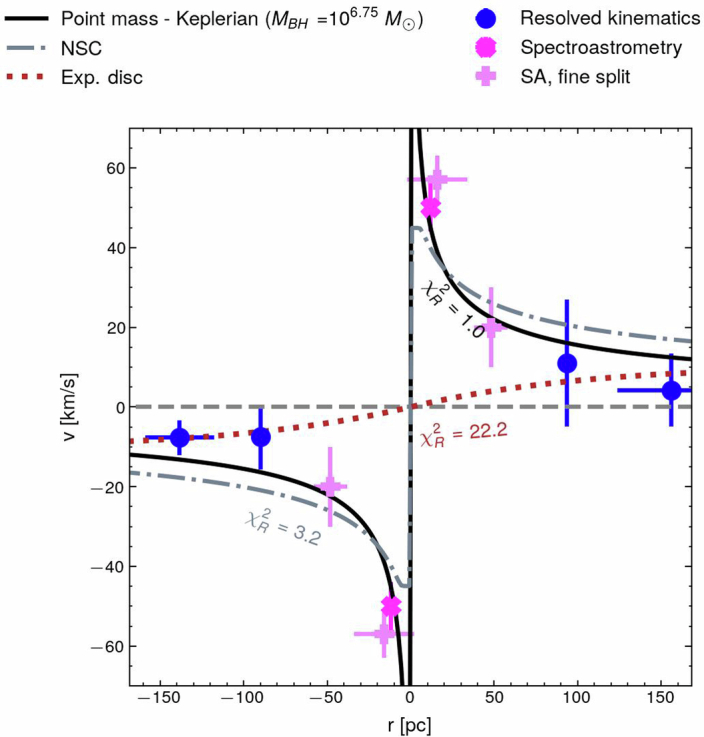
Recent discoveries of faint active galactic nuclei (AGN) at the redshift frontier have revealed a plethora of broad Hα emitters with optically red continua, named little red dots (LRDs) 1 , which comprise 15–30% of the high-redshift broad-line AGN population 2 . Owing to their peculiar properties 3–6 , modelling LRDs with standard AGN scenarios has proven challenging. In particular, the validity of single-epoch virial mass estimates in determining the black-hole masses of LRDs has been called into question, with some models claiming that masses might be overestimated by up to two orders of magnitude 7–10 . Here we report a direct, dynamical black-hole mass measurement in a strongly lensed LRD at a redshift of 7.04. The combination of lensing with deep spectroscopic data reveals a rotation curve that is inconsistent with a nuclear star cluster, yet can be well explained by Keplerian rotation around a point mass of 50 million solar masses, consistent with virial black-hole mass estimates. The Keplerian rotation leaves little room for any stellar component in a host galaxy, as we conservatively infer M BH / M ⁎ > 2 (where M BH is the black-hole mass and M ⁎ is the stellar mass). Such a ‘naked’ black hole, together with its near-pristine environment 11 , indicates that this LRD is a massive black-hole seed caught in its earliest accretion phase.
Overview
CoChat Summary
TL;DR
A strongly lensed little red dot at z = 7.04, Abell 2744−QSO1, shows a rotation curve best explained by Keplerian motion around a point mass, giving a direct dynamical black-hole mass measurement at high redshift. The result supports virial black-hole mass estimates for this LRD and implies an extremely high black-hole-to-stellar mass ratio, consistent with a massive black-hole seed in an early accretion phase.
Key findings
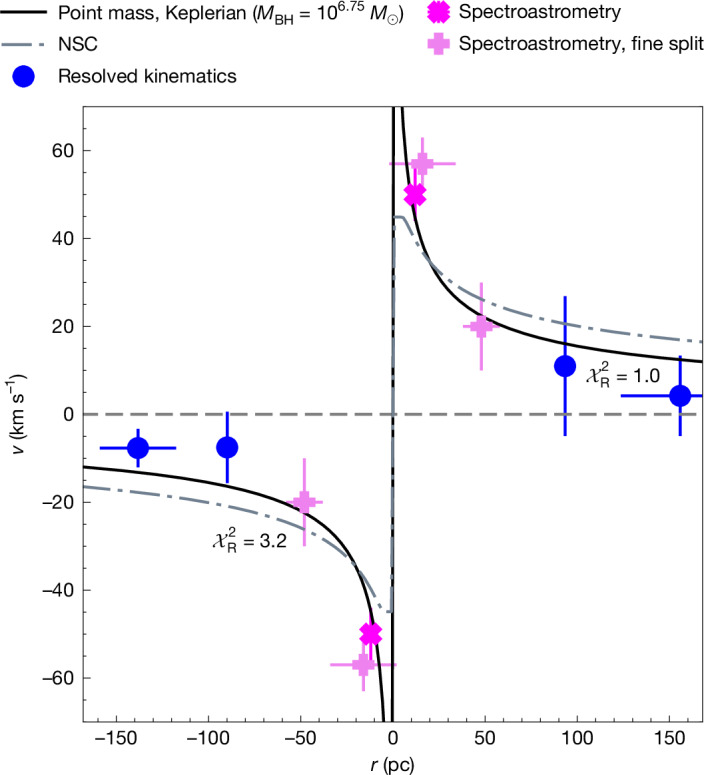
- The one-dimensional rotation curve is fit better by a point mass than by a Milky Way-like nuclear star cluster: point mass χR² = 1.0 versus NSC χR² = 3.2, with >5σ preference and ΔBIC ≈ 11; the point-mass fit gives log(MBH/M⊙) = 6.75 ± 0.15 as a lower limit because inclination is unconstrained.
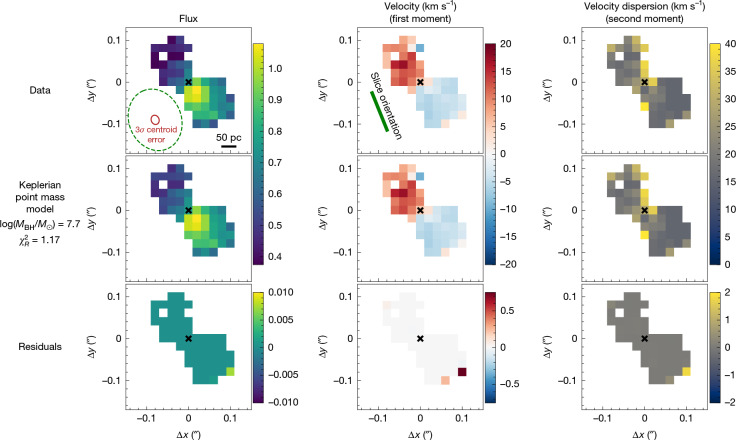
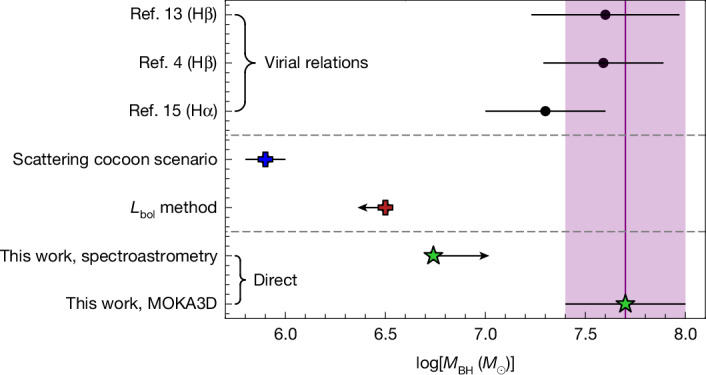
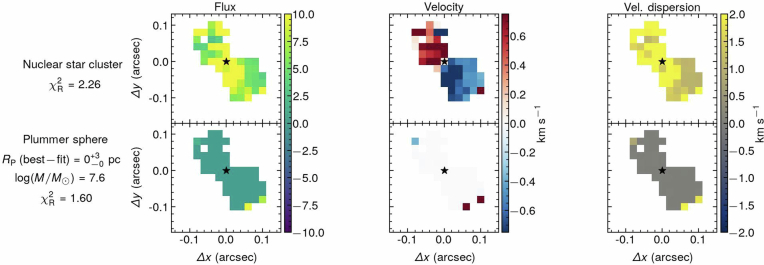
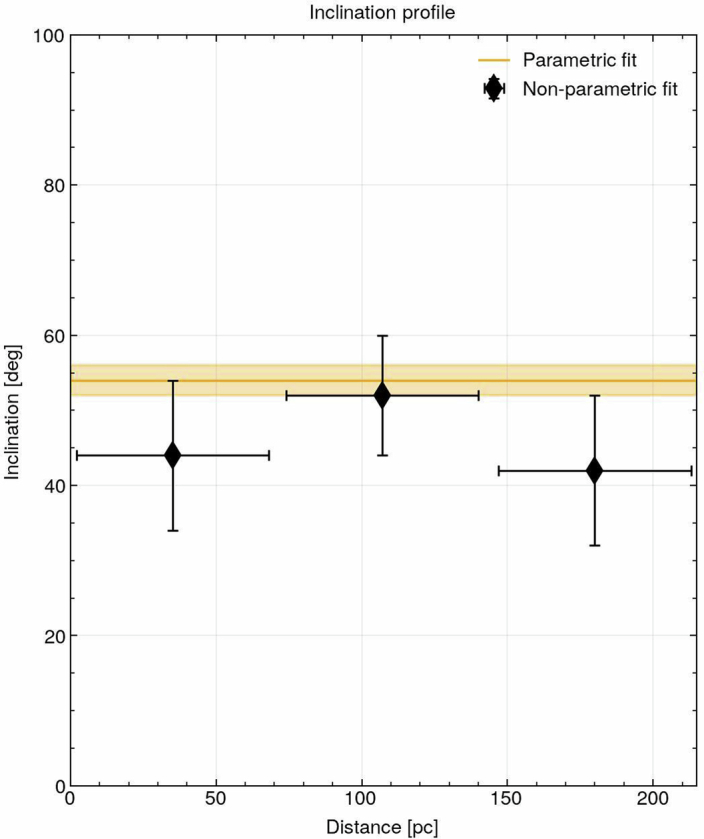
- Independent MOKA3D 3D kinematic modelling gives a Keplerian point-mass fit with log(MBH/M⊙) = 7.7 ± 0.3 after correcting for an inclination of 52° ± 2°, consistent with the lower limit; the NSC model has χR² = 2.26 and systematic residuals, while the Plummer sphere collapses to a point mass.
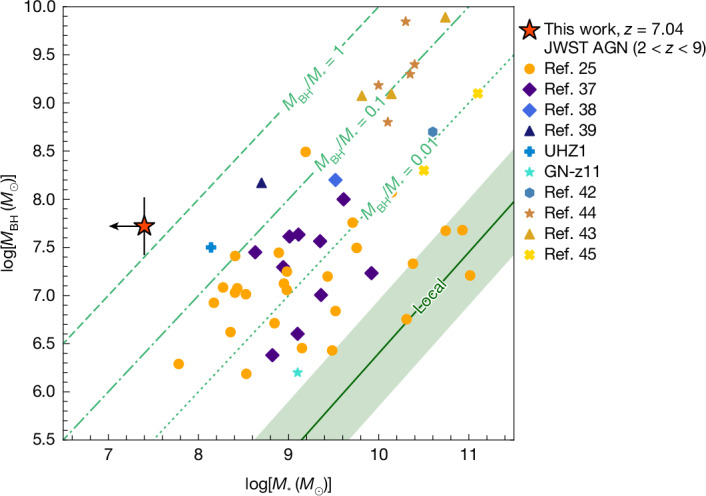
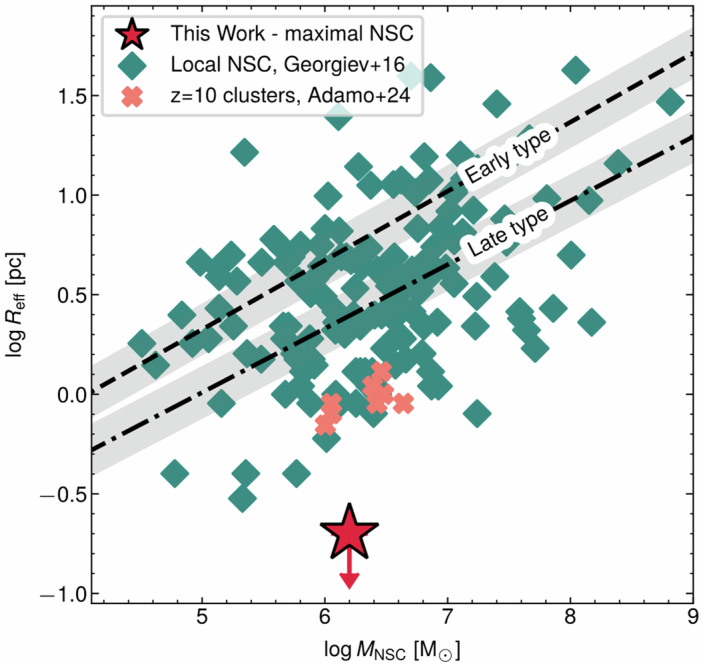
- The Keplerian rotation leaves little room for stars: the paper conservatively derives M⁎ < 2 × 10⁷ M⊙ and MBH/M⁎ > 2, making QSO1 the most “naked” massive black hole known to the authors and about 1 dex more overmassive than the most extreme JWST sources shown.
- The black hole has LEdd = 7.6 × 10⁴⁵ erg s⁻¹ and L/LEdd ≈ 0.02 using standard broad Hα-to-bolometric scaling, or ≈0.01 or lower if that relation is higher; virial mass estimates are consistent with the direct measurement, whereas an electron-scattering broad-line scenario underestimates the mass by nearly 2 dex.
Methods
- Uses JWST/NIRSpec integral field spectroscopy from the BlackTHUNDER survey, 7.3-hour G395H exposures, centred on lensed image A of QSO1 at z = 7.04; adopts μ = 6.2, shear 3.52, and a 0.02″ oversampled cube for main analysis.
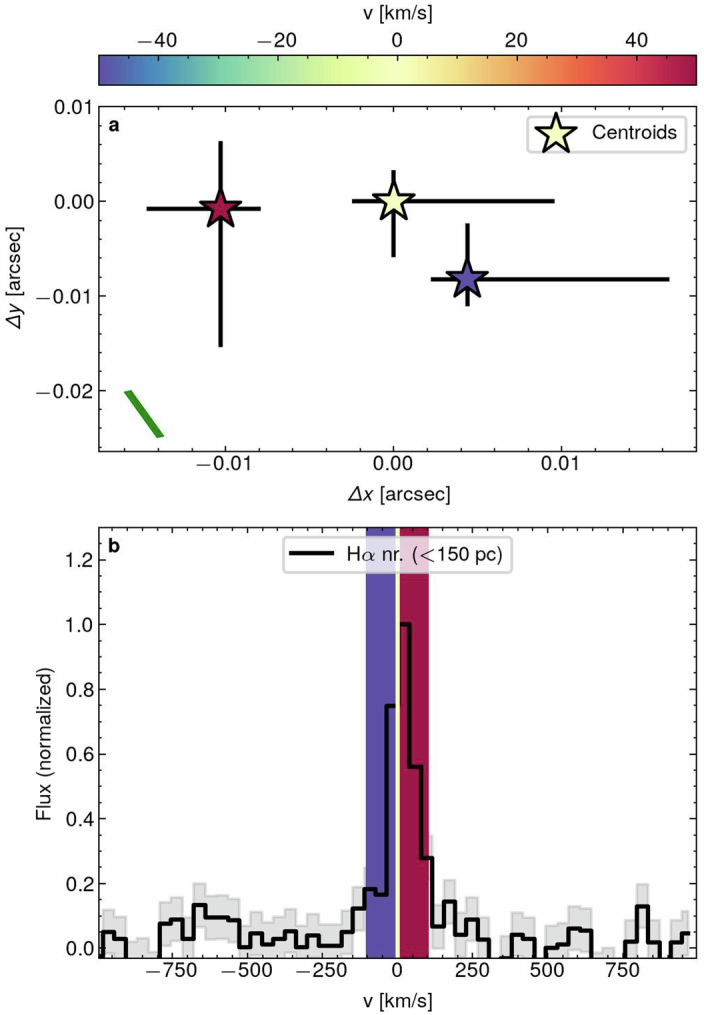
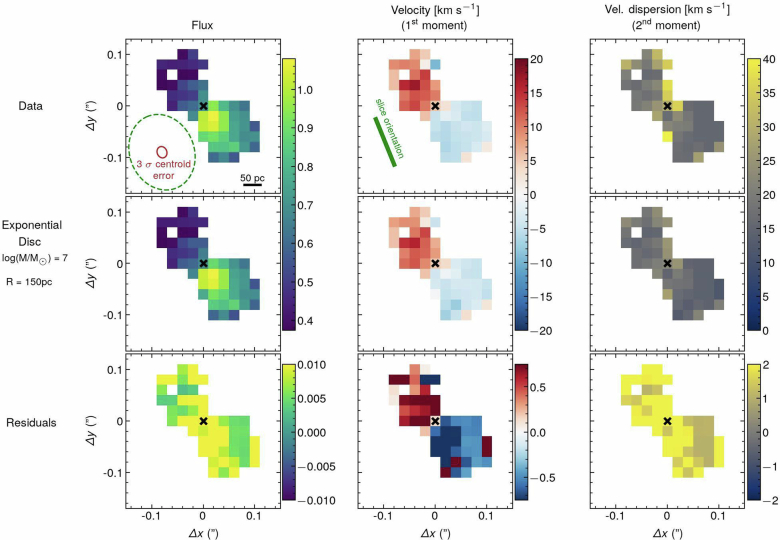
- Extracts narrow Hα flux, velocity, and velocity dispersion maps; bins the line-of-sight velocity field at 100 pc and 150 pc from the rotation centre and adds spectroastrometric centroid measurements below the spatial resolution beam.
- Fits the rotation curve with Keplerian point-mass, nuclear star cluster, Plummer sphere, and Navarro–Frenk–White models, then independently refits the narrow-line cube with the MOKA3D 3D kinematic framework including point-spread-function smearing, inclination, and flux weighting.
Limitations
- The paper states that inclination is unconstrained in the direct spectroastrometric and one-dimensional rotation-curve fits, so those black-hole masses are lower limits; the rotation curve is sparsely sampled and only simple one- or two-parameter models are considered.
- The paper notes that flux calibrations beyond the nominal NIRSpec range may be inaccurate, affecting black-hole mass measurements more than kinematics, though the square-root dependence on luminosity limits the impact; it also states that only isotropic velocity distributions were considered, though anisotropies are unlikely to change the conclusion.
- The text makes evident that the object’s small size makes the inner rotation curve difficult to trace, that finer spectroastrometric velocity bins have lower signal-to-noise, and that Hβ narrow and [O iii] lines are too faint for constraining measurements.
Model-written summary. Check it against the paper before relying on it.
Integrity signals
Registry
Cites
Statistics
Figures
Verification
Claims the paper makes
0 Valid · 0 Not valid · 26 Not checked · 71 Own results and interpretations
A result the paper reports from its own data — it cites no other source for it, so there is none to check. The quote shows it is in the paper.
In the paper
“The evidence from kinematics alone corresponds to >5σ preference for a point mass.”
§ A direct black-hole mass measurement in a little red dot at high redshift > Main
plainSingle case- Asserted: passes — The authors put it forward as true.
- Checkable: passes — It can be checked against evidence.
- Load-bearing: passes — The paper’s conclusions depend on it.
- Based: passes — The paper gives a reason why it holds.
- Rests on an assumption not shown here.
None of the sources cited for this claim have been checked yet.
In the paper
“The narrow-line emission is spatially extended on scales of up to approximately 200 pc, as found by ref. 11 (whereas the continuum is unresolved13).”
§ A direct black-hole mass measurement in a little red dot at high redshift > Main
What the sources say
- Not checked yetcites [11] Maiolino, R. et al. A black hole in a near-pristine galaxy 700 million years after the Big Bang. Mon. Not. R. Astron. Soc.548, 1–19 (2026).
- Not checked yetcites [13] Furtak, L. J. et al. A high black-hole-to-host mass ratio in a lensed AGN in the early Universe. Nature 628, 57–61 (2024). 38354833 source
plain- Asserted: passes — The authors put it forward as true.
- Checkable: passes — It can be checked against evidence.
- Load-bearing: passes — The paper’s conclusions depend on it.
- Based: passes — The paper gives a reason why it holds.
A result the paper reports from its own data — it cites no other source for it, so there is none to check. The quote shows it is in the paper.
In the paper
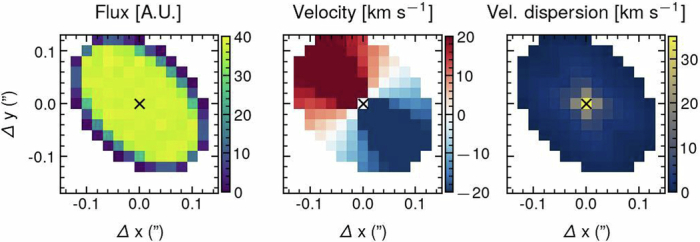
“Clearly, the narrow Hα velocity field reveals a velocity gradient with an amplitude of approximately 10 km s−1.”
§ A direct black-hole mass measurement in a little red dot at high redshift > Main
boostedSingle case- Asserted: passes — The authors put it forward as true.
- Checkable: passes — It can be checked against evidence.
- Load-bearing: passes — The paper’s conclusions depend on it.
- Based: passes — The paper gives a reason why it holds.
- Rests on an assumption not shown here.
A result the paper states — it cites no source for it, so there is none to check. The quote shows it is in the paper.
In the paper
“in Supplementary Information section 1.7, we conservatively derive a dynamical upper limit on the stellar mass in the host galaxy of M⁎ < 2 × 10⁷ M⊙.”
§ A direct black-hole mass measurement in a little red dot at high redshift > Main
hedgedSingle case- Asserted: passes — The authors put it forward as true.
- Checkable: passes — It can be checked against evidence.
- Load-bearing: passes — The paper’s conclusions depend on it.
- Based: passes — The paper gives a reason why it holds.
In the paper
“However, the scenario in which the broad lines are produced by electron scattering7, while providing a good spectral fit to the broad lines (Supplementary Fig. 8), underestimates the BH mass by nearly 2 dex (Fig. 3).”
§ A direct black-hole mass measurement in a little red dot at high redshift > Main
What the sources say
- Not checked yetcites [7] Rusakov, V. et al. JWST’s little red dots: an emerging population of young, low-mass AGN cocooned in dense ionized gas. Nature649, 574–579 (2026). PMC12804088 41535486 source
plainstates a causeSingle case- Asserted: passes — The authors put it forward as true.
- Checkable: passes — It can be checked against evidence.
- Load-bearing: passes — The paper’s conclusions depend on it.
- Based: passes — The paper gives a reason why it holds.
51 more claims
Create a free account to see all 97 claims and to verify the 45 references still open.
- It may state two separate claims as one. 32
- Probably not a substantial claim. 10
Self-check
Percentages, sums and reported differences re-computed from the paper’s own numbers.
Each contradiction between two passages listed here was confirmed by an independent check.
Rated minor: it would not touch a result — a value no result rests on, a p-value that stays on the same side of the significance level, or a conflict that is clerical, resolved elsewhere in the paper, or outside its own findings.
In the paper
§ A direct black-hole mass measurement in a little red dot at high redshift > Main
“In these tests, the NSC effective radius Rc was fixed to 5 pc, as in the Milky Way’s NSC”
§ A direct black-hole mass measurement in a little red dot at high redshift > Methods > Spectroastrometry of the rotation curve
“It is important to note that this is different from the ‘effective radius’ Re of the two-dimensional light distribution; in the case of the Milky Way NSC, the Re is a factor of 0.84 smaller than Rc.”
Citations
Cites
Storn, R., & Price, K. (1997) · Journal of Global Optimization · doi:10.1023/a:1008202821328 · Cited by 29,569
Planck 2018 results: VI. Cosmological parameters
Planck Collaboration, Aghanim, N., Akrami, Y., Ashdown, M., Aumont, J., Baccigalupi, C., Ballardini, M., Banday, A. J., Barreiro, R. B., Bartolo, N., et al. (2020) · Astronomy & Astrophysics · doi:10.1051/0004-6361/201833910 · Cited by 14,258
<tt>emcee</tt>: The MCMC Hammer
Foreman-Mackey, D., Hogg, D. W., Lang, D., & Goodman, J. (2013) · Publications of the Astronomical Society of the Pacific · doi:10.1086/670067 · Cited by 12,414
The Structure of Cold Dark Matter Halos
Navarro, J. F., Frenk, C. S., & White, S. D. M. (1996) · The Astrophysical Journal · doi:10.1086/177173 · Cited by 8,544
On the Problem of Distribution in Globular Star Clusters: (Plate 8.)
Plummer, H. C. (1911) · Monthly Notices of the Royal Astronomical Society · doi:10.1093/mnras/71.5.460 · Cited by 1,682
RELATIONS BETWEEN CENTRAL BLACK HOLE MASS AND TOTAL GALAXY STELLAR MASS IN THE LOCAL UNIVERSE
Reines, A. E., & Volonteri, M. (2015) · The Astrophysical Journal · doi:10.1088/0004-637x/813/2/82 · Cited by 849
Self-citationFormation of the First Supermassive Black Holes
Bromm, V., & Loeb, A. (2003) · The Astrophysical Journal · doi:10.1086/377529 · Cited by 810
Self-citationPrimordial Black Holes as Dark Matter: Recent Developments
Carr, B., & Kühnel, F. (2020) · Annual Review of Nuclear and Particle Science · doi:10.1146/annurev-nucl-050520-125911 · Cited by 807
Matthee, J., Naidu, R. P., Brammer, G., Chisholm, J., Eilers, A.-C., Goulding, A., Greene, J., Kashino, D., Labbe, I., Lilly, S. J., et al. (2024) · The Astrophysical Journal · doi:10.3847/1538-4357/ad2345 · Cited by 540
Bromm, V., & Yoshida, N. (2011) · Annual Review of Astronomy and Astrophysics · doi:10.1146/annurev-astro-081710-102608 · Cited by 512
Self-citationHarikane, Y., Zhang, Y., Nakajima, K., Ouchi, M., Isobe, Y., Ono, Y., Hatano, S., Xu, Y., & Umeda, H. (2023) · The Astrophysical Journal · doi:10.3847/1538-4357/ad029e · Cited by 492
Self-citationGreene, J. E., Labbe, I., Goulding, A. D., Furtak, L. J., Chemerynska, I., Kokorev, V., Dayal, P., Volonteri, M., Williams, C. C., Wang 王, B. 冰., et al. (2024) · The Astrophysical Journal · doi:10.3847/1538-4357/ad1e5f · Cited by 429
Self-citationA gas-enshrouded and gas-reddened black hole at cosmic dawn
Naidu, R. P., Matthee, J., Katz, H., de Graaff, A., Oesch, P. A., Smith, A., Greene, J. E., Brammer, G., Weibel, A., Hviding, R. E., et al. (2026) · Nature · doi:10.1038/s41586-026-10846-4 · Cited by 371
Self-citationA small and vigorous black hole in the early Universe
Maiolino, R., Scholtz, J., Witstok, J., Carniani, S., D’Eugenio, F., de Graaff, A., Übler, H., Tacchella, S., Curtis-Lake, E., Arribas, S., et al. (2024) · Nature · doi:10.1038/s41586-024-07052-5 · Cited by 345
Self-citationMaiolino, R., Risaliti, G., Signorini, M., Trefoloni, B., Juodžbalis, I., Scholtz, J., Übler, H., D’Eugenio, F., Carniani, S., Fabian, A. C., et al. (2025) · Monthly Notices of the Royal Astronomical Society · doi:10.1093/mnras/staf359 · Cited by 336
Self-citationGA-NIFS: A massive black hole in a low-metallicity AGN at z ∼ 5.55 revealed by JWST/NIRSpec IFS
Übler, H., Maiolino, R., Curtis-Lake, E., Pérez-González, P. G., Curti, M., Perna, M., Arribas, S., Charlot, S., Marshall, M. A., D’Eugenio, F., et al. (2023) · Astronomy & Astrophysics · doi:10.1051/0004-6361/202346137 · Cited by 300
Self-citationIvison, R. J., Greve, T. R., Dunlop, J. S., Peacock, J. A., Egami, E., Smail, I. R., Ibar, E., Kampen, E. V., Aretxaga, I., Babbedge, T. S. R., et al. (2007) · Monthly Notices of the Royal Astronomical Society · doi:10.1111/j.1365-2966.2007.12044.x · Cited by 299
Self-citationGebhardt, K., Rich, R. M., & Ho, L. C. (2005) · The Astrophysical Journal · doi:10.1086/497023 · Cited by 268
The Gravitational Slingshot and the Structure of Extragalactic Radio Sources
Saslaw, W. C., Valtonen, M. J., & Aarseth, S. J. (1974) · The Astrophysical Journal · doi:10.1086/152870 · Cited by 254
A massive quiescent galaxy at redshift 4.658
Carnall, A. C., McLure, R. J., Dunlop, J. S., McLeod, D. J., Wild, V., Cullen, F., Magee, D., Begley, R., Cimatti, A., Donnan, C. T., et al. (2023) · Nature · doi:10.1038/s41586-023-06158-6 · Cited by 236
Formation of massive black holes in rapidly growing pre-galactic gas clouds
Wise, J. H., Regan, J. A., O’Shea, B. W., Norman, M. L., Downes, T. P., & Xu, H. (2019) · Nature · doi:10.1038/s41586-019-0873-4 · Cited by 228
Cosmic conundra explained by thermal history and primordial black holes
Carr, B., Clesse, S., García-Bellido, J., & Kühnel, F. (2021) · Physics of the Dark Universe · doi:10.1016/j.dark.2020.100755 · Cited by 223
UNCOVER: A NIRSpec Identification of a Broad-line AGN at z = 8.50
Kokorev, V., Fujimoto, S., Labbe, I., Greene, J. E., Bezanson, R., Dayal, P., Nelson, E. J., Atek, H., Brammer, G., Caputi, K. I., et al. (2023) · The Astrophysical Journal Letters · doi:10.3847/2041-8213/ad037a · Cited by 213
Self-citationSurface brightness profile of the Milky Way’s nuclear star cluster
Schödel, R., Feldmeier, A., Kunneriath, D., Stolovy, S., Neumayer, N., Amaro-Seoane, P., & Nishiyama, S. (2014) · Astronomy & Astrophysics · doi:10.1051/0004-6361/201423481 · Cited by 206
JWST UNCOVER: Extremely Red and Compact Object at z phot ≃ 7.6 Triply Imaged by A2744
Furtak, L. J., Zitrin, A., Plat, A., Fujimoto, S., Wang, B., Nelson, E. J., Labbé, I., Bezanson, R., Brammer, G., van Dokkum, P., et al. (2023) · The Astrophysical Journal · doi:10.3847/1538-4357/acdc9d · Cited by 205
Self-citationGoulding, A. D., Greene, J. E., Setton, D. J., Labbe, I., Bezanson, R., Miller, T. B., Atek, H., Bogdán, Á., Brammer, G., Chemerynska, I., et al. (2023) · The Astrophysical Journal Letters · doi:10.3847/2041-8213/acf7c5 · Cited by 203
Self-citationKocevski, D. D., Finkelstein, S. L., Barro, G., Taylor, A. J., Calabrò, A., Laloux, B., Buchner, J., Trump, J. R., Leung, G. C. K., Yang, G., et al. (2025) · The Astrophysical Journal · doi:10.3847/1538-4357/adbc7d · Cited by 199
Self-citationBaggen, J. F. W., van Dokkum, P., Brammer, G., de Graaff, A., Franx, M., Greene, J. E., Labbé, I., Leja, J., Maseda, M. V., Nelson, E. J., et al. (2024) · The Astrophysical Journal Letters · doi:10.3847/2041-8213/ad90b8 · Cited by 199
Georgiev, I. Y., Böker, T., Leigh, N., Lützgendorf, N., & Neumayer, N. (2016) · Monthly Notices of the Royal Astronomical Society · doi:10.1093/mnras/stw093 · Cited by 197
A dormant overmassive black hole in the early Universe
Juodžbalis, I., Maiolino, R., Baker, W. M., Tacchella, S., Scholtz, J., D’Eugenio, F., Witstok, J., Schneider, R., Trinca, A., Valiante, R., et al. (2024) · Nature · doi:10.1038/s41586-024-08210-5 · Cited by 188
Self-citationBound star clusters observed in a lensed galaxy 460 Myr after the Big Bang
Adamo, A., Bradley, L. D., Vanzella, E., Claeyssens, A., Welch, B., Diego, J. M., Mahler, G., Oguri, M., Sharon, K., Abdurro’uf, et al. (2024) · Nature · doi:10.1038/s41586-024-07703-7 · Cited by 185
Type 1 AGN at low z- I. Emission properties
Stern, J. P., & Laor, A. (2012) · Monthly Notices of the Royal Astronomical Society · doi:10.1111/j.1365-2966.2012.20901.x · Cited by 181
JADES – the Rosetta stone of JWST-discovered AGN: deciphering the intriguing nature of early AGN
Juodžbalis, I., Ji, X., Maiolino, R., D’Eugenio, F., Scholtz, J., Risaliti, G., Fabian, A. C., Mazzolari, G., Gilli, R., Prandoni, I., et al. (2024) · Monthly Notices of the Royal Astronomical Society · doi:10.1093/mnras/stae2367 · Cited by 181
Self-citationDetection of stellar light from quasar host galaxies at redshifts above 6
Ding, X., Onoue, M., Silverman, J. D., Matsuoka, Y., Izumi, T., Strauss, M. A., Jahnkę, K., Phillips, C. L., Li, J., Volonteri, M., et al. (2023) · Nature · doi:10.1038/s41586-023-06345-5 · Cited by 179
Self-citationA high black-hole-to-host mass ratio in a lensed AGN in the early Universe
Furtak, L. J., Labbé, I., Zitrin, A., Greene, J. E., Dayal, P., Chemerynska, I., Kokorev, V., Miller, T. B., Goulding, A. D., de Graaff, A., et al. (2024) · Nature · doi:10.1038/s41586-024-07184-8 · Cited by 174
Self-citationJADES: comprehensive census of broad-line AGN from reionization to cosmic noon revealed by JWST
Juodžbalis, I., Maiolino, R., Baker, W. M., Curtis-Lake, E., Scholtz, J., D’Eugenio, F., Trefoloni, B., Isobe, Y., Tacchella, S., Bunker, A. J., et al. (2026) · Monthly Notices of the Royal Astronomical Society · doi:10.1093/mnras/stag086 · Cited by 171
Self-citationLambrides, E., Larson, R. L., Garofali, K., Ptak, A. F., Chiaberge, M., Long, A. S., Hutchison, T. A., Norman, C., McKinney, J., Akins, H. B., et al. (2026) · Nature Astronomy · doi:10.1038/s41550-026-02813-w · Cited by 169
Perna, M., Arribas, S., Marshall, M., D’Eugenio, F., Übler, H., Bunker, A. J., Charlot, S., Carniani, S., Jakobsen, P., Maiolino, R., et al. (2023) · Astronomy and Astrophysics · doi:10.1051/0004-6361/202346649 · Cited by 168
Self-citationEIGER. V. Characterizing the Host Galaxies of Luminous Quasars at z ≳ 6
Yue, M., Eilers, A., Simcoe, R. A., Mackenzie, R., Matthee, J., Kashino, D., Bordoloi, R., Lilly, S. J., & Naidu, R. P. (2024) · The Astrophysical Journal · doi:10.3847/1538-4357/ad3914 · Cited by 166
Natarajan, P., Pacucci, F., Ricarte, A., Bogdán, Á., Goulding, A. D., & Cappelluti, N. (2024) · The Astrophysical Journal Letters · doi:10.3847/2041-8213/ad0e76 · Cited by 154
The Discovery of Little Red Dots in the Local Universe: Signatures of Cool Gas Envelopes
Lin, X., Fan, X., Cai, Z., Bian, F., Liu, H., Sun, F., Ma, Y., Greene, J. E., Strauss, M. A., Green, R., et al. (2026) · The Astrophysical Journal · doi:10.3847/1538-4357/ae2bdf · Cited by 138
Self-citationSimmonds, C., Tacchella, S., Hainline, K., Johnson, B. D., Puskás, D., Robertson, B. E., Baker, W. M., Bhatawdekar, R., Boyett, K., Bunker, A. J., et al. (2024) · Monthly Notices of the Royal Astronomical Society · doi:10.1093/mnras/stae2537 · Cited by 135
Self-citationThe Formation of Galaxy Stellar Cores by the Hierarchical Merging of Supermassive Black Holes
Volonteri, M., Madau, P., & Haardt, F. (2003) · The Astrophysical Journal · doi:10.1086/376722 · Cited by 130
Self-citationLittle red dots as young supermassive black holes in dense ionized cocoons
Rusakov, V., Watson, D., Nikopoulos, G. P., Brammer, G., Gottumukkala, R., Harvey, T., Heintz, K. E., Damgaard, R., Sim, S. A., Sneppen, A., et al. (2026) · Nature · doi:10.1038/s41586-025-09900-4 · Cited by 110
Self-citationBubbles and outflows: The novel JWST/NIRSpec view of the z = 1.59 obscured quasar XID2028
Cresci, G., Tozzi, G. P., Perna, M., Brusa, M., Marconcini, C., Marconi, A., Carniani, S., Brienza, M., Giroletti, M., Belfiore, F., et al. (2023) · Astronomy and Astrophysics · doi:10.1051/0004-6361/202346001 · Cited by 106
Self-citationA black hole in a near pristine galaxy 700 Myr after the big bang
Maiolino, R., Übler, H., D’Eugenio, F., Scholtz, J., Juodžbalis, I., Ji, X., Perna, M., Bromm, V., Dayal, P., Koudmani, S., et al. (2026) · Monthly Notices of the Royal Astronomical Society · doi:10.1093/mnras/staf2109 · Cited by 105
Self-citationWhat You See Is What You Get: Empirically Measured Bolometric Luminosities of Little Red Dots
Greene, J. E., Setton, D. J., Furtak, L. J., Naidu, R. P., Volonteri, M., Dayal, P., Labbe, I., van Dokkum, P., Bezanson, R., Brammer, G., et al. (2026) · The Astrophysical Journal · doi:10.3847/1538-4357/ae1836 · Cited by 104
Self-citationBlackTHUNDER strikes twice: Balmer-line absorption in an overmassive Little Red Dot at z = 7.04
D’Eugenio, F., Maiolino, R., Perna, M., Übler, H., Ji, X., McClymont, W., Koudmani, S., Sijacki, D., Juodžbalis, I., Scholtz, J., et al. (2026) · Monthly Notices of the Royal Astronomical Society · doi:10.1093/mnras/stag401 · Cited by 101
Self-citationBlackTHUNDER – A non-stellar Balmer break in a black hole-dominated little red dot at z = 7.04
Ji, X., Maiolino, R., Übler, H., Scholtz, J., D’Eugenio, F., Sun, F., Perna, M., Turner, H., Carniani, S., Arribas, S., et al. (2025) · Monthly Notices of the Royal Astronomical Society · doi:10.1093/mnras/staf1867 · Cited by 96
Self-citationUndermassive Host Galaxies of Five z ∼ 6 Luminous Quasars Detected with JWST
Stone, M. A., Lyu, J., Rieke, G. H., Alberts, S. L., & Hainline, K. (2024) · The Astrophysical Journal · doi:10.3847/1538-4357/ad2a57 · Cited by 96
Self-citationSize matters: are we witnessing super-Eddington accretion in high-redshift black holes from JWST?
Lupi, A., Trinca, A., Volonteri, M., Dotti, M., & Mazzucchelli, C. (2024) · Astronomy and Astrophysics · doi:10.1051/0004-6361/202451249 · Cited by 94
Self-citationDifferential Speckle Interferometry
Beckers, J. M. (1982) · Optica Acta International Journal of Optics · doi:10.1080/713820871 · Cited by 91
Evidence for Line Broadening by Electron Scattering in the Broad‐Line Region of NGC 4395
Laor, A. (2006) · The Astrophysical Journal · doi:10.1086/502798 · Cited by 89
Impact of resonance, Raman, and Thomson scattering on hydrogen line formation in Little Red Dots
Chang, S.-J., Grönke, M., Matthee, J., & Mason, C. A. (2025) · Monthly Notices of the Royal Astronomical Society · doi:10.1093/mnras/staf2131 · Cited by 89
Shining in the dark: the spectral evolution of the first black holes
Pacucci, F., Ferrara, A., Volonteri, M., & Dubus, G. (2015) · Monthly Notices of the Royal Astronomical Society · doi:10.1093/mnras/stv2196 · Cited by 81
Self-citationPRESSURE SUPPORT IN GALAXY DISKS: IMPACT ON ROTATION CURVES AND DARK MATTER DENSITY PROFILES
Dalcanton, J. J., & Stilp, A. M. (2010) · The Astrophysical Journal · doi:10.1088/0004-637x/721/1/547 · Cited by 78
UNCOVER: 404 Error—Models Not Found for the Triply Imaged Little Red Dot A2744-QSO1*
Ma, Y., Greene, J. E., Setton, D. J., Volonteri, M., Leja, J., Wang, B., Bezanson, R., Brammer, G., Cutler, S. E., Dayal, P., et al. (2025) · The Astrophysical Journal · doi:10.3847/1538-4357/ada613 · Cited by 78
Self-citationLord of LRDs: insights into a 'Little Red Dot' with a low-ionization spectrum at z = 0.1
Ji, X., D’Eugenio, F., Juodžbalis, I., Walton, D. J., Fabian, A. C., Maiolino, R., Almeida, C. R., Pulido, J. A. A., Belokurov, V. A., Isobe, Y., et al. (2025) · Monthly Notices of the Royal Astronomical Society · doi:10.1093/mnras/staf2235 · Cited by 75
Self-citationA dynamical measure of the black hole mass in a quasar 11 billion years ago
Abuter, R., Allouche, F., Amorim, A., Bailet, C., Berdeu, A., Berger, J.-P., Bério, P., Bigioli, A., Boebion, O., Bolzer, M.-L., et al. (2024) · Nature · doi:10.1038/s41586-024-07053-4 · Cited by 69
An Investigation into the Selection and Colors of Little Red Dots and Active Galactic Nuclei
Hainline, K. N., Maiolino, R., Juodžbalis, I., Scholtz, J., Übler, H., D’Eugenio, F., Helton, J. M., Sun, Y., Sun, F., Robertson, B., et al. (2025) · The Astrophysical Journal · doi:10.3847/1538-4357/ad9920 · Cited by 65
Self-citationLittle Red Dots as the Very First Activity of Black Hole Growth
Inayoshi, K. (2025) · The Astrophysical Journal Letters · doi:10.3847/2041-8213/adea66 · Cited by 63
Self-citationBrazzini, M., D’Eugenio, F., Maiolino, R., Juodžbalis, I., Ji, X., Scholtz, J., & Chang, S.-J. (2025) · Monthly Notices of the Royal Astronomical Society Letters · doi:10.1093/mnrasl/slaf116 · Cited by 60
Self-citationPechetti, R., Seth, A., Neumayer, N., Georgiev, I., Kacharov, N., & den Brok, M. (2020) · The Astrophysical Journal · doi:10.3847/1538-4357/abaaa7 · Cited by 53
Furtak, L. J., Secunda, A. R., Greene, J. E., Zitrin, A., Labbé, I., Golubchik, M., Bezanson, R., Kokorev, V., Atek, H., Brammer, G. B., et al. (2025) · Astronomy & Astrophysics · doi:10.1051/0004-6361/202554110 · Cited by 50
Self-citationTorralba, A., Matthee, J., Pezzulli, G., Urrutia, T., Grönke, M., Mascia, S., D’Eugenio, F., Cesare, C. D., Eilers, A., Greene, J. E., et al. (2026) · Astronomy and Astrophysics · doi:10.1051/0004-6361/202555596 · Cited by 40
Self-citationFeedback and ionized gas outflows in four low-radio power AGN at z ∼ 0.15
Ulivi, L., Venturi, G., Cresci, G., Marconi, A., Marconcini, C., Amiri, A., Belfiore, F., Bertola, E., Carniani, S., D’Amato, Q., et al. (2024) · Astronomy & Astrophysics · doi:10.1051/0004-6361/202347436 · Cited by 33
Self-citationMOKA3D: An innovative approach to 3D gas kinematic modelling: I. Application to AGN ionised outflows
Marconcini, C., Marconi, A., Cresci, G., Venturi, G., Ulivi, L., Mannucci, F., Belfiore, F., Tozzi, G., Ginolfi, M., Marasco, A., et al. (2023) · Astronomy & Astrophysics · doi:10.1051/0004-6361/202346821 · Cited by 26
Self-citationMiller, T. B., Suess, K. A., Setton, D. J., Price, S. H., Labbé, I., Bezanson, R., Brammer, G., Cutler, S. E., Furtak, L. J., Leja, J., et al. (2025) · The Astrophysical Journal · doi:10.3847/1538-4357/ade438 · Cited by 25
Self-citationA dynamical mass estimator for highzgalaxies based on spectroastrometry
Gnerucci, A., MARCONI, A., Cresci, G., Maiolino, R., Mannucci, F., Schreiber, N. M. F., Davies, R., Shapiro, K. L., & Hicks, E. K. S. (2011) · Astronomy and Astrophysics · doi:10.1051/0004-6361/201117277 · Cited by 25
Self-citationHow Do Primordial Black Holes Change the Halo Mass Function and Structure?
Zhang 張, S. 賽., Bromm, V., & Liu 劉, B. 博. (2024) · The Astrophysical Journal · doi:10.3847/1538-4357/ad7b0d · Cited by 22
Self-citationHow do Massive Primordial Black Holes Impact the Formation of the First Stars and Galaxies?
Zhang 張, S. 賽., Liu 劉, B. 博., Bromm, V., Jeon, J., Boylan-Kolchin, M., & Kühnel, F. (2025) · The Astrophysical Journal · doi:10.3847/1538-4357/adddb4 · Cited by 21
Self-citationEvidence of the fast acceleration of AGN-driven winds at kiloparsec scales
Marconcini, C., Marconi, A., Cresci, G., Mannucci, F., Ulivi, L., Venturi, G., Scialpi, M., Tozzi, G., Belfiore, F., Bertola, E., et al. (2025) · Nature Astronomy · doi:10.1038/s41550-025-02518-6 · Cited by 21
Self-citationPerna, M., Arribas, S., Ji, X., Marconcini, C., Lamperti, I., Bertola, E., Circosta, C., D’Eugenio, F., Übler, H., Böker, T., et al. (2025) · Astronomy & Astrophysics · doi:10.1051/0004-6361/202453090 · Cited by 16
Self-citationTetrapus: non diffraction-limited resolution using chromatic positiondifference measurements.
Aime, C. J., Borgnino, J., Lund, G. I., & Ricort, G. (1988) · European Southern Observatory Conference and Workshop Proceedings · Cited by 8
A "Black Hole Star" Reveals the Remarkable Gas-Enshrouded Hearts of the Little Red Dots
Naidu, R. P., Matthee, J., Katz, H., de Graaff, A., Oesch, P., Smith, A., Greene, J. E., Brammer, G., Weibel, A., Hviding, R., et al. (2025) · arXiv · doi:10.48550/arxiv.2503.16596
Self-citation
Research works printed but not linked: 1
- Aime, C., Borgnino, J., Lund, G. & Ricort, G. Imaging of multiple star systems using the second probability density function. Mathematical description and numerical simulation. In European Southern Observatory Conference and Workshop Proceedings Vol. 29, European Southern Observatory Conference and Workshop Proc. (ed. Merkle, F.) 249–256 (ESO, 1988).
Cited by
A black hole in a near pristine galaxy 700 Myr after the big bang
Maiolino, R., Übler, H., D’Eugenio, F., Scholtz, J., Juodžbalis, I., Ji, X., Perna, M., Bromm, V., Dayal, P., Koudmani, S., et al. (2026) · Monthly Notices of the Royal Astronomical Society · doi:10.1093/mnras/staf2109 · Cited by 105
Self-citationBlackTHUNDER strikes twice: Balmer-line absorption in an overmassive Little Red Dot at z = 7.04
D’Eugenio, F., Maiolino, R., Perna, M., Übler, H., Ji, X., McClymont, W., Koudmani, S., Sijacki, D., Juodžbalis, I., Scholtz, J., et al. (2026) · Monthly Notices of the Royal Astronomical Society · doi:10.1093/mnras/stag401 · Cited by 101
Self-citationMatthee, J., Torralba, A., Pezzulli, G., Naidu, R. P., Chisholm, J., Mascia, S., Greene, J. E., Ishikawa, Y., Grönke, M., Wuyts, S., et al. (2026) · arXiv · doi:10.48550/arxiv.2603.17667 · Cited by 93
Little red dots as obscured little blue dots: A super-Eddington unification model
Madau, P., & Maiolino, R. (2026) · Astronomy and Astrophysics · doi:10.1051/0004-6361/202659606 · Cited by 84
Self-citationPérez‐González, P. G., Barro, G., Carniani, S., D'Eugenio, F., Rieke, G. H., Tripodi, R., Bunker, A. J., Ji, X., Marques-Chaves, R., Schaerer, D., et al. (2026) · The Astrophysical Journal · doi:10.48550/arxiv.2602.20247 · Cited by 82
Self-citation
Metadata
- Authors
- Juodžbalis, I., Marconcini, C., D’Eugenio, F., Maiolino, R., Marconi, A., Übler, H., Scholtz, J., Ji, X., Jones, G. C., Perna, M., Arribas, S., Bennett, J. S., Bromm, V., Bunker, A. J., Carniani, S., Charlot, S., Cresci, G., Dayal, P., Egami, E., Fabian, A., Inayoshi, K., Isobe, Y., Ivey, L. R., Koudmani, S., Laporte, N., Liu, B., Lyu, J., Mazzolari, G., Monty, S., Parlanti, E., Pérez-González, P. G., Robertson, B., Schneider, R., Sijacki, D., Tacchella, S., Trinca, A., Valiante, R., Volonteri, M., Witstok, J., & Zhang, S.
- Affiliations
- University of Cambridge (GB)
- Arcetri Astrophysical Observatory (IT)
- Max Planck Institute for Extraterrestrial Physics (DE)
- Centro de Astrobiología (ES)
- Center for Astrophysics Harvard & Smithsonian (US)
- The University of Texas at Austin (US)
- University of Oxford (GB)
- Scuola Normale Superiore (IT)
- Centre National de la Recherche Scientifique (FR)
- University of Groningen (NL)
- University of Arizona (US)
- Peking University (CN)
- Waseda University (JP)
- University of Hertfordshire (GB)
- Heidelberg University (DE)
- University of California, Santa Cruz (US)
- Sapienza University of Rome (IT)
- University of Insubria (IT)
- Astronomical Observatory of Rome (IT)
- University of Copenhagen (DK)
- Corresponding author
- Juodžbalis, Ignas
- ORCID
- Juodžbalis, Ignas
- Marconcini, Cosimo
- D’Eugenio, Francesco
- Maiolino, Roberto
- Marconi, Alessandro
- Übler, Hannah
- Scholtz, Jan
- Ji, Xihan
- Jones, Gareth C.
- Perna, Michele
- Arribas, Santiago
- Bennett, Jake S.
- Bromm, Volker
- Bunker, Andrew J.
- Carniani, Stefano
- Charlot, Stéphane
- Cresci, Giovanni
- Dayal, Pratika
- Egami, Eiichi
- Fabian, Andrew
- Inayoshi, Kohei
- Isobe, Yuki
- Ivey, Lucy R.
- Koudmani, Sophie
- Laporte, Nicolas
- Liu, Boyuan
- Lyu, Jianwei
- Mazzolari, Giovanni
- Monty, Stephanie
- Parlanti, Eleonora
- Pérez-González, Pablo G.
- Robertson, Brant
- Schneider, Raffaella
- Sijacki, Debora
- Tacchella, Sandro
- Trinca, Alessandro
- Valiante, Rosa
- Volonteri, Marta
- Witstok, Joris
- Zhang, Saiyang
- Venue
- Nature
- Published
- 2026-05-27
- Volume
- 653
- Issue
- 8116
- Pages
- 1017-1021
- ISSN
- 0028-0836 (ISSN-L)
- 1476-4687
- PMC
- PMC13215880
- OpenAlex
- W4415105201
- Cited by
- 151
- References
- 74
- Citations by year
- 2026: 137
- FWCI
- 80.91
- Type
- journal article
- Language
- en
- Open access
- hybrid
- doi.org
- Licence
- cc-by
- creativecommons.org/licenses/by/4.0 (tdm)
- creativecommons.org/licenses/by/4.0 (vor)
- Locations
- Nature (publishedVersion, cc-by)
- Oxford University Research Archive (ORA) (University of Oxford) (publishedVersion)
- PubMed Central (publishedVersion, cc-by)
- PubMed (publishedVersion)
- Research at the University of Copenhagen (University of Copenhagen) (publishedVersion, cc-by)
- University of Groningen research database (University of Groningen / Centre for Information Technology) (publishedVersion, cc-by)
- arXiv (submittedVersion, cc-by)
- Scuola Normale Superiore di Pisa (submittedVersion, cc-by)
- University of Hertfordshire Research Archive (University of Hertfordshire) (submittedVersion, cc-by)
- Apollo (University of Cambridge) (submittedVersion, cc-by)
- HAL (submittedVersion)
- Florence Research (University of Florence) (submittedVersion)
- Zenodo (CERN European Organization for Nuclear Research) (submittedVersion, cc-by)
- Funders
- National Aeronautics and Space Administration (5-03127, NAS5-03127, RYC2023-044853-I, PID2021-127718NB-I00)
- Space Telescope Science Institute (NAS5-03127, 5-03127)
- UK Research and Innovation (101040227, PID2021-127718NB-I00, 789056, MCIN/AEI/10.13039/501100011033, ST/W000997/1)
- European Space Agency (MCIN/AEI/10.13039/501100011033)
- Royal Commission for the Exhibition of 1851
- European Commission (PID2021-127718NB-I00, MCIN /AEI/ 10.13039/501100011033, 10.13039/501100011033, C53D23000950006, RYC2023-044853-I, 13039/501100011033, 501100011033, ERC APEX, 101164796, MCIN / AEI/10, CUP C53D23000950006, /AEI/10.13039/501100011033, 101040227, PID2024-159902NA-I00, PRIN-2022)
- National Research Foundation
- Danmarks Grundforskningsfond
- National Natural Science Foundation of China (1251101148, 12233001, CMS-CSST-2025-A09, 12573015)
- Ministerio de Ciencia e Innovación (MCIN/AEI/10, MICIN AEI/10.13039/501100011033/, .13039/501100011033, PID2024-159902NA-I00, / AEI/10, MCIN/AEI/10.13039/501100011033,, grant PID2021, 13039, PID2022-139567NB- I00, 10.13039/501100011033/, PID2021-127718NB-I00, 501100011033, RYC2023-044853-I, /AEI/10.13039/ 501100011033)
- Huo Family Foundation (PID2021-127718NB-I00, 101164796, PID2022-139567NB-I00)
- Canadian Space Agency
- Science and Technology Facilities Council (PID2022-139567NB-I00, PID2021-127718NB-I00, ST/W000997/1, MCIN/AEI/10.13039/501100011033, RYC2023-044853-I, PID2024-159902NA-I00)
- Agencia Estatal de Investigación (AEI//10.13039/501100011033/, 501100011033, 10.13039/501100011033, MCIN/AEI/10.13039/501 100 011 033, 13039, .13039/501100011033, MCIN / AEI/10, 10.13039, AEI/10, PID2021)
- European Social Fund (MCIN/AEI/10.13039/ 501100011033, 501100011033, AEI/10.13039/501100011033)
- H2020 European Research Council (789056, 695671)
- HORIZON EUROPE European Research Council (101164796)
- NextGenerationEU (MCIN/AEI/10.13039/5011 00011033, PRIN2022, 13039/501100011033, AEI/10.13039/501100011033, 10.13039/501100011033)
- Topics
- Physical Sciences › Physics and Astronomy › Astronomy and Astrophysics › Galaxies: Formation, Evolution, Phenomena
- Physical Sciences › Physics and Astronomy › Astronomy and Astrophysics › Astrophysical Phenomena and Observations
- Physical Sciences › Physics and Astronomy › Astronomy and Astrophysics › Stellar, planetary, and galactic studies
- Keywords
- Little Red Dots, black hole mass, high-redshift AGN, strong gravitational lensing, Keplerian rotation, black hole accretion, host galaxy stellar mass
About these checks
Registry, retraction, Cites and statistics results are computed, not judged, with one exception: a printed reference that no index lists is read once by a model before it counts as a citation error. Claims are extracted by a model and kept only when their quote appears verbatim in the text; each cited source is then checked, with a model’s help, for whether it says what the claim relies on. Those verdicts can be wrong — read the claim’s quote and the cited source before relying on one.
A language model drew the claims from the paper on 2026-11-28, under version 3 of the claim definition (model deepseek-v4.1-flash, prompt extract-v3).
A second model labelled each claim on 2026-11-28 (model jev-1.13-20260917, definition revision gold-guideline-v0.2).
Statistics and arithmetic are recomputed, not judged.
Confidence bands are shown only for fields calibrated on our annotated test set. None is calibrated yet, so no band is shown.
What counts as a claim ›How we measure confidence ›How we check this ›
Are you an author, or do you see a problem with this page? Request a review
Data sources
Bibliographic data: Semantic Scholar, OpenAlex, Crossref.
Contains information from the Semantic Scholar Academic Graph Datasets, made available under the ODC Attribution License (ODC-BY 1.0).
Semantic Scholar’s data is described in: Kinney, R., et al. (2023). The Semantic Scholar Open Data Platform. arXiv:2301.10140.
