

The DOI matches its Crossref record; 155 of the 155 references it cites were found in a registry or an index.
An ontology-based knowledge graph for representing interactions involving RNA molecules
Open accessAbstract
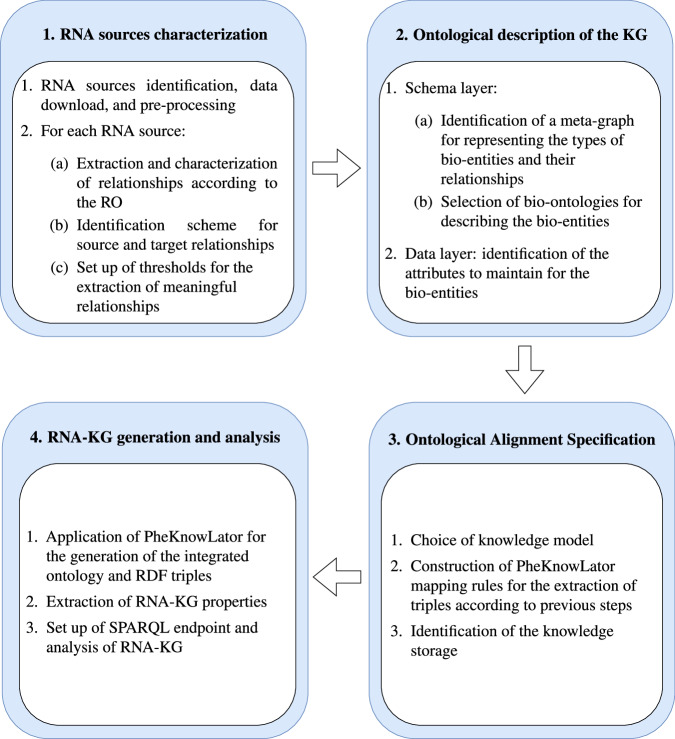
The "RNA world" represents a novel frontier for the study of fundamental biological processes and human diseases and is paving the way for the development of new drugs tailored to each patient's biomolecular characteristics. Although scientific data about coding and non-coding RNA molecules are constantly produced and available from public repositories, they are scattered across different databases and a centralized, uniform, and semantically consistent representation of the "RNA world" is still lacking. We propose RNA-KG, a knowledge graph (KG) encompassing biological knowledge about RNAs gathered from more than 60 public databases, integrating functional relationships with genes, proteins, and chemicals and ontologically grounded biomedical concepts. To develop RNA-KG, we first identified, pre-processed, and characterized each data source; next, we built a meta-graph that provides an ontological description of the KG by representing all the bio-molecular entities and medical concepts of interest in this domain, as well as the types of interactions connecting them. Finally, we leveraged an instance-based semantically abstracted knowledge model to specify the ontological alignment according to which RNA-KG was generated. RNA-KG can be downloaded in different formats and also queried by a SPARQL endpoint. A thorough topological analysis of the resulting heterogeneous graph provides further insights into the characteristics of the "RNA world". RNA-KG can be both directly explored and visualized, and/or analyzed by applying computational methods to infer bio-medical knowledge from its heterogeneous nodes and edges. The resource can be easily updated with new experimental data, and specific views of the overall KG can be extracted according to the bio-medical problem to be studied.
Overview
The claims and statistics of this paper haven’t been checked yet.
Free: it reads the open-access text and checks the first 5 claims that cite a source we can check. Create a free account to check every claim.
Integrity signals
Registry
Cites
Statistics
Figures




Verification
Claims the paper makes
The claims and statistics of this paper haven’t been checked yet.
Free: it reads the open-access text and checks the first 5 claims that cite a source we can check. Create a free account to check every claim.
Self-check
Percentages, sums and reported differences re-computed from the paper’s own numbers.
The self-check needs the paper’s full text.
Citations
Cites
1 retracted
WITHDRAWN: Knowledge Graph Quality Control: A Survey
Wang, X., Chen, L., Ban, T., Usman, M., Guan, Y., Liu, S., Wu, T., & Chen, H. (2021) · Fundamental Research · doi:10.1016/j.fmre.2021.08.018 · Cited by 7
RetractedBasic local alignment search tool
Altschul, S. F., Gish, W., Miller, W., Myers, E. W., & Lipman, D. J. (1990) · Journal of Molecular Biology · doi:10.1006/jmbi.1990.9999 · Cited by 98,669
Gene Ontology: tool for the unification of biology
Ashburner, M., Ball, C. A., Blake, J. A., Botstein, D., Butler, H., Cherry, J. M., Davis, A. P., Dolinski, K., Dwight, S. S., Eppig, J. T., et al. (2000) · Nature Genetics · doi:10.1038/75556 · Cited by 43,206
Improved tools for biological sequence comparison.
Pearson, W. R., & Lipman, D. J. (1988) · Proceedings of the National Academy of Sciences · doi:10.1073/pnas.85.8.2444 · Cited by 11,227
node2vec: Scalable Feature Learning for Networks
Grover, A., & Leskovec, J. (2016) · Proceedings of the 22nd ACM SIGKDD International Conference on Knowledge Discovery and Data Mining · doi:10.1145/2939672.2939754 · Cited by 10,926
DrugBank 5.0: a major update to the DrugBank database for 2018
Wishart, D. S., Feunang, Y. D., Guo, A. C., Lo, E. J., Marcu, A., Grant, J. R., Sajed, T., Johnson, D., Li, C., Sayeeda, Z., et al. (2018) · Nucleic Acids Research · doi:10.1093/nar/gkx1037 · Cited by 8,404
Power-Law Distributions in Empirical Data
Clauset, A., Shalizi, C. R., & Newman, M. E. J. (2009) · SIAM Review · doi:10.1137/070710111 · Cited by 8,019
Gene regulation by long non-coding RNAs and its biological functions
Statello, L., Guo, C.-J., Chen, L.-L., & Huarte, M. (2021) · Nature Reviews Molecular Cell Biology · doi:10.1038/s41580-020-00315-9 · Cited by 4,991
miRBase: from microRNA sequences to function
Kozomara, A., Birgaoanu, M., & Griffiths-Jones, S. (2019) · Nucleic Acids Research · doi:10.1093/nar/gky1141 · Cited by 4,843
Hannon, G. J. (2002) · Nature · doi:10.1038/418244a · Cited by 3,538
Research works printed but not linked: 2
- Hamilton, W. L., Ying, R. & Leskovec, J. Representation learning on graphs: Methods and applications. IEEE Data Eng. Bull. 40, 52–74 (2017).
- Liu, L. et al. Lncrnawiki 2.0: a knowledgebase of human long non-coding rnas with enhanced curation model and database system. Nucleic Acids Research 50, D190–D195, https://doi.org/10.1093/nar/gkab998 (2021). · DOI
Cited by
Anbukkarasi, S., Hemalatha, S., Balakrishnan, A., Varadhaganapathy, S., & Easwaramoorthy, S. V. (2026) · Scientific reports · doi:10.1038/s41598-026-47146-w · Cited by 1
“By integrating an organized biological background provided by ontology-based knowledge graphs with machine learning models, the models’ interpretability and clinical reasoning can be enhanced 13 .”
Metadata
- Authors
- Cavalleri, E., Cabri, A., Soto-Gomez, M., Bonfitto, S., Perlasca, P., Gliozzo, J., Callahan, T. J., Reese, J., Robinson, P. N., Casiraghi, E., Valentini, G., & Mesiti, M.
- Affiliations
- University of Milan (IT)
- Columbia University Irving Medical Center (US)
- Lawrence Berkeley National Laboratory (US)
- Berlin Institute of Health at Charité - Universitätsmedizin Berlin (DE)
- Corresponding author
- Mesiti, Marco
- ORCID
- Venue
- Scientific Data
- Published
- 2024-08-22
- Volume
- 11
- Issue
- 1
- Pages
- 906-906
- ISSN
- 2052-4463 (ISSN-L)
- PMC
- PMC11341713
- OpenAlex
- W4401814202
- Semantic Scholar
- 6288f7a5d61d6ae6babc8e1ec10ac50cc389de0c
- Cited by
- 33
- References
- 155
- Citations by year
- 2026: 14 · 2025: 15 · 2024: 4
- Type
- data paper
- Language
- en
- Open access
- gold
- doi.org
- Licence
- cc-by-nc-nd
- creativecommons.org/licenses/by-nc-nd/4.0 (tdm)
- creativecommons.org/licenses/by-nc-nd/4.0 (vor)
- Locations
- Scientific Data (publishedVersion, cc-by-nc-nd)
- PubMed Central (publishedVersion, cc-by-nc-nd)
- PubMed (publishedVersion)
- Archivio Istituzionale della Ricerca (Universita Degli Studi Di Milano) (submittedVersion, other-oa)
- eScholarship (California Digital Library) (submittedVersion, cc-by)
- OSTI OAI (U.S. Department of Energy Office of Scientific and Technical Information) (submittedVersion)
- DOAJ (DOAJ: Directory of Open Access Journals) (submittedVersion)
- Funders
- U.S. Department of Energy (-AC02-05CH11231, 05CH11231, DE AC02 05CH11231, DE-AC02-)
- U.S. Department of Health and Human Services (T15LM009451, T15LM007079, 5U24HG011449)
- Office of Science (DEAC02–05CH11231, AC02-05CH11231, DE-AC02)
- National Human Genome Research Institute (DE-AC02-05CH11231, U24HG011449)
- U.S. National Library of Medicine (T15LM007079, T15LM009451)
- Basic Energy Sciences (DE-AC02, DE-AC02-05CH11231., AC02–05CH11231)
- NextGenerationEU
- Topics
- Health Sciences › Medicine › Health Informatics › Biomedical Text Mining and Ontologies
- Life Sciences › Biochemistry, Genetics and Molecular Biology › Molecular Biology › Bioinformatics and Genomic Networks
- Physical Sciences › Computer Science › Artificial Intelligence › Semantic Web and Ontologies
- Keywords
- RNA world, knowledge graphs, RNA interactions, ontology mapping, metagraphs, heterogeneous graphs, non-coding RNA, coding RNA, biomedical ontologies, SPARQL endpoint
- MeSH terms
- Humans, RNA, Biological Ontologies
About these checks
Registry, retraction, Cites and statistics results are computed, not judged, with one exception: a printed reference that no index lists is read once by a model before it counts as a citation error. Claims are extracted by a model and kept only when their quote appears verbatim in the text; each cited source is then checked, with a model’s help, for whether it says what the claim relies on. Those verdicts can be wrong — read the claim’s quote and the cited source before relying on one.
Statistics and arithmetic are recomputed, not judged.
Confidence bands are shown only for fields calibrated on our annotated test set. None is calibrated yet, so no band is shown.
What counts as a claim ›How we measure confidence ›How we check this ›
Are you an author, or do you see a problem with this page? Request a review
How to cite
Cite CoChat for the checks on this page, and the paper for its own findings.
- This page
- CoChat. (2026). Citation check: An ontology-based knowledge graph for representing interactions involving RNA molecules. https://app.cochat.ai/papers/10.1038/s41597-024-03673-7
- The paper
- Cavalleri, E., Cabri, A., Soto-Gomez, M., Bonfitto, S., Perlasca, P., Gliozzo, J., Callahan, T. J., Reese, J., Robinson, P. N., Casiraghi, E., Valentini, G., & Mesiti, M. (2024). An ontology-based knowledge graph for representing interactions involving RNA molecules. Scientific Data. https://doi.org/10.1038/s41597-024-03673-7
Data sources
Bibliographic data: Semantic Scholar, OpenAlex, Crossref.
Contains information from the Semantic Scholar Academic Graph Datasets, made available under the ODC Attribution License (ODC-BY 1.0).
Semantic Scholar’s data is described in: Kinney, R., et al. (2023). The Semantic Scholar Open Data Platform. arXiv:2301.10140.
