

The DOI matches its Crossref record; 48 of the 48 references it cites were found in a registry or an index.
Quantum mechanical electronic and geometric parameters for DNA k-mers as features for machine learning
Open accessPublished version of a preprint
Abstract
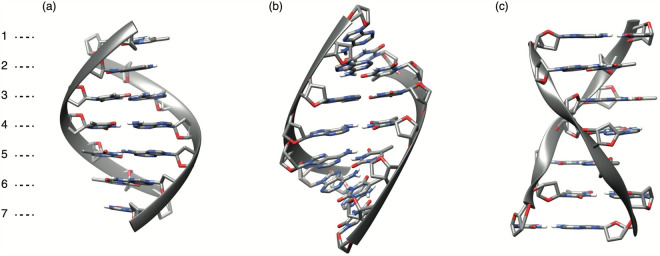
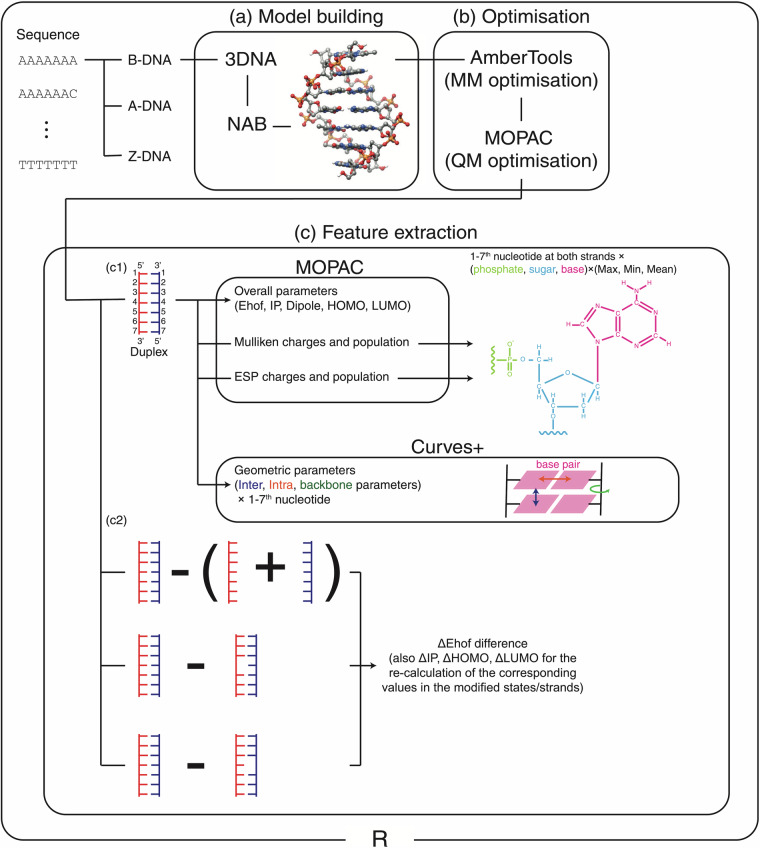
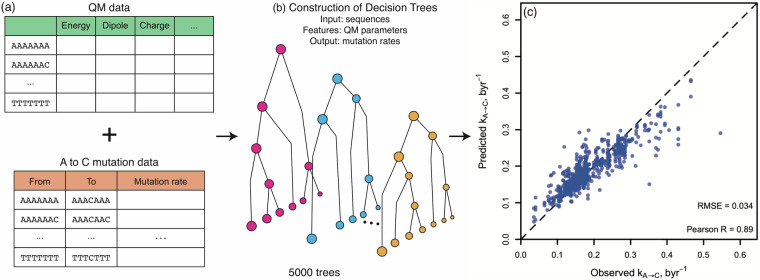
We are witnessing a steep increase in model development initiatives in genomics that employ high-end machine learning methodologies. Of particular interest are models that predict certain genomic characteristics based solely on DNA sequence. These models, however, treat the DNA as a mere collection of four, A, T, G and C, letters, dismissing the past advancements in science that can enable the use of more intricate information from nucleic acid sequences. Here, we provide a comprehensive database of quantum mechanical (QM) and geometric features for all the permutations of 7-meric DNA in their representative B, A and Z conformations. The database is generated by employing the applicable high-cost and time-consuming QM methodologies. This can thus make it seamless to associate a wealth of novel molecular features to any DNA sequence, by scanning it with a matching k-meric window and pulling the pre-computed values from our database for further use in modelling. We demonstrate the usefulness of our deposited features through their exclusive use in developing a model for A->C mutation rates.
Overview
The claims and statistics of this paper haven’t been checked yet.
Run the check — free, no account needed. It reads the open-access text and checks the sources it cites.
Integrity signals
Registry
Cites
Statistics
Figures
Verification
Claims the paper makes
The claims and statistics of this paper haven’t been checked yet.
Run the check — free, no account needed. It reads the open-access text and checks the sources it cites.
Self-check
Percentages, sums and reported differences re-computed from the paper’s own numbers.
The self-check needs the paper’s full text.
Citations
Cites
XGBoost: A Scalable Tree Boosting System
Chen, T., & Guestrin, C. (2016) · Proceedings of the 22nd ACM SIGKDD International Conference on Knowledge Discovery and Data Mining · doi:10.1145/2939672.2939785 · Cited by 54,569
Highly accurate protein structure prediction with AlphaFold
Jumper, J., Evans, R., Pritzel, A., Green, T., Figurnov, M., Ronneberger, O., Tunyasuvunakool, K., Bates, R., Žídek, A., Potapenko, A., et al. (2021) · Nature · doi:10.1038/s41586-021-03819-2 · Cited by 43,764
From local explanations to global understanding with explainable AI for trees
Lundberg, S. M., Erion, G., Chen, H., DeGrave, A., Prutkin, J. M., Nair, B., Katz, R., Himmelfarb, J., Bansal, N., & Lee, S.-I. (2020) · Nature Machine Intelligence · doi:10.1038/s42256-019-0138-9 · Cited by 10,551
Klamt, A., & Schüürmann, G. (1993) · J. Chem. Soc., Perkin Trans. 2 · doi:10.1039/p29930000799 · Cited by 9,445
Friedman, J. H. (2002) · Computational Statistics & Data Analysis · doi:10.1016/s0167-9473(01)00065-2 · Cited by 7,067
Gradient boosting machines, a tutorial
Natekin, A., & Knoll, A. (2013) · Frontiers in Neurorobotics · doi:10.3389/fnbot.2013.00021 · Cited by 3,887
Atomic charges derived from semiempirical methods
Besler, B. H., Merz, K. M., & Kollman, P. A. (1990) · Journal of Computational Chemistry · doi:10.1002/jcc.540110404 · Cited by 3,321
Predicting the sequence specificities of DNA- and RNA-binding proteins by deep learning
Alipanahi, B., Delong, A., Weirauch, M. T., & Frey, B. J. (2015) · Nature Biotechnology · doi:10.1038/nbt.3300 · Cited by 2,873
An empirical comparison of supervised learning algorithms
Caruana, R., & Niculescu-Mizil, A. (2006) · Proceedings of the 23rd international conference on Machine learning - ICML '06 · doi:10.1145/1143844.1143865 · Cited by 2,780
Predicting effects of noncoding variants with deep learning–based sequence model
Zhou, J., & Troyanskaya, O. G. (2015) · Nature Methods · doi:10.1038/nmeth.3547 · Cited by 2,338
Research works printed but not linked: 1
- Russo, N., Toscano, M. & Grand, A. Theoretical determination of electron affinity and ionization potential of DNA and RNA bases. Journal of Computational Chemistry 21, 1243–1250, https://doi.org/10.1002/1096-987X(20001115)21:14 (2000). · doi:10.1002/1096-987x(20001115)21:14
Metadata
- Authors
- Masuda, K., Abdullah, A. A., Pflughaupt, P., & Sahakyan, A. B.
- Affiliations
- University of Oxford (GB)
- Corresponding author
- Sahakyan, Aleksandr B.
- Venue
- Scientific Data
- Published
- 2024-08-22
- Volume
- 11
- Issue
- 1
- Pages
- 911-911
- ISSN
- 2052-4463 (ISSN-L)
- PMC
- PMC11341866
- OpenAlex
- W4401814295
- Cited by
- 7
- References
- 48
- Citations by year
- 2026: 4 · 2025: 1 · 2024: 2
- Type
- data paper
- Language
- en
- Open access
- gold
- doi.org
- Licence
- cc-by
- creativecommons.org/licenses/by/4.0 (tdm)
- creativecommons.org/licenses/by/4.0 (vor)
- Locations
- Scientific Data (publishedVersion, cc-by)
- PubMed Central (publishedVersion, cc-by)
- PubMed (publishedVersion)
- DOAJ (DOAJ: Directory of Open Access Journals) (submittedVersion)
- Topics
- Life Sciences › Biochemistry, Genetics and Molecular Biology › Molecular Biology › Fractal and DNA sequence analysis
- Life Sciences › Biochemistry, Genetics and Molecular Biology › Molecular Biology › DNA and Nucleic Acid Chemistry
- Life Sciences › Biochemistry, Genetics and Molecular Biology › Molecular Biology › RNA and protein synthesis mechanisms
- Keywords
- geometric features, DNA sequence features, B-DNA conformation, feature database
- MeSH terms
- Machine Learning, DNA, Quantum Theory
About these checks
Registry, retraction, Cites and statistics results are computed, not judged, with one exception: a printed reference that no index lists is read once by a model before it counts as a citation error. Claims are extracted by a model and kept only when their quote appears verbatim in the text; each cited source is then checked, with a model’s help, for whether it says what the claim relies on. Those verdicts can be wrong — read the claim’s quote and the cited source before relying on one.
Statistics and arithmetic are recomputed, not judged.
Confidence bands are shown only for fields calibrated on our annotated test set. None is calibrated yet, so no band is shown.
What counts as a claim ›How we measure confidence ›How we check this ›
Are you an author, or do you see a problem with this page? Request a review
How to cite
Cite CoChat for the checks on this page, and the paper for its own findings.
- This page
- CoChat. (2026). Citation check: Quantum mechanical electronic and geometric parameters for DNA k-mers as features for machine learning. https://app.cochat.ai/papers/10.1038/s41597-024-03772-5
- The paper
- Masuda, K., Abdullah, A. A., Pflughaupt, P., & Sahakyan, A. B. (2024). Quantum mechanical electronic and geometric parameters for DNA k-mers as features for machine learning. Scientific Data. https://doi.org/10.1038/s41597-024-03772-5
Data sources
Bibliographic data: Semantic Scholar, OpenAlex, Crossref.
Contains information from the Semantic Scholar Academic Graph Datasets, made available under the ODC Attribution License (ODC-BY 1.0).
Semantic Scholar’s data is described in: Kinney, R., et al. (2023). The Semantic Scholar Open Data Platform. arXiv:2301.10140.
