

Functional distinction of hyphal compartments
Open accessThe DOI matches its Crossref record; 37 of the 37 references it cites were found in a registry or an index.
Abstract
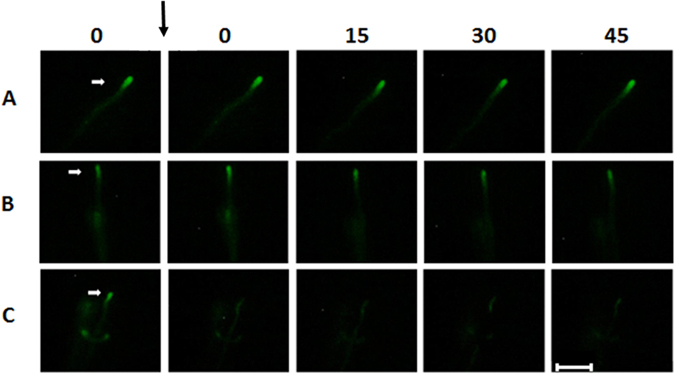
Hyphae of higher fungi grow at their tips and are compartmentalized by porous septa that enable inter-compartmental cytoplasmic streaming. Woronin bodies discontinue cytoplasmic streaming by plugging the septal pores. Here, it was assessed whether apical compartments of Aspergillus niger sustain their own growth or whether their growth depends on subapical compartments. Hyphae of wildtype and the Δ hexA strain, lacking Woronin bodies, had a similar morphology and growth rate. A total of 58% and 17% of the hyphae continued growing, respectively, after dissecting the 2 nd compartment. Extension rate of the apical compartments that continued growing was not affected, even when the carbon or nitrogen source was limiting. Thus, apical compartments are self-sustaining in growth. It was also shown that the first 8 subapical compartments of the wildtype, but not of the Δ hexA strain, function as a backup system for growth by forming new branches when their apical neighbouring compartment has been damaged. This backup system is pivotal in nature because of the life style of fungi to continuously explore their surrounding substrate that may prove hostile.
Overview
The claims and statistics of this paper haven’t been checked yet.
Free: it reads the open-access text and checks the first 5 claims that cite a source we can check. Create a free account to check every claim.
Integrity signals
Registry
Cites
Statistics
Figures
Verification
Claims the paper makes
The claims and statistics of this paper haven’t been checked yet.
Free: it reads the open-access text and checks the first 5 claims that cite a source we can check. Create a free account to check every claim.
Claims other papers make about this one
Each is checked against this paper’s own text: does it say what the citing paper says it does?
The cited source says what the claim attributes to it.
In the citing paper
“Heterogeneity in growth, secretion, and RNA composition can be found between and within zones of colonization, and the quantitative composition of the secretome of the different zones differs (517, 518).”
From Aspergillus fumigatus and Aspergillosis in 2019 (2019) · cites this paper as [518]
Self-check
Percentages, sums and reported differences re-computed from the paper’s own numbers.
The self-check needs the paper’s full text.
Citations
Cites
Vishniac, W., & Santer, M. (1957) · Bacteriological Reviews · doi:10.1128/br.21.3.195-213.1957 · Cited by 444
Vishniac, W. V., & Santer, M. (1957) · Bacteriological Reviews · doi:10.1128/mmbr.21.3.195-213.1957 · Cited by 427
Bos, C. J., Debets, A. J. M., Swart, K., Huybers, A., Kobus, G., & Slakhorst, S. M. (1988) · Current Genetics · doi:10.1007/bf00521266 · Cited by 317
Localization of growth and secretion of proteins in Aspergillus niger
Wosten, H. A. B., Moukha, S. M., Sietsma, J. H., & Wessels, J. G. H. (1991) · Journal of General Microbiology · doi:10.1099/00221287-137-8-2017 · Cited by 290
Self-citationA new self-assembled peroxisomal vesicle required for efficient resealing of the plasma membrane
Jedd, G., & Chua, N.-H. (2000) · Nature Cell Biology · doi:10.1038/35008652 · Cited by 279
TRINCI, A. P. J. (1971) · Journal of General Microbiology · doi:10.1099/00221287-67-3-325 · Cited by 262
Electron Microscopy of Neurospora crassa Mycelia
Shatkin, A. J., & Tatum, E. L. (1959) · The Journal of Cell Biology · doi:10.1083/jcb.6.3.423 · Cited by 176
FINE STRUCTURE OF MYCOTA. 7. OBSERVATIONS ON SEPTA OF ASCOMYCETES AND BASIDIOMYCETES
Moore, R. T., & McAlear, J. H. (1962) · American Journal of Botany · doi:10.1002/j.1537-2197.1962.tb11750.x · Cited by 161
Tenney, K., Hunt, I., Sweigard, J. A., Pounder, J. I., McClain, C., Bowman, E. J., & Bowman, B. J. (2000) · Fungal Genetics and Biology · doi:10.1006/fgbi.2000.1230 · Cited by 151
Spatial Differentiation in the Vegetative Mycelium of Aspergillus niger
Levin, A. M., de Vries, R. P., Conesa, A., de Bekker, C., Talon, M., Menke, H. H., van Peij, N. N. M. E., & Wösten, H. A. B. (2007) · Eukaryotic Cell · doi:10.1128/ec.00244-07 · Cited by 129
Cited by
Aspergillus fumigatus and Aspergillosis in 2019
Latgé, J.-P., & Chamilos, G. (2019) · Clinical Microbiology Reviews · doi:10.1128/cmr.00140-18 · Cited by 1,400
Filamentous fungi for the production of enzymes, chemicals and materials
Wösten, H. A. B. (2019) · Current Opinion in Biotechnology · doi:10.1016/j.copbio.2019.02.010 · Cited by 177
Self-citationFungal Cell Factories for Efficient and Sustainable Production of Proteins and Peptides
Lübeck, M., & Lübeck, P. S. (2022) · Microorganisms · doi:10.3390/microorganisms10040753 · Cited by 158
Fungal evolution: cellular, genomic and metabolic complexity
Naranjo‐Ortiz, M. A., & Gabaldón, T. (2020) · Biological Reviews · doi:10.1111/brv.12605 · Cited by 159
Seeking the Roles for Fungal Small-Secreted Proteins in Affecting Saprophytic Lifestyles
Feldman, D., Yarden, O., & Hadar, Y. (2020) · Frontiers in Microbiology · doi:10.3389/fmicb.2020.00455 · Cited by 84
Metadata
- Authors
- Tegelaar, M., & Wösten, H. A. B.
- Affiliations
- Utrecht University (NL)
- Corresponding author
- Wösten, Han A. B.
- Venue
- Scientific Reports
- Published
- 2017-07-20
- Volume
- 7
- Issue
- 1
- Pages
- 6039-6039
- ISSN
- 2045-2322 (ISSN-L)
- PMC
- PMC5519613
- OpenAlex
- W2736249523
- Cited by
- 40
- References
- 37
- Citations by year
- 2026: 5 · 2025: 6 · 2024: 2 · 2023: 7 · 2022: 3 · 2021: 4 · 2020: 7 · 2019: 4 · 2018: 2
- FWCI
- 1.45
- Type
- journal article
- Language
- en
- Open access
- gold
- doi.org
- Licence
- cc-by
- creativecommons.org/licenses/by/4.0 (tdm)
- creativecommons.org/licenses/by/4.0 (vor)
- Locations
- Scientific Reports (publishedVersion, cc-by)
- Europe PMC (PubMed Central) (publishedVersion, cc-by)
- PubMed Central (publishedVersion, cc-by)
- PubMed (publishedVersion)
- DOAJ (DOAJ: Directory of Open Access Journals) (submittedVersion, cc-by-sa)
- Utrecht University Repository (Utrecht University) (submittedVersion, other-oa)
- Topics
- Life Sciences › Biochemistry, Genetics and Molecular Biology › Molecular Biology › Fungal and yeast genetics research
- Life Sciences › Agricultural and Biological Sciences › Plant Science › Plant Pathogens and Fungal Diseases
- Life Sciences › Agricultural and Biological Sciences › Plant Science › Mycorrhizal Fungi and Plant Interactions
- Keywords
- hyphal growth, Woronin bodies, HEXA, cytoplasmic streaming, Aspergillus niger, hyphal branching, fungal hyphae
- MeSH terms
- Aspergillus niger, Fungal Proteins, Sequence Deletion, Hyphae, Genetic Association Studies
About these checks
Registry, retraction, Cites and statistics results are computed, not judged, with one exception: a printed reference that no index lists is read once by a model before it counts as a citation error. Claims are extracted by a model and kept only when their quote appears verbatim in the text; each cited source is then checked, with a model’s help, for whether it says what the claim relies on. Those verdicts can be wrong — read the claim’s quote and the cited source before relying on one.
Statistics and arithmetic are recomputed, not judged.
Confidence bands are shown only for fields calibrated on our annotated test set. None is calibrated yet, so no band is shown.
What counts as a claim ›How we measure confidence ›How we check this ›
Are you an author, or do you see a problem with this page? Request a review
How to cite
Cite CoChat for the checks on this page, and the paper for its own findings.
- This page
- CoChat. (2026). Citation check: Functional distinction of hyphal compartments. https://app.cochat.ai/papers/10.1038/s41598-017-06422-6
- The paper
- Tegelaar, M., & Wösten, H. A. B. (2017). Functional distinction of hyphal compartments. Scientific Reports. https://doi.org/10.1038/s41598-017-06422-6
Data sources
Bibliographic data: Semantic Scholar, OpenAlex, Crossref.
Contains information from the Semantic Scholar Academic Graph Datasets, made available under the ODC Attribution License (ODC-BY 1.0).
Semantic Scholar’s data is described in: Kinney, R., et al. (2023). The Semantic Scholar Open Data Platform. arXiv:2301.10140.
