

Real-time EEG-based brain-computer interface to a virtual avatar enhances cortical involvement in human treadmill walking
Open accessThe DOI matches its Crossref record; 62 of the 62 references it cites were found in a registry or an index.
Abstract
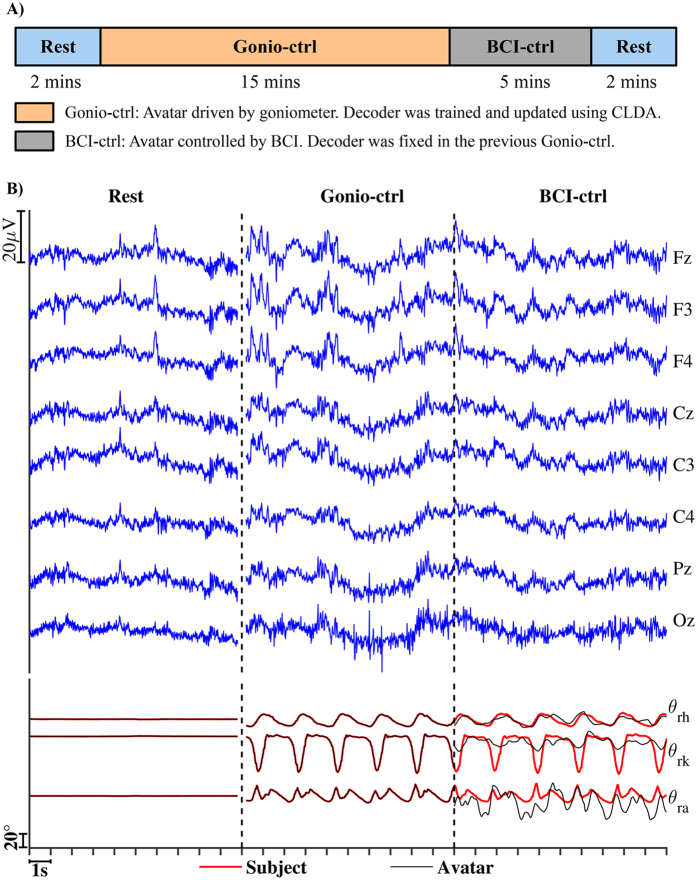
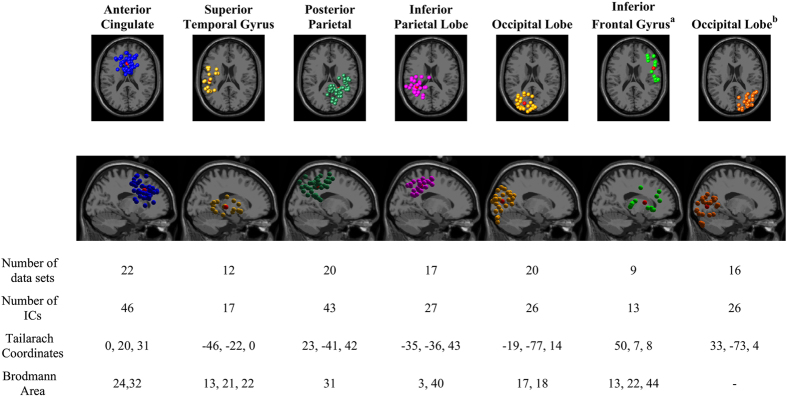
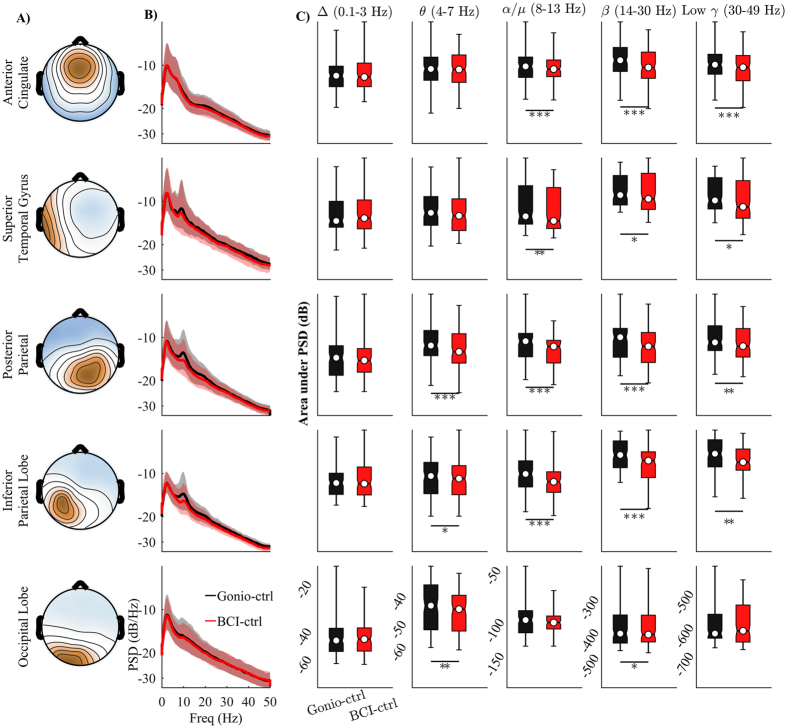
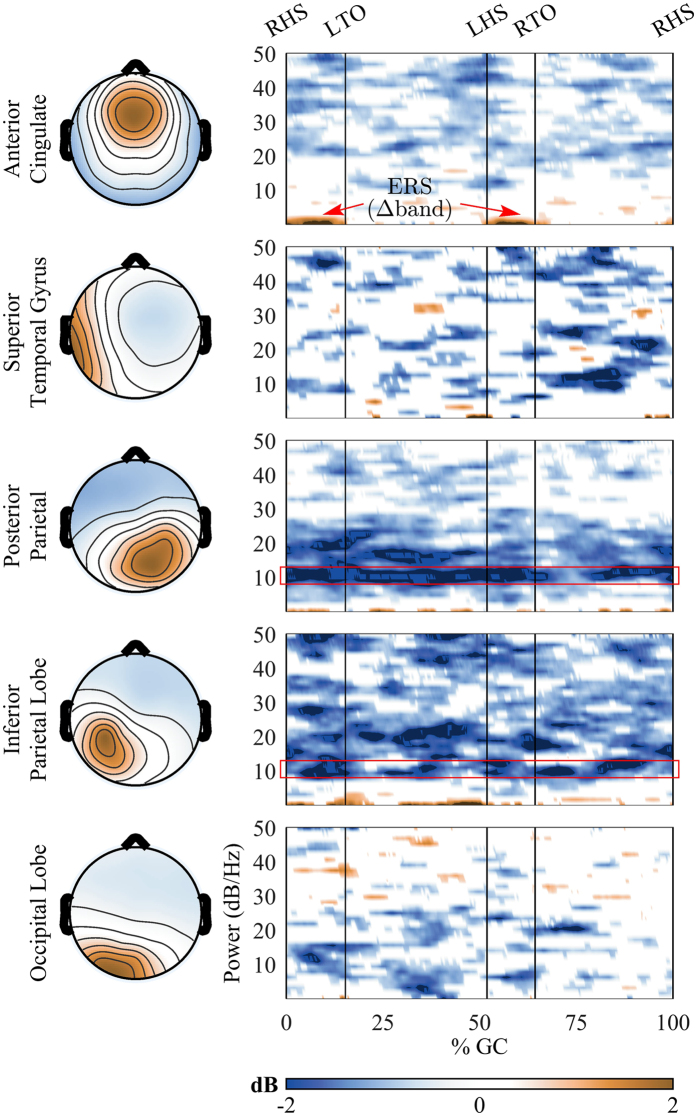
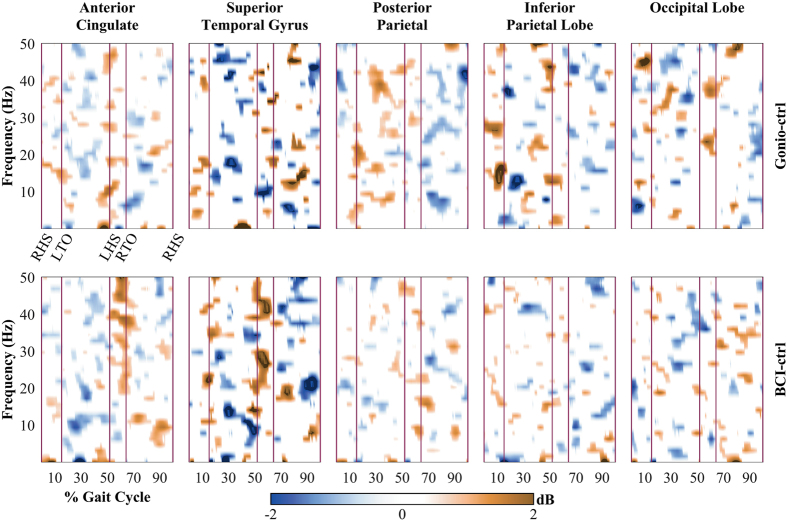
Recent advances in non-invasive brain-computer interface (BCI) technologies have shown the feasibility of neural decoding for both users’ gait intent and continuous kinematics. However, the dynamics of cortical involvement in human upright walking with a closed-loop BCI has not been investigated. This study aims to investigate the changes of cortical involvement in human treadmill walking with and without BCI control of a walking avatar. Source localization revealed significant differences in cortical network activity between walking with and without closed-loop BCI control. Our results showed sustained α/µ suppression in the Posterior Parietal Cortex and Inferior Parietal Lobe, indicating increases of cortical involvement during walking with BCI control. We also observed significant increased activity of the Anterior Cingulate Cortex (ACC) in the low frequency band suggesting the presence of a cortical network involved in error monitoring and motor learning. Additionally, the presence of low γ modulations in the ACC and Superior Temporal Gyrus may associate with increases of voluntary control of human gait. This work is a further step toward the development of a novel training paradigm for improving the efficacy of rehabilitation in a top-down approach.
Overview
The claims and statistics of this paper haven’t been checked yet.
Free: it reads the open-access text and checks the first 5 claims that cite a source we can check. Create a free account to check every claim.
Integrity signals
Registry
Cites
Statistics
Figures
Verification
Claims the paper makes
The claims and statistics of this paper haven’t been checked yet.
Free: it reads the open-access text and checks the first 5 claims that cite a source we can check. Create a free account to check every claim.
Claims other papers make about this one
Each is checked against this paper’s own text: does it say what the citing paper says it does?
The source backs part of the claim, not all of it — or backs it for a different population, condition or comparison.
In the citing paper
“Finally, speech decoders have yet to fully leverage paradigms of feedback-based learning that have the potential to entrain new patterns of neural activity for better control171–174.”
From The speech neuroprosthesis (2024) · cites this paper as [173]
Experimental — accuracy not yet measured
Self-check
Percentages, sums and reported differences re-computed from the paper’s own numbers.
The self-check needs the paper’s full text.
Citations
Cites
Delorme, A., & Makeig, S. (2004) · Journal of Neuroscience Methods · doi:10.1016/j.jneumeth.2003.10.009 · Cited by 24,371
Event-related EEG/MEG synchronization and desynchronization: basic principles
Pfurtscheller, G., & Lopes da Silva, F. H. (1999) · Clinical Neurophysiology · doi:10.1016/s1388-2457(99)00141-8 · Cited by 7,328
Frequency Dependence of Signal Power and Spatial Reach of the Local Field Potential
Leski, S., Lindén, H., Tetzlaff, T., Pettersen, K. H., & Einevoll, G. T. (2013) · PubMed · doi:10.18154/rwth-conv-084442 · Cited by 3,639
Automated Talairach Atlas labels for functional brain mapping
Lancaster, J. L., Woldorff, M. G., Parsons, L. M., Liotti, M., Freitas, C. S., Rainey, L., Kochunov, P. V., Nickerson, D., Mikiten, S. A., & Fox, P. T. (2000) · Human Brain Mapping · doi:10.1002/1097-0193(200007)10:3<120::aid-hbm30>3.0.co;2-8 · Cited by 3,387
Anterior Cingulate Cortex, Error Detection, and the Online Monitoring of Performance
Carter, C. S., Braver, T. S., Barch, D. M., Botvinick, M. M., Noll, D., & Cohen, J. D. (1998) · Science · doi:10.1126/science.280.5364.747 · Cited by 3,273
Beta-band oscillations—Signalling the status quo?
Engel, A. K., & Fries, P. (2010) · Current Opinion in Neurobiology · doi:10.1016/j.conb.2010.02.015 · Cited by 2,953
Anterior Cingulate Conflict Monitoring and Adjustments in Control
Kerns, J. G., Cohen, J. D., MacDonald, A. W., Cho, R. Y., Stenger, V. A., & Carter, C. S. (2004) · Science · doi:10.1126/science.1089910 · Cited by 2,891
Gevins, A. (1997) · Cerebral Cortex · doi:10.1093/cercor/7.4.374 · Cited by 1,623
Nonlinear dynamical analysis of EEG and MEG: Review of an emerging field
Stam, C. J. (2005) · Clinical Neurophysiology · doi:10.1016/j.clinph.2005.06.011 · Cited by 1,417
Wolff, P., & Barbey, A. K. (2015) · Frontiers in Human Neuroscience · doi:10.3389/fnhum.2015.00001 · Cited by 788
Motor learning elicited by voluntary drive
Lotze, M. (2003) · Brain · doi:10.1093/brain/awg079 · Cited by 691
Action observation has a positive impact on rehabilitation of motor deficits after stroke
Ertelt, D., Small, S., Solodkin, A., Dettmers, C., McNamara, A., Binkofski, F., & Buccino, G. (2007) · NeuroImage · doi:10.1016/j.neuroimage.2007.03.043 · Cited by 663
New insights into the relationship between dopamine, beta oscillations and motor function
Jenkinson, N., & Brown, P. (2011) · Trends in Neurosciences · doi:10.1016/j.tins.2011.09.003 · Cited by 659
Boosting Cortical Activity at Beta-Band Frequencies Slows Movement in Humans
Pogosyan, A., Gaynor, L. D., Eusebio, A., & Brown, P. (2009) · Current Biology · doi:10.1016/j.cub.2009.07.074 · Cited by 643
Oscillatory synchronization in large-scale cortical networks predicts perception
Hipp, J. F., Engel, A. K., & Siegel, M. (2011) · Neuron · doi:10.1016/j.neuron.2010.12.027 · Cited by 599
Luu, P., Tucker, D. M., & Makeig, S. (2004) · Clinical Neurophysiology · doi:10.1016/j.clinph.2004.03.031 · Cited by 545
Henderson, A., Korner-Bitensky, N., & Levin, M. (2007) · Topics in Stroke Rehabilitation · doi:10.1310/tsr1402-52 · Cited by 542
How about taking a low‐cost, small, and wireless EEG for a walk?
Debener, S., Minow, F., Emkes, R., Gandras, K., & de Vos, M. (2012) · Psychophysiology · doi:10.1111/j.1469-8986.2012.01471.x · Cited by 540
Frontoparietal Cortex Controls Spatial Attention through Modulation of Anticipatory Alpha Rhythms
Capotosto, P., Babiloni, C., Romani, G. L., & Corbetta, M. (2009) · The Journal of Neuroscience · doi:10.1523/jneurosci.0539-09.2009 · Cited by 483
Electrocortical activity is coupled to gait cycle phase during treadmill walking
Gwin, J. T., Gramann, K., Makeig, S., & Ferris, D. P. (2011) · NeuroImage · doi:10.1016/j.neuroimage.2010.08.066 · Cited by 479
Theta band power in the human scalp EEG and the encoding of new information
Klimesch, W., Doppelmayr, M., Russegger, H., & Pachinger, T. (1996) · NeuroReport · doi:10.1097/00001756-199605170-00002 · Cited by 422
Gilbertson, T., Lalo, E., Doyle, L., Di Lazzaro, V., Cioni, B., & Brown, P. (2005) · The Journal of Neuroscience · doi:10.1523/jneurosci.1762-05.2005 · Cited by 396
Real-time modeling and 3D visualization of source dynamics and connectivity using wearable EEG
Mullen, T., Kothe, C., Chi, Y. M., Ojeda, A., Kerth, T., Makeig, S., Cauwenberghs, G., & Jung, T.-P. (2013) · 2013 35th Annual International Conference of the IEEE Engineering in Medicine and Biology Society (EMBC) · doi:10.1109/embc.2013.6609968 · Cited by 390
EEG oscillations and recognition memory: Theta correlates of memory retrieval and decision making
Jacobs, J., Hwang, G., Curran, T., & Kahana, M. J. (2006) · NeuroImage · doi:10.1016/j.neuroimage.2006.02.018 · Cited by 306
Wagner, J., Solis-Escalante, T., Grieshofer, P., Neuper, C., Müller-Putz, G., & Scherer, R. (2012) · NeuroImage · doi:10.1016/j.neuroimage.2012.08.019 · Cited by 301
Oxytocin-Motivated Ally Selection is Moderated by Fetal Testosterone Exposure and Empathic Concern
Kret, M. E., & De Dreu, C. K. W. (2013) · Frontiers in Neuroscience · doi:10.3389/fnins.2013.00001 · Cited by 283
Closed-Loop Decoder Adaptation Shapes Neural Plasticity for Skillful Neuroprosthetic Control
Orsborn, A. L., Moorman, H. G., Overduin, S. A., Shanechi, M. M., Dimitrov, D. F., & Carmena, J. M. (2014) · Neuron · doi:10.1016/j.neuron.2014.04.048 · Cited by 280
Womelsdorf, T., Johnston, K., Vinck, M., & Everling, S. (2010) · Proceedings of the National Academy of Sciences · doi:10.1073/pnas.0906194107 · Cited by 234
Effects of Action Observation on Physical Training After Stroke
Celnik, P., Webster, B., Glasser, D. M., & Cohen, L. G. (2008) · Stroke · doi:10.1161/strokeaha.107.508184 · Cited by 226
EEG beta suppression and low gamma modulation are different elements of human upright walking
Seeber, M., Scherer, R., Wagner, J., Solis-Escalante, T., & Müller-Putz, G. R. (2014) · Frontiers in Human Neuroscience · doi:10.3389/fnhum.2014.00485 · Cited by 219
Proprioceptive Feedback and Brain Computer Interface (BCI) Based Neuroprostheses
Ramos-Murguialday, A., Schürholz, M., Caggiano, V., Wildgruber, M., Caria, A., Hammer, E. M., Halder, S., & Birbaumer, N. (2012) · PLoS ONE · doi:10.1371/journal.pone.0047048 · Cited by 215
Paluš, M. (1996) · Biological Cybernetics · doi:10.1007/s004220050304 · Cited by 200
High accuracy decoding of user intentions using EEG to control a lower-body exoskeleton
Kilicarslan, A., Prasad, S., Grossman, R. G., & Contreras-Vidal, J. L. (2013) · 2013 35th Annual International Conference of the IEEE Engineering in Medicine and Biology Society (EMBC) · doi:10.1109/embc.2013.6610821 · Cited by 196
Self-citationFranceschini, M., Ceravolo, M. G., Agosti, M., Cavallini, P., Bonassi, S., Dall’Armi, V., Massucci, M., Schifini, F., & Sale, P. (2012) · Neurorehabilitation and Neural Repair · doi:10.1177/1545968311427406 · Cited by 193
Distinct β Band Oscillatory Networks Subserving Motor and Cognitive Control during Gait Adaptation
Wagner, J., Makeig, S., Gola, M., Neuper, C., & Müller-Putz, G. (2016) · The Journal of Neuroscience · doi:10.1523/jneurosci.3543-15.2016 · Cited by 193
Role of Voluntary Drive in Encoding an Elementary Motor Memory
Kaelin-Lang, A., Sawaki, L., & Cohen, L. G. (2005) · Journal of Neurophysiology · doi:10.1152/jn.00143.2004 · Cited by 190
A robust adaptive denoising framework for real-time artifact removal in scalp EEG measurements
Kilicarslan, A., Grossman, R. G., & Contreras-Vidal, J. L. (2016) · Journal of Neural Engineering · doi:10.1088/1741-2560/13/2/026013 · Cited by 184
Self-citationOrsborn, A. L., Dangi, S., Moorman, H. G., & Carmena, J. M. (2012) · IEEE Transactions on Neural Systems and Rehabilitation Engineering · doi:10.1109/tnsre.2012.2185066 · Cited by 170
It's how you get there: walking down a virtual alley activates premotor and parietal areas
Wagner, J., Solis-Escalante, T., Scherer, R., Neuper, C., & Müller-Putz, G. (2014) · Frontiers in Human Neuroscience · doi:10.3389/fnhum.2014.00093 · Cited by 163
Bulea, T. C., Kim, J., Damiano, D. L., Stanley, C. J., & Park, H. S. (2015) · Frontiers in Human Neuroscience · doi:10.3389/fnhum.2015.00247 · Cited by 157
Negligible Motion Artifacts in Scalp Electroencephalography (EEG) During Treadmill Walking
Nathan, K., & Contreras-Vidal, J. L. (2016) · Frontiers in Human Neuroscience · doi:10.3389/fnhum.2015.00708 · Cited by 151
Self-citationThe reorganization of corticomuscular coherence during a transition between sensorimotor states
Mehrkanoon, S., Breakspear, M. J., & Boonstra, T. W. (2014) · NeuroImage · doi:10.1016/j.neuroimage.2014.06.050 · Cited by 124
Luu, T. P., He, Y., Brown, S., Nakagome, S., & Contreras-Vidal, J. L. (2016) · Journal of Neural Engineering · doi:10.1088/1741-2560/13/3/036006 · Cited by 123
Self-citationElectrocortical activity distinguishes between uphill and level walking in humans
Bradford, J. C., Lukos, J. R., & Ferris, D. P. (2015) · Journal of Neurophysiology · doi:10.1152/jn.00089.2015 · Cited by 117
Presacco, A., Forrester, L. W., & Contreras-Vidal, J. L. (2012) · IEEE Transactions on Neural Systems and Rehabilitation Engineering · doi:10.1109/tnsre.2012.2188304 · Cited by 115
Self-citationOperation of a brain-computer interface walking simulator for individuals with spinal cord injury
King, C., Wang, P. T., Chui, L. A., Do, A. H., & Nenadić, Z. (2013) · Journal of NeuroEngineering and Rehabilitation · doi:10.1186/1743-0003-10-77 · Cited by 110
Independent component analysis of dynamic brain responses during visuomotor adaptation
Contreras-Vidal, J. L., & Kerick, S. E. (2004) · NeuroImage · doi:10.1016/j.neuroimage.2003.10.037 · Cited by 85
Self-citationAn individual-specific gait pattern prediction model based on generalized regression neural networks
Luu, T. P., Low, K. H., Qu, X., Lim, H. B., & Hoon, K. H. (2013) · Gait & Posture · doi:10.1016/j.gaitpost.2013.08.028 · Cited by 84
Self-citationGarcía‐Cossio, E., Severens, M., Nienhuis, B., Duysens, J., Desain, P., Keijsers, N. L. W., & Farquhar, J. D. R. (2015) · PLoS ONE · doi:10.1371/journal.pone.0137910 · Cited by 83
More than an imitation game: Top-down modulation of the human mirror system
Campbell, M. E. J., & Cunnington, R. (2017) · Neuroscience & Biobehavioral Reviews · doi:10.1016/j.neubiorev.2017.01.035 · Cited by 70
He, Y., Nathan, K., Venkatakrishnan, A., Rovekamp, R., Beck, C., Ozdemir, R. A., Francisco, G. E., & Contreras-Vidal, J. L. (2014) · Annual International Conference of the IEEE Engineering in Medicine and Biology Society (EMBC) · doi:10.1109/embc.2014.6944497 · Cited by 67
Self-citationSelf-paced brain–computer interface control of ambulation in a virtual reality environment
Wang, P. T., King, C., Chui, L. A., Do, A. H., & Nenadić, Z. (2012) · Journal of Neural Engineering · doi:10.1088/1741-2560/9/5/056016 · Cited by 66
Load Dependence of β and γ Oscillations Predicts Individual Capacity of Visual Attention
Rouhinen, S., Panula, J., Palva, J. M., & Palva, S. (2013) · The Journal of Neuroscience · doi:10.1523/jneurosci.1666-13.2013 · Cited by 66
A BMI-based occupational therapy assist suit: asynchronous control by SSVEP
Sakurada, T., Kawase, T., Takano, K., Komatsu, T., & Kansaku, K. (2013) · Frontiers in Neuroscience · doi:10.3389/fnins.2013.00172 · Cited by 64
Oscillations in the human brain during walking execution, imagination and observation
Cevallos, C., Zarka, D., Hoellinger, T., Leroy, A., Dan, B., & Chéron, G. (2015) · Neuropsychologia · doi:10.1016/j.neuropsychologia.2015.06.039 · Cited by 56
Neural Correlates of Skill Acquisition with a Cortical Brain–Machine Interface
Ganguly, K., & Carmena, J. M. (2010) · Journal of Motor Behavior · doi:10.1080/00222895.2010.526457 · Cited by 49
Luu, T. P., He, Y., Brown, S., Nakagome, S., & Contreras-Vidal, J. L. (2015) · International Conference on Virtual Rehabilitation · doi:10.1109/icvr.2015.7358598 · Cited by 35
Self-citationUser-driven control increases cortical activity during treadmill walking: An EEG study
Bulea, T. C., Kim, J., Damiano, D. L., Stanley, C. J., & Park, H. (2014) · Annual International Conference of the IEEE Engineering in Medicine and Biology Society (EMBC) · doi:10.1109/embc.2014.6944033 · Cited by 30
Noninvasive EEG correlates of overground and stair walking
Brantley, J. A., Luu, T. P., Ozdemir, R. A., Zhu, F., Winslow, A. T., Huang, H., & Contreras-Vidal, J. L. (2016) · Annual International Conference of the IEEE Engineering in Medicine and Biology Society (EMBC) · doi:10.1109/embc.2016.7592028 · Cited by 26
Self-citationLuu, T. P., He, Y., Nakagome, S., Gorges, J. J., Nathan, K., & Contreras-Vidal, J. L. (2016) · Annual International Conference of the IEEE Engineering in Medicine and Biology Society (EMBC) · doi:10.1109/embc.2016.7591006 · Cited by 23
Self-citationSeeber, M., Scherer, R., Wagner, J., Solis‐Escalante, T., & Muller-Putz, G. R. (2015) · Frontiers in Human Neuroscience · doi:10.3389/fnhum.2015.00542 · Cited by 8
Observation-based training for neuroprosthetic control of grasping by amputees
Agashe, H. A., & Contreras-Vidal, J. L. (2014) · Annual International Conference of the IEEE Engineering in Medicine and Biology Society (EMBC) · doi:10.1109/embc.2014.6944498 · Cited by 8
Self-citation
Research works printed but not linked: 1
- He, Y. et al. In 2014 36th Annual International Conference of the IEEE Engineering in Medicine and Biology Society 3985–3988 (IEEE, 2014).
Cited by
EEG-Based Brain-Computer Interfaces Using Motor-Imagery: Techniques and Challenges
Padfield, N., Zabalza, J., Zhao, H., Masero, V., & Ren, J. (2019) · Sensors · doi:10.3390/s19061423 · Cited by 596
Brain–machine interfaces for controlling lower-limb powered robotic systems
He, Y., Eguren, D., Azorín, J. M., Grossman, R. G., Luu, T. P., & Contreras-Vidal, J. L. (2018) · Journal of Neural Engineering · doi:10.1088/1741-2552/aaa8c0 · Cited by 224
Self-citationReal-Time EEG–EMG Human–Machine Interface-Based Control System for a Lower-Limb Exoskeleton
Gordleeva, S. Y., Lobov, S. A., Grigorev, N. A., Savosenkov, A. O., Shamshin, M. O., Lukoyanov, M. V., Khoruzhko, M. A., & Kazantsev, V. B. (2020) · IEEE Access · doi:10.1109/access.2020.2991812 · Cited by 174
EEG-Based Control for Upper and Lower Limb Exoskeletons and Prostheses: A Systematic Review
AL-Quraishi, M. S., Elamvazuthi, I., Daud, S. A., Parasuraman, S., & Borboni, A. (2018) · Sensors · doi:10.3390/s18103342 · Cited by 164
Peterson, S. M., & Ferris, D. P. (2018) · eNeuro · doi:10.1523/eneuro.0207-18.2018 · Cited by 171
Metadata
- Authors
- Luu, T. P., Nakagome, S., He, Y., & Contreras-Vidal, J. L.
- Affiliations
- University of Houston (US)
- Corresponding author
- Luu, Trieu Phat
- Venue
- Scientific Reports
- Published
- 2017-08-21
- Volume
- 7
- Issue
- 1
- Pages
- 8895-8895
- ISSN
- 2045-2322 (ISSN-L)
- PMC
- PMC5567182
- OpenAlex
- W2745687202
- Cited by
- 101
- References
- 62
- Citations by year
- 2026: 4 · 2025: 14 · 2024: 10 · 2023: 11 · 2022: 2 · 2021: 16 · 2020: 12 · 2019: 15 · 2018: 17
- FWCI
- 6.91
- Type
- journal article
- Language
- en
- Open access
- gold
- doi.org
- Licence
- cc-by
- creativecommons.org/licenses/by/4.0 (tdm)
- creativecommons.org/licenses/by/4.0 (vor)
- Locations
- Scientific Reports (publishedVersion, cc-by)
- PubMed Central (publishedVersion, cc-by)
- PubMed (publishedVersion)
- DOAJ (DOAJ: Directory of Open Access Journals) (submittedVersion, cc-by-sa)
- Funders
- National Institutes of Health
- National Institute of Neurological Disorders and Stroke (R01NS075889)
- Topics
- Life Sciences › Neuroscience › Cognitive Neuroscience › EEG and Brain-Computer Interfaces
- Health Sciences › Medicine › Rehabilitation › Stroke Rehabilitation and Recovery
- Physical Sciences › Engineering › Biomedical Engineering › Muscle activation and electromyography studies
- Keywords
- brain-computer interface, treadmill walking, avatars, cortical involvement, feedback control, source localization, posterior parietal cortex, inferior parietal lobule, anterior cingulate cortex, error monitoring, motor learning, gamma oscillations, gait rehabilitation, top-down control
- MeSH terms
- Adult, Biomechanical Phenomena, Brain Mapping, Cerebral Cortex, Computer Simulation, Electroencephalography, Exercise Test, Female, Humans, Male, Walking, Electrophysiological Phenomena, Young Adult, Brain Waves, Brain-Computer Interfaces
About these checks
Registry, retraction, Cites and statistics results are computed, not judged, with one exception: a printed reference that no index lists is read once by a model before it counts as a citation error. Claims are extracted by a model and kept only when their quote appears verbatim in the text; each cited source is then checked, with a model’s help, for whether it says what the claim relies on. Those verdicts can be wrong — read the claim’s quote and the cited source before relying on one.
Statistics and arithmetic are recomputed, not judged.
Confidence bands are shown only for fields calibrated on our annotated test set. None is calibrated yet, so no band is shown.
What counts as a claim ›How we measure confidence ›How we check this ›
Are you an author, or do you see a problem with this page? Request a review
Data sources
Bibliographic data: Semantic Scholar, OpenAlex, Crossref.
Contains information from the Semantic Scholar Academic Graph Datasets, made available under the ODC Attribution License (ODC-BY 1.0).
Semantic Scholar’s data is described in: Kinney, R., et al. (2023). The Semantic Scholar Open Data Platform. arXiv:2301.10140.
