

The DOI matches its Crossref record; 51 of the 51 references it cites were found in a registry or an index.
Repetition suppression to objects is modulated by stimulus-specific expectations
Open accessAbstract
Repeated exposure to the same stimulus results in an attenuated brain response in cortical regions that are activated during the processing of that stimulus. This phenomenon, called repetition suppression (RS), has been shown to be modulated by expectation. Typically, this is achieved by varying the probability of stimulus repetitions (P rep) between blocks of an experiment, generating an abstract expectation that ‘things will repeat’. Here, we examined whether stimulus-specific expectations also modulate RS. We designed a task where expectation and repetition are manipulated independently, using stimulus-specific expectations. We investigated to which extent such stimulus-specific expectations modulated the visual evoked response to objects in lateral occipital cortex (LOC) and primary visual cortex (V1), using functional magnetic resonance imaging (fMRI). In LOC, we found that RS interacted with expectation, such that repetition suppression was more pronounced for unexpected relative to expected stimuli. Additionally, we found that the response of stimulus-preferring voxels in V1 was generally decreased when stimuli were expected. These results suggest that stimulus-specific expectations about objects modulate LOC and propagate back to the earliest cortical station processing visual input.
Overview
The claims and statistics of this paper haven’t been checked yet.
Free: it reads the open-access text and checks the first 5 claims that cite a source we can check. Create a free account to check every claim.
Integrity signals
Registry
Cites
Statistics
Figures


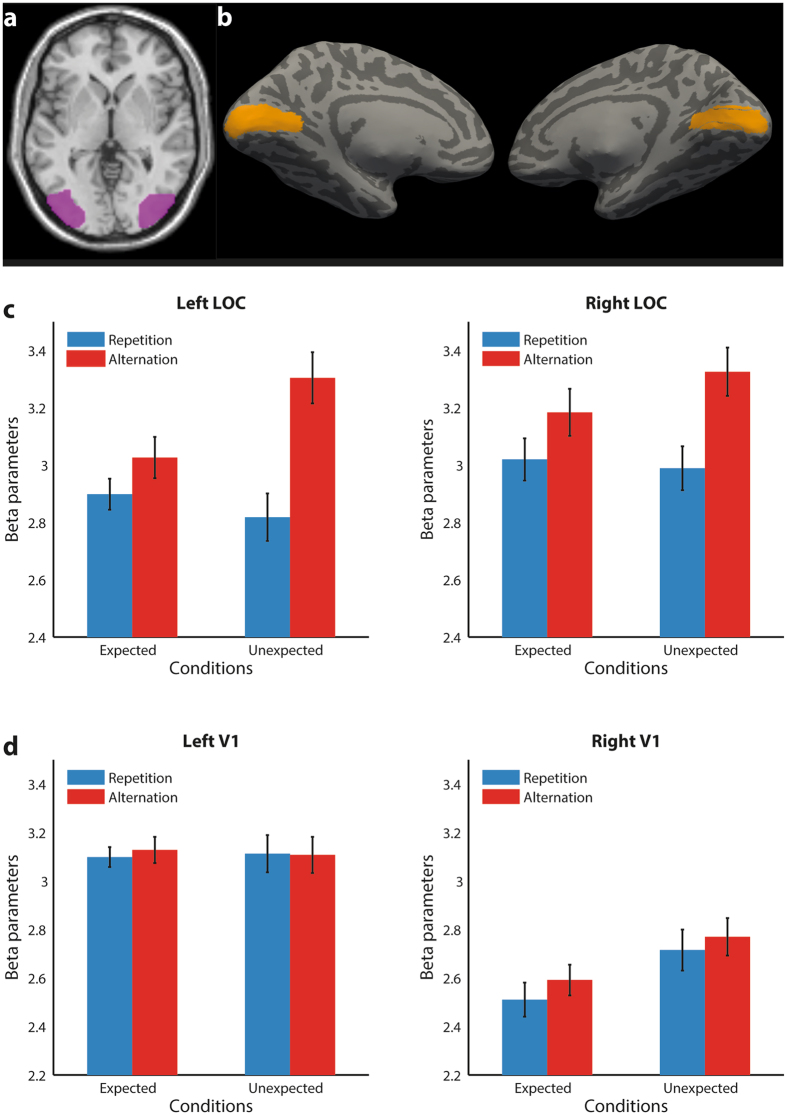
Verification
Claims the paper makes
The claims and statistics of this paper haven’t been checked yet.
Free: it reads the open-access text and checks the first 5 claims that cite a source we can check. Create a free account to check every claim.
Claims other papers make about this one
Each is checked against this paper’s own text: does it say what the citing paper says it does?
The source backs part of the claim, not all of it — or backs it for a different population, condition or comparison.
In the citing paper
“For example, complex stimuli like faces may not yield any specific predictions at the level of detail pertaining to the simple stimulus preferences of V1 receptive fields.”
From Evaluating the neurophysiological evidence for predictive processing as a model of perception (2020) · cites this paper as [67]
Experimental — accuracy not yet measuredThe source backs part of the claim, not all of it — or backs it for a different population, condition or comparison.
In the citing paper
“For example, Utzerath et al. 67 found evidence of RS, ES, and an interaction between expectation and repetition in area LOC.”
From Evaluating the neurophysiological evidence for predictive processing as a model of perception (2020) · cites this paper as [67]
Experimental — accuracy not yet measuredThe cited source says what the claim attributes to it.
In the citing paper
“No evidence of RS, nor an interaction between repetition and expectation, was observed in V1, while ES was only detected in right V1.”
From Evaluating the neurophysiological evidence for predictive processing as a model of perception (2020) · cites this paper as [67]
The cited source says what the claim attributes to it.
In the citing paper
“In the Utzerath et al. paradigm, the stimulus pool was composed of just four stimuli and the “unexpected” transitions occurred in 25% of trials.”
From Evaluating the neurophysiological evidence for predictive processing as a model of perception (2020) · cites this paper as [67]
Self-check
Percentages, sums and reported differences re-computed from the paper’s own numbers.
The self-check needs the paper’s full text.
Citations
Cites
Brainard, D. H. (1997) · Spatial Vision · doi:10.1163/156856897x00357 · Cited by 19,702
Baron-Cohen, S., Wheelwright, S., Skinner, R., Martin, J., & Clubley, E. (2001) · Journal of Autism and Developmental Disorders · doi:10.1023/a:1005653411471 · Cited by 6,450
Rao, R. P. N., & Ballard, D. H. (1999) · Nature Neuroscience · doi:10.1038/4580 · Cited by 5,483
A theory of cortical responses.
Friston, K. (2005) · Philosophical Transactions of the Royal Society B: Biological Sciences · doi:10.1098/rstb.2005.1622 · Cited by 4,578
Repetition and the brain: neural models of stimulus-specific effects
Grill-Spector, K., Henson, R., & Martin, A. (2006) · Trends in Cognitive Sciences · doi:10.1016/j.tics.2005.11.006 · Cited by 2,256
Confidence Intervals from Normalized Data: A correction to Cousineau (2005)
Morey, R. D. (2008) · Tutorials in Quantitative Methods for Psychology · doi:10.20982/tqmp.04.2.p061 · Cited by 1,997
Confidence intervals in within-subject designs: A simpler solution to Loftus and Masson's method
Cousineau, D. (2005) · Tutorials in Quantitative Methods for Psychology · doi:10.20982/tqmp.01.1.p042 · Cited by 1,874
Activation of the middle fusiform 'face area' increases with expertise in recognizing novel objects
Gauthier, I., Tarr, M. J., Anderson, A. W., Skudlarski, P., & Gore, J. C. (1999) · Nature Neuroscience · doi:10.1038/9224 · Cited by 1,188
Grill-Spector, K., Kushnir, T., Edelman, S., Avidan, G., Itzchak, Y., & Malach, R. (1999) · Neuron · doi:10.1016/s0896-6273(00)80832-6 · Cited by 1,166 · cited 10×
“The expectation x repetition interaction was not significant (F(1,23) = 0.”
BackgroundResultInfluentialControlling low-level image properties: The SHINE toolbox
Willenbockel, V., Sadr, J., Fiset, D., Horne, G. O., Gosselin, F., & Tanaka, J. W. (2010) · Behavior Research Methods · doi:10.3758/brm.42.3.671 · Cited by 1,166
Cited by
Evaluating the neurophysiological evidence for predictive processing as a model of perception
Walsh, K. S., McGovern, D. P., Clark, A., & O'Connell, R. G. (2020) · Annals of the New York Academy of Sciences · doi:10.1111/nyas.14321 · Cited by 333
Evaluating the evidence for expectation suppression in the visual system
Feuerriegel, D., Vogels, R., & Kovács, G. (2021) · Neuroscience & Biobehavioral Reviews · doi:10.1016/j.neubiorev.2021.04.002 · Cited by 95
Kuiper, M. W. M., Verhoeven, E. W. M., & Geurts, H. M. (2019) · Journal of Autism and Developmental Disorders · doi:10.1007/s10803-019-03890-9 · Cited by 83
Towards a Unified View on Pathways and Functions of Neural Recurrent Processing
Pennartz, C. M. A., Dora, S., Muckli, L., & Lorteije, J. A. M. (2019) · Trends in Neurosciences · doi:10.1016/j.tins.2019.07.005 · Cited by 73
Sarma, P., & Barma, S. (2022) · IEEE Transactions on Instrumentation and Measurement · doi:10.1109/tim.2022.3147876 · Cited by 41
“’s [43] study, it could be due to the subject’s acquaintance with a stimulus from the very beginning of stimuli presentation.”
Background
Metadata
- Authors
- Utzerath, C., St. John-Saaltink, E., Buitelaar, J., & de Lange, F. P.
- Affiliations
- Radboud University Nijmegen (NL)
- Corresponding author
- Utzerath, Christian
- Venue
- Scientific Reports
- Published
- 2017-08-18
- Volume
- 7
- Issue
- 1
- Pages
- 8781-8781
- ISSN
- 2045-2322 (ISSN-L)
- PMC
- PMC5562860
- OpenAlex
- W2749697433
- Cited by
- 28
- References
- 51
- Citations by year
- 2026: 1 · 2025: 1 · 2024: 4 · 2023: 2 · 2022: 3 · 2021: 5 · 2020: 4 · 2019: 5 · 2018: 3
- FWCI
- 1.88
- Type
- journal article
- Language
- en
- Open access
- gold
- doi.org
- Licence
- cc-by
- creativecommons.org/licenses/by/4.0 (tdm)
- creativecommons.org/licenses/by/4.0 (vor)
- Locations
- Scientific Reports (publishedVersion, cc-by)
- Europe PMC (PubMed Central) (publishedVersion, cc-by)
- PubMed Central (publishedVersion, cc-by)
- PubMed (publishedVersion)
- DOAJ (DOAJ: Directory of Open Access Journals) (submittedVersion, cc-by-sa)
- Radboud Repository (Radboud University) (submittedVersion)
- Radboud Repository (Radboud University) (submittedVersion, other-oa)
- Topics
- Life Sciences › Neuroscience › Cognitive Neuroscience › Visual perception and processing mechanisms
- Life Sciences › Neuroscience › Cognitive Neuroscience › Face Recognition and Perception
- Physical Sciences › Computer Science › Computer Vision and Pattern Recognition › Visual Attention and Saliency Detection
- Keywords
- repetition suppression, object processing, lateral occipital cortex, primary visual cortex, visual evoked potentials, stimulus probability
- MeSH terms
- Adult, Brain, Brain Mapping, Humans, Image Processing, Computer-Assisted, Magnetic Resonance Imaging, Male, Physical Stimulation, Reaction Time, Young Adult, Healthy Volunteers
About these checks
Registry, retraction, Cites and statistics results are computed, not judged, with one exception: a printed reference that no index lists is read once by a model before it counts as a citation error. Claims are extracted by a model and kept only when their quote appears verbatim in the text; each cited source is then checked, with a model’s help, for whether it says what the claim relies on. Those verdicts can be wrong — read the claim’s quote and the cited source before relying on one.
Statistics and arithmetic are recomputed, not judged.
Confidence bands are shown only for fields calibrated on our annotated test set. None is calibrated yet, so no band is shown.
What counts as a claim ›How we measure confidence ›How we check this ›
Are you an author, or do you see a problem with this page? Request a review
How to cite
Cite CoChat for the checks on this page, and the paper for its own findings.
- This page
- CoChat. (2026). Citation check: Repetition suppression to objects is modulated by stimulus-specific expectations. https://app.cochat.ai/papers/10.1038/s41598-017-09374-z
- The paper
- Utzerath, C., St. John-Saaltink, E., Buitelaar, J., & de Lange, F. P. (2017). Repetition suppression to objects is modulated by stimulus-specific expectations. Scientific Reports. https://doi.org/10.1038/s41598-017-09374-z
Data sources
Bibliographic data: Semantic Scholar, OpenAlex, Crossref.
Contains information from the Semantic Scholar Academic Graph Datasets, made available under the ODC Attribution License (ODC-BY 1.0).
Semantic Scholar’s data is described in: Kinney, R., et al. (2023). The Semantic Scholar Open Data Platform. arXiv:2301.10140.
