

Myoelectric Pattern Recognition Outperforms Direct Control for Transhumeral Amputees with Targeted Muscle Reinnervation: A Randomized Clinical Trial
Open accessThe DOI matches its Crossref record; the references it cites are not checked yet.
Abstract
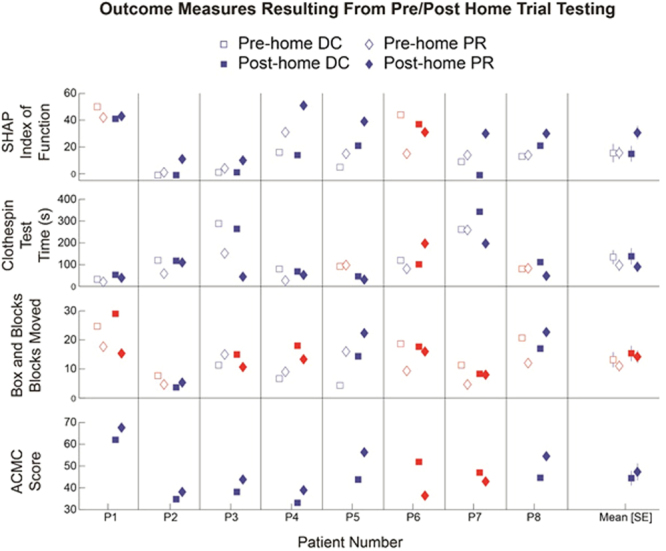
Recently commercialized powered prosthetic arm systems hold great potential in restoring function for people with upper-limb loss. However, effective use of such devices remains limited by conventional (direct) control methods, which rely on electromyographic signals produced from a limited set of muscles. Targeted Muscle Reinnervation (TMR) is a nerve transfer procedure that creates additional recording sites for myoelectric prosthesis control. The effects of TMR may be enhanced when paired with pattern recognition technology. We sought to compare pattern recognition and direct control in eight transhumeral amputees who had TMR in a balanced randomized cross-over study. Subjects performed a 6–8 week home trial using direct and pattern recognition control with a custom prostheses made from commercially available parts. Subjects showed statistically better performance in the Southampton Hand Assessment Procedure (p = 0.04) and the Clothespin relocation task (p = 0.02). Notably, these tests required movements along 3 degrees of freedom. Seven of 8 subjects preferred pattern recognition control over direct control. This study was the first home trial large enough to establish clinical and statistical significance in comparing pattern recognition with direct control. Results demonstrate that pattern recognition is a viable option and has functional advantages over direct control.
Overview
The claims and statistics of this paper haven’t been checked yet.
Free: it reads the open-access text and checks the first 5 claims that cite a source we can check. Create a free account to check every claim.
Integrity signals
Registry
Cites
Statistics
Figures



Verification
Claims the paper makes
The claims and statistics of this paper haven’t been checked yet.
Free: it reads the open-access text and checks the first 5 claims that cite a source we can check. Create a free account to check every claim.
Claims other papers make about this one
Each is checked against this paper’s own text: does it say what the citing paper says it does?
The cited source says what the claim attributes to it.
In the citing paper
“To date, pattern recognition controllers have outperformed conventional controllers during standardized functional trials (36).”
From A regenerative peripheral nerve interface allows real-time control of an artificial hand in upper limb amputees (2020) · cites this paper as [36]
Self-check
Percentages, sums and reported differences re-computed from the paper’s own numbers.
The self-check needs the paper’s full text.
Citations
The citation lists are queued
They are fetched later and appear here then.
References 35 · Cited by 190
Metadata
- Authors
- Hargrove, L. J., Miller, L. A., Turner, K., & Kuiken, T. A.
- Affiliations
- Northwestern University (US)
- Shirley Ryan AbilityLab (US)
- Corresponding author
- Hargrove, Levi J.
- Venue
- Scientific Reports
- Published
- 2017-10-23
- Volume
- 7
- Issue
- 1
- Pages
- 13840-13840
- ISSN
- 2045-2322 (ISSN-L)
- PMC
- PMC5653840
- OpenAlex
- W2765226128
- Cited by
- 190
- References
- 35
- Citations by year
- 2026: 11 · 2025: 23 · 2024: 21 · 2023: 20 · 2022: 23 · 2021: 31 · 2020: 21 · 2019: 23 · 2018: 17
- FWCI
- 7.50
- Type
- journal article
- Language
- en
- Open access
- gold
- doi.org
- Licence
- cc-by
- creativecommons.org/licenses/by/4.0 (tdm)
- creativecommons.org/licenses/by/4.0 (vor)
- Locations
- Scientific Reports (publishedVersion, cc-by)
- PubMed Central (publishedVersion, cc-by)
- PubMed (publishedVersion)
- DOAJ (DOAJ: Directory of Open Access Journals) (submittedVersion)
- Funders
- Congressionally Directed Medical Research Programs (W81XWH-12-2-0072)
- Topics
- Physical Sciences › Engineering › Biomedical Engineering › Muscle activation and electromyography studies
- Physical Sciences › Engineering › Biomedical Engineering › Prosthetics and Rehabilitation Robotics
- Life Sciences › Neuroscience › Cellular and Molecular Neuroscience › Neuroscience and Neural Engineering
- Keywords
- myoelectric pattern recognition, direct control, targeted muscle reinnervation, transhumeral amputation, upper limb prosthesis, nerve transfer, electromyography, prosthetic control
- MeSH terms
- Adult, Amputees, Artificial Limbs, Electromyography, Humans, Male, Middle Aged, Motor Skills, Pattern Recognition, Automated, Prosthesis Design, Muscle, Skeletal, Cross-Over Studies, Upper Extremity
About these checks
Registry, retraction, Cites and statistics results are computed, not judged, with one exception: a printed reference that no index lists is read once by a model before it counts as a citation error. Claims are extracted by a model and kept only when their quote appears verbatim in the text; each cited source is then checked, with a model’s help, for whether it says what the claim relies on. Those verdicts can be wrong — read the claim’s quote and the cited source before relying on one.
Statistics and arithmetic are recomputed, not judged.
Confidence bands are shown only for fields calibrated on our annotated test set. None is calibrated yet, so no band is shown.
What counts as a claim ›How we measure confidence ›How we check this ›
Are you an author, or do you see a problem with this page? Request a review
How to cite
Cite CoChat for the checks on this page, and the paper for its own findings.
- This page
- CoChat. (2026). Citation check: Myoelectric Pattern Recognition Outperforms Direct Control for Transhumeral Amputees with Targeted Muscle Reinnervation: A Randomized Clinical Trial. https://app.cochat.ai/papers/10.1038/s41598-017-14386-w
- The paper
- Hargrove, L. J., Miller, L. A., Turner, K., & Kuiken, T. A. (2017). Myoelectric Pattern Recognition Outperforms Direct Control for Transhumeral Amputees with Targeted Muscle Reinnervation: A Randomized Clinical Trial. Scientific Reports. https://doi.org/10.1038/s41598-017-14386-w
Data sources
Bibliographic data: Semantic Scholar, OpenAlex, Crossref.
Contains information from the Semantic Scholar Academic Graph Datasets, made available under the ODC Attribution License (ODC-BY 1.0).
Semantic Scholar’s data is described in: Kinney, R., et al. (2023). The Semantic Scholar Open Data Platform. arXiv:2301.10140.
