

High Resolution AMS Dates from Shubayqa 1, northeast Jordan Reveal Complex Origins of Late Epipalaeolithic Natufian in the Levant
Open accessThe DOI matches its Crossref record; 70 of the 71 references it cites were found in a registry or an index; none of the 83 sources its claims cite is checked for support yet.
Abstract
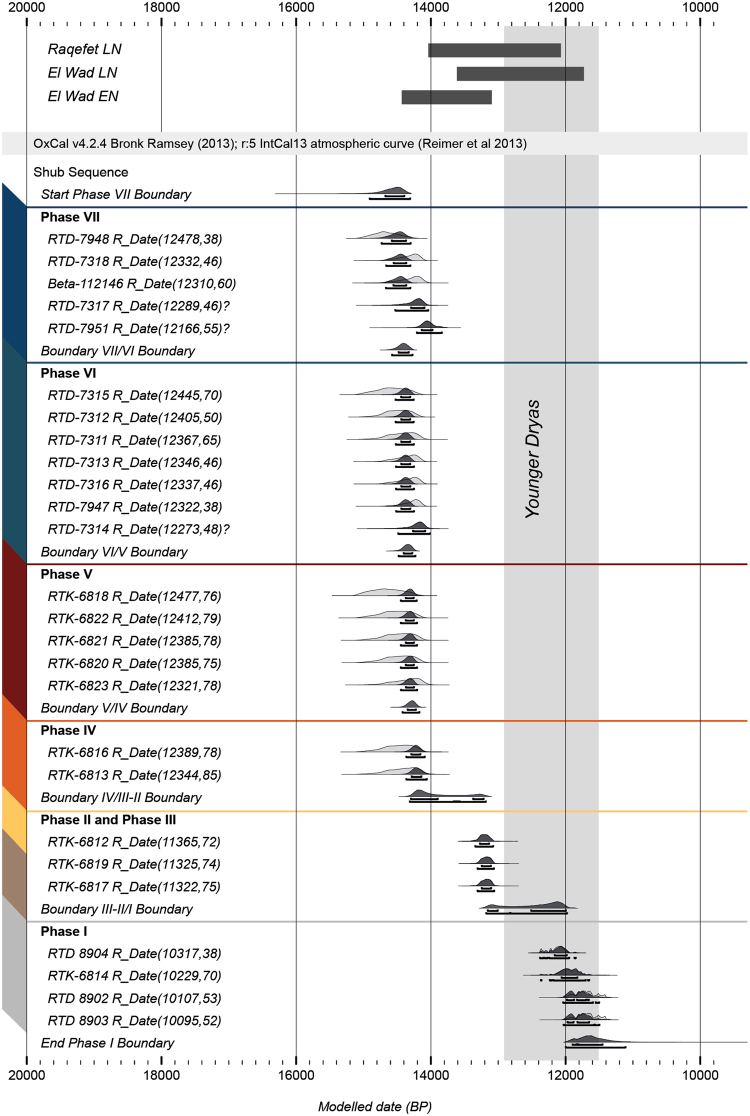
The Late Epipalaeolithic Natufian (~14,600 − 11,500 cal BP) is a key period in the prehistory of southwest Asia. Often described as a complex hunting and gathering society with increased sedentism, intensive plant exploitation and associated with an increase in artistic and symbolic material culture, it is positioned between the earlier Upper- and Epi-Palaeolithic and the early Neolithic, when plant cultivation and subsequently animal domestication began. The Natufian has thus often been seen as a necessary pre-adaptation for the emergence of Neolithic economies in southwest Asia. Previous work has pointed to the Mediterranean woodland zone of the southern Levant as the ‘core zone’ of the Early Natufian. Here we present a new sequence of 27 AMS radiocarbon dates from the Natufian site Shubayqa 1 in northeast Jordan. The results suggest that the site was occupied intermittently between ~14,600 − 12,000 cal BP. The dates indicate the Natufian emerged just as early in eastern Jordan as it did in the Mediterranean woodland zone. This suggests that the origins and development of the Natufian were not tied to the ecological conditions of the Mediterranean woodlands, and that the evolution of this hunting and gathering society was more complex and heterogeneous than previously thought.
Overview
CoChat Summary
TL;DR
A new sequence of 27 AMS radiocarbon dates from Shubayqa 1 in northeast Jordan shows intermittent occupation between ~14,600 and 12,000 cal BP, with Early Natufian occupation beginning as early as in the Mediterranean woodland zone. The results challenge the idea that Natufian origins were tied to the Mediterranean core zone and suggest a more complex, heterogeneous development.
Key findings
- Shubayqa 1 was occupied intermittently between ~14,600 and 12,000 cal BP. The site was first occupied ~14,400–14,200 cal BP (1σ) or ~14,600–14,200 cal BP (2σ); the Early Natufian occupation lasted 300–600 years; after a hiatus of c. 900 years, late Natufian occupation dates to ~13,300–13,100 cal BP (1σ) or ~13,300–13,000 cal BP (2σ); re-occupation dates to ~12,160–11,650 cal BP (1σ) or ~12,380–11,500 cal BP (2σ).
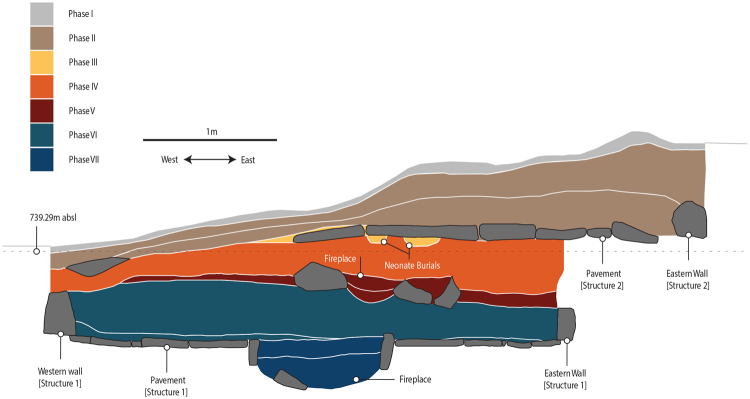
- Phases 7–4 (Early Natufian) are bracketed between ~14,400–14,100 cal BP (1σ), a total span of ~300 years, or ~14,600–14,000 cal BP (2σ). The hiatus between Phase 4 and Phase 3 is at minimum 820 years and at maximum 1100 years; Phases 3 and 2 date from ~13,390 to ~13,070 cal BP; the break between Phase 2 and Phase 1 lasted 1000–1100 years (1σ) or 700–1000 years (2σ).
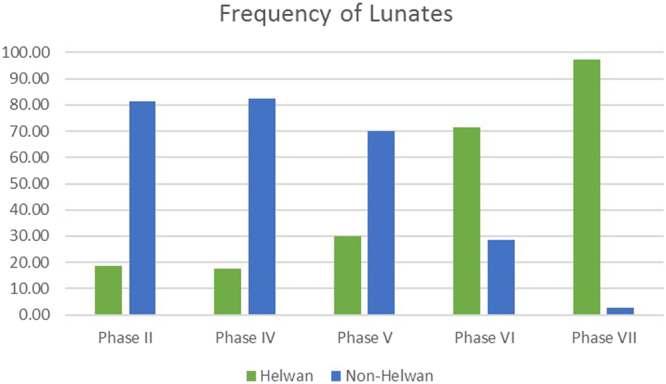
- Among 429 complete and broken lunates from Phases 7–2, Helwan lunates are typical in Phases 7 and 6, while non-Helwan lunates make up 82.3% in Phase 4 and are the majority in Phases 2 & 3. The switch from Helwan to non-Helwan lunates likely occurred between ~14,300 and 14,100 cal BP, suggesting the Late Natufian lithic marker appeared early and overlapped with Early Natufian industries.
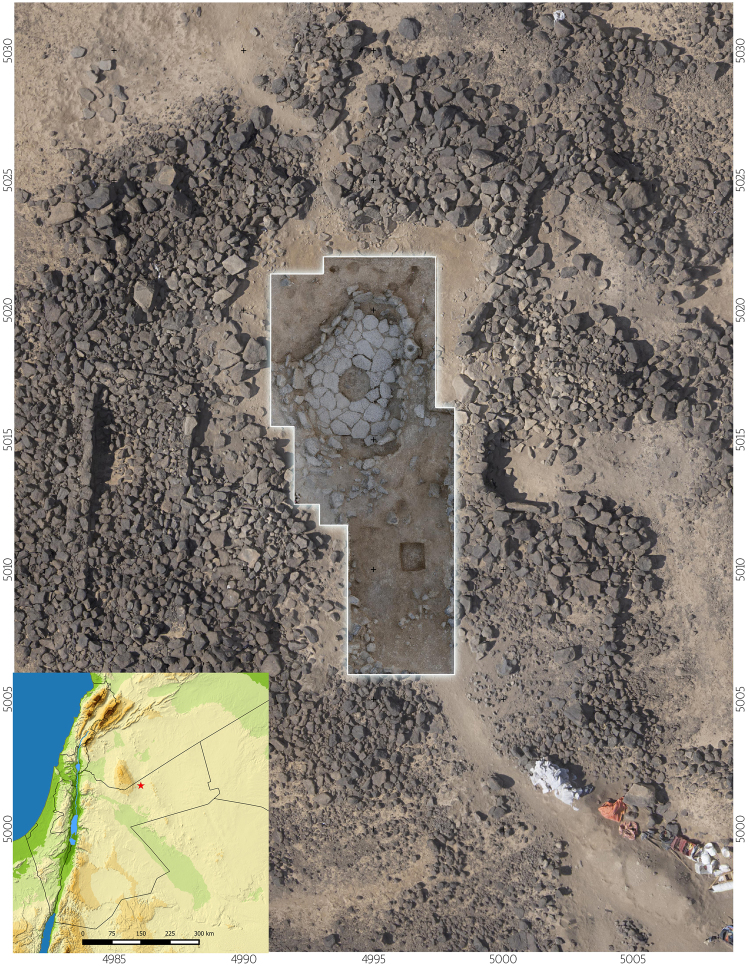
- Shubayqa 1 is described as the first well-dated Early to Late Natufian site with significant architecture outside the Mediterranean woodland zone, measuring more than 1,000 m² and fulfilling base-camp criteria. Botanical evidence suggests Early Natufian hunter-gatherers in eastern Jordan relied on club-rush tubers rather than cereals or nuts as their primary plant food, indicating more variable subsistence and multiple routes toward the Neolithic.
Methods
- Twenty-seven charred botanical samples were dated at the D-REAMS Laboratory; all material was identified to genus level and only short-lived plants or terminal branches of woody plants were used. One sample contained too little carbon for measurement, one Phase 1 sample was intrusive and omitted, and one previously unpublished date (Beta-112146) from Betts’s 1996 excavations was incorporated, yielding 26 reliable dates.
- Dates were modeled in OxCal 4.3 using the phase function, subdivided into seven phases based on stratigraphy, and run with the INTCal13 calibration curve.
- Lunate analysis examined 429 complete and broken lunates from Phases 7–2, recording Helwan versus non-Helwan backed retouch and measuring length and width on complete specimens.
Limitations
- Stated: the paper notes that Natufian radiocarbon records are patchy, often based on few dates with unclear provenience, unspecified or unidentified sample material, high standard deviations, or old dating methods. For Shubayqa 1, three Phase 7 dates showed poor agreement and were considered outliers; RTK-6818 in Phase 5 had low agreement and appeared too old; reasons for these outliers are unclear, and accidental contamination or other factors may explain them. Few lunates were available from Phases 6 and 5, the lunate sample is proportionally skewed toward Phases 2 and 3 (79%), and some non-Helwan lunates in Phase 4 may be intrusive from Phase 3 due to later grave digging. Phase 1 secure contexts were limited to Area C and the southern extension, and dates from two separate excavation areas were combined into one phase.
- Evident from the text: the phase model was chosen over finer stratigraphic subdivision because not all units within the same phase were necessarily superimposed, so the chronology is presented at a broader resolution. Some radiocarbon outliers remain unexplained, and the reliability of lunate data from Phases 6 and 5 is explicitly questioned by the authors.
Model-written summary. Check it against the paper before relying on it.
Integrity signals
Registry
Cites
Statistics
Figures
Verification
Claims the paper makes
0 Valid · 0 Not valid · 27 Not checked · 65 Own results and interpretations
A result the paper reports from its own data — it cites no other source for it, so there is none to check. The quote shows it is in the paper.
In the paper
“There is another break in occupation between Phase 2 and 1, which lasted between 1000–1100 years (1σ) or 700–1000 years (2σ).”
§ High Resolution AMS Dates from Shubayqa 1, northeast Jordan Reveal Complex Origins of Late Epipalaeolithic Natufian in the Levant > Results
plain- Asserted: passes — The authors put it forward as true.
- Checkable: passes — It can be checked against evidence.
- Load-bearing: passes — The paper’s conclusions depend on it.
- Based: passes — The paper gives a reason why it holds.
- Rests on 2 assumptions not shown here.
A result the paper states — it cites no source for it, so there is none to check. The quote shows it is in the paper.
In the paper
“Unlike most other Natufian sites in the Levant Shubayqa 1 has exceptional preservation conditions for botanical remains that has enabled us to obtain the most detailed series of AMS dates yet available from any Natufian site in the southern Levant.”
§ High Resolution AMS Dates from Shubayqa 1, northeast Jordan Reveal Complex Origins of Late Epipalaeolithic Natufian in the Levant > Introduction
plainstates a causeSingle case- Asserted: passes — The authors put it forward as true.
- Checkable: passes — It can be checked against evidence.
- Load-bearing: passes — The paper’s conclusions depend on it.
- Based: passes — The paper gives a reason why it holds.
A result the paper reports from its own data — it cites no other source for it, so there is none to check. The quote shows it is in the paper.
In the paper
“but no significant reduction in length or width within this group is evident.”
§ High Resolution AMS Dates from Shubayqa 1, northeast Jordan Reveal Complex Origins of Late Epipalaeolithic Natufian in the Levant > Results
plain- Asserted: passes — The authors put it forward as true.
- Checkable: passes — It can be checked against evidence.
- Load-bearing: unclear — It is unclear whether the paper’s conclusions depend on it.
- Based: passes — The paper gives a reason why it holds.
A result the paper reports from its own data — it cites no other source for it, so there is none to check. The quote shows it is in the paper.
In the paper
“At 2σ the dates are bracketed between ~14,600 − 14,000 cal BP.”
§ High Resolution AMS Dates from Shubayqa 1, northeast Jordan Reveal Complex Origins of Late Epipalaeolithic Natufian in the Levant > Results
plain- Asserted: passes — The authors put it forward as true.
- Checkable: passes — It can be checked against evidence.
- Load-bearing: passes — The paper’s conclusions depend on it.
- Based: passes — The paper gives a reason why it holds.
- Rests on an assumption not shown here.
A result the paper reports from its own data — it cites no other source for it, so there is none to check. The quote shows it is in the paper.
In the paper
“The model demonstrates that Phases 7–4 were laid down in relatively quick succession.”
§ High Resolution AMS Dates from Shubayqa 1, northeast Jordan Reveal Complex Origins of Late Epipalaeolithic Natufian in the Levant > Results
boosted- Asserted: passes — The authors put it forward as true.
- Checkable: passes — It can be checked against evidence.
- Load-bearing: passes — The paper’s conclusions depend on it.
- Based: passes — The paper gives a reason why it holds.
- Rests on an assumption not shown here.
59 more claims
Create a free account to see all 92 claims and to verify the 56 references still open.
- It may state two separate claims as one. 18
- Probably not a substantial claim. 14
Self-check
Percentages, sums and reported differences re-computed from the paper’s own numbers.
Each contradiction between two passages listed here was confirmed by an independent check.
Rated minor: it would not touch a result — a value no result rests on, a p-value that stays on the same side of the significance level, or a conflict that is clerical, resolved elsewhere in the paper, or outside its own findings.
In the paper
§ High Resolution AMS Dates from Shubayqa 1, northeast Jordan Reveal Complex Origins of Late Epipalaeolithic Natufian in the Levant > Shubayqa 1
“Betts carried out reconnaissance survey in the Qa’ Shubayqa area during the early to mid-1990s and reported the presence of a number of late Epipalaeolithic sites in the area, including Shubayqa 1 (54).”
§ High Resolution AMS Dates from Shubayqa 1, northeast Jordan Reveal Complex Origins of Late Epipalaeolithic Natufian in the Levant > References
“54. Blockley SPE Pinhasi R A revised chronology for the adoption of agriculture in the Southern Levant and the role of Lateglacial climatic change Quaternary Science Reviews 2011 30 98 108 10.1016/j.quascirev.2010.09.021”
Citations
Cites
Bayesian Analysis of Radiocarbon Dates
Bronk Ramsey, C. (2009) · Radiocarbon · doi:10.1017/s0033822200033865 · Cited by 8,725
Development of the Radiocarbon Calibration Program
Bronk Ramsey, C. (2001) · Radiocarbon · doi:10.1017/s0033822200038212 · Cited by 2,022
Recent and Planned Developments of the Program OxCal
Ramsey, C. B., & Lee, S. (2013) · Radiocarbon · doi:10.1017/s0033822200057878 · Cited by 1,468
Examining the Farming/Language Dispersal Hypothesis
Bellwood, P. S., & Renfrew, C. (2003) · Medical Entomology and Zoology · Cited by 628
Last Hunters-First Farmers: New Perspectives on the Prehistoric Transition to Agriculture
Harris, D. R., Price, T. D., & Gebauer, A. B. (1999) · Journal of Field Archaeology · doi:10.2307/530521 · Cited by 391
Kuijt, I., & Goring-Morris, N. (2002) · Journal of World Prehistory · doi:10.1023/a:1022973114090 · Cited by 387
Life in neolithic farming communities: social organization, identity, and differentiation
(2000) · Choice Reviews Online · doi:10.5860/choice.38-2231 · Cited by 384
New evidence of Lateglacial cereal cultivation at Abu Hureyra on the Euphrates
Hillman, G., Hedges, R., Moore, A., Colledge, S., & Pettitt, P. (2001) · The Holocene · doi:10.1191/095968301678302823 · Cited by 320
Rolling Out Revolution: Using Radiocarbon Dating in Archaeology
Bayliss, A. (2009) · Radiocarbon · doi:10.1017/s0033822200033750 · Cited by 315
Transitions to agriculture in prehistory
(1992) · Choice Reviews Online · doi:10.5860/choice.30-1586 · Cited by 288
Research works printed but not linked: 11
- Valla, F. R. In TheArchaeologyoftheHolyLand (ed Levy, T.) 169–190 (Leicester University press, 1995).
- Boyd, B. In FreshFieldsandPasturesNewPapersPresentedinHonorofAndrewM.T. Moore (eds Lilios, K. T. & Chazan, M.) 21–39 (Sidestone Press, 2016).
- Bar-Yosef, O. & Meadow, R. H. In Lasthunters-firstfarmers: Newperspectivesontheprehistorictransitiontoagriculture (eds Price, T. D. & Gebauer, A. B.) 39–94 (School of American Research Press, 1995).
- Olszewski DI On the Margins: Early Natufian in the Wadi al-Hasa Region, Jordan Eurasian Prehistory 2010 7 85 97
- Bar-Yosef, O. & Belfer-Cohen, A. In Between bands and states (ed S. A. Gregg) 181-202 (Southern Illinois University Press, 1991).
- Munro ND Small game, the younger dryas, and the transition to agriculture in the southern Levant Mitteilungen der Gesellschaft fuer Urgeschichte 2003 12 47 64
- Harris, D. R. In Evolution on Planet Earth: The Impact of the Physical Environment (edited by L. Rothschild & A. Lister) 379–394 (Elsevier, 2003).
- Makarewicz, C. A. In HunterGathererBehavior: HumanResponseDuringthe Younger Dryas. (ed M. Eren) 195–230 (Left Coast Press, 2012).
- Richter, T. In Quaternary of the Levant. Environments, Climate Change and Humans (eds Y. Enzel & O. Bar-Yosef) 715–722 (Cambride University Press, 2017).
- Wicks, K. et al. In Proceedings of the Prehistoric Society. 1-51 (Cambridge University Press).
- Garrard, A. & Yazbeck, C. Qadisha Valley Prehistory Project, Northern Lebanon: results of 2003 survey season. Bulletin d’Archéologie et d’Architecture Libanaises8, 5–46 (2004).
Cited by
Archaeobotanical evidence reveals the origins of bread 14,400 years ago in northeastern Jordan
Arranz-Otaegui, A., Gonzalez Carretero, L., Ramsey, M. N., Fuller, D. Q., & Richter, T. (2018) · Proceedings of the National Academy of Sciences · doi:10.1073/pnas.1801071115 · Cited by 338
Self-citation20,000 years of societal vulnerability and adaptation to climate change in southwest Asia
Jones, M. D., Abu-Jaber, N. S., AlShdaifat, A., Baird, D., Cook, B. I., Cuthbert, M. O., Dean, J. R., Djamali, M., Eastwood, W. J., Fleitmann, D., et al. (2019) · Wiley Interdisciplinary Reviews Water · doi:10.1002/wat2.1330 · Cited by 75
Self-citationArranz‐Otaegui, A., Carretero, L. G., Roe, J., & Richter, T. (2018) · Quaternary Science Reviews · doi:10.1016/j.quascirev.2018.02.011 · Cited by 65
Self-citationYeomans, L., Richter, T., & Martin, L. A. (2017) · Levant · doi:10.1080/00758914.2017.1368820 · Cited by 53
Self-citationYeomans, L., Martin, L. A., & Richter, T. (2018) · Journal of Anthropological Archaeology · doi:10.1016/j.jaa.2018.12.005 · Cited by 48
Self-citation
Metadata
- Authors
- Richter, T., Arranz-Otaegui, A., Yeomans, L., & Boaretto, E.
- Affiliations
- University of Copenhagen (DK)
- Corresponding author
- Richter, Tobias
- Boaretto, Elisabetta
- Venue
- Scientific Reports
- Published
- 2017-12-05
- Volume
- 7
- Issue
- 1
- Pages
- 17025-17025
- ISSN
- 2045-2322 (ISSN-L)
- PMC
- PMC5717003
- OpenAlex
- W2769271463
- Semantic Scholar
- 134c6f556c32e02dd362d5088a7eb451a40bc951
- Cited by
- 56
- References
- 71
- Citations by year
- 2026: 5 · 2025: 10 · 2024: 7 · 2023: 5 · 2022: 3 · 2021: 6 · 2020: 6 · 2019: 7 · 2018: 5 · 2017: 1
- FWCI
- 7.38
- Type
- journal article
- Language
- en
- Open access
- gold
- doi.org
- Licence
- cc-by
- creativecommons.org/licenses/by/4.0 (tdm)
- creativecommons.org/licenses/by/4.0 (vor)
- Locations
- Scientific Reports (publishedVersion, cc-by)
- Europe PMC (PubMed Central) (publishedVersion, cc-by)
- PubMed Central (publishedVersion, cc-by)
- PubMed (publishedVersion)
- Research at the University of Copenhagen (University of Copenhagen) (publishedVersion, cc-by)
- Topics
- Social Sciences › Archeology › Archaeology and ancient environmental studies
- Social Sciences › Anthropology › Pleistocene-Era Hominins and Archaeology
- Social Sciences › Arts and Humanities › Archeology (arts and humanities) › Archaeological and Geological Studies
- Keywords
- Natufian, radiocarbon chronology, hunter-gatherers, sedentism, plant exploitation, origins of agriculture, Neolithic transition, Levant prehistory, Eastern Jordan
- MeSH terms
- Domestication, Animals, Animals, Domestic, Humans, Jordan, Lunate Bone, History, Ancient, Plant Development
About these checks
Registry, retraction, Cites and statistics results are computed, not judged, with one exception: a printed reference that no index lists is read once by a model before it counts as a citation error. Claims are extracted by a model and kept only when their quote appears verbatim in the text; each cited source is then checked, with a model’s help, for whether it says what the claim relies on. Those verdicts can be wrong — read the claim’s quote and the cited source before relying on one.
A language model drew the claims from the paper on 2026-11-24, under version 3 of the claim definition (model deepseek-v4.1-flash, prompt extract-v3).
A second model labelled each claim on 2026-11-24 (model jev-1.13-20260917, definition revision gold-guideline-v0.2).
Statistics and arithmetic are recomputed, not judged.
Confidence bands are shown only for fields calibrated on our annotated test set. None is calibrated yet, so no band is shown.
What counts as a claim ›How we measure confidence ›How we check this ›
Are you an author, or do you see a problem with this page? Request a review
How to cite
Cite CoChat for the checks on this page, and the paper for its own findings.
- This page
- CoChat. (2026). Citation check: High Resolution AMS Dates from Shubayqa 1, northeast Jordan Reveal Complex Origins of Late Epipalaeolithic Natufian in the Levant. https://app.cochat.ai/papers/10.1038/s41598-017-17096-5
- The paper
- Richter, T., Arranz-Otaegui, A., Yeomans, L., & Boaretto, E. (2017). High Resolution AMS Dates from Shubayqa 1, northeast Jordan Reveal Complex Origins of Late Epipalaeolithic Natufian in the Levant. Scientific Reports. https://doi.org/10.1038/s41598-017-17096-5
Data sources
Bibliographic data: Semantic Scholar, OpenAlex, Crossref.
Contains information from the Semantic Scholar Academic Graph Datasets, made available under the ODC Attribution License (ODC-BY 1.0).
Semantic Scholar’s data is described in: Kinney, R., et al. (2023). The Semantic Scholar Open Data Platform. arXiv:2301.10140.
