

Conformational Landscape of the PRKACA-DNAJB1 Chimeric Kinase, the Driver for Fibrolamellar Hepatocellular Carcinoma
Open accessThe DOI matches its Crossref record; 40 of the 40 references it cites were found in a registry or an index; 3 of the 26 sources its claims cite were checked for support.
Abstract
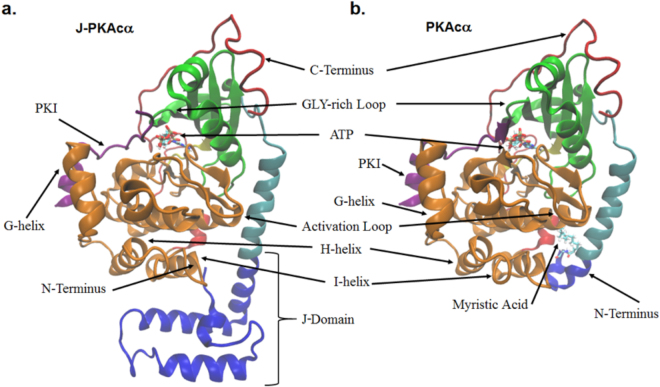
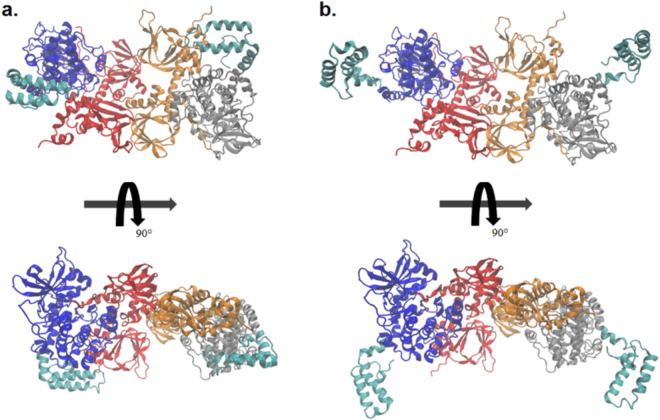
In fibrolamellar hepatocellular carcinoma a single genetic deletion results in the fusion of the first exon of the heat shock protein 40, DNAJB1, which encodes the J domain, with exons 2–10 of the catalytic subunit of protein kinase A, PRKACA. This produces an enzymatically active chimeric protein J-PKAcα. We used molecular dynamics simulations and NMR to analyze the conformational landscape of native and chimeric kinase, and found an ensemble of conformations. These ranged from having the J-domain tucked under the large lobe of the kinase, similar to what was reported in the crystal structure, to others where the J-domain was dislodged from the core of the kinase and swinging free in solution. These simulated dislodged states were experimentally captured by NMR. Modeling of the different conformations revealed no obvious steric interactions of the J-domain with the rest of the RIIβ holoenzyme.
Overview
CoChat Summary
TL;DR
MD simulations and NMR show that the FLC driver J-PKAcα has a mobile J-domain that samples both a crystal-like tucked state and dislodged states swinging away from the kinase core. Modeling suggests the J-domain can move without steric hindrance in the RIIβ holoenzyme, and its flexibility may offer a route to selective inhibition.
Key findings
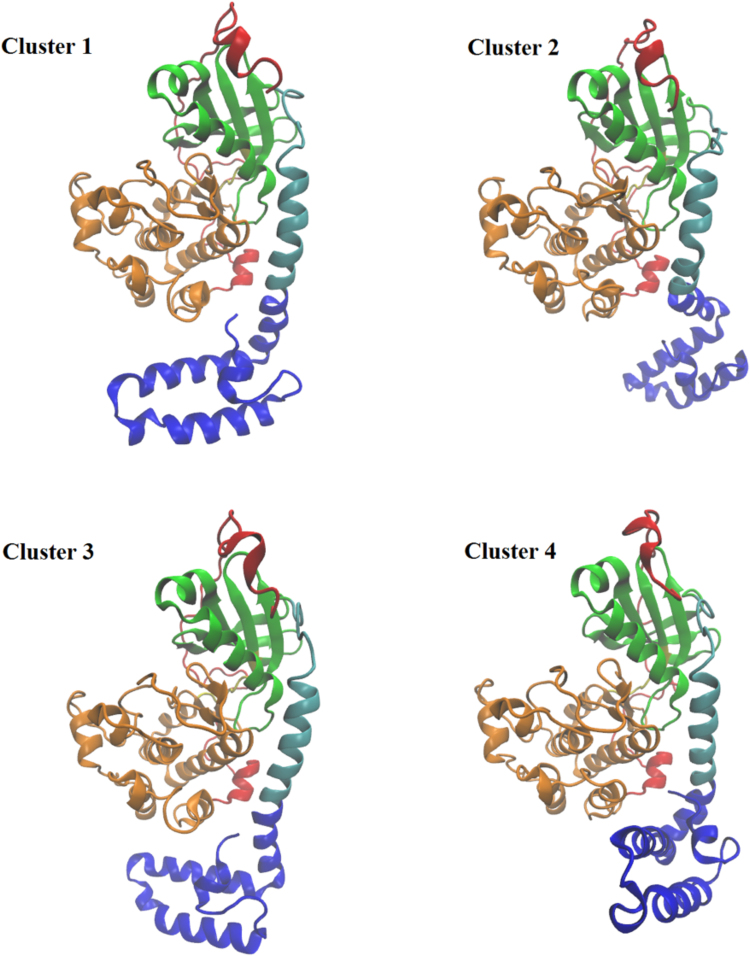
- In 1 μs MD simulations across ATP-, ADP-, Apo-, and ATP-PKI–bound states, the J-domain of J-PKAcα sampled a wide conformational ensemble; the top cluster (62% of conformations) resembled the crystal structure, while other clusters showed A-helix kinking near Arg10 and J-domain dislodging/rotation. The top four clusters accounted for 91% of conformations, with 21 clusters total; pooled wild-type PKAcα simulations gave only 2 clusters, with >99% in the first cluster.
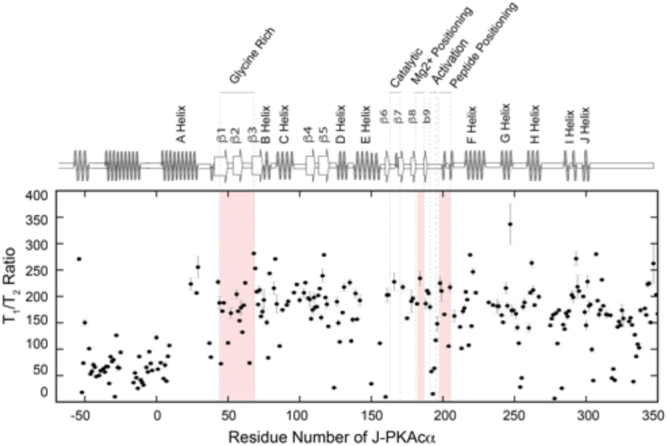
- NMR relaxation supported J-domain flexibility: the T1/T2 ratio averaged ~200 for the catalytic core but ~55 for the N-terminal J-domain, and the ternary J-PKAcα chimera had a faster experimental rotational correlation time (22.9 ns) than wild-type PKAcα (24.0 ns), despite its larger mass; HYDRONMR predicted 29.4 ns for wild-type and 37.4 ns for the chimera.
- Modeling the top two J-domain clusters into the RIIβ holoenzyme showed no obvious steric hindrance in either a “J-in” tucked state or a “J-out” dislodged state.
- The J-domain motions were observed in all nucleotide/substrate binding modes tested, and additional ATP-bound simulations sampled θ3 rotations from 24° to 180°, indicating that 1 μs simulations did not fully converge.
Methods
- Atomistic MD simulations of wild-type PKAcα and J-PKAcα chimera in ATP-bound, ADP-bound, Apo, and ATP + PKI5-24 bound states, built from PDB 4DFX and 4WB7, using Desmond with the OPLS3 force field; production runs were 1 μs (or 300 ns for additional simulations), with snapshots every 50 ps.
- Conformational clustering was performed after aligning helices E and F, using GROMACS `gmx rms` and `gmx cluster` with a 5 Å cutoff and gromos clustering; representative structures were the smallest average-RMSD members of each cluster.
- NMR experiments used U-2H,15N-labeled J-PKAcα and wild-type PKAcα, plus a DnaJB1 peptide, with resonance assignment by TROSY triple-resonance experiments; 15N T1 and T2 relaxation times were measured at 850/900 MHz and 300 K, and T1/T2 ratios were analyzed residue-specifically.
Limitations
- Stated: 1 μs simulation time may not sample all possible conformations; the authors tested this with additional simulations and found ATP-bound 1 μs runs were not converged.
- Stated: the first 103 N-terminal residues of RIIβ, containing the AKAP binding domain, were not resolved in the crystal structure, so this region could interact with the J-domain and alter its dynamics.
- Evident from the text: the holoenzyme analysis is based on modeling rather than experimental holoenzyme dynamics, and the study does not directly test how the observed J-domain flexibility affects FLC transformation, kinase activity, or substrate specificity in cells.
Model-written summary. Check it against the paper before relying on it.
Integrity signals
Registry
Cites
Statistics
Figures
Verification
Claims the paper makes
2 Valid · 0 Not valid · 18 Not checked · 66 Own results and interpretations
Every source the paper cites for this claim was checked and supports it.
In the paper
“Expression of the chimera in mouse liver either by recreating the deletion by CRISPR/Cas9, or expression, in trans, by a transposon is sufficient to produce FLC7.”
§ Conformational Landscape of the PRKACA-DNAJB1 Chimeric Kinase, the Driver for Fibrolamellar Hepatocellular Carcinoma > Introduction
What the sources say
- Supportedcites [7] Kastenhuber, E. R. et al. DNAJB1–PRKACA fusion kinase interacts with β-catenin and the liver regenerative response to drive fibrolamellar hepatocellular carcinoma. Proc. Natl. Acad. Sci. 114 13076–13084 (2017). PMC5740683 29162699 source
The Abstract states that CRISPR/Cas9 editing and transposon-mediated somatic gene transfer show that 'expression of both the endogenous fusion protein or a chimeric cDNA leads to the formation of indolent liver tumors in mice that closely resemble human FL-HCC.' The CRISPR section concludes that 'induction of an endogenous Dnajb1-Prkaca fusion through intrachromosomal deletion drives tumors with features of FL-HCC in mice,' and the transposon section ('DNAJB1-PRKACA fusion drives liver tumorigenesis', tested explicitly for whether the fusion 'is sufficient to drive tumorigenesis') reports that the fusion cDNA produced tumors with similar kinetics, penetrance and morphology, whereas wild-type PRKACA did not. The Discussion ties both arms together: the fusion 'is a bona fide oncogene that drives FL-HCC' since tumors arose from the endogenous fusion and from ectopic cDNA expression. (LLM, conf=0.90)
plainstates a cause- Asserted: passes — The authors put it forward as true.
- Checkable: passes — It can be checked against evidence.
- Load-bearing: passes — The paper’s conclusions depend on it.
- Based: passes — The paper gives a reason why it holds.
- Supported
The cited sources support only part of this claim — read each source’s verdict below.
In the paper
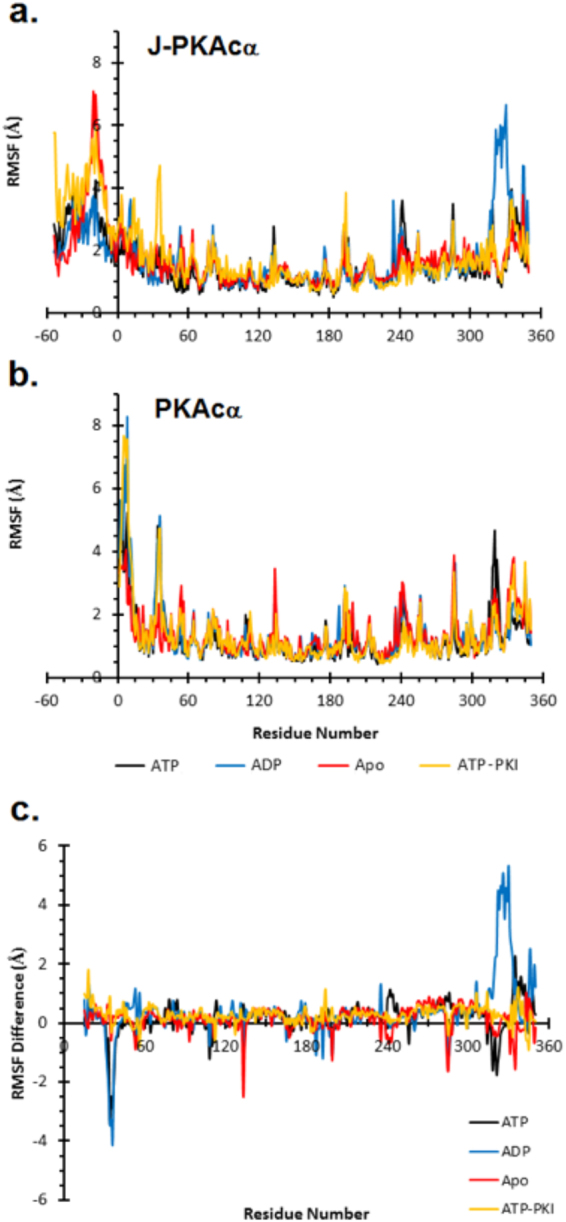
“For native PKAcα (Fig. 2b), in agreement with previous studies13,19, we observed large fluctuations in catalytically important loops such as the Gly-rich loop (residues 50 to 55) and portions of the activation loop (residues 192 to 199).”
§ Conformational Landscape of the PRKACA-DNAJB1 Chimeric Kinase, the Driver for Fibrolamellar Hepatocellular Carcinoma > Results
What the sources say
- Partly supportedcites [13] Cembran A Conformational equilibrium of N-myristoylated cAMP-dependent protein kinase A by molecular dynamics simulations Biochemistry 2012 51 10186 10196 10.1021/bi301279f 23205665 PMC3545707 sourceExperimental — accuracy not yet measured
Our copy supports only the general level of the claim: the Introduction (Sec. 1) states that 'catalysis is orchestrated by several flexible regions that activate the enzyme (activation loop), position the substrate (peptide positioning loop), and screen the active site from water (Gly-rich loop)', and the Results section 'Allosteric coupling between the N-terminus/A-helix and catalytically-relevant regions' analyses Gly-rich loop opening/closing motion (S53-G186 distance) and the Gly-rich loop's involvement in small-lobe correlated motions. However, no passage reports large fluctuations for the specific residue ranges cited (Gly-rich loop 50-55, activation loop 192-199) in the native/unmyristoylated enzyme; the RMSF results (Sec. 3, 'The motions at the N-terminus are quenched upon N-myristoylation') attribute enhanced sub-nanosecond flexibility only to A-helix residues 1-14 in myr(-) PKA-C and state that the rest of the protein shows no substantial change in backbone amide dynamics. So the residue-specific fluctuation observation attributed to this source is not in our copy, though nothing in it contradicts it. (LLM, conf=0.65)
- Partly supportedcites [19] Masterson LR Dynamically committed, uncommitted, and quenched states encoded in protein kinase A revealed by NMR spectroscopy Proc. Natl. Acad. Sci. USA 2011 108 6969 6974 10.1073/pnas.1102701108 21471451 PMC3084134 sourceExperimental — accuracy not yet measured
The Results section 'PKA-C Energy Landscape' states that rmsf from MD simulations of PKA-C 'confirmed that the most dynamic regions of the enzyme reside in the proximity of the catalytically important loops (glycine-rich, activation, DFG, and peptide positioning loops)', which supports the claim's core point about large fluctuations in the Gly-rich and activation loops of the PKA catalytic subunit (including the apo/native form, simulated alongside the binary and ternary complexes). However, our copy nowhere gives the residue ranges the citing sentence attaches to those loops (50-55 for the Gly-rich loop, 192-199 for the activation segment); searches for 'residues 50-55', 'Gly-rich loop residues' and 'activation loop residues 192-199' returned only loop names and reference entries, so that numeric specificity is not this source's. Related passages (Results, Fig. 1 F/G discussion of chemical-shift differences in the glycine-rich, activation, DFG and peptide positioning loops; Results note on 'local rigidification of the glycine-rich loop' credited to ref. 28) likewise name loops without residue boundaries. (LLM, conf=0.70)
plain- Asserted: passes — The authors put it forward as true.
- Checkable: passes — It can be checked against evidence.
- Load-bearing: unclear — It is unclear whether the paper’s conclusions depend on it.
- Based: passes — The paper gives a reason why it holds.
- Rests on an assumption not shown here.
- Partly supported
A result the paper reports from its own data — it cites no other source for it, so there is none to check. The quote shows it is in the paper.
In the paper
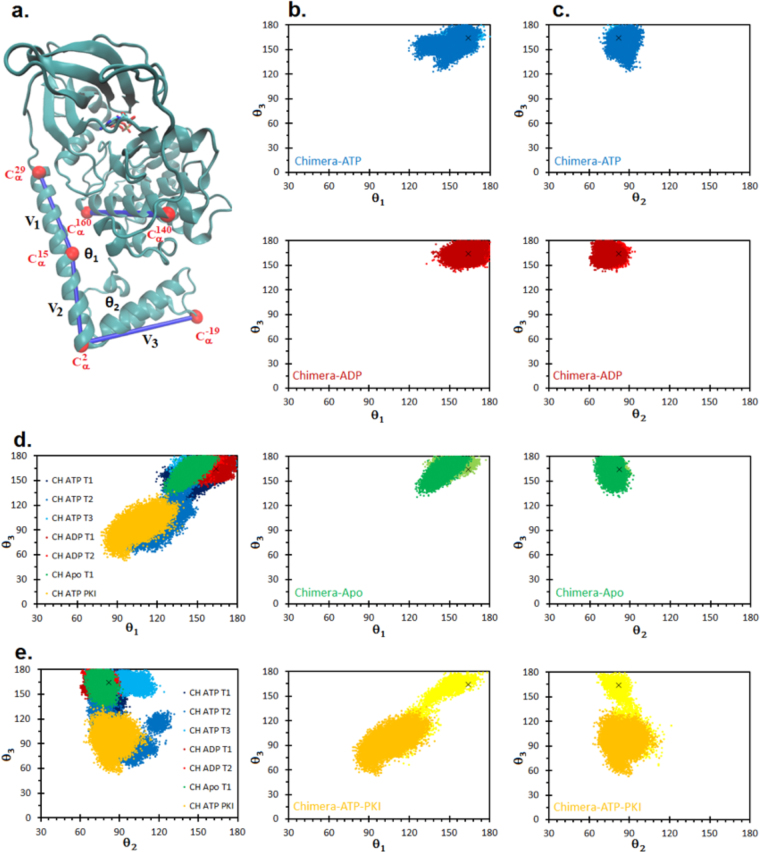
“The ATP, ADP, and Apo forms of the chimera also show movement of the J-domain away from its position in the crystal structure, though to a lesser extent than ATP-PKI bound chimera.”
§ Conformational Landscape of the PRKACA-DNAJB1 Chimeric Kinase, the Driver for Fibrolamellar Hepatocellular Carcinoma > Results
plainstates an association- Asserted: passes — The authors put it forward as true.
- Checkable: passes — It can be checked against evidence.
- Load-bearing: passes — The paper’s conclusions depend on it.
- Based: passes — The paper gives a reason why it holds.
- Rests on an assumption not shown here.
A result the paper reports from its own data — it cites no other source for it, so there is none to check. The quote shows it is in the paper.
In the paper
“We find the J-domain of J-PKAcα samples a wide range of conformations in all substrate/nucleotide binding modes tested.”
§ Conformational Landscape of the PRKACA-DNAJB1 Chimeric Kinase, the Driver for Fibrolamellar Hepatocellular Carcinoma > Introduction
plain- Asserted: passes — The authors put it forward as true.
- Checkable: passes — It can be checked against evidence.
- Load-bearing: passes — The paper’s conclusions depend on it.
- Based: passes — The paper gives a reason why it holds.
- Rests on an assumption not shown here.
A result the paper reports from its own data — it cites no other source for it, so there is none to check. The quote shows it is in the paper.
In the paper
“In simulations of non-myristoylated PKAcα, the N-terminal residues (1–8) were highly dynamic (Supplementary Fig. S2).”
§ Conformational Landscape of the PRKACA-DNAJB1 Chimeric Kinase, the Driver for Fibrolamellar Hepatocellular Carcinoma > Results
plain- Asserted: passes — The authors put it forward as true.
- Checkable: passes — It can be checked against evidence.
- Load-bearing: unclear — It is unclear whether the paper’s conclusions depend on it.
- Based: passes — The paper gives a reason why it holds.
- Rests on an assumption not shown here.
49 more claims
Create a free account to see all 86 claims and to verify the 22 references still open.
- It may state two separate claims as one. 25
- The quote only partly states this claim. 1
- Probably not a substantial claim. 6
Claims other papers make about this one
Each is checked against this paper’s own text: does it say what the citing paper says it does?
In the citing paper
“In contrast, our computational and solution NMR studies suggest that PKA-CDNAJB1 spans a large ensemble of conformations, with the J-domain undergoing fast re-orientational dynamics relative to the core of the enzyme22.”
From Defective internal allosteric network imparts dysfunctional ATP/substrate-binding cooperativity in oncogenic chimera of protein kinase A (2021) · cites this paper as [22]
In the citing paper
“In solution, however, NMR and SAXS have shown that the J-domain is flexible, assuming both in and out conformations22.”
From Defective internal allosteric network imparts dysfunctional ATP/substrate-binding cooperativity in oncogenic chimera of protein kinase A (2021) · cites this paper as [22]
Self-check
Percentages, sums and reported differences re-computed from the paper’s own numbers.
Each contradiction between two passages listed here was confirmed by an independent check.
Rated minor: it would not touch a result — a value no result rests on, a p-value that stays on the same side of the significance level, or a conflict that is clerical, resolved elsewhere in the paper, or outside its own findings.
In the paper
§ Conformational Landscape of the PRKACA-DNAJB1 Chimeric Kinase, the Driver for Fibrolamellar Hepatocellular Carcinoma > Materials and Methods > NMR Spectroscopy
“For both T1 and T2, the relaxation decay was sampled for 8 different delays.”
§ Conformational Landscape of the PRKACA-DNAJB1 Chimeric Kinase, the Driver for Fibrolamellar Hepatocellular Carcinoma > Materials and Methods > NMR Spectroscopy
“T1 delays: 0, 10, 100, 300, 500, 700, 900, 1200 and 1700 ms”
Rated minor: it would not touch a result — a value no result rests on, a p-value that stays on the same side of the significance level, or a conflict that is clerical, resolved elsewhere in the paper, or outside its own findings.
In the paper
§ Conformational Landscape of the PRKACA-DNAJB1 Chimeric Kinase, the Driver for Fibrolamellar Hepatocellular Carcinoma > Results
“ν1 (Cα of Lys29 and Cα of Val15)”
§ Conformational Landscape of the PRKACA-DNAJB1 Chimeric Kinase, the Driver for Fibrolamellar Hepatocellular Carcinoma > Results
“ν2 (Cα of Lys15 and Cα of Pro2)”
Rated minor: it would not touch a result — a value no result rests on, a p-value that stays on the same side of the significance level, or a conflict that is clerical, resolved elsewhere in the paper, or outside its own findings.
In the paper
§ Conformational Landscape of the PRKACA-DNAJB1 Chimeric Kinase, the Driver for Fibrolamellar Hepatocellular Carcinoma > Results
“(d) and (e) Motions of the J-domain for nine different 1 μs simulations.”
§ Conformational Landscape of the PRKACA-DNAJB1 Chimeric Kinase, the Driver for Fibrolamellar Hepatocellular Carcinoma > Results
“The aggregate data for the J-domain motions from all seven 1 μs simulations is shown in Fig. 4d,e.”
Rated minor: it would not touch a result — a value no result rests on, a p-value that stays on the same side of the significance level, or a conflict that is clerical, resolved elsewhere in the paper, or outside its own findings.
In the paper
§ Conformational Landscape of the PRKACA-DNAJB1 Chimeric Kinase, the Driver for Fibrolamellar Hepatocellular Carcinoma > Results
“The bending of this helix, given by θ1, is 161° in the crystal structure17”
§ Conformational Landscape of the PRKACA-DNAJB1 Chimeric Kinase, the Driver for Fibrolamellar Hepatocellular Carcinoma > Results
“| Crystal Structure | 164° | 82° | 164° |”
Citations
Cites
NMRPipe: A multidimensional spectral processing system based on UNIX pipes
Delaglio, F., Grzesiek, S., Vuister, G., Zhu, G., Pfeifer, J., & Bax, A. (1995) · Journal of Biomolecular NMR · doi:10.1007/bf00197809 · Cited by 15,965
OPLS3: A Force Field Providing Broad Coverage of Drug-like Small Molecules and Proteins
Harder, E., Damm, W., Maple, J., Wu, C., Reboul, M., Xiang, J. Y., Wang, L., Lupyan, D., Dahlgren, M. K., Knight, J. L., et al. (2016) · Journal of Chemical Theory and Computation · doi:10.1021/acs.jctc.5b00864 · Cited by 3,047
Molecular dynamics---Scalable algorithms for molecular dynamics simulations on commodity clusters
Bowers, K. J., Sacerdoti, F. D., Salmon, J. K., Shan, Y., Shaw, D. E., Chow, E., Xu, H., Dror, R. O., Eastwood, M. P., Gregersen, B. A., et al. (2006) · Proceedings of the 2006 ACM/IEEE conference on Supercomputing - SC '06 · doi:10.1145/1188455.1188544 · Cited by 2,580
Pervushin, K., Riek, R., Wider, G., & Wüthrich, K. (1997) · Proceedings of the National Academy of Sciences · doi:10.1073/pnas.94.23.12366 · Cited by 2,445
Peptide Folding: When Simulation Meets Experiment
Daura, X., Gademann, K., Jaun, B., Seebach, D., van Gunsteren, W. F., & Mark, A. E. (1999) · Angewandte Chemie International Edition · doi:10.1002/(sici)1521-3773(19990115)38:1/2<236::aid-anie236>3.0.co;2-m · Cited by 1,962
Knighton, D. R., Zheng, J., Ten Eyck, L. F., Ashford, V. A., Xuong, N.-H., Taylor, S. S., & Sowadski, J. M. (1991) · Science · doi:10.1126/science.1862342 · Cited by 1,759
Self-citationScalable Algorithms for Molecular Dynamics Simulations on Commodity Clusters
Bowers, K. J., Chow, D. E., Xu, H., Dror, R. O., Eastwood, M. P., Gregersen, B. A., Klepeis, J. L., Kolossvary, I., Moraes, M. A., Sacerdoti, F. D., et al. (2006) · ACM/IEEE SC 2006 Conference (SC'06) · doi:10.1109/sc.2006.54 · Cited by 1,673
Grzesiek, S., & Bax, A. (1992) · Journal of the American Chemical Society · doi:10.1021/ja00042a003 · Cited by 1,022
Knighton, D. R., Zheng, J., Ten Eyck, L. F., Xuong, N.-H., Taylor, S. S., & Sowadski, J. M. (1991) · Science · doi:10.1126/science.1862343 · Cited by 960
Self-citationPERVUSHIN, K., RIEK, R., WIDER, G., & WÜTHRICH, K. (2021) · NMR with Biological Macromolecules in Solution · doi:10.1142/9789811235795_0006 · Cited by 951
Cited by
Hepatoblastoma and Pediatric Hepatocellular Carcinoma: An Update
Ranganathan, S., Lopez-Terrada, D., & Alaggio, R. (2020) · Pediatric and Developmental Pathology · doi:10.1177/1093526619875228 · Cited by 219
Vyas, M., Hechtman, J. F., Zhang, Y., Benayed, R., Yavas, A., Askan, G., Shia, J., Klimstra, D. S., & Basturk, O. (2020) · Modern Pathology · doi:10.1038/s41379-019-0398-2 · Cited by 127
The Molecular Basis for Specificity at the Level of the Protein Kinase a Catalytic Subunit
Søberg, K., & Skålhegg, B. S. (2018) · Frontiers in Endocrinology · doi:10.3389/fendo.2018.00538 · Cited by 95
“In fibrolamellar hepatocellular carcinoma (FLHCC), which is a rare liver tumor, a ∼400-kilobase deletion on chromosome 19 leads to a chimeric gene product consisting of exon 1, also including parts of exon 2, of DNAJB1 fused with exon 2–10 of PRKACA (DNAJB1-PRKACA) (206, 207).”
BackgroundModulation of polycystic kidney disease by G-protein coupled receptors and cyclic AMP signaling
Sussman, C. R., Wang, X., Chebib, F. T., & Torres, V. E. (2020) · Cellular Signalling · doi:10.1016/j.cellsig.2020.109649 · Cited by 72
A framework for fibrolamellar carcinoma research and clinical trials
Dinh, T. A., Utria, A. F., Barry, K. C., Ma, R. K., Abou‐Alfa, G. K., Gordan, J. D., Jaffee, E. M., Scott, J. D., Zucman‐Rossi, J., O'Neill, A. F., et al. (2022) · Nature Reviews Gastroenterology & Hepatology · doi:10.1038/s41575-022-00580-3 · Cited by 60
“Moreover, like wild-type C subunits, the oncogenic DNAJ–PKAc C subunits interact with R subunits to form functional holoenzymes, and PKA activity in FLC cells remains responsive to cAMP 65,68,69 .”
Background
Metadata
- Authors
- Tomasini, M. D., Wang, Y., Karamafrooz, A., Li, G., Beuming, T., Gao, J., Taylor, S. S., Veglia, G., & Simon, S. M.
- Affiliations
- Rockefeller University (US)
- University of Minnesota (US)
- Schrodinger (United States) (US)
- University of California San Diego (US)
- Corresponding author
- Simon, Sanford M.
- ORCID
- Venue
- Scientific Reports
- Published
- 2018-01-15
- Volume
- 8
- Issue
- 1
- Pages
- 720-720
- ISSN
- 2045-2322 (ISSN-L)
- PMC
- PMC5768683
- OpenAlex
- W2782599768
- Semantic Scholar
- b3477ad5d55dc0415019ac042ab556d2e3b61f72
- Cited by
- 30
- References
- 40
- Citations by year
- 2025: 1 · 2024: 1 · 2023: 5 · 2022: 7 · 2021: 5 · 2020: 4 · 2019: 5 · 2018: 2
- FWCI
- 1.12
- Type
- journal article
- Language
- en
- Open access
- gold
- doi.org
- Licence
- cc-by
- creativecommons.org/licenses/by/4.0 (tdm)
- creativecommons.org/licenses/by/4.0 (vor)
- Locations
- Scientific Reports (publishedVersion, cc-by)
- PubMed (publishedVersion)
- PubMed Central (publishedVersion, cc-by)
- DOAJ (DOAJ: Directory of Open Access Journals) (submittedVersion)
- Funders
- U.S. Department of Defense
- Fibrolamellar Cancer Foundation
- National Cancer Institute (P50CA210964)
- National Institute of General Medical Sciences (R01GM100310)
- Topics
- Life Sciences › Biochemistry, Genetics and Molecular Biology › Molecular Biology › Protein Structure and Dynamics
- Health Sciences › Medicine › Hepatology › Hepatocellular Carcinoma Treatment and Prognosis
- Life Sciences › Biochemistry, Genetics and Molecular Biology › Molecular Biology › Protein Kinase Regulation and GTPase Signaling
- Keywords
- fibrolamellar hepatocellular carcinoma, J-domain, protein kinase A, conformational ensembles, protein conformational landscape, molecular dynamics simulation, NMR spectroscopy
- MeSH terms
- Carcinoma, Hepatocellular, Humans, Liver Neoplasms, Magnetic Resonance Spectroscopy, Protein Conformation, Recombinant Fusion Proteins, HSP40 Heat-Shock Proteins, Cyclic AMP-Dependent Protein Kinase Catalytic Subunits, Molecular Dynamics Simulation
About these checks
Registry, retraction, Cites and statistics results are computed, not judged, with one exception: a printed reference that no index lists is read once by a model before it counts as a citation error. Claims are extracted by a model and kept only when their quote appears verbatim in the text; each cited source is then checked, with a model’s help, for whether it says what the claim relies on. Those verdicts can be wrong — read the claim’s quote and the cited source before relying on one.
The claim verdicts this report counts are experimental: their accuracy is not yet measured.
A language model drew the claims from the paper on 2026-11-18, under version 3 of the claim definition (model deepseek-v4.1-flash, prompt extract-v3).
A second model labelled each claim on 2026-11-18 (model jev-1.13-20260917, definition revision gold-guideline-v0.2).
Cited sources are checked with a language model’s help (qwen3.8-omni-flash).
Statistics and arithmetic are recomputed, not judged.
Confidence bands are shown only for fields calibrated on our annotated test set. None is calibrated yet, so no band is shown.
What counts as a claim ›How we measure confidence ›How we check this ›
Are you an author, or do you see a problem with this page? Request a review
Data sources
Bibliographic data: Semantic Scholar, OpenAlex, Crossref.
Contains information from the Semantic Scholar Academic Graph Datasets, made available under the ODC Attribution License (ODC-BY 1.0).
Semantic Scholar’s data is described in: Kinney, R., et al. (2023). The Semantic Scholar Open Data Platform. arXiv:2301.10140.
