

Visual impairment and risk of depression: A longitudinal follow-up study using a national sample cohort
Open accessThe DOI matches its Crossref record; 29 of the 29 references it cites were found in a registry or an index.
Abstract
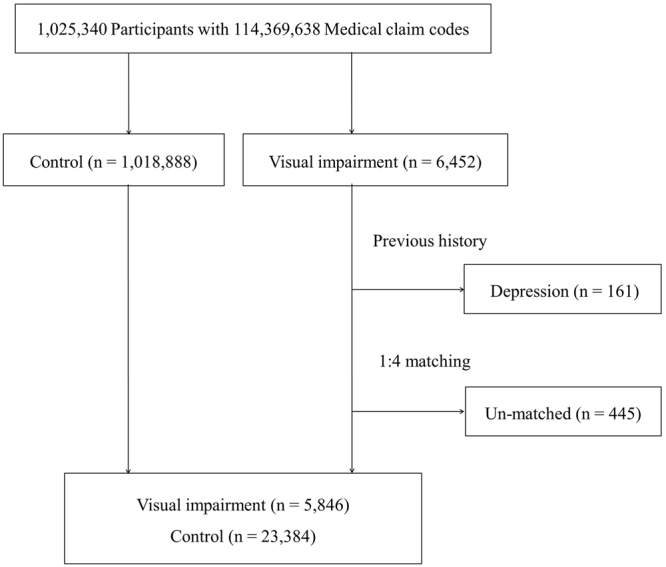
The association of visual impairment and depression has been investigated in several studies based on a cross-sectional design, which cannot delineate temporal relationships. In the present study, we evaluated the influence of visual impairment on depression in all age groups using a longitudinal database of a national sample cohort from 2002 to 2013 provided by the Korean National Health Insurance Service. Of a total of 1,025,340 subjects, 5,846 participants who were registered as visually impaired persons without a previous diagnosis of depression were enrolled at a 1:4 ratio with 23,384 control participants matched for age, sex, income, and region of residence. The crude and adjusted (age, sex, income, region of residence, hypertension, diabetes, and dyslipidemia) hazard ratios (HRs) for the development of depression between the visually impaired and control groups were analyzed using a Cox proportional hazards model. Visual impairment increased the risk of depression after adjusting for age, sex, income, region of residence, hypertension, diabetes, and dyslipidemia (adjusted HR = 1.19, P = 0.002). The risk of depression increased significantly in both the non-blindness visual impairment (adjusted HR = 1.15, P = 0.036) and blindness subgroups (adjusted HR = 1.31, P = 0.016), with a higher HR in the blindness subgroup.
Overview
The claims and statistics of this paper haven’t been checked yet.
Free: it reads the open-access text and checks the first 5 claims that cite a source we can check. Create a free account to check every claim.
Integrity signals
Registry
Cites
Statistics
Figures
Verification
Claims the paper makes
The claims and statistics of this paper haven’t been checked yet.
Free: it reads the open-access text and checks the first 5 claims that cite a source we can check. Create a free account to check every claim.
Claims other papers make about this one
Each is checked against this paper’s own text: does it say what the citing paper says it does?
The check wasn’t confident either way, so it gives no verdict — never disputed.
In the citing paper
“Non-ophthalmological health care resources were not consistently accounted for, thus potentially underestimating health care resource use and costs amongst patients prone to falls and depression [64–66].”
From The economic impact of retinal diseases for which gene therapy is emerging: a systematic literature review (2025) · cites this paper as [65]
Experimental — accuracy not yet measured
Self-check
Percentages, sums and reported differences re-computed from the paper’s own numbers.
The self-check needs the paper’s full text.
Citations
Cites
Socioeconomic inequalities in depression: a meta-analysis
Lorant, V. (2003) · American Journal of Epidemiology · doi:10.1093/aje/kwf182 · Cited by 2,603
Cohort Profile: The National Health Insurance Service–National Sample Cohort (NHIS-NSC), South Korea
Lee, J., Lee, J. S., Park, S.-H., Shin, S. A., & Kim, K. (2016) · International Journal of Epidemiology · doi:10.1093/ije/dyv319 · Cited by 1,469
Nationwide Population Science: Lessons From the Taiwan National Health Insurance Research Database
Hsing, A. W., & Ioannidis, J. P. A. (2015) · JAMA Internal Medicine · doi:10.1001/jamainternmed.2015.3540 · Cited by 581
Sensory Impairment and Quality of Life in a Community Elderly Population
Carabellese, C., Appollonio, I., Rozzini, R., Bianchetti, A., Frisoni, G. B., Frattola, L., & Trabucchi, M. (1993) · Journal of the American Geriatrics Society · doi:10.1111/j.1532-5415.1993.tb06948.x · Cited by 436
Depression and Anxiety in Visually Impaired Older People
Evans, J. R., Fletcher, A. E., & Wormald, R. P. L. (2007) · Ophthalmology · doi:10.1016/j.ophtha.2006.10.006 · Cited by 415
Zhang, X., Bullard, K. M., Cotch, M. F., Wilson, M. R., Rovner, B. W., McGwin, G., Owsley, C., Barker, L., Crews, J. E., & Saaddine, J. B. (2013) · JAMA Ophthalmology · doi:10.1001/jamaophthalmol.2013.2597 · Cited by 293
Major Depressive and Anxiety Disorders in Visually Impaired Older Adults
van der Aa, H. P. A., Comijs, H. C., Penninx, B. W. J. H., van Rens, G. H. M. B., & van Nispen, R. M. A. (2015) · Investigative Ophthalmology & Visual Science · doi:10.1167/iovs.14-15848 · Cited by 280
Depression and Disability Associated with Impaired Vision: The MoVIES Project
Rovner, B. W., & Ganguli, M. (1998) · Journal of the American Geriatrics Society · doi:10.1111/j.1532-5415.1998.tb01080.x · Cited by 237
The prevalence of depressive symptoms and predisposing factors in an elderly Chinese population
Woo, J., Ho, S. C., Lau, J., Yuen, Y. K., Chiu, H., Lee, H. C., & Chi, I. (1994) · Acta Psychiatrica Scandinavica · doi:10.1111/j.1600-0447.1994.tb01478.x · Cited by 206
The prevalence of low vision and blindness in Canada
Maberley, D. A. L., Hollands, H., Chuo, J., Tam, G., Konkal, J., Roesch, M., Veselinovic, A., Witzigmann, M., & Bassett, K. (2006) · Eye · doi:10.1038/sj.eye.6701879 · Cited by 203
Cited by
Items 101–129 of 129
Développement des compétences socio-émotionnelles chez les personnes avec une déficience visuelle
Chennaz, L., & Leavy, A. (2025) · Revue interdisciplinaire sur le handicap visuel · doi:10.5077/journals/rihv.2025.e1721 · Cited by 1
Willmington, C., Kirby, A., & Murphy, A. (2025) · Health Economics Review · doi:10.1186/s13561-025-00707-7
Cataract Services in the COVID-19 era: Risk, Consent and PrioritisationPreprint
Cheng, K. K. W., Anderson, M., Velissaris, S., Moreton, R., Al-Mansour, A., Sanders, P. R., Sutherland, S., Wilson, P., & Blaikie, A. J. (2020) · Research Square · doi:10.21203/rs.3.rs-72755/v1
“In addition, visual impairment is also associated with increased risk of depression after adjusting for confounding factors (10).”
BackgroundChoi, H. G., Lee, M. J., & Baek, S. U. (2021) · Research Square · doi:10.21203/rs.3.rs-530551/v1
Self-citationAvaliação dos sintomas de depressão em pessoas com deficiência visual
Cambraia, M. I. D. A., & Nazima, M. T. S. T. (2021) · Revista da SBPH · doi:10.57167/rev-sbph.24.67
The Impact of Cataract Surgery on Depression in Elderly Iranian Patients: A Case–Control Study
Deilami, K. N., Gorji, M. A. H., Hoseini, S. H., & Farokhfar, A. (2021) · Sudan Journal of Medical Sciences · doi:10.18502/sjms.v16i4.9942 · Cited by 2
Rellini, E. (2021) · Mental Health & Human Resilience International Journal · doi:10.23880/mhrij-16000155
Sung, C., Chung, C., Lin, F., Chien, W., Sun, C., Tsao, C., & Weng, C. (2022) · Research Square · doi:10.21203/rs.3.rs-1625237/v1
DEPRESSION IN ELDERLY WITH IMPAIRED VISION
Tulumović, Š., & Mahmic, N. (2022) · Journal Human Research in Rehabilitation · doi:10.21554/hrr.042209
Meilicke, H. M. X., Hui, Y., Li, J., Čolić, L., Wu, S., Chen, S., Zhang, S., Li, R., Lv, B., Li, H., et al. (2024) · Biomarkers in Neuropsychiatry · doi:10.1016/j.bionps.2024.100094
Bandar, N. F. A., Hassan, Z., Balang, R. V., Muhamad, A. S., Wahat, N. W. A., & Sarkawi, N. N. B. (2024) · International Journal of Academic Research in Business and Social Sciences · doi:10.6007/ijarbss/v14-i8/22555
“There has been no one measure that can serve to describe the state of SWB of PVI in Malaysia, and consequently, to monitor their SWB. PVI tends to be associated with depression (Choi et al., 2018) and lower-level life satisfaction (Brunes, Hansen, and Heir (2019) and consequently affects their SWB.”
BackgroundEffect of the Braille method on the psychological health of blind people
Al-Jumaily, D. A. T., Jasim, S. A. H., Al-Fathy, M. Y. A., & Ahmed, M. (2024) · Journal of emergency medicine, trauma & acute care · doi:10.5339/jemtac.2024.absc.8
Paediatric low vision service evaluation: Sheffield teaching hospitals NHS foundation trust
Elgohary, A. M., Eid, T., Elseht, R. M., Sabry, M. M., Codina, C. J., & Arblaster, G. (2025) · British Journal of Visual Impairment · doi:10.1177/02646196251330166
“Given this, the well-evidenced higher vulnerability of CYPVI to physical and mental health difficulties necessitates effective clinical care and support (Choi et al., 2018; Teoh et al., 2021).”
Gupta, P., Man, R. E. K., Wong, C. M. J., Thakur, S., Fenwick, E., Vu, T. A., Aravindhan, A., Black, A. A., Wood, J. M., & Lamoureux, E. L. (2025) · Investigative Ophthalmology & Visual Science · doi:10.1167/iovs.66.6.3 · Cited by 2
Evaluation of Health Habits and Level of Oral and Dental Health of Children with Hearing Impairment
Asiri, F. Y. I., Tennant, M., & Kruger, E. (2025) · Turkish journal of Dental Hygiene · doi:10.51847/suxaczpdja
Khatri, B., Shrestha, R. K., Pyakurel, M., & Upadhyay, M. P. (2025) · Journal of Indian Association for Child and Adolescent Mental Health · doi:10.1177/09731342251389254
“18,19 However, in our study, adolescents with low vision were more likely to experience depressive symptoms than those with blindness, but the association was not statistically significant.”
Self-concept, Social Exclusions and Mental Health in Young Adults with Visual Impairment
Gillani, S. M. A., & Hashmi, F. (2025) · Qlantic Journal of Social Sciences and Humanities · doi:10.55737/qjssh.v-iv.24450
Phang, D. S. K., Chee, S. F., Aziz, H. A., & Zunaina, E. (2025) · Malaysian Journal of Medicine and Health Sciences · doi:10.47836/mjmhs.v21.i6.1384
“A study among Korean subjects found that the risk of depression significantly increased in both the non-blind visual impairment group and the blindness subgroup, with a higher hazard ratio observed in the blindness subgroup (25).”
Agarwal, R., Lee, D., Mendez-Bermudez, I., & Berkenstock, M. K. (2026) · Ocular immunology and inflammation · doi:10.1080/09273948.2026.2633447 · Cited by 1
“17,27 Kim et al. found increased risk of suicidal behaviors with visual impairment, more likely seen in adolescent patients.”
InfluentialCare Continuity and Risk of Glaucoma Surgery in Newly Diagnosed Primary Open Angle Glaucoma
Cho, I. H., Park, M., Kim, H., Cha, Y., & Kim, S. H. (2026) · Journal of Glaucoma · doi:10.1097/ijg.0000000000002700
The Impact of Dual Sensory Loss on Quality of Life Among Older Adults Aged 60 and Above
Kim, T., Kim, W.-K., & Lee, E.-H. (2025) · The Korean Journal of Vision Science · doi:10.17337/jmbi.2025.27.4.259
Ogedengbe, T. O., Sukhai, M. A., & Wittich, W. (2026) · Work · doi:10.1177/10519815261423278
Rahmati, M., Smith, L., Piyasena, P., Lee, S., Jeong, Y. D., Boyer, L., Nguyễn, C. D., Do, H., Tran, B. X., Fond, G. B., et al. (2026) · Journal of Epidemiology and Population Health · doi:10.1016/j.jeph.2026.203371 · Cited by 2
Self-citationJung, H. W., Kim, J.-H., & Lee, J. J. (2026) · Journal of Korean Medical Science · doi:10.3346/jkms.2026.41.e148
“However, adding simple assessments of sensory function (hearing, vision, smell, and taste), 19,30 mobility (gait tests), 22 and lifestyle factors (nutrition and exercise habits) 23,27 could significantly enhance the ability to identify older adults at risk of depression.”
Zhu, K., (8773739), S. Z., Li, W., Liu, B., Chang, D., & You, Y. (2026) · Research Square · doi:10.21203/rs.3.rs-9659783/v1
Galimov, A. R., Timofeyeva, N. S., Voskresenskaya, A. A., Kuzmina, S. V., Pozdeyeva, N. A., & Shurygina, A. D. (2026) · Neurology Bulletin · doi:10.17816/nb676929
Impact of Vision Loss on Daily Function in Older Adults with Ocular Diseases
Thomas, J., Nagarajan, N., & Varadaraj, V. (2026) · Springer eBooks · doi:10.1007/978-3-032-29691-7_1
Shaheen, T., & Gul, A. (2026) · International Journal of Emerging Multidisciplinaries Social Science · doi:10.54938/ijemdss.2026.05.1.699
“A result of longitudinal study specified that people who have visual impairment have a 19% increase probability of developing depression connected with those with typical vision, with the risk additional increasing among those who are diagnosed with blindness (Choi et al., 2018).”
Kang, H. S., Kim, J.-H., Yoo, D. M., Han, K. M., Kim, N. Y., Choi, H. G., 최영희, & Kwon, M. J. (2026) · Psychiatry Research · doi:10.1016/j.psychres.2026.117542
Self-citation
Metadata
- Authors
- Choi, H. G., Lee, M. J., & Lee, S.-M.
- Affiliations
- Hallym University (KR)
- Hallym University Sacred Heart Hospital (KR)
- Corresponding author
- Lee, Sang-Mok
- Venue
- Scientific Reports
- Published
- 2018-02-01
- Volume
- 8
- Issue
- 1
- Pages
- 2083-2083
- ISSN
- 2045-2322 (ISSN-L)
- PMC
- PMC5794974
- OpenAlex
- W2806383644
- Semantic Scholar
- 5e0c932c2f1e90ef8b50723ed617dc7a0ca32a4c
- Cited by
- 129
- References
- 29
- Citations by year
- 2026: 13 · 2025: 14 · 2024: 15 · 2023: 13 · 2022: 21 · 2021: 33 · 2020: 12 · 2019: 5 · 2018: 3
- FWCI
- 12.63
- Type
- journal article
- Language
- en
- Open access
- gold
- doi.org
- Licence
- cc-by
- creativecommons.org/licenses/by/4.0 (tdm)
- creativecommons.org/licenses/by/4.0 (vor)
- Locations
- Scientific Reports (publishedVersion, cc-by)
- Europe PMC (PubMed Central) (publishedVersion, cc-by)
- PubMed Central (publishedVersion, cc-by)
- PubMed (publishedVersion)
- DOAJ (DOAJ: Directory of Open Access Journals) (submittedVersion, cc-by-sa)
- Funders
- National Research Foundation
- Topics
- Health Sciences › Medicine › Public Health, Environmental and Occupational Health › Aging, Health, and Disability
- Health Sciences › Medicine › Ophthalmology › Ophthalmology and Visual Impairment Studies
- Health Sciences › Medicine › Psychiatry and Mental health › Mental Health Treatment and Access
- Keywords
- visual impairment, depression, blindness, depression risk, temporal relations, chronic comorbidities
- MeSH terms
- Adolescent, Adult, Aged, Child, Child, Preschool, Depression, Female, Humans, Infant, Male, Middle Aged, Vision Disorders, Republic of Korea
About these checks
Registry, retraction, Cites and statistics results are computed, not judged, with one exception: a printed reference that no index lists is read once by a model before it counts as a citation error. Claims are extracted by a model and kept only when their quote appears verbatim in the text; each cited source is then checked, with a model’s help, for whether it says what the claim relies on. Those verdicts can be wrong — read the claim’s quote and the cited source before relying on one.
Statistics and arithmetic are recomputed, not judged.
Confidence bands are shown only for fields calibrated on our annotated test set. None is calibrated yet, so no band is shown.
What counts as a claim ›How we measure confidence ›How we check this ›
Are you an author, or do you see a problem with this page? Request a review
Data sources
Bibliographic data: Semantic Scholar, OpenAlex, Crossref.
Contains information from the Semantic Scholar Academic Graph Datasets, made available under the ODC Attribution License (ODC-BY 1.0).
Semantic Scholar’s data is described in: Kinney, R., et al. (2023). The Semantic Scholar Open Data Platform. arXiv:2301.10140.
