

Analysis of β-tubulin-carbendazim interaction reveals that binding site for MBC fungicides does not include residues involved in fungicide resistance
Open accessThe DOI matches its Crossref record; 48 of the 48 references it cites were found in a registry or an index.
Abstract
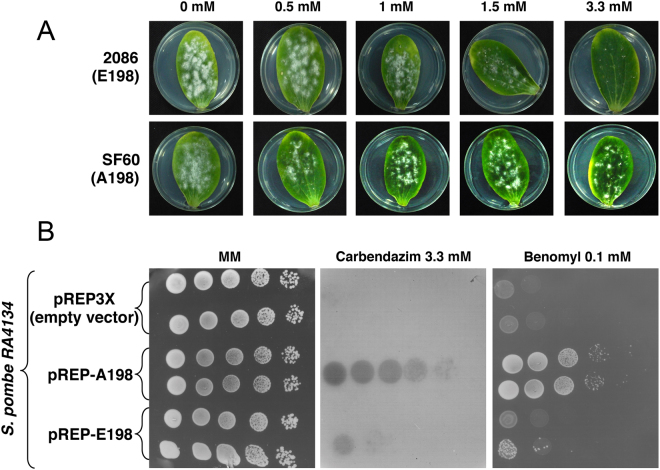
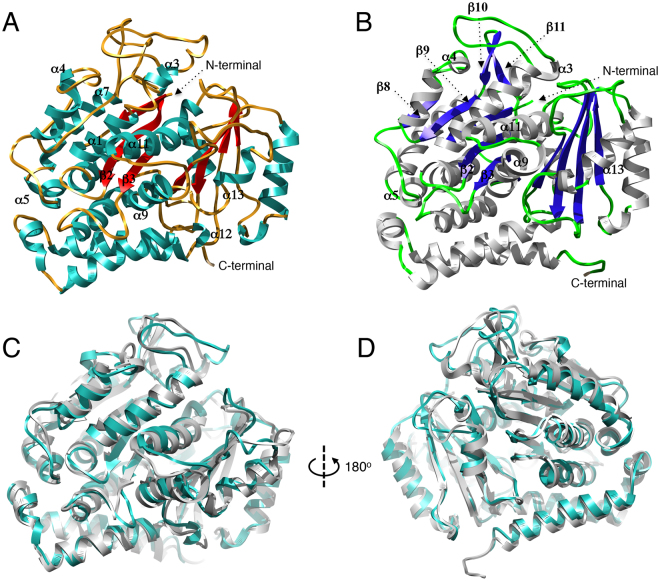
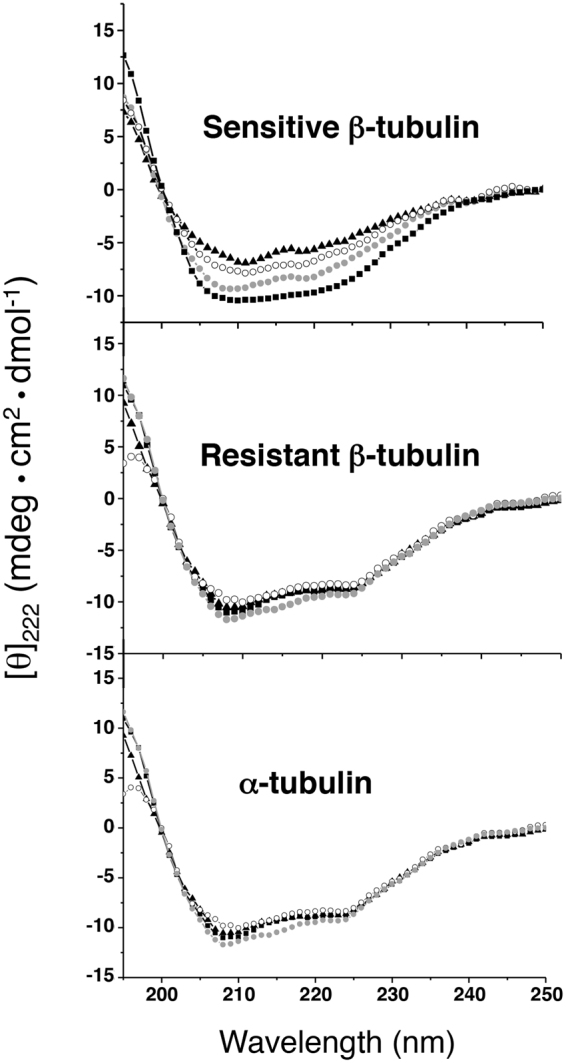
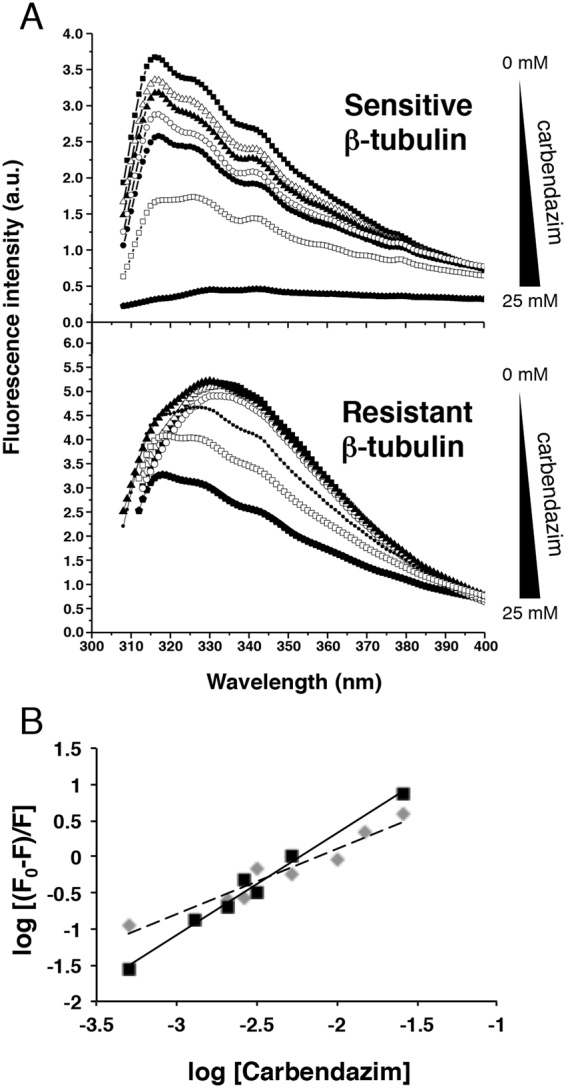
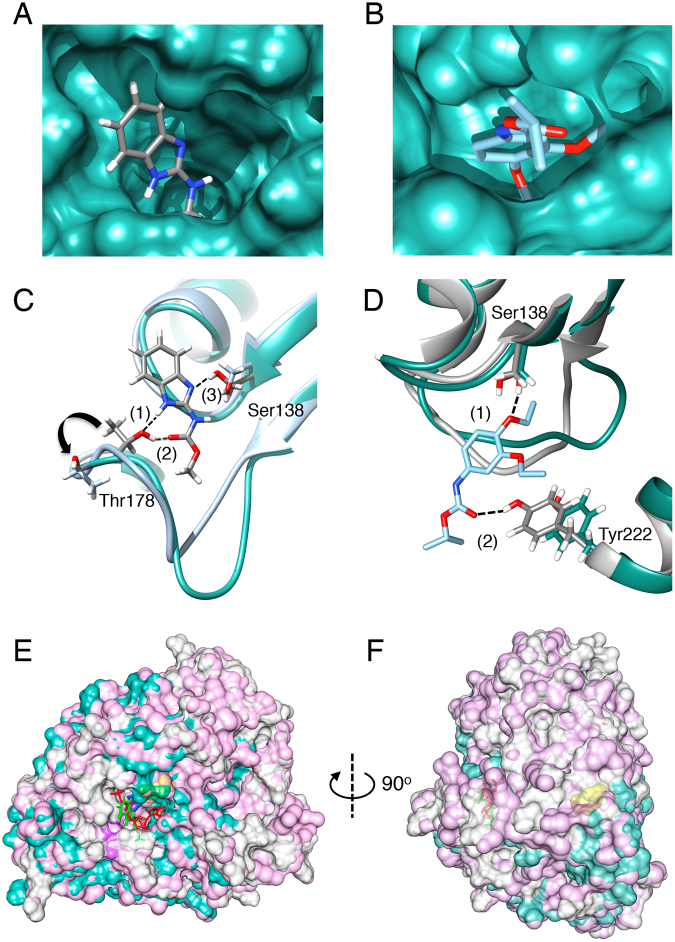
Methyl benzimidazole carbamate (MBC) fungicides are fungicidal compounds that exert their biological activities by preventing cell division through the inhibition of tubulin polymerization, which is the major component of microtubules. Several mutations in the β-tubulin gene contribute to MBC resistance, the most common and significant of which occur at residues 198 and 200. Despite nearly 50 years of agricultural use, the binding site of MBCs and the precise mechanism by which those mutations affect fungicide efficacy have not been determined. The aim of this work was to clarify the mode of action and the mechanism of resistance to MBC fungicides in Podosphaera xanthii, the primary causal agent of cucurbit powdery mildew, using a combination of biochemical, biophysical and computational approaches. The results allow us to propose an MBC binding site in β-tubulin that lies close to the GTP binding site and does not include residue 198 involved in MBC resistance.
Overview
The claims and statistics of this paper haven’t been checked yet.
Free: it reads the open-access text and checks the first 5 claims that cite a source we can check. Create a free account to check every claim.
Integrity signals
Registry
Cites
Statistics
Figures
Verification
Claims the paper makes
The claims and statistics of this paper haven’t been checked yet.
Free: it reads the open-access text and checks the first 5 claims that cite a source we can check. Create a free account to check every claim.
Self-check
Percentages, sums and reported differences re-computed from the paper’s own numbers.
The self-check needs the paper’s full text.
Citations
Cites
Transformation of intact yeast cells treated with alkali cations
Ito, H., Fukuda, Y., Murata, K., & Kimura, A. (1983) · Journal of Bacteriology · doi:10.1128/jb.153.1.163-168.1983 · Cited by 7,518
How to study proteins by circular dichroism
Kelly, S. M., Jess, T. J., & Price, N. C. (2005) · Biochimica et Biophysica Acta (BBA) - Proteins and Proteomics · doi:10.1016/j.bbapap.2005.06.005 · Cited by 3,351
Rosenfeld, J., Capdevielle, J., Guillemot, J. C., & Ferrara, P. (1992) · Analytical Biochemistry · doi:10.1016/0003-2697(92)90061-b · Cited by 1,239
Refined structure of αβ-tubulin at 3.5 Å resolution 1 1Edited by I. A. Wilson
Löwe, J., Li, H., Downing, K. H., & Nogales, E. (2001) · Journal of Molecular Biology · doi:10.1006/jmbi.2001.5077 · Cited by 1,145
QMEAN: A comprehensive scoring function for model quality assessment
Benkert, P., Tosatto, S. C. E., & Schomburg, D. (2008) · Proteins: Structure, Function, and Bioinformatics · doi:10.1002/prot.21715 · Cited by 1,022
Hellman, U., Wernstedt, C., Gonez, J., & Heldin, C. H. (1995) · Analytical Biochemistry · doi:10.1006/abio.1995.1070 · Cited by 753
Louis‐Jeune, C., Andrade‐Navarro, M. A., & Perez‐Iratxeta, C. (2012) · Proteins: Structure, Function, and Bioinformatics · doi:10.1002/prot.23188 · Cited by 742
The Evolution of Fungicide Resistance
Lucas, J. A., Hawkins, N. J., & Fraaije, B. A. (2015) · Advances in Applied Microbiology · doi:10.1016/bs.aambs.2014.09.001 · Cited by 638
Ma, Z., & Michailides, T. J. (2005) · Crop Protection · doi:10.1016/j.cropro.2005.01.011 · Cited by 628
Gauthier, T. D., Shane, E. C., Guerin, W. F., Seitz, W. R., & Grant, C. L. (1986) · Environmental Science & Technology · doi:10.1021/es00153a012 · Cited by 598
Cited by
Antifungal Agents in Agriculture: Friends and Foes of Public Health
Brauer, V. S., Rezende, C. P., Pessoni, A. M., De Paula, R. G., Rangappa, K. S., Nayaka, S. C., Gupta, V. K., & Almeida, F. (2019) · Biomolecules · doi:10.3390/biom9100521 · Cited by 305
Evolution of antifungal resistance in the environment
van Rhijn, N., & Rhodes, J. L. (2025) · Nature Microbiology · doi:10.1038/s41564-025-02055-y · Cited by 94
Kunova, A., Pizzatti, C., Saracchi, M., Pasquali, M., & Cortesi, P. (2021) · Microorganisms · doi:10.3390/microorganisms9071541 · Cited by 77
Advances in Fusarium drug resistance research
Zhao, B., He, D., & Wang, L. (2021) · Journal of Global Antimicrobial Resistance · doi:10.1016/j.jgar.2020.12.016 · Cited by 63
Mutations associated with fungicide resistance in Colletotrichum species: A Review
Cortaga, C. Q., Cordez, B. W. P., Dacones, L. S., Balendres, M. A., & Cueva, F. M. D. (2023) · Phytoparasitica · doi:10.1007/s12600-023-01063-0 · Cited by 59
Metadata
- Authors
- Vela-Corcía, D., Romero, D., de Vicente, A., & Pérez-García, A.
- Affiliations
- Consejo Superior de Investigaciones Científicas (ES)
- Corresponding author
- Romero, Diego
- Venue
- Scientific Reports
- Published
- 2018-05-08
- Volume
- 8
- Issue
- 1
- Pages
- 7161-7161
- ISSN
- 2045-2322 (ISSN-L)
- PMC
- PMC5940828
- OpenAlex
- W2806043847
- Cited by
- 75
- References
- 47
- Citations by year
- 2026: 8 · 2025: 11 · 2024: 8 · 2023: 8 · 2022: 6 · 2021: 14 · 2020: 14 · 2019: 6
- FWCI
- 7.16
- Type
- journal article
- Language
- en
- Open access
- gold
- doi.org
- Licence
- cc-by
- creativecommons.org/licenses/by/4.0 (tdm)
- creativecommons.org/licenses/by/4.0 (vor)
- Locations
- Scientific Reports (publishedVersion, cc-by)
- Europe PMC (PubMed Central) (publishedVersion, other-oa)
- PubMed Central (publishedVersion, cc-by)
- PubMed (publishedVersion)
- DOAJ (DOAJ: Directory of Open Access Journals) (submittedVersion, cc-by-sa)
- Funders
- Universidad de Málaga
- European Commission
- Ministerio de Economía y Competitividad (RyC-2011-080605, AGL2013-41939-R)
- Ministerio de Ciencia e Innovación
- Agencia Estatal de Investigación (AGL2016-76216-C2-1-R, AGL2013-41939-R)
- Krell Institute
- Topics
- Life Sciences › Agricultural and Biological Sciences › Plant Science › Fungal Plant Pathogen Control
- Life Sciences › Agricultural and Biological Sciences › Plant Science › Powdery Mildew Fungal Diseases
- Life Sciences › Biochemistry, Genetics and Molecular Biology › Molecular Biology › Insect Resistance and Genetics
- Keywords
- beta-tubulin, carbendazim, fungicide resistance, binding sites, Podosphaera xanthii, cucurbit powdery mildew, tubulin polymerization inhibition, GTP binding site, resistance mutations, mechanism of action
- MeSH terms
- Ascomycota, Benzimidazoles, Binding Sites, Carbamates, Fungicides, Industrial, Plant Diseases, Protein Binding, Tubulin, Drug Resistance, Fungal
About these checks
Registry, retraction, Cites and statistics results are computed, not judged, with one exception: a printed reference that no index lists is read once by a model before it counts as a citation error. Claims are extracted by a model and kept only when their quote appears verbatim in the text; each cited source is then checked, with a model’s help, for whether it says what the claim relies on. Those verdicts can be wrong — read the claim’s quote and the cited source before relying on one.
Statistics and arithmetic are recomputed, not judged.
Confidence bands are shown only for fields calibrated on our annotated test set. None is calibrated yet, so no band is shown.
What counts as a claim ›How we measure confidence ›How we check this ›
Are you an author, or do you see a problem with this page? Request a review
How to cite
Cite CoChat for the checks on this page, and the paper for its own findings.
- This page
- CoChat. (2026). Citation check: Analysis of β-tubulin-carbendazim interaction reveals that binding site for MBC fungicides does not include residues involved in fungicide resistance. https://app.cochat.ai/papers/10.1038/s41598-018-25336-5
- The paper
- Vela-Corcía, D., Romero, D., de Vicente, A., & Pérez-García, A. (2018). Analysis of β-tubulin-carbendazim interaction reveals that binding site for MBC fungicides does not include residues involved in fungicide resistance. Scientific Reports. https://doi.org/10.1038/s41598-018-25336-5
Data sources
Bibliographic data: Semantic Scholar, OpenAlex, Crossref.
Contains information from the Semantic Scholar Academic Graph Datasets, made available under the ODC Attribution License (ODC-BY 1.0).
Semantic Scholar’s data is described in: Kinney, R., et al. (2023). The Semantic Scholar Open Data Platform. arXiv:2301.10140.
