

Radiation Exposure and Mortality from Cardiovascular Disease and Cancer in Early NASA Astronauts
Open accessThe DOI matches its Crossref record; 52 of the 52 references it cites were found in a registry or an index.
Abstract
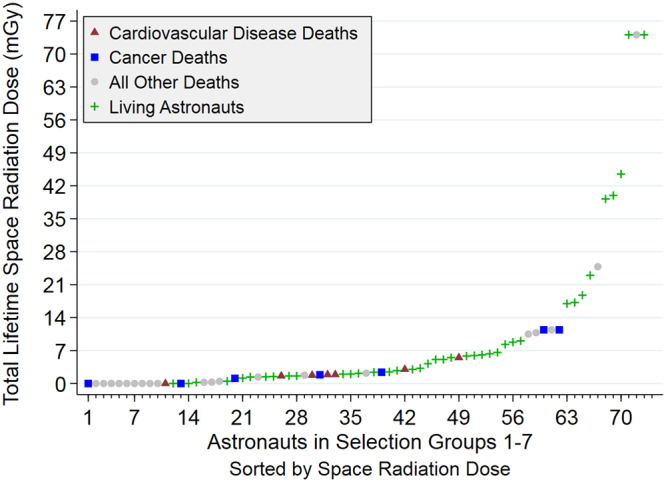
Understanding space radiation health effects is critical due to potential increased morbidity and mortality following spaceflight. We evaluated whether there is evidence for excess cardiovascular disease or cancer mortality in early NASA astronauts and if a correlation exists between space radiation exposure and mortality. Astronauts selected from 1959–1969 were included and followed until death or February 2017, with 39 of 73 individuals still alive at that time. Calculated standardized mortality rates for tested outcomes were significantly below U.S. white male population rates, including all-cardiovascular disease (n = 7, SMR = 33; 95% CI, 14–65) and all-cancer (n = 7, SMR = 43; 95% CI, 18–83), as anticipated in a healthy worker population. Space radiation doses for cohort members ranged from 0–78 mGy. No significant associations between space radiation dose and mortality were found using logistic regression with an internal reference group, adjusting for medical radiation. Statistical power of the logistic regression was <6%, remaining <12% even when expected risk level or observed deaths were assumed to be 10 times higher than currently reported. While no excess radiation-associated cardiovascular or cancer mortality risk was observed, findings must be tempered by the statistical limitations of this cohort; notwithstanding, this small unique cohort provides a foundation for assessment of astronaut health.
Overview
The claims and statistics of this paper haven’t been checked yet.
Free: it reads the open-access text and checks the first 5 claims that cite a source we can check. Create a free account to check every claim.
Integrity signals
Registry
Cites
Statistics
Figures
Verification
Claims the paper makes
The claims and statistics of this paper haven’t been checked yet.
Free: it reads the open-access text and checks the first 5 claims that cite a source we can check. Create a free account to check every claim.
Claims other papers make about this one
Each is checked against this paper’s own text: does it say what the citing paper says it does?
The cited source says what the claim attributes to it.
In the citing paper
“This issue is especially significant in astronaut cohorts because those studies have small sample sizes35.”
From Red risks for a journey to the red planet: The highest priority human health risks for a mission to Mars (2020) · cites this paper as [35]
Self-check
Percentages, sums and reported differences re-computed from the paper’s own numbers.
The self-check needs the paper’s full text.
Citations
Cites
(2005) · Statistics for Biology and Health · doi:10.1007/0-387-27255-0_9 · Cited by 20,133
(1992) · Applied Ergonomics · doi:10.1016/0003-6870(92)90338-v · Cited by 7,112
Risk of Ischemic Heart Disease in Women after Radiotherapy for Breast Cancer
Darby, S. C., Ewertz, M., McGale, P., Bennet, A. M., Blom-Goldman, U., Brønnum, D., Correa, C., Cutter, D., Gagliardi, G., Gigante, B., et al. (2013) · New England Journal of Medicine · doi:10.1056/nejmoa1209825 · Cited by 3,974
Pearce, M. S., Salotti, J. A., Little, M. P., McHugh, K., Lee, C., Kim, K. P., Howe, N. L., Ronckers, C. M., Rajaraman, P., Craft, A. W., et al. (2012) · The Lancet · doi:10.1016/s0140-6736(12)60815-0 · Cited by 3,735
Self-citationMeasurement Error in Nonlinear Models
Carroll, R. J., Ruppert, D., Stefanski, L. A., & Crainiceanu, C. M. (2006) · Chapman & Hall/CRC eBooks · doi:10.1201/9781420010138 · Cited by 2,116
Stewart, F. A., Akleyev, A. V., Hauer-Jensen, M., Hendry, J. H., Kleiman, N. J., MacVittie, T. J., Aleman, B. M., Edgar, A. B., Mabuchi, K., Muirhead, C. R., et al. (2012) · Annals of the ICRP · doi:10.1016/j.icrp.2012.02.001 · Cited by 1,604
Measurement error in nonlinear models: a modern perspective
Carroll, R. J. (2006) · Cited by 1,374
Schervish, M. J. (1995) · Springer Series in Statistics · doi:10.1007/978-1-4612-4250-5 · Cited by 1,046
Ozasa, K., Shimizu, Y., Suyama, A., Kasagi, F., Soda, M., Grant, E. J., Sakata, R., Sugiyama, H., & Kodama, K. (2012) · Radiation Research · doi:10.1667/rr2629.1 · Cited by 882
Heavy ion carcinogenesis and human space exploration
Durante, M., & Cucinotta, F. A. (2008) · Nature Reviews Cancer · doi:10.1038/nrc2391 · Cited by 578
Research works printed but not linked: 2
- McCormack, P. D., Swenberg, C. E. & Bucker, H. Terrestrial Space Radiation and Its Biological Effects. (Springer Science & Business Media 2012).
- Gordis, L. More on causal inferences: bias, confounding, and interaction. Epidemiology 4, 247–264 (2000).
Cited by
Patel, Z. S., Brunstetter, T. J., Tarver, W. J., Whitmire, A. M., Zwart, S. R., Smith, S. M., & Huff, J. L. (2020) · npj Microgravity · doi:10.1038/s41526-020-00124-6 · Cited by 373
Self-citationPatel, S. (2020) · IJC Heart & Vasculature · doi:10.1016/j.ijcha.2020.100595 · Cited by 107
“These differences may be accounted for by higher levels of exposure to components of galactic cosmic rays and solar particle events outside the Earth’s protective magnetosphere [5].”
BackgroundCirculating miRNA Spaceflight Signature Reveals Targets for Countermeasure Development
Malkani, S., Chin, C. R., Cekanaviciute, E., Mortreux, M., Okinula, H., Tarbier, M., Schreurs, A., Shirazi‐Fard, Y., Tahimic, C. G. T., Rodríguez, D. N., et al. (2020) · Cell Reports · doi:10.1016/j.celrep.2020.108448 · Cited by 88
“…responses to the space environment, including bone and muscle atrophy (Burkhart et al., 2019; Gerbaix et al., 2017), immune dysfunction (Baqai et al., 2009), neurobehavioral changes (Ronca et al., 2019), vision impairment (Mader et al., 2011), and cardiovascular damage (Elgart et al., 2018).”
Myocardial Disease and Long-Distance Space Travel: Solving the Radiation Problem
Meerman, M., Gartner, T. C. L. B., Buikema, J. W., Wu, S. M., Siddiqi, S., Bouten, C. V. C., Grande-Allen, K. J., Suyker, W. J. L., & Hjortnaes, J. (2021) · Frontiers in Cardiovascular Medicine · doi:10.3389/fcvm.2021.631985 · Cited by 61
“Besides, another study showed no increased risk of CVD in this group (29).”
BackgroundWhy Human Enhancement is Necessary for Successful Human Deep-space Missions
Szocik, K., & Braddock, M. (2019) · The New Bioethics · doi:10.1080/20502877.2019.1667559 · Cited by 57
“Despite this, the study of early NASA astronauts shows that there is no higher risk of cancer or cardiovascular disease when compared with a non-astronaut cohort (Elgart et al. 2018).”
BackgroundResultWhy space colonization will be fully automated
Campa, R., Szocik, K., & Braddock, M. (2019) · Technological Forecasting and Social Change · doi:10.1016/j.techfore.2019.03.021 · Cited by 63
Cardiovascular disease in space: A systematic review
Krittanawong, C., Isath, A. M., Kaplin, S. L., Virk, H. U. H., Fogg, S. E., Wang, Z., Shepanek, M. A., Scheuring, R. A., & Lavie, C. J. (2023) · Progress in Cardiovascular Diseases · doi:10.1016/j.pcad.2023.07.009 · Cited by 59
Updates to the NASA human system risk management process for space exploration
Antonsen, E., Connell, E., Anton, W., Reynolds, R. J., Buckland, D. M., & Baalen, M. G. V. (2023) · npj Microgravity · doi:10.1038/s41526-023-00305-z · Cited by 57
“Travel outside Earth ’ s magnetic sphere increases the radiation exposure of crews beyond that which has been experienced in low Earth orbit 33,34 .”
A reappraisal of Kartagener's syndrome.
Holmes, L. B., Blennerhassett, J. B., & Austen, K. F. (1968) · PubMed · Cited by 44
Translating current biomedical therapies for long duration, deep space missions
Iosim, S., MacKay, M. J., Westover, C. D., & Mason, C. E. (2019) · Precision Clinical Medicine · doi:10.1093/pcmedi/pbz022 · Cited by 44
“However, a study of former astronauts found no significant correlation between space radiation dose and cardiovascular or cancer-associated mortality.(2) The study recognizes its small sample size and statistical limitations, but it points out that much remains to be learned about long-term outcomes of space radiation…”
BackgroundCancer incidence and mortality in the USA Astronaut Corps, 1959–2017
Reynolds, R. J., Little, M. P., Day, S. M., Charvat, J. M., Blattnig, S. R., Huff, J. L., & Patel, Z. S. (2021) · Occupational and Environmental Medicine · doi:10.1136/oemed-2020-107143 · Cited by 48
Self-citationMiller, K. B., Mi, K. L., Nelson, G. A., Norman, R. B., Patel, Z. S., & Huff, J. L. (2022) · Frontiers in Physiology · doi:10.3389/fphys.2022.1008640 · Cited by 42
Self-citationThe Million Person Study relevance to space exploration and Mars
Boice, J. D. (2022) · International Journal of Radiation Biology · doi:10.1080/09553002.2019.1589020 · Cited by 34
“2016) and not borne out with subsequent study using a more valid methodology (Elgart et al. 2018).”
BackgroundCardiovascular Disease Risk Modeling for Astronauts: Making the Leap From Earth to Space
Huff, J. L., Plante, I., Blattnig, S. R., Norman, R. B., Little, M. P., Khera, A., Simonsen, L. C., & Patel, Z. S. (2022) · Frontiers in Cardiovascular Medicine · doi:10.3389/fcvm.2022.873597 · Cited by 39
“The baseline CVD rates used could be derived directly from certain non-smoking populations (53), alternatively by scaling rates from a standard US population via the known ratio of CVD rates in astronauts and a general US population (54).”
MethodSelf-citationReynolds, R. J., Bukhtiyarov, I. V., Tikhonova, G. I., Day, S. M., Ушаков, И. Б., & Gorchakova, T. Y. (2019) · Scientific Reports · doi:10.1038/s41598-019-44858-0 · Cited by 31
Lau, P., Vico, L., & Rittweger, J. (2022) · Biomedicines · doi:10.3390/biomedicines10020342 · Cited by 33
Consequences of space radiation on the brain and cardiovascular system
Davis, C. M., Allen, A. R., & Bowles, D. E. (2021) · Journal of Environmental Science and Health Part C · doi:10.1080/26896583.2021.1891825 · Cited by 35
“Indeed, in support of Cucinotta, Elgart et al.120 showed reduced risk of all-cause mortality, cancer, and all-cardiovascular disease in early NASA astronauts compared to the U.S. white male population.”
MethodChauhan, V., Hamada, N., Monceau, V., Ebrahimian, T. G., Adam, N., Wilkins, R. C., Sebastian, S., Patel, Z. S., Huff, J. L., Simonetto, C., et al. (2021) · International Journal of Radiation Biology · doi:10.1080/09553002.2021.1969466 · Cited by 34
“It was noted that, although there is no evidence of cardiovascular effects from the relatively short-term space travel experienced by astronaut crews to date (Cucinotta et al. 2016; Ade et al. 2017; Elgart et al. 2018), the risk would be relevant after longer missions to Mars, where astronauts would be exposed to mult…”
BackgroundSelf-citationDose-Effects Models for Space Radiobiology: An Overview on Dose-Effect Relationships
Strigari, L., Strolin, S., MORGANTI, A. G., & Bartoloni, A. (2021) · Frontiers in Public Health · doi:10.3389/fpubh.2021.733337 · Cited by 38
“There is no demonstrated relationship between CVD risk and low-dose cardiac exposures after a space mission, likely due to the statistical limitations of cohorts of astronauts (30) preselected among health subjects with appropriate life habits.”
BackgroundPapadopoulos, A., Kyriakou, I., Incerti, S., Santin, G., Nieminen, P. J., Daglis, I. A., Li, W. B., & Emfietzoglou, D. (2023) · Radiation and Environmental Biophysics · doi:10.1007/s00411-023-01023-6 · Cited by 35
“As a result, the biological concerns from GCRs are mostly carcinogenesis and the degenerative late effects of specific tissues, such as cardiovascular disease (CVD), damage to the Central Nervous System (CNS), and the induction of cataracts (National Council on Radiation Protection and Measurements 2006; Durante and C…”
BackgroundDrago‐Ferrante, R., Fiore, R. D., Karouia, F., Subbannayya, Y., Das, S., Mathyk, B. A., Arif, S., Guevara-Cerdán, A. P., Seylani, A., Galsinh, A. S., et al. (2022) · International Journal of Molecular Sciences · doi:10.3390/ijms23137465 · Cited by 33
Hamada, N. (2023) · Radiation Research · doi:10.1667/rade-23-00030.1 · Cited by 32
“Caution would, however, be needed in interpreting the results (167–169), and a later study actually reported no excess radiation risk for mortality from DCS and cancer in early NASA astronauts (170).”
ResultThe 20th Gray lecture 2019: health and heavy ions
Blakely, E. A. (2020) · British Journal of Radiology · doi:10.1259/bjr.20200172 · Cited by 26
Cancer Studies under Space Conditions: Finding Answers Abroad
Cortés-Sánchez, J. L., Callant, J., Krüger, M., Sahana, J., Kraus, A., Baselet, B., Infanger, M., Baatout, S., & Grimm, D. G. (2021) · Biomedicines · doi:10.3390/biomedicines10010025 · Cited by 25
Late onset cardiovascular dysfunction in adult mice resulting from galactic cosmic ray exposure
Bishawi, M. M., Lee, F. H., Abraham, D., Glass, C., Blocker, S. J., Cox, D. J., Brown, Z. D., Rockman, H. A., Mao, L., Slaba, T. C., et al. (2022) · iScience · doi:10.1016/j.isci.2022.104086 · Cited by 28
Long-term Cardiovascular Risk in Astronauts
Charvat, J. M., Leonard, D. S., Barlow, C. E., DeFina, L. F., Willis, B. L., Lee, S. M. C., Stenger, M. B., Mercaldo, S., & Baalen, M. G. V. (2022) · Mayo Clinic Proceedings · doi:10.1016/j.mayocp.2022.04.003 · Cited by 26
A Historical Survey of Key Epidemiological Studies of Ionizing Radiation Exposure
Little, M. P., Bаzyка, D., de González, A. B., Brenner, A. V., Chumak, V. V., Cullings, H. M., Daniels, R. D., French, B. C., Grant, E. J., Hamada, N., et al. (2024) · Radiation Research · doi:10.1667/rade-24-00021.1 · Cited by 26
Self-citationCardiovascular risk in high-hazard occupations: the role of occupational cardiology
Parsons, I., Nicol, E. D., Holdsworth, D., Guettler, N. J., Rienks, R., Davos, C. H., Halle, M., & Parati, G. (2021) · European Journal of Preventive Cardiology · doi:10.1093/eurjpc/zwab202 · Cited by 25
Melanin protects Cryptococcus neoformans from spaceflight effects
Cordero, R. J. B., Dragotakes, Q., Friello, P. J., & Casadevall, A. (2022) · Environmental Microbiology Reports · doi:10.1111/1758-2229.13078 · Cited by 20
“Beyond Earth’s protective magnetosphere, astronauts travelling to the moon or Mars will be exposed to ionizing radiation for longer periods, which may lead to serious health problems (Delp et al., 2016; Elgart et al., 2018; Patel et al., 2020).”
BackgroundBokhari, R. S., Beheshti, A., Blutt, S. E., Bowles, D. E., Brenner, D., Britton, R. A., Bronk, L. F., Cao, X., Chatterjee, A., Clay, D. E., et al. (2022) · Life Sciences in Space Research · doi:10.1016/j.lssr.2022.08.003 · Cited by 18
Caddy, H. T., Kelsey, L. J., Parker, L. P., GREEN, D. J., & Doyle, B. J. (2024) · npj Microgravity · doi:10.1038/s41526-024-00348-w · Cited by 19
Hoffmann, F., Möstl, S., Luchitskaya, E. S., Funtova, I. I., Jordan, J., Baevsky, R. M., & Tank, J. (2019) · International Journal of Cardiology Hypertension · doi:10.1016/j.ijchy.2019.100013 · Cited by 12
Space Radiation Effects on Crew During and After Deep Space Missions
Straume, T. (2018) · Current Pathobiology Reports · doi:10.1007/s40139-018-0175-9 · Cited by 14
Solar modulation of the GCR flux and dose rate, observed in space between 1991 and 2019
Dachev, T. P., Tomov, B. T., Matviichuk, Y. N., Dimitrov, P. G., Semkova, J., Koleva, R., Jordanova, M. M., Bankov, N. G., Shurshakov, V., & Benghin, V. V. (2020) · Life Sciences in Space Research · doi:10.1016/j.lssr.2020.06.002 · Cited by 17
Kozbenko, T., Adam, N., Grybas, V. S., Smith, B. J., Alomar, D., Hocking, R., Abdelaziz, J., Pace, A., Boerma, M., Azimzadeh, O., et al. (2024) · Environmental and Molecular Mutagenesis · doi:10.1002/em.22636 · Cited by 15
“…missions has received high priority for investigation based on the likelihood of occurrence and potential impact on crew health (Patel et al., 2020), although excess radiation risk has currently not been reported in astronauts (Cucinotta et al., 2016; Elgart et al., 2018; Reynolds & Day, 2017).”
Goukassian, D. A., Arakelyan, A., Brojakowska, A., Bisserier, M., Hakobyan, S., Hadri, L., Rai, A. K., Evans, A. C., Sebastian, A., Truongcao, M. M., et al. (2022) · Clinical and Translational Medicine · doi:10.1002/ctm2.845 · Cited by 12
Hellweg, C. E., Arena, C., Baatout, S., Baselet, B., Beblo‐Vranesevic, K., Caplin, N., Coos, R., Pieve, F. D., Micco, V. D., Foray, N., et al. (2023) · Springer eBooks · doi:10.1007/978-3-031-18810-7_10 · Cited by 18
Dauer, L. T., Mumma, M. T., Lima, J. C., Cohen, S. S., Andresen, D., Bahadori, A. A., Bellamy, M. B., Bierman, D. A., Blattnig, S. R., French, B. C., et al. (2024) · Radiation Research · doi:10.1667/rade-23-00186.1 · Cited by 12
“There are several limitations of the existing data for evaluating neurodegenerative diseases within spaceflight crews, specifically the small number of astronauts who have accumulated relatively high doses and their short follow-up for outcome evaluation ( 86 – 89 ).”
Little, M. P., Boerma, M., Bernier, M., Azizova, T. V., Zablotska, L. B., Einstein, A. J., & Hamada, N. (2024) · BMC Public Health · doi:10.1186/s12889-024-18701-9 · Cited by 13
Self-citationSlim, A. M., Fentanes, E., Cheezum, M. K., Parsons, I., Maroules, C. D., Chen, B., Abbara, S., Branch, K. R., Nagpal, P., Shah, N. R., et al. (2021) · Journal of cardiovascular computed tomography · doi:10.1016/j.jcct.2021.03.010 · Cited by 11
Circulatory disease mortality among male medical radiation workers in South Korea, 1996–2019
Bang, Y. J., Kim, Y. M., & Lee, W. J. (2022) · Scandinavian Journal of Work Environment & Health · doi:10.5271/sjweh.4066 · Cited by 6
“Significant dose–response associations have been observed for cardiovascular disease in Canadian radiation workers (25), and in the International Nuclear Workers Study (INWORKS) of three large national groups of workers in France, the United Kingdom (UK), the United States (US) (26), as well as in the National Registr…”
BackgroundHuman Health in the Lunar Environment
Reynolds, R. J. (2019) · IntechOpen eBooks · doi:10.5772/intechopen.84352 · Cited by 7
Johnson, B. J., Andrews, R. N., Olson, J. D., & Cline, J. M. (2025) · Radiation Research · doi:10.1667/rade-24-00033.1 · Cited by 5
Potential Futures in Human Habitation of Martian Lava Tubes
Mari, N., Groemer, G. E., & Sejkora, N. (2021) · Springer eBooks · doi:10.1007/978-3-030-84103-4_11 · Cited by 5
Chandra, A., & Aswal, D. K. (2023) · MAPAN · doi:10.1007/s12647-023-00710-5 · Cited by 4
“Astronauts operate in a high-dose environment of the order of hundreds of mSv and receive doses of the order of tens of mSv [86], but recent evidence indicates there does not appear to be an elevated cancer risk in this cohort [24, 87].”
Heavy-Ion-Induced Lung Tumors: Dose- & LET-Dependence
Chang, P. Y., Bakke, J. P., Rosen, C. J., Bjornstad, K. A., Mao, J., & Blakely, E. A. (2022) · Life · doi:10.3390/life12060907 · Cited by 3
Mahmood, R., Shaik, T. A., Kaur, I. P., Gupta, V., Shaik, A., Anamika, F., Garg, N., & Jain, R. (2024) · Cardiology in Review · doi:10.1097/crd.0000000000000642 · Cited by 3
Utilizing the Life Span Study data in NASA astronaut cancer risk assessment
Stegeman, L., Slaba, T. C., Huff, J. L., Semones, E., Zawaski, J. A., & Saha, J. (2025) · Carcinogenesis · doi:10.1093/carcin/bgaf076 · Cited by 3
Self-citationHealth impacts of radiation in space and countermeasures
Tasoula, A., Poignant, F., Guarnieri, J. W., Schwertz, H., & Nelson, G. A. (2025) · Elsevier eBooks · doi:10.1016/b978-0-443-32904-3.00034-0 · Cited by 8
Pettinau, F., & Orrù, A. (2026) · Applied Sciences · doi:10.3390/app16041860 · Cited by 3
Radiation induced cardiovascular disease: An odyssey of bedside-bench-bedside approach
Rikhi, R. R., Samra, G. S., Arustamyan, M., Patel, J., Zhou, L., Bungo, B., & Moudgil, R. (2020) · Life Sciences in Space Research · doi:10.1016/j.lssr.2020.07.005 · Cited by 3
Jackson, I., & Martens, P. C. H. (2024) · The Astrophysical Journal Supplement Series · doi:10.3847/1538-4365/ad3fba · Cited by 3
Arterial structure and function in the years after long-duration spaceflight
Lee, S. M. C., Ribeiro, L. C., Martin, D. S., Laurie, S. S., Zwart, S. R., Chen, X., Young, M., Crucian, B. E., Smith, S. M., & Macias, B. R. (2025) · Journal of Applied Physiology · doi:10.1152/japplphysiol.00264.2024 · Cited by 6
Cardiovascular risks and hazards associated with deep space exploration
Brojakowska, A., Bisserier, M., Eskandari, A., Jagana, V., Khlgatian, M. K., Arakelyan, A., Fogarty, J., Kovacic, J. C., & Goukassian, D. A. (2026) · Communications Medicine · doi:10.1038/s43856-026-01728-x · Cited by 2
“One study long-itudinally following astronauts active between 1959 and 1969 ( n = 73) until theprimaryoutcomeofdeathorend ofthestudy (February2017)found no signi fi cant associations between space IR dose and mortality, notwith-standing the statistical limitations of the small cohort 73 .”
Radiation Considerations for Lunar Crews
Elgart, S. R., Blue, R. S., & Stoffle, N. (2022) · Springer eBooks · doi:10.1007/978-3-030-05323-9_4-1 · Cited by 1
Self-citationChappell, L. J., Rahill, K. M., & Elgart, S. R. (2023) · Radiation Research · doi:10.1667/rade-22-00176.1 · Cited by 1
“However, due to the limited number of space travelers to date, no robust epidemiological studies of humans exposed to space radiation exist to support space radiation risk estimates (13).”
BackgroundSelf-citationMuradian, K. K., Tolstun, D. A., Kholin, V. A., Bezrukov, V. V., & Fraifeld, V. E. (2024) · Ageing & Longevity · doi:10.47855/al9020-2024-5-9 · Cited by 1
The space radiation environment and human health risks
Werneth, C. M., & Huff, J. L. (2024) · Elsevier eBooks · doi:10.1016/b978-0-443-22259-7.00010-2 · Cited by 2
Self-citationEfectos adversos de la radiación cósmica en personal aeronáutico: Revisión Sistemática
Ortiz-Ortiz, M. T., Romero-Aguirre, A. C., Morillo, V. O., & Gonzales-Alvarado, F. R. (2023) · Medicina y Seguridad del Trabajo · doi:10.4321/s0465-546x2023000300004 · Cited by 2
Cancer Incidence and Mortality in the U.S. Astronaut Corps, 1959-2017Preprint
Reynolds, R. J., Little, M. P., Day, S. M., Charvat, J. M., Blattnig, S. R., Huff, J. L., & Patel, Z. S. (2020) · doi:10.21203/rs.3.rs-55517/v1 · Cited by 1
Self-citationHuman Health Risks Relevant to Deep Space Mars Exploration Missions
Patel, Z. S., Gibson, C. R., Mader, T. H., Whitmire, A. M., Norcross, J. R., Thompson, M. S., Nemec-Bakk, A. S., Boerma, M., & Huff, J. L. (2023) · American Institute of Aeronautics and Astronautics eBooks · doi:10.2514/5.9781624106545.0487.0542
Self-citationA systematic review of the effects of space and simulated microgravity on dermatologic conditions
Kassels, A. C., Arora, J. S., Sharma, S. N., & Sharma, A. (2024) · JAAD reviews. · doi:10.1016/j.jdrv.2024.05.001
Crew health—Psychological, biological, and medical issues and the need for a systems approach
Shelhamer, M., & Fogarty, J. A. (2024) · Elsevier eBooks · doi:10.1016/b978-0-323-91280-8.00001-0 · Cited by 1
Wang, J., & Sun, F. (2026) · Journal of Alzheimer s Disease · doi:10.1177/13872877261447533
“14,15 IR can be applied as an experimental tool to investigate neuronal DNA damage responses.”
Astronaut life expectancy and the limits of general population comparisons
Reynolds, R. J., & Day, S. M. (2026) · npj Microgravity · doi:10.1038/s41526-026-00620-1
Innovation and the Governance of Outer Space as a Commons
Choi, E., & Rausser, G. C. (2026) · Annual Review of Resource Economics · doi:10.1146/annurev-resource-102025-033558
Metadata
- Authors
- Elgart, S. R., Little, M. P., Chappell, L. J., Milder, C. M., Shavers, M. R., Huff, J. L., & Patel, Z. S.
- Affiliations
- University of Houston (US)
- National Institutes of Health (US)
- Wyle (United States) (US)
- MEI Technologies (United States) (US)
- Corresponding author
- Patel, Zarana S.
- Venue
- Scientific Reports
- Published
- 2018-05-31
- Volume
- 8
- Issue
- 1
- Pages
- 8480-8480
- ISSN
- 2045-2322 (ISSN-L)
- PMC
- PMC5981602
- OpenAlex
- W2805577719
- Cited by
- 66
- References
- 52
- Citations by year
- 2026: 5 · 2025: 4 · 2024: 11 · 2023: 9 · 2022: 12 · 2021: 9 · 2020: 7 · 2019: 7 · 2018: 1
- FWCI
- 4.11
- Type
- journal article
- Language
- en
- Open access
- gold
- doi.org
- Licence
- cc-by
- creativecommons.org/licenses/by/4.0 (tdm)
- creativecommons.org/licenses/by/4.0 (vor)
- Locations
- Scientific Reports (publishedVersion, cc-by)
- Europe PMC (PubMed Central) (publishedVersion, other-oa)
- PubMed Central (publishedVersion, cc-by)
- PubMed (publishedVersion)
- DOAJ (DOAJ: Directory of Open Access Journals) (submittedVersion)
- Funders
- National Aeronautics and Space Administration (NNJ15HK11B)
- National Institutes of Health
- National Cancer Institute
- Topics
- Health Sciences › Medicine › Physiology (medical) › Spaceflight effects on biology
- Health Sciences › Medicine › Radiology, Nuclear Medicine and Imaging › Effects of Radiation Exposure
- Health Sciences › Medicine › Radiology, Nuclear Medicine and Imaging › Radiation Dose and Imaging
- Keywords
- space radiation, astronaut health, cardiovascular mortality, cancer mortality, radiation dose, standardized mortality rate, spaceflight health effects, radiation-induced cancer risk
- MeSH terms
- Radiation Exposure, Cardiovascular Diseases, Cause of Death, Humans, Neoplasms, Radiometry, Risk Factors, Space Flight, United States, Logistic Models, Odds Ratio, Survival Analysis, Astronauts, United States National Aeronautics and Space Administration
About these checks
Registry, retraction, Cites and statistics results are computed, not judged, with one exception: a printed reference that no index lists is read once by a model before it counts as a citation error. Claims are extracted by a model and kept only when their quote appears verbatim in the text; each cited source is then checked, with a model’s help, for whether it says what the claim relies on. Those verdicts can be wrong — read the claim’s quote and the cited source before relying on one.
Statistics and arithmetic are recomputed, not judged.
Confidence bands are shown only for fields calibrated on our annotated test set. None is calibrated yet, so no band is shown.
What counts as a claim ›How we measure confidence ›How we check this ›
Are you an author, or do you see a problem with this page? Request a review
Data sources
Bibliographic data: Semantic Scholar, OpenAlex, Crossref.
Contains information from the Semantic Scholar Academic Graph Datasets, made available under the ODC Attribution License (ODC-BY 1.0).
Semantic Scholar’s data is described in: Kinney, R., et al. (2023). The Semantic Scholar Open Data Platform. arXiv:2301.10140.
