

Anticoagulants impact on innate immune responses and bacterial survival in whole blood models of Neisseria meningitidis infection
Open accessThe DOI matches its Crossref record; 60 of the 60 references it cites were found in a registry or an index.
Abstract
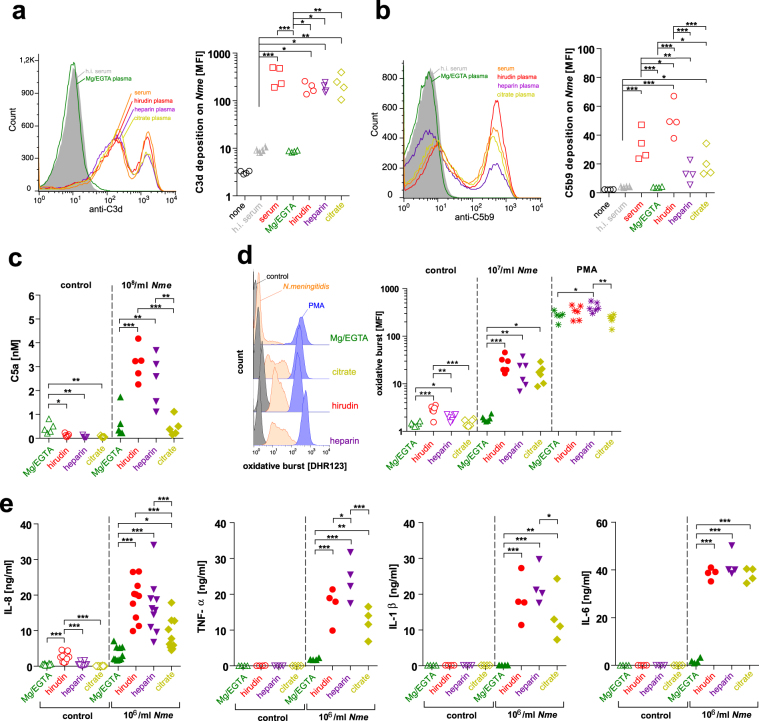
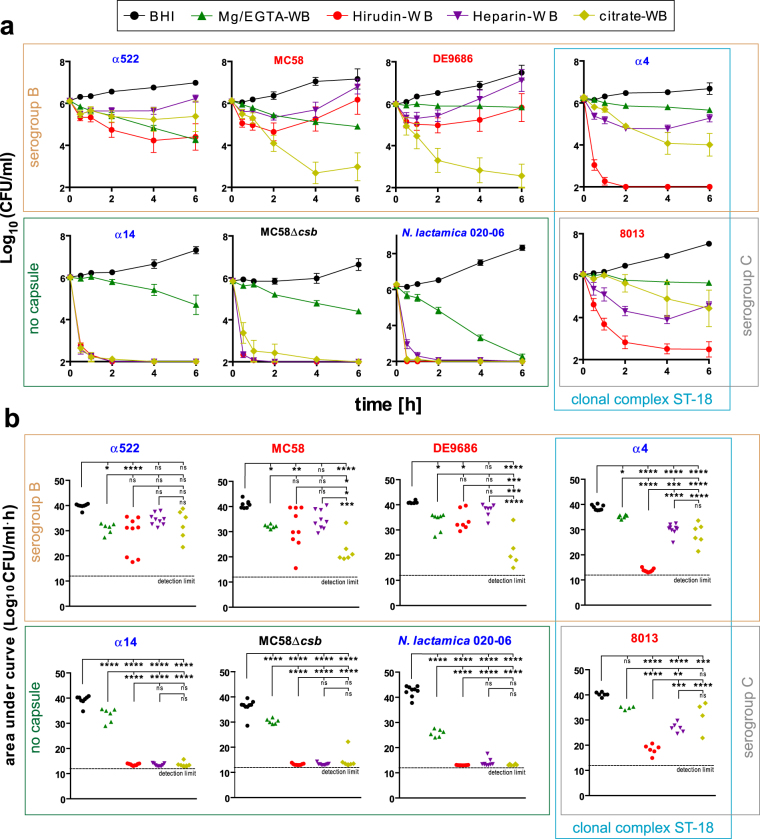
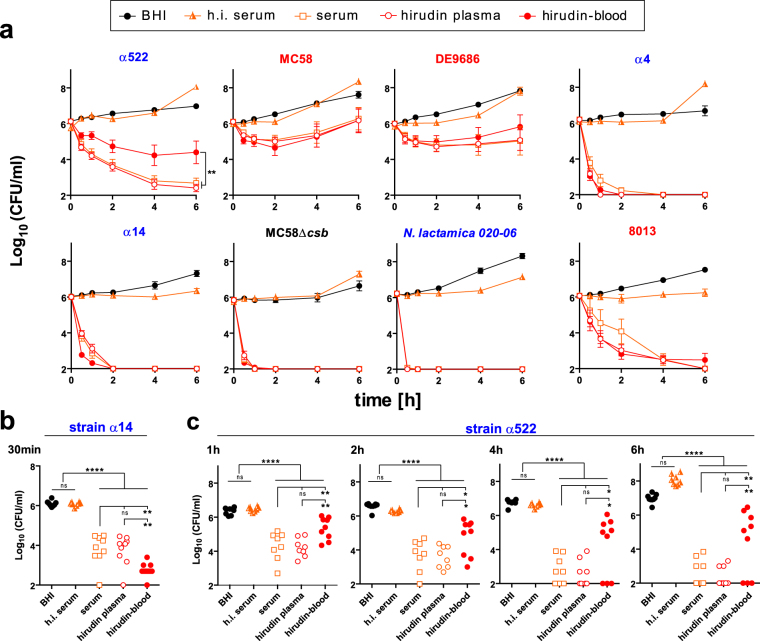
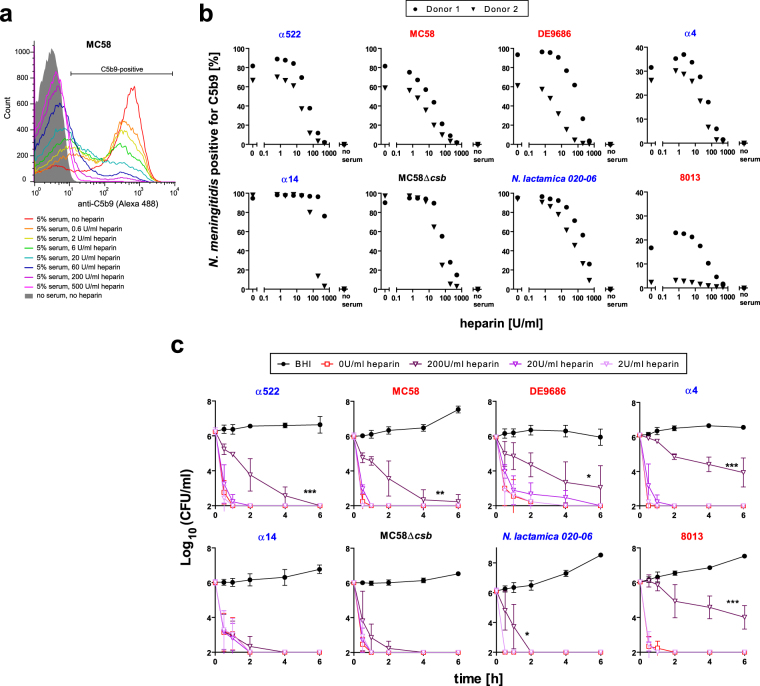
Neisseria meningitidis(meningococcus) causes invasive diseases such as meningitis or septicaemia.Ex vivo infection of human whole blood is a valuable tool to study meningococcal virulence factors and the host innate immune responses. In order to consider effects of cellular mediators, the coagulation cascade must be inhibited to avoid clotting. There is considerable variation in the anticoagulants used among studies of N.meningitidis whole blood infections, featuring citrate, heparin or derivatives of hirudin, a polypeptide from leech saliva. Here, we compare the influence of these three different anticoagulants, and additionally Mg/EGTA, on host innate immune responses as well as on viability of N.meningitidis strains isolated from healthy carriers and disease cases, reflecting different sequence types and capsule phenotypes. We found that the anticoagulants significantly impact on cellular responses and, strain-dependently, also on bacterial survival. Hirudin does not inhibit complement and is therefore superior over the other anticoagulants; indeed hirudin-plasma most closely reflects the characteristics of serum during N.meningitidis infection. We further demonstrate the impact of heparin on complement activation on N.meningitidis and its consequences on meningococcal survival in immune sera, which appears to be independent of the heparin binding antigens Opc and NHBA.
Overview
The claims and statistics of this paper haven’t been checked yet.
Free: it reads the open-access text and checks the first 5 claims that cite a source we can check. Create a free account to check every claim.
Integrity signals
Registry
Cites
Statistics
Figures
Verification
Claims the paper makes
The claims and statistics of this paper haven’t been checked yet.
Free: it reads the open-access text and checks the first 5 claims that cite a source we can check. Create a free account to check every claim.
Claims other papers make about this one
Each is checked against this paper’s own text: does it say what the citing paper says it does?
The source backs part of the claim, not all of it — or backs it for a different population, condition or comparison.
In the citing paper
“although sodium citrate is known to possess some complement inhibitory properties, particularly toward the classical and lectin pathways, its effect on the complement system is less than other anticoagulants such as heparin, EDTA or EGTA (27).”
From Pre-existing humoral immunity and complement pathway contribute to immunogenicity of adeno-associated virus (AAV) vector in human blood (2022) · cites this paper as [27]
Experimental — accuracy not yet measuredThe cited source says what the claim attributes to it.
In the citing paper
“Sodium citrate was chosen because it largely preserves the function of the complement cascade up through C3 cleavage (27).”
From Pre-existing humoral immunity and complement pathway contribute to immunogenicity of adeno-associated virus (AAV) vector in human blood (2022) · cites this paper as [27]
Self-check
Percentages, sums and reported differences re-computed from the paper’s own numbers.
The self-check needs the paper’s full text.
Citations
Cites
Clinical and Experimental Immunology
Kay, H. (1966) · PubMed Central · Cited by 2,177
HUMAN IMMUNITY TO THE MENINGOCOCCUS
Goldschneider, I., Gotschlich, E. C., & Artenstein, M. S. (1969) · The Journal of Experimental Medicine · doi:10.1084/jem.129.6.1327 · Cited by 995
Update on Meningococcal Disease with Emphasis on Pathogenesis and Clinical Management
van Deuren, M., Brandtzaeg, P., & van der Meer, J. W. M. (2000) · Clinical Microbiology Reviews · doi:10.1128/cmr.13.1.144 · Cited by 588
Mollnes, T. E., Brekke, O., Fung, M. S. C., Fure, H., Christiansen, D., Bergseth, G., Videm, V., Lappegård, K. T., Köhl, J., & Lambris, J. D. (2002) · PubMed · doi:10.1182/blood.v100.5.1869.h81702001869_1869_1877 · Cited by 455
Madico, G., Welsch, J. A., Lewis, L. A., McNaughton, A., Perlman, D. H., Costello, C. E., Ngampasutadol, J., Vogel, U., Granoff, D. M., & Ram, S. (2006) · The Journal of Immunology · doi:10.4049/jimmunol.177.1.501 · Cited by 390
Neisseria meningitidis: an overview of the carriage state
Yazdankhah, S. P., & Caugant, D. A. (2004) · Journal of Medical Microbiology · doi:10.1099/jmm.0.45529-0 · Cited by 379
C3 Shunt Activation in Human Serum Chelated with EGTA
Fine, D. P., Marney, S. R., Colley, D. G., Sergent, J. S., & Des Prez, R. M. (1972) · The Journal of Immunology · doi:10.4049/jimmunol.109.4.807 · Cited by 346
Lee, C. J., & Ansell, J. E. (2011) · British Journal of Clinical Pharmacology · doi:10.1111/j.1365-2125.2011.03916.x · Cited by 272
Virji, M., Makepeace, K., Ferguson, D. J. P., Achtman, M., & Moxon, E. R. (1993) · Molecular Microbiology · doi:10.1111/j.1365-2958.1993.tb00922.x · Cited by 263
Meningococcal disease and the complement system
Lewis, L. A., & Ram, S. (2014) · Virulence · doi:10.4161/viru.26515 · Cited by 227
Neisseria meningitidis GNA2132, a heparin-binding protein that induces protective immunity in humans
Serruto, D., Spadafina, T., Ciucchi, L., Lewis, L. A., Ram, S., Tontini, M., Santini, L., Biolchi, A., Seib, K. L., Giuliani, M. M., et al. (2010) · Proceedings of the National Academy of Sciences · doi:10.1073/pnas.0915162107 · Cited by 207
Mollnes, T. E., Garred, P., & Bergseth, G. (1988) · PubMed Central · Cited by 205
Blackmore, T. K., Sadlon, T. A., Ward, H. M., Lublin, D. M., & Gordon, D. L. (1996) · The Journal of Immunology · doi:10.4049/jimmunol.157.12.5422 · Cited by 195
Schreiber, R. D., Pangburn, M. K., Lesavre, P. H., & Müller-Eberhard, H. J. (1978) · Proceedings of the National Academy of Sciences · doi:10.1073/pnas.75.8.3948 · Cited by 174
Achtman, M., Neibert, M., Crowe, B. A., Strittmatter, W., Kusecek, B., Weyse, E., Walsh, M. J., Slawig, B., Morelli, G., & Moll, A. (1988) · The Journal of experimental medicine · doi:10.1084/jem.168.2.507 · Cited by 161
Lewis, L. A., Ngampasutadol, J., Wallace, R., Reid, J. E. A., Vogel, U., & Ram, S. (2010) · PLoS Pathogens · doi:10.1371/journal.ppat.1001027 · Cited by 159
Echenique-Rivera, H., Muzzi, A., Del Tordello, E., Seib, K. L., Francois, P., Rappuoli, R., Pizza, M., & Serruto, D. (2011) · PLoS Pathogens · doi:10.1371/journal.ppat.1002027 · Cited by 148
Pathophysiology of meningococcal meningitis and septicaemia
Pathan, N. (2003) · Archives of Disease in Childhood · doi:10.1136/adc.88.7.601 · Cited by 142
Konar, M., & Granoff, D. M. (2017) · Blood · doi:10.1182/blood-2017-05-781450 · Cited by 128
Neisseria meningitidis producing the Opc adhesin binds epithelial cell proteoglycan receptors
Vries, F. P. D., Cole, R. L., Dankert, J., Frosch, M., & van Putten, J. P. M. (1998) · Molecular Microbiology · doi:10.1046/j.1365-2958.1998.00763.x · Cited by 124
Sprong, T., Brandtzaeg, P., Fung, M. S. C., Pharo, A. M., Høiby, E. A., Michaelsen, T. E., Aase, A., van der Meer, J. W. M., van Deuren, M., & Mollnes, T. E. (2003) · Blood · doi:10.1182/blood-2003-03-0703 · Cited by 103
Transgenic mice expressing human transferrin as a model for meningococcal infection
Zarantonelli, M.-L., Szatanik, M., Giorgini, D., Hong, E., Huerre, M., Guillou, F., Alonso, J.-M., & Taha, M.-K. (2007) · Infection and Immunity · doi:10.1128/iai.00781-07 · Cited by 97
Joseph, B., Schwarz, R. F., Linke, B., Blom, J., Becker, A., Claus, H., Goesmann, A., Frosch, M., Müller, T., Vogel, U. F., et al. (2011) · PLoS ONE · doi:10.1371/journal.pone.0018441 · Cited by 95
Prez, R. M. D., Bryan, C. S., Hawiger, J., & Colley, D. G. (1975) · Infection and Immunity · doi:10.1128/iai.11.6.1235-1243.1975 · Cited by 92
Qualitative and quantitative studies of heparin and chondroitin sulfates in normal human plasma
Volpi, N. (1995) · Biochimica et Biophysica Acta (BBA) - General Subjects · doi:10.1016/0304-4165(94)00123-f · Cited by 88
Serum bactericidal antibody assays – The role of complement in infection and immunity
McIntosh, E. D. G., Bröker, M., Wassil, J., Welsch, J. A., & Borrow, R. (2015) · Vaccine · doi:10.1016/j.vaccine.2015.07.019 · Cited by 84
Plasma Heparin Levels in Normal Man
Engelberg, H., & Dudley, A. (1961) · Circulation · doi:10.1161/01.cir.23.4.578 · Cited by 84
In Vivo Adaptation and Persistence of Neisseria meningitidis within the Nasopharyngeal Mucosa
Johswich, K. O., McCaw, S. E., Islam, E. A., Sintsova, A., Gu, A., Shively, J. E., & Gray‐Owen, S. D. (2013) · PLoS Pathogens · doi:10.1371/journal.ppat.1003509 · Cited by 76
Self-citationLewis, L. A., Carter, M., & Ram, S. (2012) · The Journal of Immunology · doi:10.4049/jimmunol.1103748 · Cited by 71
Agarwal, S., Ferreira, V. P., Cortes, C., Pangburn, M. K., Rice, P. A., & Ram, S. (2010) · The Journal of Immunology · doi:10.4049/jimmunol.0903598 · Cited by 66
Herrmann, J., Muenstermann, M., Strobel, L., Schubert‐Unkmeir, A., Woodruff, T. M., Gray‐Owen, S. D., Klos, A., & Johswich, K. O. (2018) · mBio · doi:10.1128/mbio.01755-17 · Cited by 61
Self-citationBjerre, A., Brusletto, B., Mollnes, T. E., Fritzsønn, E., Rosenqvist, E., Wedege, E., Namork, E., Kierulf, P., & Brandtzæg, P. (2002) · The Journal of Infectious Diseases · doi:10.1086/338269 · Cited by 50
Direct thrombin inhibitors: pharmacology and clinical relevance
Kam, P. C. A., Kaur, N., & Thong, C. L. (2005) · Anaesthesia · doi:10.1111/j.1365-2044.2005.04192.x · Cited by 49
van der Maten, E., de Jonge, M. I., de Groot, R., van der Flier, M., & Langereis, J. D. (2017) · Scientific Reports · doi:10.1038/srep42137 · Cited by 44
Hellerud, B. C., Stenvik, J., Espevik, T., Lambris, J. D., Mollnes, T. E., & Brandtzaeg, P. (2008) · Infection and Immunity · doi:10.1128/iai.00195-08 · Cited by 43
Whole blood model of meningococcal bacteraemia—a method for exploring host-bacterial interactions
ISON, C. A., Heyderman, R. S., Klein, N. J., Peakman, M., & Levin, M. (1995) · Microbial Pathogenesis · doi:10.1016/s0882-4010(95)90093-4 · Cited by 39
Experimental disease models for the assessment of meningococcal vaccines
GORRINGE, A. R., Reddin, K. M., Funnell, S. G. P., Johansson, L., Rytkönen, A., & JONSSON, A. (2005) · Vaccine · doi:10.1016/j.vaccine.2005.01.053 · Cited by 39
Fine, D. P. (1977) · Infection and Immunity · doi:10.1128/iai.16.1.124-128.1977 · Cited by 39
Inhibition of the Classical Pathway of Complement by Meningococcal Capsular Polysaccharides
Agarwal, S., Vasudhev, S., DeOliveira, R. B., & Ram, S. (2014) · The Journal of Immunology · doi:10.4049/jimmunol.1303177 · Cited by 36
Innate immune recognition and inflammation in Neisseria meningitidis infection
Johswich, K. O. (2017) · Pathogens and Disease · doi:10.1093/femspd/ftx022 · Cited by 35
Self-citationLow concentrations of citrate reduce complement and granulocyte activation in vitro in human blood
Huang, S., Sandholm, K., Jonsson, N., Nilsson, A., Wieslander, A. P., Grundström, G., Hancock, V., & Ekdahl, K. N. (2014) · Clinical Kidney Journal · doi:10.1093/ckj/sfu127 · Cited by 34
Klughammer, J., Dittrich, M. T., Blom, J., Mitesser, V., Vogel, U. F., Frosch, M., Goesmann, A., Müller, T., & Schoen, C. U. (2017) · PLoS ONE · doi:10.1371/journal.pone.0169892 · Cited by 34
Experimental meningococcal infection in neonatal animals: models for mucosal invasiveness
Salit, I. E., Melle, E. V., & Tomalty, L. (1984) · Canadian Journal of Microbiology · doi:10.1139/m84-159 · Cited by 32
Tordello, E. D., Bottini, S., Muzzi, A., & Serruto, D. (2012) · Journal of Bacteriology · doi:10.1128/jb.01055-12 · Cited by 29
Øvstebø, R., Hellum, M., Aass, H. C. D., Trøseid, A. M., Brandtzaeg, P., Mollnes, T. E., & Henriksson, C. E. (2014) · Innate Immunity · doi:10.1177/1753425913502099 · Cited by 28
Øvstebø, R., Aass, H. C. D., Haug, K. B. F., Trøseid, A. S., Gopinathan, U., Kierulf, P., Berg, J. P., Brandtzaeg, P., & Henriksson, C. E. (2011) · Innate Immunity · doi:10.1177/1753425911428230 · Cited by 28
Effect of aprotinin on activated clotting time whole blood and plasma heparin measurements
Despotis, G. J., Joist, J. H., Joiner-Maier, D., Alsoufiev, A. L., Triantafillou, A. N., Goodnough, L. T., Santoro, S. A., & Lappas, D. G. (1995) · The Annals of Thoracic Surgery · doi:10.1016/0003-4975(94)00798-c · Cited by 27
Endogenous heparinase-sensitive anticoagulant activity in human plasma
Cavari, S., Stramaccia, L., & Vannucchi, S. (1992) · Thrombosis Research · doi:10.1016/0049-3848(92)90135-w · Cited by 23
Transcriptomic buffering of cryptic genetic variation contributes to meningococcal virulence
Ampattu, B. J., Hagmann, L., Liang, C., Dittrich, M. T., Schlüter, A., Blom, J., Krol, E., Goesmann, A., Becker, A., Dandekar, T., et al. (2017) · BMC Genomics · doi:10.1186/s12864-017-3616-7 · Cited by 23
Influence of Age on Serogroup Distribution of Endemic Meningococcal Disease
Baker, C. J., & Griffiss, J. M. (1983) · PEDIATRICS · doi:10.1542/peds.71.6.923 · Cited by 20
Identification of the immunoproteome of the meningococcus by cell surface immunoprecipitation and MS
Newcombe, J., Mendum, T. A., Cp, R., & McFadden, J. (2013) · Microbiology · doi:10.1099/mic.0.071829-0 · Cited by 17
Heparin therapy in fulminant meningococcemia
Najjar, S. S., & Ahmad, M. N. (1969) · The Journal of Pediatrics · doi:10.1016/s0022-3476(69)80272-6 · Cited by 15
Binding of heparin to human endothelial cell monolayer and extracellular matrix in culture
Psuja, P., Drouet, L. O., & Zawilska, K. (1987) · Thrombosis Research · doi:10.1016/0049-3848(87)90462-2 · Cited by 13
Heparin therapy in meningococcal septicaemia
Hunter, J. (1973) · Archives of Disease in Childhood · doi:10.1136/adc.48.3.233 · Cited by 13
von Papen, M., Oosthuysen, W. F., Becam, J., Claus, H., & Schubert‐Unkmeir, A. (2016) · Infection and Immunity · doi:10.1128/iai.00296-16 · Cited by 13
Impact of Moderate Temperature Changes on Neisseria meningitidis Adhesion Phenotypes and Proteome
Lappann, M., Otto, A., Brauer, M., Becher, D., Vogel, U. F., & Johswich, K. O. (2016) · Infection and Immunity · doi:10.1128/iai.00584-16 · Cited by 12
Self-citationNolte, O., Rickert, A., Ehrhard, I., Ledig, S., & Sonntag, H.-G. (2002) · FEMS Immunology & Medical Microbiology · doi:10.1111/j.1574-695x.2002.tb00539.x · Cited by 11
Aass, H. C. D., Hellum, M., Trøseid, A. S., Brandtzaeg, P., Berg, J. P., Øvstebø, R., & Henriksson, C. E. (2018) · Innate Immunity · doi:10.1177/1753425917749299 · Cited by 10
Hellum, M., Trøseid, A. S., Berg, J. P., Brandtzaeg, P., Øvstebø, R., & Henriksson, C. E. (2016) · Innate Immunity · doi:10.1177/1753425916684201 · Cited by 6
The use of heparin in meningococcal disease.
Oberholzer, D., & Jp, L. (1973) · PubMed · Cited by 1
Research works printed but not linked: 2
- Edens RE Linhardt RJ Weiler JM Heparin is not just an anticoagulant anymore: Six and one-half decades of studies on the ability of heparin to regulate complement activity Complement Profiles 1993 1 96 120
- Delany, I. et al. In Poster presented at 18th international pathogenic Neisseria conference (IPNC) meeting, September 9–14, Würzburg, Germany (2012) Poster013 (2012).
Cited by
Cortellini, A., Tucci, M., Adamo, V., Stucci, L. S., Russo, A., Tanda, E. T., Spagnolo, F., Rastelli, F., Bisonni, R., Santini, D., et al. (2020) · Journal for ImmunoTherapy of Cancer · doi:10.1136/jitc-2020-001361 · Cited by 275
Smith, C. J., Ross, N., Kamal, A., Kim, K. Y., Kropf, E., Deschatelets, P., Francois, C., Quinn, W. J., Singh, I., Majowicz, A., et al. (2022) · Frontiers in Immunology · doi:10.3389/fimmu.2022.999021 · Cited by 86
“The choice of anticoagulant is an important one when studying complement and although sodium citrate is known to possess some complement inhibitory properties, particularly toward the classical and lectin pathways, its effect on the complement system is less than other anticoagulants such as heparin, EDTA or EGTA (27).”
BackgroundPitfalls in complement analysis: A systematic literature review of assessing complement activation
Brandwijk, R. J. M. G. E., Michels, M. A. H. M., van Rossum, M., de Nooijer, A., Nilsson, P. H., de Bruin, W., & Toonen, E. J. M. (2022) · Frontiers in Immunology · doi:10.3389/fimmu.2022.1007102 · Cited by 77
Muenstermann, M., Strobel, L., Klos, A., Wetsel, R. A., Woodruff, T. M., Köhl, J., & Johswich, K. O. (2019) · Virulence · doi:10.1080/21505594.2019.1640035 · Cited by 34
“Hirudin was chosen as anticoagulant since it does not interfere with complement or with Nme viability [50].”
Self-citationChan, C. H. H., Ki, K. K., Zhang, M., Asnicar, C., Cho, H. J., Ainola, C., Bouquet, M., Heinsar, S., Pauls, J. P., Bassi, G. L., et al. (2021) · Membranes · doi:10.3390/membranes11050313 · Cited by 31
Metadata
- Authors
- Strobel, L., & Johswich, K. O.
- Affiliations
- University of Würzburg (DE)
- Corresponding author
- Johswich, Kay O.
- ORCID
- Johswich, Kay O.
- Venue
- Scientific Reports
- Published
- 2018-07-05
- Volume
- 8
- Issue
- 1
- Pages
- 10225-10225
- ISSN
- 2045-2322 (ISSN-L)
- PMC
- PMC6033889
- OpenAlex
- W2809827390
- Cited by
- 37
- References
- 60
- Citations by year
- 2025: 1 · 2024: 3 · 2023: 3 · 2022: 10 · 2021: 5 · 2020: 11 · 2019: 3 · 2018: 1
- FWCI
- 4.04
- Type
- journal article
- Language
- en
- Open access
- gold
- doi.org
- Licence
- cc-by
- creativecommons.org/licenses/by/4.0 (tdm)
- creativecommons.org/licenses/by/4.0 (vor)
- Locations
- Scientific Reports (publishedVersion, cc-by)
- Europe PMC (PubMed Central) (publishedVersion, other-oa)
- PubMed Central (publishedVersion, cc-by)
- PubMed (publishedVersion)
- DOAJ (DOAJ: Directory of Open Access Journals) (submittedVersion)
- Online Publication Service of Würzburg University (Würzburg University) (submittedVersion, cc-by)
- Funders
- Deutsche Forschungsgemeinschaft (JO 1204/2-1)
- Topics
- Life Sciences › Immunology and Microbiology › Microbiology › Bacterial Infections and Vaccines
- Life Sciences › Immunology and Microbiology › Immunology › Complement system in diseases
- Life Sciences › Immunology and Microbiology › Microbiology › Microbial infections and disease research
- Keywords
- Neisseria meningitidis, anticoagulants, hirudin, heparin, citrate, innate immune response, complement activation, bacterial survival, sequence types, NHBA, coagulation cascade
- MeSH terms
- Animals, Anticoagulants, Bacterial Outer Membrane Proteins, Blood Cells, Carrier Proteins, Complement Activation, Heparin, Hirudins, Humans, Immunity, Innate, Meningococcal Infections, Models, Biological, Neisseria meningitidis, Citric Acid, Microbial Viability
About these checks
Registry, retraction, Cites and statistics results are computed, not judged, with one exception: a printed reference that no index lists is read once by a model before it counts as a citation error. Claims are extracted by a model and kept only when their quote appears verbatim in the text; each cited source is then checked, with a model’s help, for whether it says what the claim relies on. Those verdicts can be wrong — read the claim’s quote and the cited source before relying on one.
Statistics and arithmetic are recomputed, not judged.
Confidence bands are shown only for fields calibrated on our annotated test set. None is calibrated yet, so no band is shown.
What counts as a claim ›How we measure confidence ›How we check this ›
Are you an author, or do you see a problem with this page? Request a review
Data sources
Bibliographic data: Semantic Scholar, OpenAlex, Crossref.
Contains information from the Semantic Scholar Academic Graph Datasets, made available under the ODC Attribution License (ODC-BY 1.0).
Semantic Scholar’s data is described in: Kinney, R., et al. (2023). The Semantic Scholar Open Data Platform. arXiv:2301.10140.
