

The DOI matches its Crossref record; 19 of the 19 references it cites were found in a registry or an index.
Scalable Memdiodes Exhibiting Rectification and Hysteresis for Neuromorphic Computing
Open accessAbstract
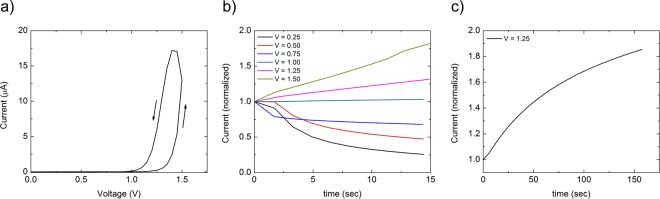
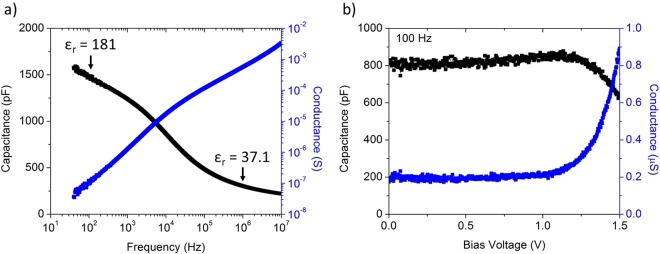
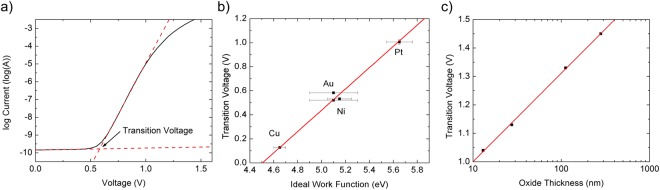
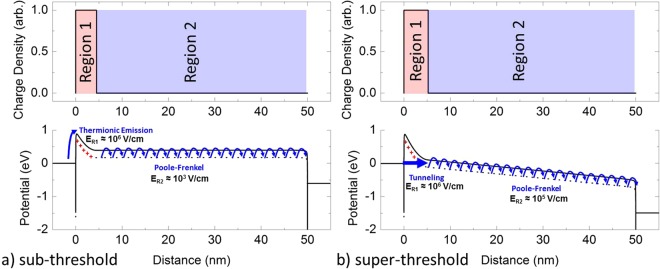
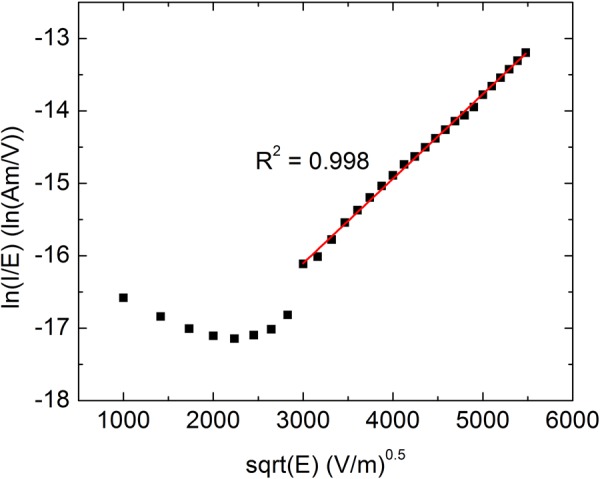
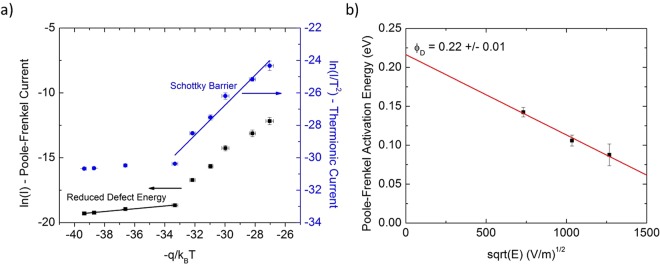
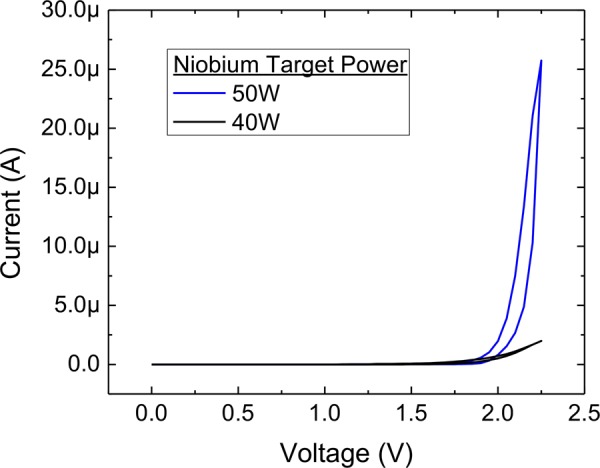
Metal-Nb 2 O 5−x-metal memdiodes exhibiting rectification, hysteresis, and capacitance are demonstrated for applications in neuromorphic circuitry. These devices do not require any post-fabrication treatments such as filament creation by electroforming that would impede circuit scalability. Instead these devices operate due to Poole-Frenkel defect controlled transport where the high defect density is inherent to the Nb 2 O 5−x deposition rather than post-fabrication treatments. Temperature dependent measurements reveal that the dominant trap energy is 0.22 eV suggesting it results from the oxygen deficiencies in the amorphous Nb 2 O 5−x. Rectification occurs due to a transition from thermionic emission to tunneling current and is present even in thick devices (>100 nm) due to charge trapping which controls the tunneling distance. The turn-on voltage is linearly proportional to the Schottky barrier height and, in contrast to traditional metal-insulator-metal diodes, is logarithmically proportional to the device thickness. Hysteresis in the I–V curve occurs due to the current limited filling of traps.
Overview
The claims and statistics of this paper haven’t been checked yet.
Run the check — free, no account needed. It reads the open-access text and checks the sources it cites.
Integrity signals
Registry
Cites
Statistics
Figures
Verification
Claims the paper makes
The claims and statistics of this paper haven’t been checked yet.
Run the check — free, no account needed. It reads the open-access text and checks the sources it cites.
Claims other papers make about this one
Each is checked against this paper’s own text: does it say what the citing paper says it does?
The source backs part of the claim, not all of it — or backs it for a different population, condition or comparison.
In the citing paper
“The shallow trap levels assist fluent carrier injection via Poole‐Frenkel (P‐F) emission.[ 32 ]”
From Retention Secured Nonlinear and Self-Rectifying Analog Charge Trap Memristor for Energy-Efficient Neuromorphic Hardware (2023) · cites this paper as [32]
Experimental — accuracy not yet measured
Self-check
Percentages, sums and reported differences re-computed from the paper’s own numbers.
The self-check needs the paper’s full text.
Citations
Cites
Physics of Semiconductor Devices
Colinge, J.-P., & Colinge, C. (2002) · Kluwer Academic Publishers eBooks · doi:10.1007/b117561 · Cited by 14,074
Neuromorphic electronic systems
Mead, C. (1990) · Proceedings of the IEEE · doi:10.1109/5.58356 · Cited by 2,368
Neuromorphic Silicon Neuron Circuits
Indiveri, G., Linares-Barranco, B., Hamilton, T. J., André, V. S., Etienne‐Cummings, R., Delbrück, T., Liu, S., Dudek, P., Hafliger, P. D., Renaud, S., et al. (2011) · Frontiers in Neuroscience · doi:10.3389/fnins.2011.00073 · Cited by 1,836
A scalable neuristor built with Mott memristors
Pickett, M. D., Medeiros‐Ribeiro, G., & Williams, R. S. (2012) · Nature Materials · doi:10.1038/nmat3510 · Cited by 1,046
Electrophysiological properties of neocortical neurons in vitro.
Connors, B. W., Gutnick, M., & Prince, D. (1982) · Journal of Neurophysiology · doi:10.1152/jn.1982.48.6.1302 · Cited by 954
On Spike-Timing-Dependent-Plasticity, Memristive Devices, and Building a Self-Learning Visual Cortex
Zamarreño-Ramos, C., Camuñas-Mesa, L. A., Pérez‐Carrasco, J. A., Masquelier, T., Serrano‐Gotarredona, T., & Linares-Barranco, B. (2011) · Frontiers in Neuroscience · doi:10.3389/fnins.2011.00026 · Cited by 564
Aegerter, M. A. (2001) · Solar Energy Materials and Solar Cells · doi:10.1016/s0927-0248(00)00372-x · Cited by 210
An accurate locally active memristor model for S-type negative differential resistance in NbOx
Gibson, G. A., Musunuru, S., Zhang, J., Vandenberghe, K., Lee, J., Hsieh, C., Jackson, W. B., Jeon, Y., Henze, D., Li, Z., et al. (2016) · Applied Physics Letters · doi:10.1063/1.4939913 · Cited by 209
Work functions of elements expressed in terms of the Fermi energy and the density of free electrons
Hałas, S., & Durakiewicz, T. (1998) · Journal of Physics Condensed Matter · doi:10.1088/0953-8984/10/48/005 · Cited by 201
Physical model of threshold switching in NbO 2 based memristors
Slesazeck, S., Mähne, H., Wylezich, H., Wachowiak, A., Radhakrishnan, J., Ascoli, A., Tetzlaff, R., & Mikolajick, T. (2015) · RSC Advances · doi:10.1039/c5ra19300a · Cited by 168
Cited by
Sorted by citations
Hosen, A., Mian, M. S., & Ahmed, S. R. A. (2023) · Advanced Theory and Simulations · doi:10.1002/adts.202200652 · Cited by 79
Kim, G., Son, S., Song, H., Jeon, J. B., Lee, J., Cheong, W. H., Choi, S., & Kim, K. M. (2023) · Advanced Science · doi:10.1002/advs.202205654 · Cited by 72
Weissbach, A., Bongartz, L. M., Cucchi, M., Tseng, H., Leo, K., & Kleemann, H. (2022) · Journal of Materials Chemistry C · doi:10.1039/d1tc04230k · Cited by 73
Building Brain-Inspired Logic Circuits from Dynamically Switchable Transition-Metal Oxides
Andrews, J. L., Santos, D. A., Meyyappan, M., Williams, R. S., & Banerjee, S. (2019) · Trends in Chemistry · doi:10.1016/j.trechm.2019.07.005 · Cited by 71
Structural Phase Transitions of NbO 2 : Bulk versus Surface
Fajardo, G. J. P., Howard, S. A., Evlyukhin, E., Wahila, M. J., Mondal, W. R., Zuba, M. J., Boschker, J. E., Paik, H., Schlom, D. G., Sadowski, J. T., et al. (2021) · Chemistry of Materials · doi:10.1021/acs.chemmater.0c04566 · Cited by 35
Self-citation
Metadata
- Authors
- Shank, J. C., Tellekamp, M. B., Wahila, M. J., Howard, S., Weidenbach, A. S., Zivasatienraj, B., Piper, L. F. J., & Doolittle, W. A.
- Affiliations
- Georgia Institute of Technology (US)
- Binghamton University (US)
- Corresponding author
- Doolittle, W. Alan
- ORCID
- Venue
- Scientific Reports
- Published
- 2018-08-28
- Volume
- 8
- Issue
- 1
- Pages
- 12935-12935
- ISSN
- 2045-2322 (ISSN-L)
- PMC
- PMC6113211
- OpenAlex
- W2888632952
- Cited by
- 29
- References
- 19
- Citations by year
- 2026: 3 · 2025: 5 · 2024: 2 · 2023: 4 · 2022: 6 · 2021: 3 · 2019: 6
- FWCI
- 0.86
- Type
- journal article
- Language
- en
- Open access
- gold
- doi.org
- Locations
- Scientific Reports (publishedVersion, cc-by)
- Europe PMC (PubMed Central) (publishedVersion, other-oa)
- PubMed Central (publishedVersion, cc-by)
- PubMed (publishedVersion)
- arXiv (Cornell University) (submittedVersion)
- DOAJ (DOAJ: Directory of Open Access Journals) (submittedVersion)
- arXiv (Cornell University)
- Funders
- Diamond Light Source
- Defense Threat Reduction Agency (HDTRA1-12-1-0031)
- Air Force Office of Scientific Research (FA9550-, FA9550-18–1-0024)
- Topics
- Physical Sciences › Engineering › Electrical and Electronic Engineering › Advanced Memory and Neural Computing
- Physical Sciences › Engineering › Electrical and Electronic Engineering › Ferroelectric and Negative Capacitance Devices
- Physical Sciences › Engineering › Electrical and Electronic Engineering › Semiconductor materials and devices
- Keywords
- memristors, Nb2O5, metal-insulator-metal devices, rectification, hysteresis, charge trapping, Poole-Frenkel effect, oxygen vacancies, thermionic emission, tunneling current, Schottky barrier height, neuromorphic computing, amorphous metal oxides
About these checks
Registry, retraction, Cites and statistics results are computed, not judged, with one exception: a printed reference that no index lists is read once by a model before it counts as a citation error. Claims are extracted by a model and kept only when their quote appears verbatim in the text; each cited source is then checked, with a model’s help, for whether it says what the claim relies on. Those verdicts can be wrong — read the claim’s quote and the cited source before relying on one.
Statistics and arithmetic are recomputed, not judged.
Confidence bands are shown only for fields calibrated on our annotated test set. None is calibrated yet, so no band is shown.
What counts as a claim ›How we measure confidence ›How we check this ›
Are you an author, or do you see a problem with this page? Request a review
How to cite
Cite CoChat for the checks on this page, and the paper for its own findings.
- This page
- CoChat. (2026). Citation check: Scalable Memdiodes Exhibiting Rectification and Hysteresis for Neuromorphic Computing. https://app.cochat.ai/papers/10.1038/s41598-018-30727-9
- The paper
- Shank, J. C., Tellekamp, M. B., Wahila, M. J., Howard, S., Weidenbach, A. S., Zivasatienraj, B., Piper, L. F. J., & Doolittle, W. A. (2018). Scalable Memdiodes Exhibiting Rectification and Hysteresis for Neuromorphic Computing. Scientific Reports. https://doi.org/10.1038/s41598-018-30727-9
