

The DOI matches its Crossref record; 96 of the 96 references it cites were found in a registry or an index.
Menstrual cycle rhythmicity: metabolic patterns in healthy women
Open accessAbstract
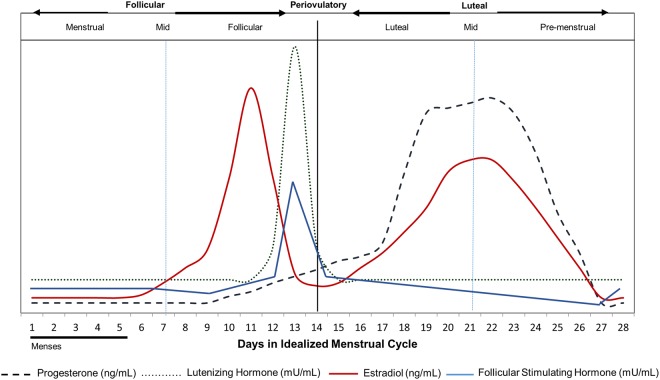
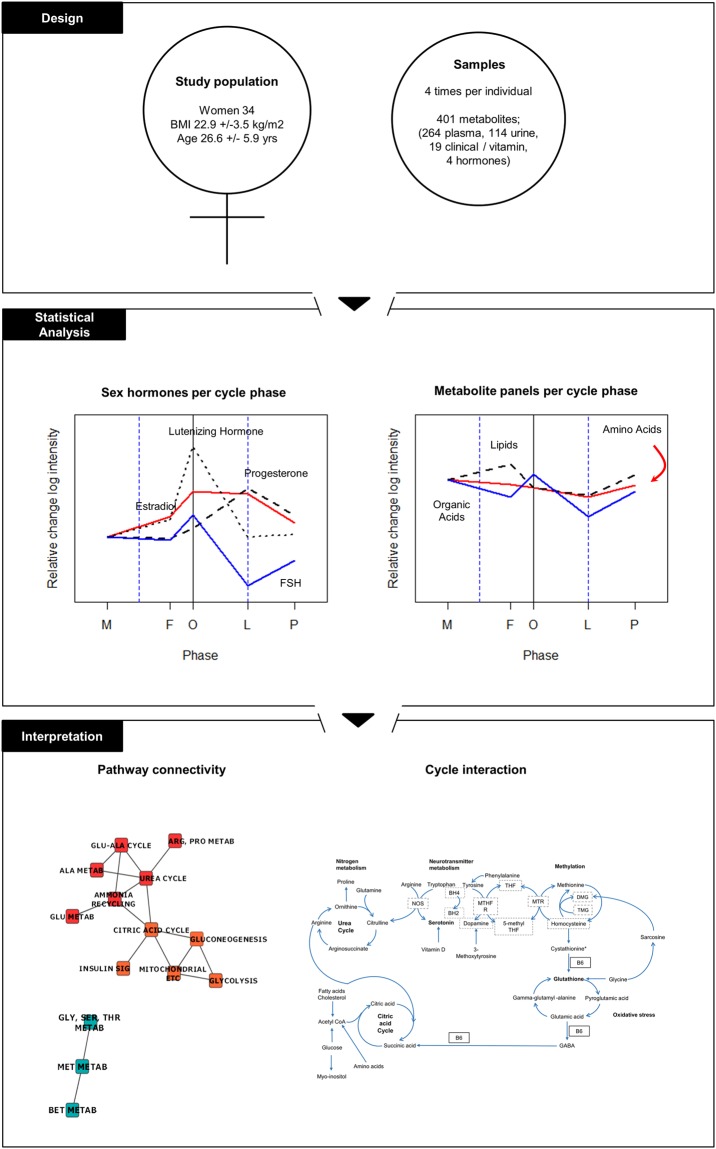
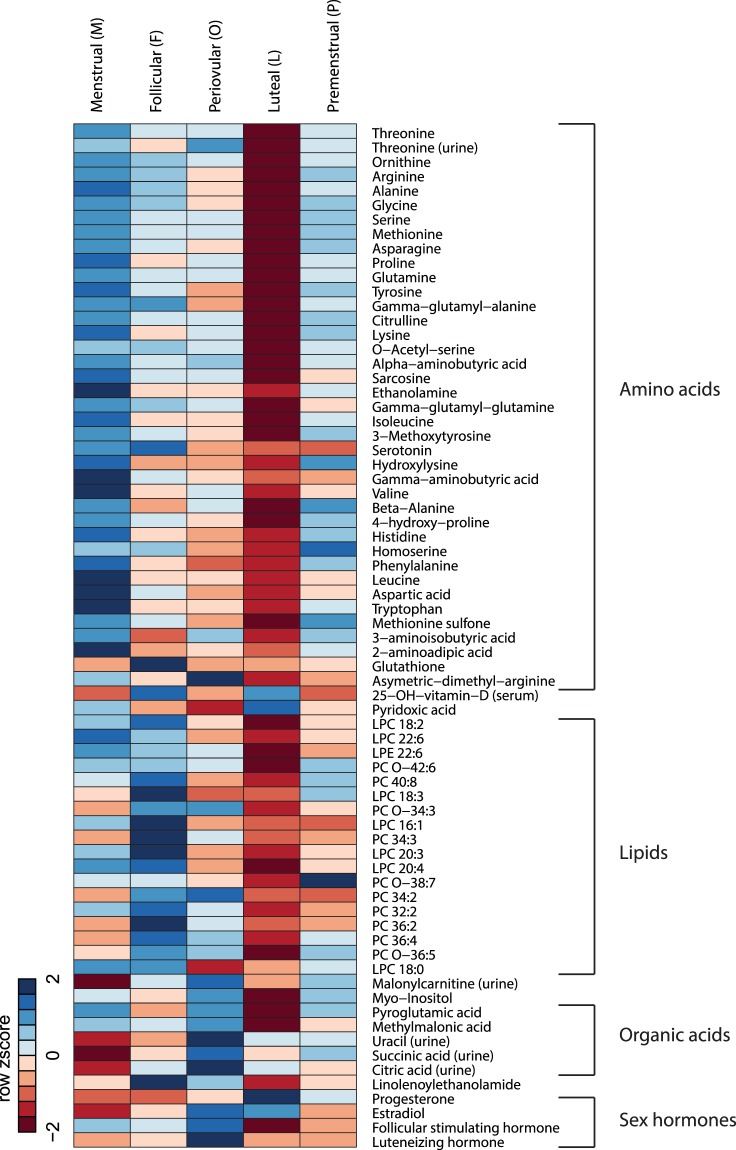
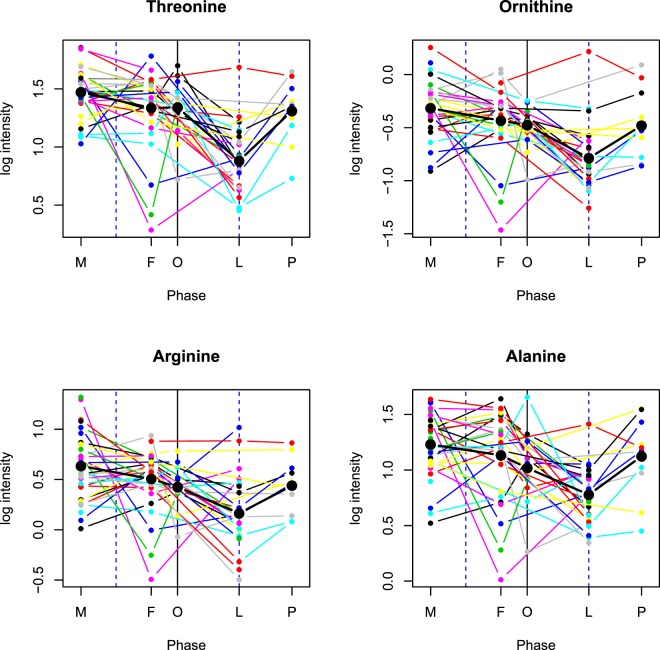
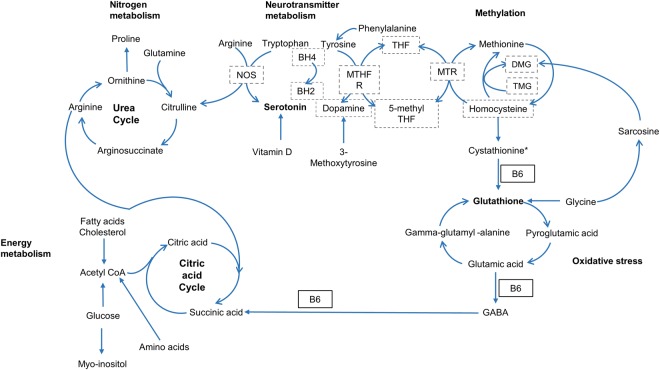
The menstrual cycle is an essential life rhythm governed by interacting levels of progesterone, estradiol, follicular stimulating, and luteinizing hormones. To study metabolic changes, biofluids were collected at four timepoints in the menstrual cycle from 34 healthy, premenopausal women. Serum hormones, urinary luteinizing hormone and self-reported menstrual cycle timing were used for a 5-phase cycle classification. Plasma and urine were analyzed using LC-MS and GC-MS for metabolomics and lipidomics; serum for clinical chemistries; and plasma for B vitamins using HPLC-FLD. Of 397 metabolites and micronutrients tested, 208 were significantly (p < 0.05) changed and 71 reached the FDR 0.20 threshold showing rhythmicity in neurotransmitter precursors, glutathione metabolism, the urea cycle, 4-pyridoxic acid, and 25-OH vitamin D. In total, 39 amino acids and derivatives and 18 lipid species decreased (FDR < 0.20) in the luteal phase, possibly indicative of an anabolic state during the progesterone peak and recovery during menstruation and the follicular phase. The reduced metabolite levels observed may represent a time of vulnerability to hormone related health issues such as PMS and PMDD, in the setting of a healthy, rhythmic state. These results provide a foundation for further research on cyclic differences in nutrient-related metabolites and may form the basis of novel nutrition strategies for women.
Overview
The claims and statistics of this paper haven’t been checked yet.
Run the check — free, no account needed. It reads the open-access text and checks the sources it cites.
Integrity signals
Registry
Cites
Statistics
Figures
Verification
Claims the paper makes
The claims and statistics of this paper haven’t been checked yet.
Run the check — free, no account needed. It reads the open-access text and checks the sources it cites.
Claims other papers make about this one
Each is checked against this paper’s own text: does it say what the citing paper says it does?
The cited source doesn’t support the claim as written.
In the citing paper
“functions catabolically to increase amino acid oxidation and decreases muscle protein synthesis [78–81]”
From International society of sports nutrition position stand: nutritional concerns of the female athlete (2023) · cites this paper as [78]
Checked by a reasoning model — may be wrong.
Experimental — accuracy not yet measuredThe source backs part of the claim, not all of it — or backs it for a different population, condition or comparison.
In the citing paper
“Similarly, metabolic function is coordinated with the menstrual cycle to ensure optimal physiological conditions for fertilization, implantation, pregnancy, parturition and lactation [71].”
From Polycystic Ovary Syndrome: An Evolutionary Adaptation to Lifestyle and the Environment (2022) · cites this paper as [71]
Experimental — accuracy not yet measuredIn the citing paper
“In the menstrual cycle, pituitary gonadotropins (follicle-stimulating and luteinizing hormones) and ovarian hormones (estrogen and progesterone) show infradian rhythmicity ( Figure 3 ) [ 87 , 88 ].”
From Physiological Rhythms and Biological Variation of Biomolecules: The Road to Personalized Laboratory Medicine (2023) · cites this paper as [88]
Self-check
Percentages, sums and reported differences re-computed from the paper’s own numbers.
The self-check needs the paper’s full text.
Citations
Cites
2 retracted
RETRACTED: Contribution of myo-inositol and melatonin to human reproduction
Carlomagno, G., Nordio, M., Chiu, T. T. Y., & Unfer, V. (2011) · European Journal of Obstetrics & Gynecology and Reproductive Biology · doi:10.1016/j.ejogrb.2011.07.038 · Cited by 84
RetractedSohrabi, N., Kashanian, M., Ghafoori, S. S., & Malakouti, S. K. (2013) · Complementary Therapies in Medicine · doi:10.1016/j.ctim.2012.12.008 · Cited by 41
RetractedControlling the False Discovery Rate: A Practical and Powerful Approach to Multiple Testing
Benjamini, Y., & Hochberg, Y. (1995) · Journal of the Royal Statistical Society Series B: Statistical Methodology · doi:10.1111/j.2517-6161.1995.tb02031.x · Cited by 109,482
Fitting Linear Mixed-Effects Models Using lme4
Bates, D., Mächler, M., Bolker, B., & Walker, S. (2015) · Journal of Statistical Software · doi:10.18637/jss.v067.i01 · Cited by 86,835
Simultaneous Inference in General Parametric Models
Hothorn, T., Bretz, F., & Westfall, P. H. (2008) · Biometrical Journal · doi:10.1002/bimj.200810425 · Cited by 14,265
KEGG: new perspectives on genomes, pathways, diseases and drugs
Kanehisa, M., Furumichi, M., Tanabe, M., Sato, Y., & Morishima, K. (2017) · Nucleic Acids Research · doi:10.1093/nar/gkw1092 · Cited by 8,865
Huber, M., Knottnerus, J. A., Green, L., van der Horst, H. E., Jadad, A. R., Kromhout, D., Leonard, B. E., Lorig, K. R., Loureiro, I., Meer, J. W. M. V. D., et al. (2011) · BMJ · doi:10.1136/bmj.d4163 · Cited by 2,983
Diagnostic Checking in Regression Relationships
Zeileis, A., & Hothorn, T. (2015) · WU Research · Cited by 1,814
Peters, F. T., Drummer, O. H., & Mußhoff, F. (2006) · Forensic Science International · doi:10.1016/j.forsciint.2006.05.021 · Cited by 1,347
Synchronization and rhythmic processes in physiology
Glass, L. (2001) · Nature · doi:10.1038/35065745 · Cited by 1,329
Research works printed but not linked: 3
- Strauss, J. F. B. & Robert L. Yen & Jaffe’s Reproductive Endocrinology: Physiology, Pathophysiology, and Clinical Management, Seventh Edition. (Saunders, 2014).
- Voet, D. E. A. Biochemistry. Second edn, 1272 (John Wiley & Sons, 1995).
- McCullogh, C. E., Searle, S. R. & Neuhaus, J. M. Generalized, linear, and mixed models, 2nd Edition. 157–187 (John Wiley & Sons, 2008).
Cited by
Sorted by citations
Items 201–224 of 224
MacGregor, K. A., Ho, F. K., Celis-Morales, C. A., Pell, J. P., Gallagher, I. J., & Moran, C. N. (2024) · Figshare · doi:10.6084/m9.figshare.24779404
Yazdanpanah, M., Yazdanpanah, N., Gamache, I., Ong, K. K., Perry, J. R. B., & Manousaki, D. (2024) · Figshare · doi:10.6084/m9.figshare.25910090
Wohlgemuth, K. J., Arieta, L. R., Brewer, G. J., Hoselton, A. L., Gould, L. M., & Smith‐Ryan, A. E. (2021) · Figshare · doi:10.6084/m9.figshare.14431715
Apicella, M. C. A., Pavis, G. F., Abdelrahman, D. R., Murton, A. J., Alamdari, N., Dirks, M. L., Wall, B. T., & Stephens, F. B. (2025) · The Journal of Nutritional Physiology · doi:10.1016/j.jnphys.2025.100014
Plant, K., Howard, C., Bourdon, P., Massarotto, R. J., Gamu, D., Gibson, W. T., Stöckler, S., Brunel‐Guitton, C., & Elango, R. (2025) · Molecular Genetics and Metabolism · doi:10.1016/j.ymgme.2025.109714
Matsuda, S., Kotani, T., Kuwabara, H., Oe, K., Yamamoto, M., Okazaki, A., Kiboshi, T., Suzuka, T., Wada, Y., Shoda, T., et al. (2025) · Arthritis Research & Therapy · doi:10.1186/s13075-025-03718-1
Haigh, F. A., Monteyne, A. J., Abdelrahman, D. R., Murton, A. J., Finnigan, T. J. A., Theobald, H. E., Stephens, F. B., & Wall, B. T. (2026) · American Journal of Clinical Nutrition · doi:10.1016/j.ajcnut.2026.101231
Anıl, B., Akdemir, E., & Yilmaz, A. F. (2026) · Chronobiology International · doi:10.1080/07420528.2026.2643808
Korol, T., Gnatchuk, I. Y., Bychkova, S. V., & Ikkert, O. (2026) · Experimental and Clinical Physiology and Biochemistry · doi:10.25040/ecpb2025.04.020
Pocate-Cheriet, K. (2020) · theses.fr (ABES) · doi:10.70675/8a1fbb23z175dz4bbcz8427z6f4af93f23d1
Essays on the Interplay of Body and Brain in Social Decision-Making and Self-Control
Falkenstein, M. (2023) · theses.fr (ABES) · doi:10.70675/319893e7zbe5az43b6z89c9z28dbe64f095b
Cabre, H. E., Hirsch, K. R., Moore, S. R., & Smith‐Ryan, A. E. (2026) · Applied Physiology, Nutrition, and Metabolism · doi:10.1139/apnm-2025-0411
Trynkiewicz, W., Stepinska, M., Omiecińska, M., Maciejewska, A., Kaczor, M., Rybka, Z., Żak, J., Lenkiewicz, E., Dąbrowska, K., & Winiarczyk, J. (2026) · International Journal of Innovative Technologies in Social Science · doi:10.31435/ijitss.2(50).2026.5248
Yurkovich, J. T., Glass, E. M., Levine, N., Lee, S., Ehlen, K., Hernandez, E., Gharti, P., Fernando, A., Witherington, D., Pflieger, L. T., et al. (2026) · medRxiv · doi:10.64898/2026.05.14.26353203
Menstrual cycle and athletic performance: a systematic review and meta-analysis
SILVA, A. B. D. A., de Assis, G. G., Ribeiro, T. D., Peralta, M., Marques, A., Trybulski, R., Grzywacz, T., Sawicki, P., & Gonçalves, C. (2026) · Human Movement · doi:10.5114/hm/216984
DMN function changes on resting state fMRI in perimenopausal women
Liu, N., Zhang, Y., Fu, W., & Liu, H. (2026) · Open Medicine · doi:10.1515/med-2026-1455
Neuroendocrine influences on dynamic cerebrovascular function and implications for functional MRIPreprint
Wright, M. E., Driver, I. D., Crofts, C., Davies, S., Steventon, J. J., Schwarzkopf, D. S., & Murphy, K. (2026) · bioRxiv (Cold Spring Harbor Laboratory) · doi:10.64898/2026.06.06.729907
Dabbs, N. C., Binkley, H. M., Bott, C., Fragala, M. R., Herda, A. A., Moeskops, S., Moore, E. W. G., Smith‐Ryan, A. E., & Triplett, N. T. (2026) · The Journal of Strength and Conditioning Research · doi:10.1519/jsc.0000000000005544
Adölesanlarda Menstrüel Anormalliklerin Yaygınlığı, İlişkili Faktörler ve Yaşam Kalitesi
Aksu, A., Töre, F. K., Katkaya, K., & Sönmez, M. (2026) · Turkish Journal of Family Medicine & Primary Care · doi:10.21763/tjfmpc.1965333
THE INFLUENCE OF MENSTRUAL CYCLE PHASES ON ATHLETIC PERFORMANCE IN WOMEN
Stępień, A., Skrzypek, J., Niewiadomska, J., Paluch, A., Bondos, B., Fussek, Ł., Lee, K., Czerny, I., Daniszewski, S., & Krajewski, M. (2026) · International Journal of Innovative Technologies in Social Science · doi:10.31435/ijitss.2(50).2026.5641
Posterior Tibial Tendon Dysfunction in Women
Burapachaisri, A., Wadley, D., & Kelly, M. (2026) · Foot and Ankle Clinics · doi:10.1016/j.fcl.2026.06.011
Reul, P., Schweda, S., Schmidt, J., Janzen, N., Niess, A. M., Krauß, I., & Munz, B. (2026) · Obesities · doi:10.3390/obesities6050074
Yurkovich, J. T., Glass, E., Nash, A. N., Levine, N., Lee, S., Ehlen, K., Hernandez, E., Gharti, P., Senadheera, C., Fernando, A., et al. (2026) · Frontiers in Digital Health · doi:10.3389/fdgth.2026.1881042
Metadata
- Authors
- Draper, C. F., Duisters, K., Weger, B., Chakrabarti, A., Harms, A. C., Brennan, L., Hankemeier, T., Goulet, L., Konz, T., Martin, F. P., Moco, S., & van der Greef, J.
- Affiliations
- Leiden University (NL)
- University College Dublin (IE)
- Corresponding author
- Draper, C. F.
- ORCID
- Venue
- Scientific Reports
- Published
- 2018-10-01
- Volume
- 8
- Issue
- 1
- Pages
- 14568-14568
- ISSN
- 2045-2322 (ISSN-L)
- PMC
- PMC6167362
- OpenAlex
- W2893363828
- Cited by
- 221
- References
- 96
- Citations by year
- 2026: 27 · 2025: 35 · 2024: 37 · 2023: 43 · 2022: 30 · 2021: 26 · 2020: 17 · 2019: 5 · 2018: 1
- FWCI
- 4.36
- Type
- journal article
- Language
- en
- Update notices
- correction (2019-04-03)
- Open access
- gold
- doi.org
- Locations
- Scientific Reports (publishedVersion, cc-by)
- Europe PMC (PubMed Central) (publishedVersion, cc-by)
- PubMed Central (publishedVersion, cc-by)
- PubMed (publishedVersion)
- Leiden Repository (Leiden University) (submittedVersion)
- Data Archiving and Networked Services (DANS) (submittedVersion, other-oa)
- DOAJ (DOAJ: Directory of Open Access Journals) (submittedVersion)
- Funders
- University College Dublin
- Universiteit Leiden
- Topics
- Life Sciences › Biochemistry, Genetics and Molecular Biology › Molecular Biology › Metabolomics and Mass Spectrometry Studies
- Health Sciences › Medicine › Public Health, Environmental and Occupational Health › Menstrual Health and Disorders
- Health Sciences › Medicine › Reproductive Medicine › Ovarian function and disorders
- Keywords
- menstrual cycle, circadian rhythm, metabolomics, lipidomics, luteal phase, follicular phase, progesterone, estradiol, neurotransmitter precursors, glutathione metabolism, urea cycle, 4-pyridoxic acid, 25-hydroxyvitamin D, amino acids, micronutrients, premenopausal women, premenstrual syndrome, premenstrual dysphoric disorder, nutritional strategies
- MeSH terms
- Adult, Biological Factors, Blood Chemical Analysis, Chromatography, Gas, Chromatography, Liquid, Female, Humans, Menstrual Cycle, Periodicity, Mass Spectrometry, Urinalysis, Metabolomics, Metabolome, Young Adult, Healthy Volunteers
About these checks
Registry, retraction, Cites and statistics results are computed, not judged, with one exception: a printed reference that no index lists is read once by a model before it counts as a citation error. Claims are extracted by a model and kept only when their quote appears verbatim in the text; each cited source is then checked, with a model’s help, for whether it says what the claim relies on. Those verdicts can be wrong — read the claim’s quote and the cited source before relying on one.
Statistics and arithmetic are recomputed, not judged.
Confidence bands are shown only for fields calibrated on our annotated test set. None is calibrated yet, so no band is shown.
What counts as a claim ›How we measure confidence ›How we check this ›
Are you an author, or do you see a problem with this page? Request a review
