

T2* weighted Deconvolution of NMR Spectra: Application to 2D Homonuclear MAS Solid-State NMR of Membrane Proteins
Open accessThe DOI matches its Crossref record; 45 of the 46 references it cites were found in a registry or an index; 3 of the 9 sources its claims cite were checked for support.
Abstract
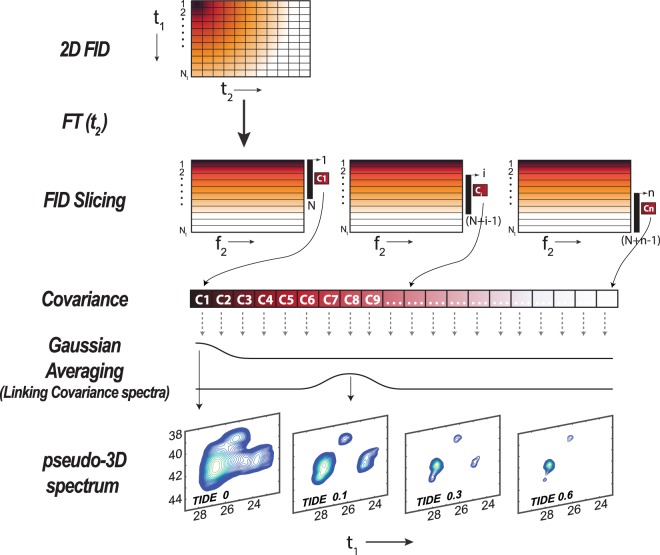
2D homonuclear NMR spectroscopy is an essential technique to characterize small and large molecules, such as organic compounds, metabolites, and biomacromolecules at atomic resolution. However, for complex samples 2D homonuclear spectra display poor resolution, making spectral assignment very cumbersome. Here, we propose a new method that exploits the differential T 2* relaxation times of individual resonances and resolves the 2D NMR peaks into pseudo-3D spectra, where time is the 3 rd dimension. T 2* weIghted DEconvolution or TIDE analyzes individual free induction decays (FIDs) and dissects them into sub-FIDs that are transformed into pseudo-3D spectra combining Fourier transformation and covariance NMR. TIDE achieves higher resolution and sensitivity for NMR spectra than classical covariance NMR reducing offset-dependent artifacts. We demonstrate the performance of TIDE for magic angle spinning (MAS) [13 C,13 C]-DARR NMR spectra of single- and multi-span membrane proteins embedded in lipid bilayers. Since TIDE is applicable to all type of homonuclear correlation experiments for liquid and solid samples, we anticipate that it will be a general method for processing NMR data of biomacromolecules, complex mixtures of metabolites as well as material samples.
Overview
CoChat Summary
TL;DR
The paper introduces TIDE (T2* weighted Deconvolution), a processing method that slices indirect-dimension FIDs into sub-FIDs, applies covariance NMR to each, and Gaussian-averages them into a pseudo-3D spectrum where the third dimension encodes T2* relaxation. Applied to MAS [13C,13C]-DARR spectra of membrane proteins, TIDE improves resolution and sensitivity over FT and covariance NMR, resolving overlapped resonances and revealing minor populations.
Key findings
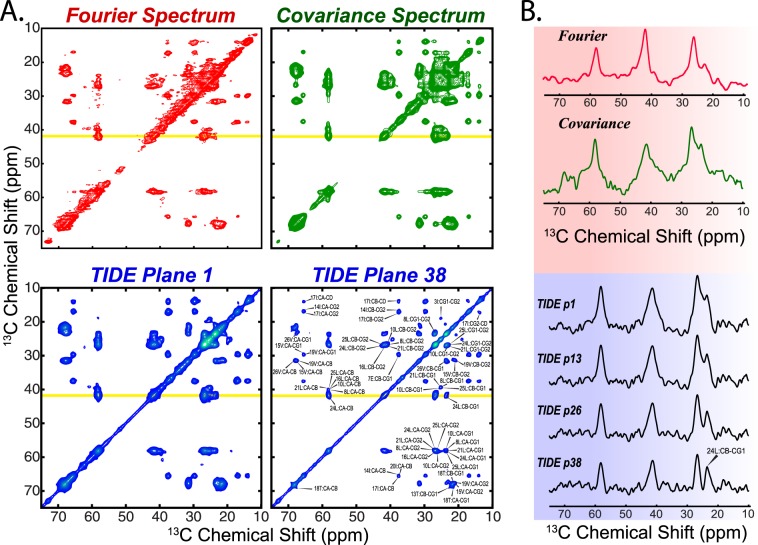
- TIDE separates 2D homonuclear NMR peaks by differential T2* into pseudo-3D spectra, combining Fourier transformation and covariance NMR; Gaussian averaging reduces offset-dependent artifacts, and the first TIDE plane is superior to the original covariance spectrum.
- In [13C,13C]-DARR experiments on U-13C,15N N-acetyl-Val-Leu (NAVL) dipeptide, the highest S/N was at θ = 90° (normalized to 100%); θ = 5°, 2°, and 1° gave relative sensitivities of 8.5%, 3.5%, and 1.8%. TIDE showed cross-correlations even at low S/N (~5), but for S/N ratios lower than 5 it introduced artifacts in the Cα region.
- Simulations with two 256-point FIDs showed that when T2a* = 5 ms and T2b* = 1 ms, the correlation coefficient increased up to 7%; for a simulated short-lived resonance (T2 = τ) overlapping two slowly relaxing resonances (T2 = 2τ), FT showed only one unresolved resonance, while TIDE resolved the low-intensity resonances at the 30th plane and fully resolved them more intensely at the 90th plane.
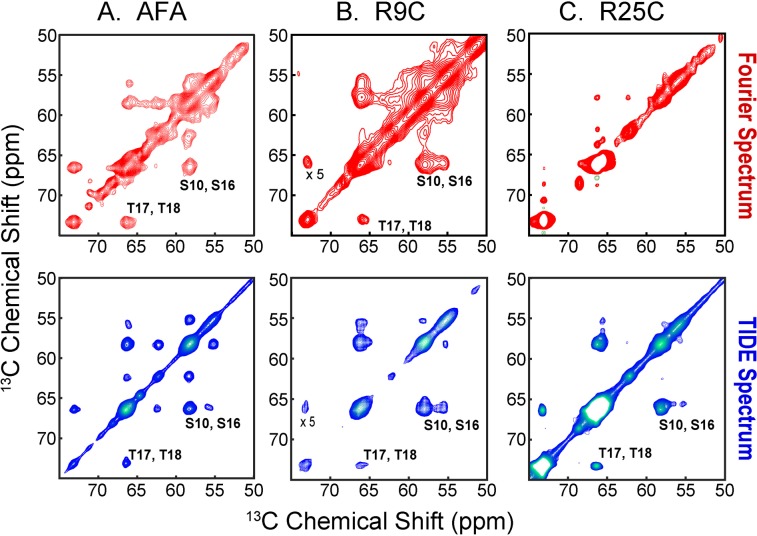
- For membrane proteins, TIDE planes 1 and 38 of sarcolipin (SLN) showed enhanced S/N and resolution, and plane 38 enabled assignment of most SLN resonances. For phospholamban (PLN), PLNAFA T- and R-state populations were estimated at 97% and 3%; TIDE visualized the small T-state population for PLNR25C that was essentially undetectable in FT spectra. For pentameric PLN with only 50 indirect points, the first TIDE plane outperformed FT, and for SatP TIDE spectra were more intense and resolved than FT.
Methods
- TIDE algorithm: the direct dimension t2 is Fourier transformed; t1 FIDs are sliced into sub-FIDs of length N (typically half the total t1 length); covariance is calculated for each sub-FID; Gaussian averaging over the covariance spectra generates pseudo-3D TIDE planes. The variance σ² is typically set to 10% of the total number of sub-FID covariance spectra. TIDE uses only real points in the indirect dimension, reducing experimental time by 50% versus classical FT. Scripts are written in MATLAB R2017a, compatible with NMRPipe, with average processing time of 10 sec (range 5 sec to 1 min).
- Samples and NMR: U-13C,15N labeled NAVL dipeptide; membrane proteins PLN, SLN, and SatP expressed recombinantly in E. coli and reconstituted into DMPC lipid bilayers. About 1.5 mg SLN, 2 mg PLN, and 8 mg SatP were packed into a 3.2 mm rotor; temperature held at 25 °C. MAS [13C,13C]-DARR experiments were performed on 600 and 700 MHz Agilent solid-state spectrometers and a 700 MHz Bruker solid-state spectrometer, spinning at 12 kHz. Mixing times: 10 ms for NAVL, 100 ms for SLN and PLN, and 200 ms for pentameric PLN.
- Analysis: FT, covariance NMR, and TIDE processing were compared; simulations tested frequency response and resolution; reduced interference distribution (RID) was used for time-frequency analysis of an experimental FID; 1D slices and assignments were used to evaluate resolution and sensitivity.
Limitations
- The paper states that TIDE introduces artifacts for S/N ratios lower than 5, which becomes a significant problem when experiments use a small number of time increments in the indirect dimension.
- The paper states that an experiment acquired with only 50 points in the indirect dimension is “at the limit of TIDE applicability.”
- Evident from the text, not stated as a limitation: experimental validation is limited to [13C,13C]-DARR MAS solid-state NMR of NAVL and the membrane proteins PLN, SLN, and SatP, despite the claim that TIDE is applicable to all types of homonuclear correlation experiments for liquid and solid samples.
Model-written summary. Check it against the paper before relying on it.
Integrity signals
Registry
Cites
Statistics
Figures
Verification
Claims the paper makes
3 Valid · 1 Not valid · 5 Not checked · 49 Own results and interpretations
The cited sources support only part of this claim — read each source’s verdict below.
In the paper
“Specifically, in the monomeric form of PLN (PLNAFA) the T and R state populations were estimated to be 97 and 3%, respectively.”
§ T2* weighted Deconvolution of NMR Spectra: Application to 2D Homonuclear MAS Solid-State NMR of Membrane Proteins > Results > Application of TIDE to membrane proteins
What the sources say
- Partly supportedcites [16] Nelson SED Effects of the Arg9Cys and Arg25Cys mutations on phospholamban’s conformational equilibrium in membrane bilayers Biochim Biophys Acta 2018 1860 1335 1341 10.1016/j.bbamem.2018.02.030 PMC6428084 29501609 sourceExperimental — accuracy not yet measured
Our copy confirms the setting and the direction of the claim: the experiments were on the monomeric PLNAFA variant in DMPC bilayers (RESULTS), where the T state is the more populated, membrane-associated helical state and the R state is a minor, dynamic population (INTRODUCTION; RESULTS, 'the R-state peaks are missing or undetectable for the R9C mutant, due to the low population of the R state'). However, no passage states 97% and 3% for PLNAFA: the paper explicitly says 'Although it is difficult to estimate the absolute R-state population,' it only obtained a 'semi-quantitative estimate' from relative INEPT-HETCOR vs CP intensities, with CP normalized to 100 (MATERIAL AND METHODS, MAS ssNMR), and reports PLNAFA only relatively (R9C ~one tenth, R25C ~7 times higher). The precise absolute percentages attributed to this source are therefore not supported by our copy, and the quantitative claim overstates the semi-quantitative nature of the estimate. (LLM, conf=0.68)
hedged- Asserted: passes — The authors put it forward as true.
- Checkable: passes — It can be checked against evidence.
- Load-bearing: unclear — It is unclear whether the paper’s conclusions depend on it.
- Based: passes — The paper gives a reason why it holds.
- Partly supported
The cited sources support only part of this claim — read each source’s verdict below.
In the paper
“For the PLNR9C mutant, the cytoplasmic region is predominantly in the membrane-bound state, whereas the PLNR25C populates mostly the R-state16.”
§ T2* weighted Deconvolution of NMR Spectra: Application to 2D Homonuclear MAS Solid-State NMR of Membrane Proteins > Results > Application of TIDE to membrane proteins
What the sources say
- Partly supportedcites [16] Nelson SED Effects of the Arg9Cys and Arg25Cys mutations on phospholamban’s conformational equilibrium in membrane bilayers Biochim Biophys Acta 2018 1860 1335 1341 10.1016/j.bbamem.2018.02.030 PMC6428084 29501609 sourceExperimental — accuracy not yet measured
The first clause is solidly supported: the INTRODUCTION states 'the R9C mutation shifts PLN's conformational equilibrium toward the membrane associated T state', and the RESULTS (Figure 1B discussion) report that in R9C the R-state population is reduced to approximately one tenth of PLNAFA, with R-state peaks 'missing or undetectable' in DARR/TOBSY. The second clause overstates the source, however: for R25C our copy only reports a semi-quantitative ~7-fold increase in relative R-state population and a shift 'toward more dynamic ensemble', explicitly noting that absolute R-state population is difficult to estimate and that 'the R25C mutation still possess a significant fraction of the membrane adsorbed helical conformation' — so 'populates mostly the R-state' is not established. A further qualifier not carried in the claim is that all measurements were made on the monomeric PLNAFA background (TM cysteines C36A/C41F/C46A) in DMPC bilayers. (LLM, conf=0.78)
plain- Asserted: passes — The authors put it forward as true.
- Checkable: passes — It can be checked against evidence.
- Load-bearing: unclear — It is unclear whether the paper’s conclusions depend on it.
- Based: passes — The paper gives a reason why it holds.
- Partly supported
The cited sources support only part of this claim — read each source’s verdict below.
In the paper
“The most remarkable application is the observation of minor population in the DARR spectra of PLN mutants, which were completely missed in our earlier 2D FT processing16.”
§ T2* weighted Deconvolution of NMR Spectra: Application to 2D Homonuclear MAS Solid-State NMR of Membrane Proteins > Discussion
What the sources say
- Partly supportedcites [16] Nelson SED Effects of the Arg9Cys and Arg25Cys mutations on phospholamban’s conformational equilibrium in membrane bilayers Biochim Biophys Acta 2018 1860 1335 1341 10.1016/j.bbamem.2018.02.030 PMC6428084 29501609 sourceExperimental — accuracy not yet measured
The RESULTS section (discussion of Figure 4) does support the first half: DARR and TOBSY spectra of the PLN mutants resolve two coexisting populations, with the cytoplasmic Ala residues A11 and A15 in slow exchange between the T and R states, and the minor R-state peaks visible for PLNAFA and PLNR25C but undetectable for R9C. However, nothing in our copy attributes the observation to a processing advance: the paper records conventional 2D FT DARR spectra (256 t1 increments, 20 ms acquisition, 100 ms mixing; Materials and Methods, MAS ssNMR) processed with NMRPipe/Sparky, and makes no statement that this minor population had been 'completely missed' in earlier 2D FT processing. That comparative claim is the citing authors' own framing and is not supported by this source. (LLM, conf=0.72)
plainstates a cause- Asserted: passes — The authors put it forward as true.
- Checkable: passes — It can be checked against evidence.
- Load-bearing: passes — The paper’s conclusions depend on it.
- Based: passes — The paper gives a reason why it holds.
- Partly supported
A result the paper reports from its own data — it cites no other source for it, so there is none to check. The quote shows it is in the paper.
In the paper
“The covariance calculation between FID-1 and FID-2 gives cross-peaks at frequencies ω2 and ω2′ for the direct dimension.”
§ T2* weighted Deconvolution of NMR Spectra: Application to 2D Homonuclear MAS Solid-State NMR of Membrane Proteins > Results > TIDE increases both resolution and sensitivity of 2D homonuclear correlation spectra
plainstates a cause- Asserted: passes — The authors put it forward as true.
- Checkable: passes — It can be checked against evidence.
- Load-bearing: unclear — It is unclear whether the paper’s conclusions depend on it.
- Based: passes — The paper gives a reason why it holds.
A result the paper reports from its own data — it cites no other source for it, so there is none to check. The quote shows it is in the paper.
In the paper
“The spectra obtained with θ = 5°, 2°, and 1° gave relative sensitivities of 8.5, 3.5, and 1.8%, respectively (Fig. S9A).”
§ T2* weighted Deconvolution of NMR Spectra: Application to 2D Homonuclear MAS Solid-State NMR of Membrane Proteins > Results > TIDE increases both resolution and sensitivity of 2D homonuclear correlation spectra
plainstates an association- Asserted: passes — The authors put it forward as true.
- Checkable: passes — It can be checked against evidence.
- Load-bearing: passes — The paper’s conclusions depend on it.
- Based: passes — The paper gives a reason why it holds.
32 more claims
Create a free account to see all 58 claims and to verify the 6 references still open.
- It may state two separate claims as one. 18
- Probably not a substantial claim. 4
Self-check
Percentages, sums and reported differences re-computed from the paper’s own numbers.
Each contradiction between two passages listed here was confirmed by an independent check.
Rated minor: it would not touch a result — a value no result rests on, a p-value that stays on the same side of the significance level, or a conflict that is clerical, resolved elsewhere in the paper, or outside its own findings.
In the paper
§ T2* weighted Deconvolution of NMR Spectra: Application to 2D Homonuclear MAS Solid-State NMR of Membrane Proteins > Material and Methods > TIDE algorithm
“p^thplaneofTIDE(TIDEp)=∑i=1NCi(ω1,ω2)×Gi(p)”
§ T2* weighted Deconvolution of NMR Spectra: Application to 2D Homonuclear MAS Solid-State NMR of Membrane Proteins > Results > Theory of the TIDE method
“3 TIDEp=∑i=1nCi(ω1,ω2)×Gi(p)”
Citations
Cites
NMRPipe: A multidimensional spectral processing system based on UNIX pipes
Delaglio, F., Grzesiek, S., Vuister, G., Zhu, G., Pfeifer, J., & Bax, A. (1995) · Journal of Biomolecular NMR · doi:10.1007/bf00197809 · Cited by 15,965
Resonance Absorption by Nuclear Magnetic Moments in a Solid
Purcell, E. M., Torrey, H. C., & Pound, R. V. (1946) · Physical Review · doi:10.1103/physrev.69.37 · Cited by 6,053
Bloch, F. (1946) · Physical Review · doi:10.1103/physrev.70.460 · Cited by 3,676
Two-dimensional spectroscopy. Application to nuclear magnetic resonance
Aue, W. P., Bartholdi, E., & Ernst, R. R. (1976) · The Journal of Chemical Physics · doi:10.1063/1.432450 · Cited by 3,082
The Nuclear Induction Experiment
Bloch, F., Hansen, W. W., & Packard, M. (1946) · Physical Review · doi:10.1103/physrev.70.474 · Cited by 1,192
– dipolar-assisted rotational resonance in magic-angle spinning NMR
Takegoshi, K., Nakamura, S., & Terao, T. (2001) · Chemical Physics Letters · doi:10.1016/s0009-2614(01)00791-6 · Cited by 1,012
Bloch, F., Hansen, W. W., & Packard, M. (1946) · Physical Review · doi:10.1103/physrev.69.127 · Cited by 883
Dilated Cardiomyopathy and Heart Failure Caused by a Mutation in Phospholamban
Schmitt, J. P., Kamisago, M., Asahi, M., Li, G. H., Ahmad, F., Mende, U., Kranias, E. G., MacLennan, D. H., Seidman, J. G., & Seidman, C. E. (2003) · Science · doi:10.1126/science.1081578 · Cited by 619
Sdol, E. (2009) · Cited by 576
Hajduk, P. J., Olejniczak, E. T., & Fesik, S. W. (1997) · Journal of the American Chemical Society · doi:10.1021/ja9715962 · Cited by 371
Research works printed but not linked: 1
- Ernst, R.R., Bodenhausen, G. & Wokaun, A. Principles of nuclear magnetic resonance in one and two dimensions, xxiv, 610 p (Clarendon Press, Oxford, 1987).
Cited by
Ahmed, R., Huang, J., Weber, D. K., Gopinath, T., Veglia, G., Akimoto, M., Khondker, A., Rheinstädter, M. C., Huynh, V., Wylie, R. G., et al. (2020) · Journal of the American Chemical Society · doi:10.1021/jacs.0c01894 · Cited by 28
Self-citationYamada, S., Kurotani, A., Chikayama, E., & Kikuchi, J. (2020) · International Journal of Molecular Sciences · doi:10.3390/ijms21082978 · Cited by 20
“Applying the same idea to covariance NMR [28], T2*-weighted covariance NMR improves the sensitivity and resolution of signals based on the difference in T2*, determined by dividing each FID in the t1 dimension of 2D-NMR to create a series of sub-FIDs [29].”
MethodSnyder, D. A. (2020) · Progress in Nuclear Magnetic Resonance Spectroscopy · doi:10.1016/j.pnmrs.2020.09.001 · Cited by 20
Shao, J., Yin, X. L., Lang, Y., Ding, M., Zhang, B., Sun, Q., Jiang, X., Song, J., & Cui, L. (2022) · Molecular Neurobiology · doi:10.1007/s12035-022-03099-5 · Cited by 13
Do, H. Q., Hewetson, A., Borcik, C. G., Hastert, M. C., Whelly, S., Wylie, B. J., Sutton, R. B., & Cornwall, G. A. (2020) · Journal of Biological Chemistry · doi:10.1074/jbc.ra120.015307 · Cited by 11
Revealing the Local Structure and Dynamics of the Solid Li Ion Conductor Li3P5O14
Duff, B. B., Corti, L., Turner, B., Han, G., Daniels, L. M., Rosseinsky, M. J., & Blanc, F. (2024) · Chemistry of Materials · doi:10.1021/acs.chemmater.4c00727 · Cited by 4
Solid-state covariance NMR spectroscopy: An update
Takeda, K. (2020) · Annual reports on NMR spectroscopy · doi:10.1016/bs.arnmr.2020.02.001 · Cited by 2
Toward the dynamic structure of the Escherichia coli integral membrane protein glycerol facilitator
Hernando, M. (2019) · Mspace (University of Manitoba)
Super-Resolution solid-state NMR Spectroscopy
Gampp, O., Cadalbert, R., Riek, R., & Overall, S. A. (2026) · Journal of Biomolecular NMR · doi:10.1007/s10858-026-00490-5
“It has been predicted that MAS frequencies of 300 kHz will be required for maximum 1 H multiple datasets (Moutzouri et al. 2021), substantial post-processing (Manu et al. 2019) or trained machine learning algorithms to achieve.”
Metadata
- Authors
- V. S., M., Gopinath, T., Wang, S., & Veglia, G.
- Affiliations
- University of Minnesota (US)
- Corresponding author
- Veglia, Gianluigi
- Venue
- Scientific Reports
- Published
- 2019-06-03
- Volume
- 9
- Issue
- 1
- Pages
- 8225-8225
- ISSN
- 2045-2322 (ISSN-L)
- PMC
- PMC6546711
- OpenAlex
- W2948144487
- Semantic Scholar
- 89126a7e6b3aea23ffeebeeed553d2f20d82b7ce
- Cited by
- 9
- References
- 46
- Citations by year
- 2026: 1 · 2024: 1 · 2022: 1 · 2020: 5 · 2019: 1
- FWCI
- 0.67
- Type
- journal article
- Language
- en
- Open access
- gold
- doi.org
- Licence
- cc-by
- creativecommons.org/licenses/by/4.0 (tdm)
- creativecommons.org/licenses/by/4.0 (vor)
- Locations
- Scientific Reports (publishedVersion, cc-by)
- PubMed (publishedVersion)
- PubMed Central (publishedVersion, cc-by)
- DOAJ (DOAJ: Directory of Open Access Journals) (submittedVersion)
- Funders
- U.S. Department of Health & Human Services | NIH | National Institute of General Medical Sciences (GM 64742)
- U.S. Department of Health & Human Services | NIH | National Heart, Lung, and Blood Institute (HL 144130)
- Topics
- Physical Sciences › Chemistry › Spectroscopy › Advanced NMR Techniques and Applications
- Life Sciences › Biochemistry, Genetics and Molecular Biology › Molecular Biology › Metabolomics and Mass Spectrometry Studies
- Physical Sciences › Chemistry › Spectroscopy › NMR spectroscopy and applications
- Keywords
- tides, magic angle spinning, membrane proteins, lipid bilayers, spectral resolution enhancement
- MeSH terms
- Algorithms, Membrane Proteins, Muscle Proteins, Magnetic Resonance Spectroscopy, Proteolipids
About these checks
Registry, retraction, Cites and statistics results are computed, not judged, with one exception: a printed reference that no index lists is read once by a model before it counts as a citation error. Claims are extracted by a model and kept only when their quote appears verbatim in the text; each cited source is then checked, with a model’s help, for whether it says what the claim relies on. Those verdicts can be wrong — read the claim’s quote and the cited source before relying on one.
The claim verdicts this report counts are experimental: their accuracy is not yet measured.
A language model drew the claims from the paper on 2026-11-18, under version 3 of the claim definition (model deepseek-v4.1-flash, prompt extract-v3).
A second model labelled each claim on 2026-11-18 (model jev-1.13-20260917, definition revision gold-guideline-v0.2).
Cited sources are checked with a language model’s help (qwen3.8-omni-flash).
Statistics and arithmetic are recomputed, not judged.
Confidence bands are shown only for fields calibrated on our annotated test set. None is calibrated yet, so no band is shown.
What counts as a claim ›How we measure confidence ›How we check this ›
Are you an author, or do you see a problem with this page? Request a review
Data sources
Bibliographic data: Semantic Scholar, OpenAlex, Crossref.
Contains information from the Semantic Scholar Academic Graph Datasets, made available under the ODC Attribution License (ODC-BY 1.0).
Semantic Scholar’s data is described in: Kinney, R., et al. (2023). The Semantic Scholar Open Data Platform. arXiv:2301.10140.
