

The DOI matches its Crossref record; 4 of the 4 references it cites were found in a registry or an index.
Empathy and compassion toward other species decrease with evolutionary divergence time
Abstract
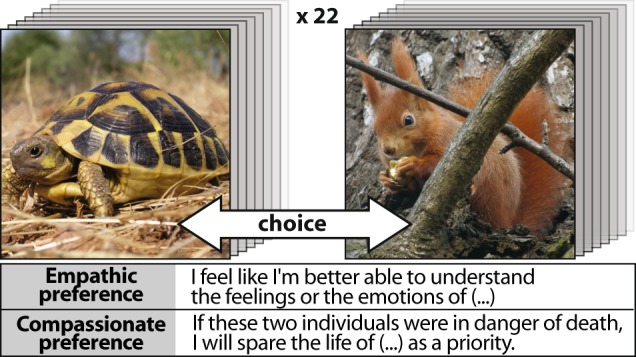
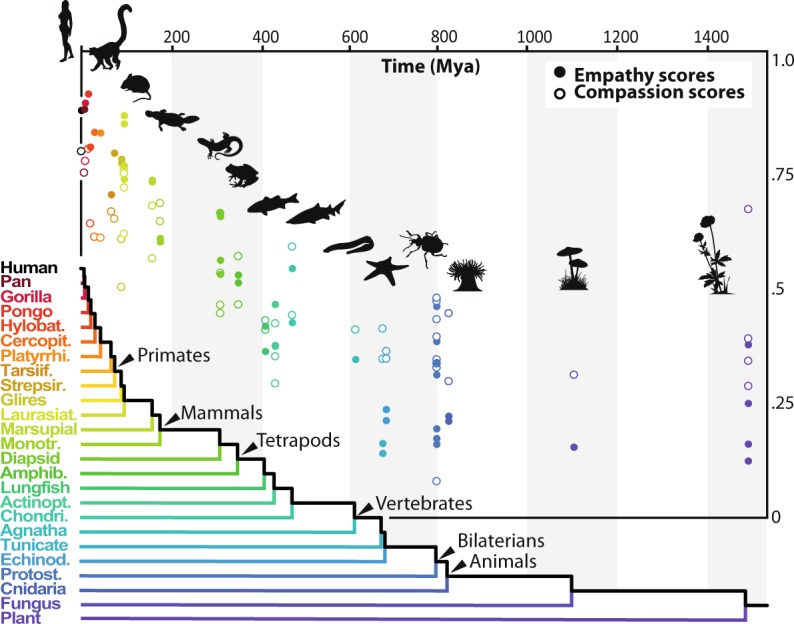
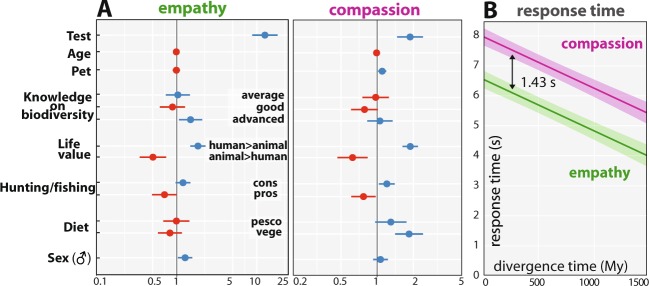
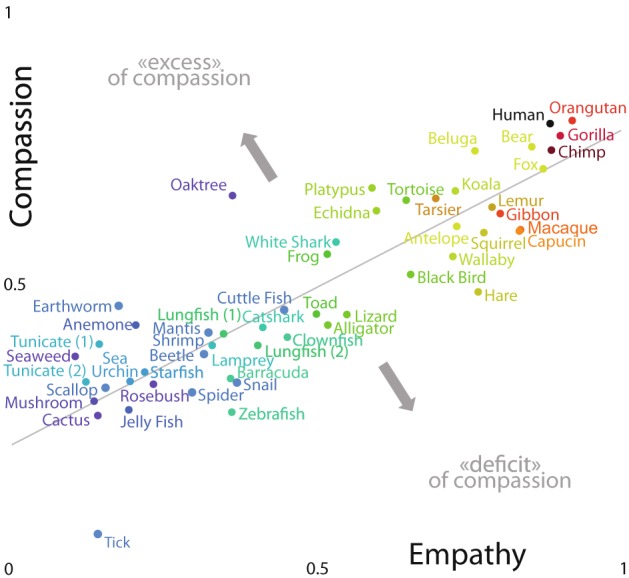
Currently the planet is inhabited by several millions of extremely diversified species. Not all of them arouse emotions of the same nature or intensity in humans. Little is known about the extent of our affective responses toward them and the factors that may explain these differences. Our online survey involved 3500 raters who had to make choices depending on specific questions designed to either assess their empathic perceptions or their compassionate reactions toward an extended photographic sampling of organisms. Results show a strong negative correlation between empathy scores and the divergence time separating them from us. However, beyond a certain time of divergence, our empathic perceptions stabilize at a minimum level. Compassion scores, although based on less spontaneous choices, remain strongly correlated to empathy scores and time of divergence. The mosaic of features characterizing humans has been acquired gradually over the course of the evolution, and the phylogenetically closer a species is to us, the more it shares common traits with us. Our results could be explained by the fact that many of these traits may arouse sensory biases. These anthropomorphic signals could be able to mobilize cognitive circuitry and to trigger prosocial behaviors usually at work in human relationships.
Overview
The claims and statistics of this paper haven’t been checked yet.
Run the check — free, no account needed. It reads the open-access text and checks the sources it cites.
Integrity signals
Registry
Cites
Statistics
Figures
Verification
Claims the paper makes
The claims and statistics of this paper haven’t been checked yet.
Run the check — free, no account needed. It reads the open-access text and checks the sources it cites.
Claims other papers make about this one
Each is checked against this paper’s own text: does it say what the citing paper says it does?
In the citing paper
“Humans tend to prefer animals that are phylogenetically close to them and perceived as physically, behaviorally or cognitively similar; these aspects trigger more positive affect and attachment and caregiving behaviors, as well as greater empathy and a higher concern in terms of welfare and conservation [52,53,54,55,56,57].”
From The Complexity of the Human–Animal Bond: Empathy, Attachment and Anthropomorphism in Human–Animal Relationships and Animal Hoarding (2022) · cites this paper as [57]
Self-check
Percentages, sums and reported differences re-computed from the paper’s own numbers.
The self-check needs the paper’s full text.
Citations
Cites
Fitting Linear Mixed-Effects Models Using lme4
Bates, D., Mächler, M., Bolker, B., & Walker, S. (2015) · Journal of Statistical Software · doi:10.18637/jss.v067.i01 · Cited by 86,835
Singer, T., & Klimecki, O. M. (2014) · Current Biology · doi:10.1016/j.cub.2014.06.054 · Cited by 1,254
Decety, J., Bartal, I. B.-A., Uzefovsky, F., & Knafo-Noam, A. (2016) · Philosophical Transactions of the Royal Society B Biological Sciences · doi:10.1098/rstb.2015.0077 · Cited by 740
Harrison, M. A., & Hall, A. E. (2010) · Journal of Social, Evolutionary, and Cultural Psychology · doi:10.1037/h0099303 · Cited by 102
Research works printed but not linked: 26
- Darwin, C. The descent of man, and selection in relation to sex. London: John Murray. 1st ed. (1871). · DOI
- Kopnina, H. The Lorax complex: deep ecology, ecocentrism and exclusion. J Integr. Environ. Sci. 9, 235–254, https://doi.org/10.1080/1943815X.2012.742914 (2012). · DOI
- Nelson, M. P., Bruskotter, J. T., Vucetich, J. A. & Chapron, G. Emotions and the ethics of consequence in conservation decisions: lessons from Cecil the Lion. Conserv. Lett. 9, 302–306, https://doi.org/10.1111/conl.12232 (2016). · DOI
- Troudet, J., Grandcolas, P., Blin, A., Vignes-Lebbe, R. & Legendre, F. Taxonomic bias in biodiversity data and societal preferences. Sci. Rep. 7, 9132, https://doi.org/10.1038/s41598-017-09084-6 (2017). · DOI
- Colléony, A., Clayton, S., Couvet, D., Saint Jalme, M. & Prévot, A.-C. Human preferences for species conservation: Animal charisma trumps endangered status. Biol. Conserv. 206, 263–269, https://doi.org/10.1016/j.biocon.2016.11.035 (2017). · DOI
- Gunnthorsdottir, A. Physical Attractiveness of an Animal Species as a Decision Factor for its Preservation. Anthrozoös 14, 204–215, https://doi.org/10.2752/089279301786999355 (2001). · DOI
- Stokes, D. L. Things We Like: Human Preferences among Similar Organisms and Implications for Conservation. Hum. Ecol. 35, 361–369, https://doi.org/10.1007/s10745-006-9056-7 (2007). · DOI · Paper page
- Landová, E. et al. Beauty ranking of mammalian species kept in the Prague Zoo: does beauty of animals increase the respondents’ willingness to protect them? Sci. Nat. 105, 69, https://doi.org/10.1007/s00114-018-1596-3 (2018). · DOI
- Schuetz, J. G. & Johnston, A. Characterizing the cultural niches of North American birds. Proc. Natl. Acad. Sci. USA 116, 10868–10873, https://doi.org/10.1073/pnas.1820670116 (2019). · DOI
- Prguda, A. & Neumann, D. L. Inter-human and animal-directed empathy: A test for evolutionary biases in empathetic responding. Behav. Process. 108, 80–86, https://doi.org/10.1016/j.beproc.2014.09.012 (2014). · DOI
- Borgi, M. & Cirulli, F. Attitudes toward Animals among Kindergarten Children: Species Preferences. Anthrozoös 28, 45–59, https://doi.org/10.2752/089279315X14129350721939 (2015). · DOI
- Lamm, C., Rütger, M. & Wagner, I. C. Imaging empathy and prosocial emotions. Neurosci. Lett. 693, 49–53, https://doi.org/10.1016/j.neulet.2017.06.054 (2019). · DOI
- Panksepp, J. & Panksepp, J. B. Toward a cross-species understanding of empathy. Trends Neurosci. 36, 489–496, https://doi.org/10.1016/j.tins.2013.04.009 (2013). · DOI
- Bloom, P. Empathy, schmempathy response to Zaki. Trends Cogn. Sci. 21, 60–61, https://doi.org/10.1016/j.tics.2016.12.003 (2017). · DOI
- Zaki, J. Moving beyond stereotypes of empathy. Trends Cogn. Sci. 21, 59–60, https://doi.org/10.1016/j.tics.2016.12.004 (2017). · DOI
- Chierchia, G. & Singer, T. The Neuroscience of Compassion and Empathy and Their Link to Prosocial Motivation and Behavior, In Decision Neuroscience, Editor(s): Jean-Claude Dreher, Léon Tremblay, Pages 247–257, Academic Press, https://doi.org/10.1016/B978-0-12-805308-9.00020-8 (2017). · DOI
- Marsh, A. A. The neuroscience of empathy. Curr. Opin. behav. Sci. 19, 110–115, https://doi.org/10.1016/j.cobeha.2017.12.016 (2018). · DOI
- Bird, G. et al. Empathic brain responses in insula are modulated by levels of alexithymia but not autism. Brain 133, 1515–1525, https://doi.org/10.1093/brain/awq060 (2010). · DOI · Paper page
- Warrier, V. et al. Genome-wide analyses of self-reported empathy: correlations with autism, schizophrenia, and anorexia nervosa. Transl. Psychiatry 8, 35, https://doi.org/10.1038/s41398-017-0082-6 (2018). · DOI
- Wyatt, G. A., West, S. A. & Gardner, A. Can natural selection favour altruism between species? J. Evol. Biol. 26, 1854–1865, https://doi.org/10.1111/jeb.12195 (2013). · DOI
- Izar, P. et al. Cross-genus adoption of a marmoset (Callithrix jacchus) by wild capuchin monkeys (Cebus libidinosus): case report. Am. J. Primatol. 68, 692–700, https://doi.org/10.1002/ajp.20259 (2006). · DOI
- Oswald, S. A., Wails, C. N., Morey, B. E. & Arnold, J. M. Caspian Terns (Hydroprogne caspia) Fledge a Ring-billed Gull (Larus delawarensis) Chick: Successful Waterbird Adoption Across Taxonomic Families. Waterbirds 36, 385–389, https://doi.org/10.1675/063.036.0318 (2013). · DOI
- Ducatez, S. Brood parasitism: a good strategy in our changing world? Proc. Royal Soc. B. 281, https://doi.org/10.1098/rspb.2013.2404 (2014). · DOI
- Kumar, S., Stecher, G., Suleski, M. & Hedges, S. B. TimeTree: A Resource for Timelines, Timetrees, and Divergence Times. Mol. Biol. Evol. 34, 1812–1819, https://doi.org/10.1093/molbev/msx116 (2017). · DOI
- Hedges, S. B., Marin, J., Suleski, M., Paymer, M. & Kumar, S. Tree of life reveals clock-like speciation and diversification. Mol. Biol. Evol. 32, 835–845, https://doi.org/10.1093/molbev/msv037 (2015). · DOI
- Mebane, W. R. & Sekhon, J. S. Genetic Optimization Using Derivatives: The rgenoud Package for R. J. Stat. Softw. 42, 1–26 (2011). · DOI
Cited by
Sorted by citations
Prato-Previde, E., Basso Ricci, E., & Colombo, E. S. (2022) · Animals · doi:10.3390/ani12202835 · Cited by 121
Metadata
- Authors
- Miralles, A., Raymond, M., & Lecointre, G.
- Venue
- Scientific Reports
- Published
- 2019-12-20
- Volume
- 9
- Issue
- 1
- ISSN
- 2045-2322
- PMC
- PMC6925286
- Cited by
- 180
- References
- 4
- Language
- en
About these checks
Registry, retraction, Cites and statistics results are computed, not judged, with one exception: a printed reference that no index lists is read once by a model before it counts as a citation error. Claims are extracted by a model and kept only when their quote appears verbatim in the text; each cited source is then checked, with a model’s help, for whether it says what the claim relies on. Those verdicts can be wrong — read the claim’s quote and the cited source before relying on one.
Statistics and arithmetic are recomputed, not judged.
Confidence bands are shown only for fields calibrated on our annotated test set. None is calibrated yet, so no band is shown.
What counts as a claim ›How we measure confidence ›How we check this ›
Are you an author, or do you see a problem with this page? Request a review
