

High-latitude neonate and perinate ornithopods from the mid-Cretaceous of southeastern Australia
Open accessThe DOI matches its Crossref record; 93 of the 93 references it cites were found in a registry or an index; none of the 122 sources its claims cite is checked for support yet.
Abstract
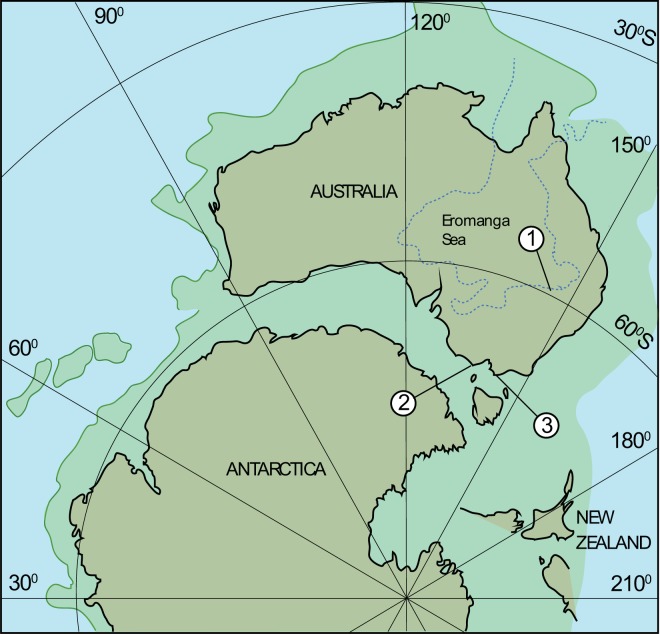
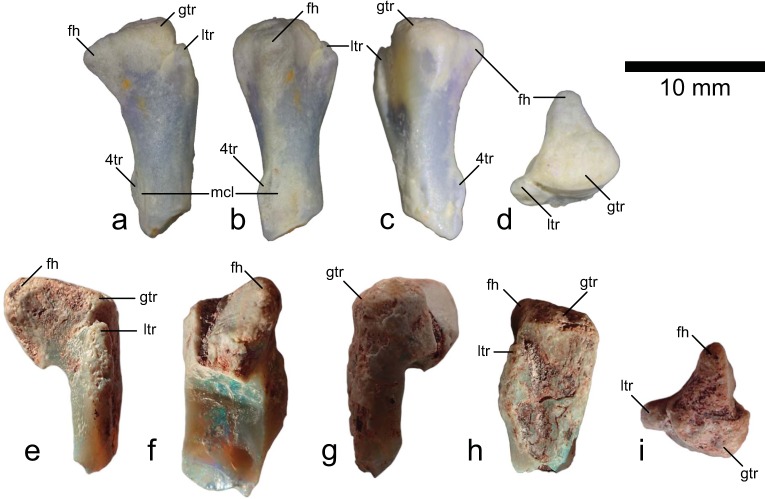
Dinosaurs were remarkably climate-tolerant, thriving from equatorial to polar latitudes. High-paleolatitude eggshells and hatchling material from the Northern Hemisphere confirms that hadrosaurid ornithopods reproduced in polar regions. Similar examples are lacking from Gondwanan landmasses. Here we describe two non-iguanodontian ornithopod femora from the Griman Creek Formation (Cenomanian) in New South Wales, Australia. These incomplete proximal femora represent the first perinatal ornithopods described from Australia, supplementing neonatal and slightly older ‘yearling’ specimens from the Aptian–Albian Eumeralla and Wonthaggi formations in Victoria. While pseudomorphic preservation obviates histological examination, anatomical and size comparisons with Victorian specimens, which underwent previous histological work, support perinatal interpretations for the Griman Creek Formation femora. Estimated femoral lengths (37 mm and 45 mm) and body masses (113–191 g and 140–236 g), together with the limited development of features in the smallest femur, suggest a possible embryonic state. Low body masses (<1 kg for ‘yearlings’ and ~20 kg at maturity) would have precluded small ornithopods from long-distance migration, even as adults, in the Griman Creek, Eumeralla, and Wonthaggi formations. Consequently, these specimens support high-latitudinal breeding in a non-iguanodontian ornithopod in eastern Gondwana during the early Late Cretaceous.
Overview
CoChat Summary
TL;DR
Two incomplete proximal ornithopod femora from the Cenomanian Griman Creek Formation, New South Wales, are described as perinatal/possible embryonic non-iguanodontian ornithopods, representing the first perinatal dinosaurs from Australia. Comparisons with histologically sampled Victorian specimens and size/mass estimates support high-latitude breeding by small ornithopods in eastern Gondwana during the early Late Cretaceous.
Key findings
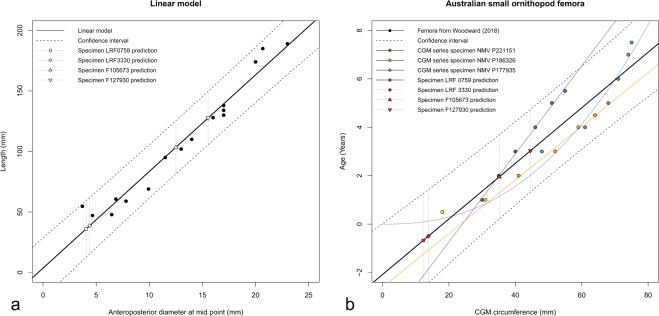
- The Griman Creek Formation femora are estimated at 37 mm and 45 mm in femoral length and 113–191 g and 140–236 g in body mass in the abstract; Table 3 gives point estimates of 36.08 mm and 38.71 mm and DME masses of 151.96 g (113.02–190.91) and 187.73 g (139.62–235.85).
- The smallest femur’s limited development suggests a possible embryonic state; age estimates for the two focal specimens are −0.68 years (−2.62–1.27) and −0.50 years (−2.42–1.43).
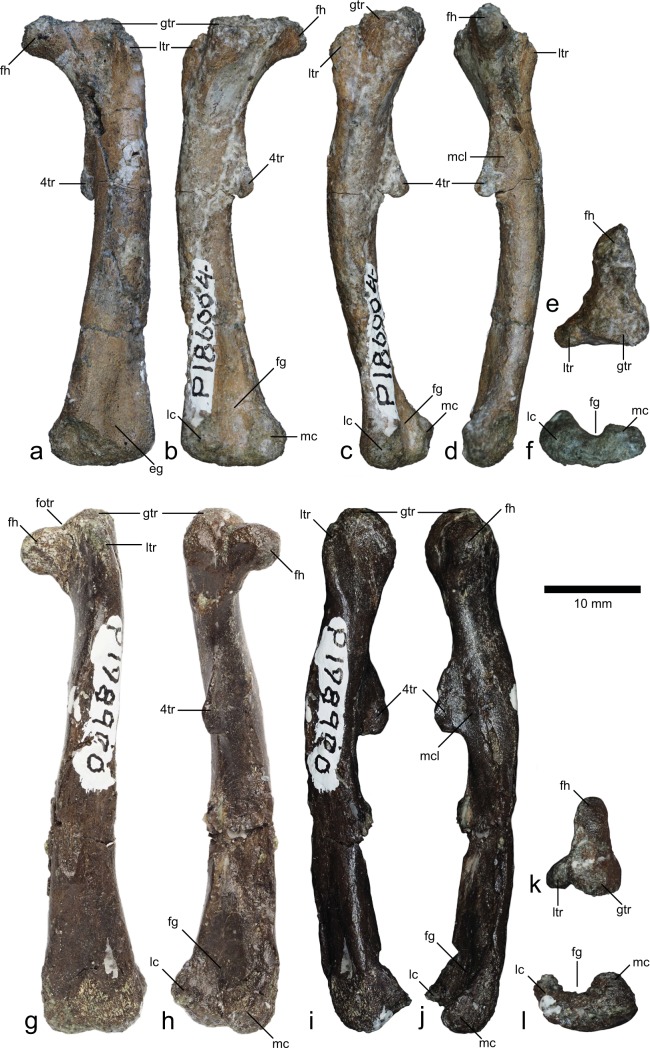
- Victorian juvenile masses range from 251–424 g for the smallest (NMV P186004) to 788–1332 g for the largest (NMV P179561); ‘yearlings’ are <1 kg and adults reached ~20 kg, below the ~20 kg threshold for the smallest extant terrestrial migrators, making long-distance migration unlikely.
- The specimens support high-latitude breeding in a non-iguanodontian ornithopod in eastern Gondwana; high-latitude ornithopod nesting sites appear restricted to moist, lowland settings.
Methods
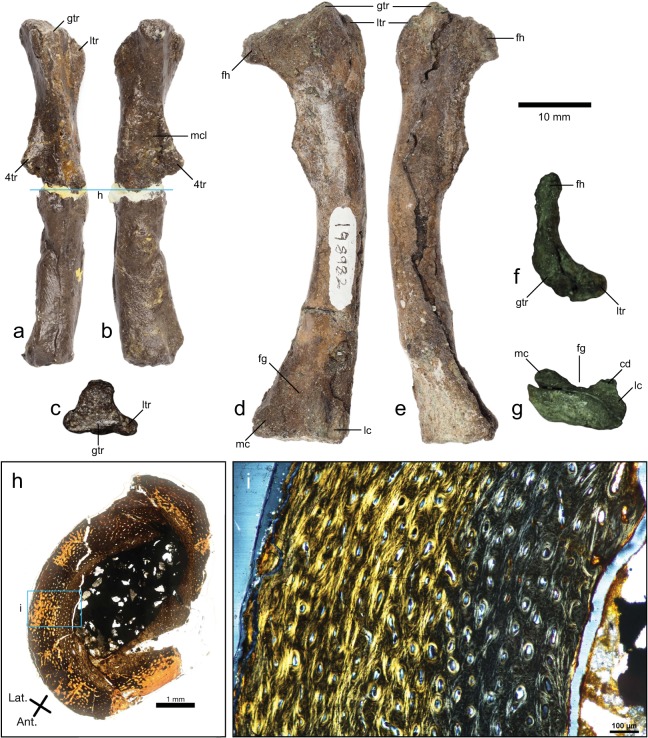
- Descriptive osteological comparison of two new Griman Creek Formation proximal femora with neonate, perinate, and ‘yearling’ femora from the Eumeralla and Wonthaggi formations; histological examination was obviated by pseudomorphic opalization.
- Femoral length was estimated via ordinary least squares regression of anteroposterior width at the midpoint against length, derived from measurements of 16 Australian small ornithopod femora.
- Body mass was estimated using MASSTIMATE v. 1.4 with developmental mass extrapolation, using NMV 177935 (208 mm femur) as the adult proxy; age was estimated via OLS regression between age and cyclical growth mark circumference from previously published histological data.
Limitations
- The paper states that pseudomorphic preservation obviates histological examination, and that because the Griman Creek Formation femora are incomplete, diameter measurements likely exceed the true narrowest section, so point length, mass, and age estimates may be overestimates.
- The paper states that taxonomic definitions of femoral morphotypes are highly ambiguous due to variable morphology and pervasive diagenetic alteration, and that the high-latitude nesting record is biased by the limited availability of appropriate strata.
- Text-evident issues: specimen numbers are inconsistent between the abstract/results (LRF 3375) and tables (LRF 3330), and the abstract’s 45 mm length estimate differs from the Table 3 point estimate of 38.71 mm; age estimates are negative and rely on extrapolation from a small histological sample.
Model-written summary. Check it against the paper before relying on it.
Integrity signals
Registry
Cites
Statistics
Figures
Verification
Claims the paper makes
0 Valid · 3 Not valid · 66 Not checked · 45 Own results and interpretations
A result the paper reports from its own data — it cites no other source for it, so there is none to check. The quote shows it is in the paper.
In the paper
“Mass estimates, calculated via DME, indicate that LRF 0759 and LRF 3375 represent the smallest individuals thus far sampled.”
§ High-latitude neonate and perinate ornithopods from the mid-Cretaceous of southeastern Australia > Results > Femur length, body mass, and age estimates
hedgedn = 2- Asserted: passes — The authors put it forward as true.
- Checkable: passes — It can be checked against evidence.
- Load-bearing: passes — The paper’s conclusions depend on it.
- Based: passes — The paper gives a reason why it holds.
- Rests on 2 assumptions not shown here.
A result the paper reports from its own data — it cites no other source for it, so there is none to check. The quote shows it is in the paper.
In the paper
“Two morphotypes are also collectively recognized from the Wonthaggi and Eumeralla formations, based on the presence/absence of a medially inset lateral condylid (Table 2).”
§ High-latitude neonate and perinate ornithopods from the mid-Cretaceous of southeastern Australia > Discussion > Taxonomic considerations
plainstates an association- Asserted: passes — The authors put it forward as true.
- Checkable: passes — It can be checked against evidence.
- Load-bearing: unclear — It is unclear whether the paper’s conclusions depend on it.
- Based: passes — The paper gives a reason why it holds.
A result the paper reports from its own data — it cites no other source for it, so there is none to check. The quote shows it is in the paper.
In the paper
“Here we describe two non-iguanodontian ornithopod femora from the Griman Creek Formation (Cenomanian) in New South Wales, Australia.”
- Also stated in: § Introduction · plain
“Here, we describe two miniscule and partial ornithopod femora from the Griman Creek Formation (GCF; Cenomanian9) in central-northern New South Wales, Australia”
§ High-latitude neonate and perinate ornithopods from the mid-Cretaceous of southeastern Australia > Abstract
plain- Asserted: passes — The authors put it forward as true.
- Checkable: passes — It can be checked against evidence.
- Load-bearing: passes — The paper’s conclusions depend on it.
- Based: passes — The paper gives a reason why it holds.
- Also stated in: § Introduction · plain
A result the paper reports from its own data — it cites no other source for it, so there is none to check. The quote shows it is in the paper.
In the paper
“Characters of femora described in this study differ from those of sauropods and theropods.”
§ High-latitude neonate and perinate ornithopods from the mid-Cretaceous of southeastern Australia > Discussion > Taxonomic considerations
plain- Asserted: passes — The authors put it forward as true.
- Checkable: passes — It can be checked against evidence.
- Load-bearing: passes — The paper’s conclusions depend on it.
- Based: passes — The paper gives a reason why it holds.
A result the paper reports from its own data — it cites no other source for it, so there is none to check. The quote shows it is in the paper.
In the paper
“Age estimates from the regression based on CGM circumferences (Fig. 5b; Table 3) further support this conclusion.”
§ High-latitude neonate and perinate ornithopods from the mid-Cretaceous of southeastern Australia > Discussion > Ontogenetic interpretations
plainstates an association- Asserted: passes — The authors put it forward as true.
- Checkable: passes — It can be checked against evidence.
- Load-bearing: passes — The paper’s conclusions depend on it.
- Based: passes — The paper gives a reason why it holds.
53 more claims
Create a free account to see all 114 claims and to verify the 114 references still open.
- It may state two separate claims as one. 37
- The quote only partly states this claim. 1
- Probably not a substantial claim. 22
Self-check
Percentages, sums and reported differences re-computed from the paper’s own numbers.
Each contradiction between two passages listed here was confirmed by an independent check.
Rated minor: it would not touch a result — a value no result rests on, a p-value that stays on the same side of the significance level, or a conflict that is clerical, resolved elsewhere in the paper, or outside its own findings.
In the paper
§ High-latitude neonate and perinate ornithopods from the mid-Cretaceous of southeastern Australia > Localities, Geological Settings, and Paleoenvironments
“The two new femora (LRF 0759 and LRF 3375) were recovered”
§ High-latitude neonate and perinate ornithopods from the mid-Cretaceous of southeastern Australia > Results > Description of material from the Eumeralla Formation, Victoria
“| LRF 3330 | Lightning Ridge | Griman Creek | Proximal left femur | Perinate | — | Morphotype 2 |”
Rated minor: it would not touch a result — a value no result rests on, a p-value that stays on the same side of the significance level, or a conflict that is clerical, resolved elsewhere in the paper, or outside its own findings.
In the paper
§ High-latitude neonate and perinate ornithopods from the mid-Cretaceous of southeastern Australia > Results > Description of material from the Griman Creek Formation, New South Wales
“LRF 0759 (maximum length = 16 mm) and LRF 3375 (maximum length = 16 mm) are partial proximal right femora.”
§ High-latitude neonate and perinate ornithopods from the mid-Cretaceous of southeastern Australia > Methods > Femur length estimation
“| LRF 759 | Lightning Ridge | Griman Creek | Proximal left femur | — | 3.73 | 4.06 | [12.24] | This study |”
Rated minor: it would not touch a result — a value no result rests on, a p-value that stays on the same side of the significance level, or a conflict that is clerical, resolved elsewhere in the paper, or outside its own findings.
In the paper
§ High-latitude neonate and perinate ornithopods from the mid-Cretaceous of southeastern Australia > Results > Femur length, body mass, and age estimates
“108.45 (incomplete)”
§ High-latitude neonate and perinate ornithopods from the mid-Cretaceous of southeastern Australia > Results > Femur length, body mass, and age estimates
“103.43 (81.5–125.35)”
Rated minor: it would not touch a result — a value no result rests on, a p-value that stays on the same side of the significance level, or a conflict that is clerical, resolved elsewhere in the paper, or outside its own findings.
In the paper
§ High-latitude neonate and perinate ornithopods from the mid-Cretaceous of southeastern Australia > Abstract
“Estimated femoral lengths (37 mm and 45 mm)”
§ High-latitude neonate and perinate ornithopods from the mid-Cretaceous of southeastern Australia > Results > Femur length, body mass, and age estimates
“LRF 0759 and LRF 3375, were estimated at 36 mm (upper maximum value of 59 mm) and 39 mm (upper maximum value of 62 mm) long, respectively”
Citations
Cites
Ror2 signaling regulates Golgi structure and transport through IFT20 for tumor invasiveness
Nishita, M., Park, S.-Y., Nishio, T., Kamizaki, K., Wang, Z., Tamada, K., Takumi, T., Hashimoto, R., Otani, H., Pazour, G. J., et al. (2017) · Scientific Reports · doi:10.1038/s41598-016-0028-x · Cited by 15,947
The Ecological Implications of Body Size
Peters, R. H. (1983) · Cambridge University Press eBooks · doi:10.1017/cbo9780511608551 · Cited by 5,649
The use of ‘altitude’ in ecological research
Körner, C. (2007) · Trends in Ecology & Evolution · doi:10.1016/j.tree.2007.09.006 · Cited by 3,116
(2026) · Acta Palaeontologica Polonica · doi:10.4202/app · Cited by 2,792
Global continental and ocean basin reconstructions since 200Ma
Seton, M., Müller, R. D., Zahirovic, S., Gaina, C., Torsvik, T., Shephard, G., Talsma, A., Gurnis, M., Turner, M., Maus, S., et al. (2012) · Earth-Science Reviews · doi:10.1016/j.earscirev.2012.03.002 · Cited by 1,908
GPlates: Building a Virtual Earth Through Deep Time
Müller, R. D., Cannon, J., Qin, X., Watson, R. J., Gurnis, M., Williams, S., Pfaffelmoser, T., Seton, M., Russell, S. H. J., & Zahirovic, S. (2018) · Geochemistry, Geophysics, Geosystems · doi:10.1029/2018gc007584 · Cited by 702
Long‐bone circumference and weight in mammals, birds and dinosaurs
Anderson, J. F., Hall‐Martin, A., & Russell, D. A. (1985) · Journal of Zoology · doi:10.1111/j.1469-7998.1985.tb04915.x · Cited by 394
New thoughts about the Cretaceous climate and oceans
Hay, W. W., & Floegel, S. (2012) · Earth-Science Reviews · doi:10.1016/j.earscirev.2012.09.008 · Cited by 378
The evolution of femoral osteology and soft tissues on the line to extant birds (Neornithes)
HUTCHINSON, J. (2001) · Zoological Journal of the Linnean Society · doi:10.1006/zjls.2000.0267 · Cited by 361
The Microstructure of Dinosaur Bone
Chinsamy-Turan, A. (2005) · doi:10.56021/9780801881206 · Cited by 342
Research works printed but not linked: 5
- Hotton, N. III An alternative to dinosaur endothermy: the happy wanderers. In A cold look at hot-blooded dinosaurs. AAAS Selected Symposium Series (eds. Thomas, R. D. K. & Olson, E. C.) 311–350 (Westview Press, Boulder, Colorado, 1980).
- Molnar RE Australian late Mesozoic terrestrial tetrapods: some implications Memoirs de les Société Géologique de France 1980 139 131 143
- Parrish JT Spicer RA Douglas JG Rich TH Vickers-Rich P Continental climate near the Albian South Pole and comparison with climate near the North Pole. In Geological Society of America Abstracts with Programs 1991 23 A302
- Arbe HA Hechem J Estratigrafía y facies de depósitos continentales, litorales y marinos del Cretácico superior, lago Argentino In IX Congreso Geológico Argentino Actas 1984 7 124 158
- Lithostratigraphic units in the Bowen and Surat basins, Queensland. The Surat and Bowen Basins, Southeast Queeronsland. Queensland Minerals and Energy Review Series, 41–108 (1997).
Cited by
Assessing ontogenetic maturity in extinct saurian reptiles
Griffin, C. T., Stocker, M. R., Colleary, C., Stefanic, C. M., Lessner, E. J., Riegler, M., Formoso, K., Koeller, K., & Nesbitt, S. J. (2021) · Biological Reviews · doi:10.1111/brv.12666 · Cited by 191
Herne, M. C., Tait, A. M., Weisbecker, V., Hall, M., Nair, J. P., Cleeland, M., & Salisbury, S. W. (2018) · PeerJ · doi:10.7717/peerj.4113 · Cited by 40
Nesting at extreme polar latitudes by non-avian dinosaurs
Druckenmiller, P. S., Erickson, G. M., Brinkman, D., Brown, C. M., & Eberle, J. J. (2021) · Current Biology · doi:10.1016/j.cub.2021.05.041 · Cited by 40
The Osteology of Haya griva (Dinosauria: Ornithischia) from the Late Cretaceous of Mongolia
Barta, D. E., & Norell, M. A. (2021) · Bulletin of the American Museum of Natural History · doi:10.1206/0003-0090.445.1.1 · Cited by 38
An annotated checklist of Australian Mesozoic tetrapods
Poropat, S. F., Bell, P. R., Hart, L. J., Salisbury, S. W., & Kear, B. P. (2023) · Alcheringa An Australasian Journal of Palaeontology · doi:10.1080/03115518.2023.2228367 · Cited by 26
Self-citation
Metadata
- Authors
- Kitchener, J. L., Campione, N. E., Smith, E. T., & Bell, P. R.
- Affiliations
- University of New England (AU)
- Corresponding author
- Kitchener, Justin L.
- Venue
- Scientific Reports
- Published
- 2019-12-20
- Volume
- 9
- Issue
- 1
- Pages
- 19600-19600
- ISSN
- 2045-2322 (ISSN-L)
- PMC
- PMC6925213
- OpenAlex
- W2996318065
- Semantic Scholar
- 5f8873910fd91d837f45f4c42e54431ac72673cc
- Cited by
- 25
- References
- 93
- Citations by year
- 2026: 3 · 2025: 5 · 2024: 4 · 2023: 4 · 2021: 5 · 2020: 3
- FWCI
- 1.16
- Type
- journal article
- Language
- en
- Open access
- gold
- doi.org
- Licence
- cc-by
- creativecommons.org/licenses/by/4.0 (tdm)
- creativecommons.org/licenses/by/4.0 (vor)
- Locations
- Scientific Reports (publishedVersion, cc-by)
- PubMed Central (publishedVersion, cc-by)
- PubMed (publishedVersion)
- RUNE (Research UNE) (submittedVersion, cc-by)
- DOAJ (DOAJ: Directory of Open Access Journals) (submittedVersion)
- Funders
- Australian Research Council (DE170101325)
- Topics
- Physical Sciences › Earth and Planetary Sciences › Paleontology › Paleontology and Evolutionary Biology
- Physical Sciences › Earth and Planetary Sciences › Paleontology › Evolution and Paleontology Studies
- Physical Sciences › Earth and Planetary Sciences › Paleontology › Paleontology and Stratigraphy of Fossils
- Keywords
- ornithopod dinosaurs, femur, Cenomanian, Gondwana, body mass estimation, Late Cretaceous
- MeSH terms
- Animals, Climate, Femur, Fossils, Geography, New South Wales, Phylogeny, Dinosaurs
About these checks
Registry, retraction, Cites and statistics results are computed, not judged, with one exception: a printed reference that no index lists is read once by a model before it counts as a citation error. Claims are extracted by a model and kept only when their quote appears verbatim in the text; each cited source is then checked, with a model’s help, for whether it says what the claim relies on. Those verdicts can be wrong — read the claim’s quote and the cited source before relying on one.
A language model drew the claims from the paper on 2026-11-23, under version 3 of the claim definition (model deepseek-v4.1-flash, prompt extract-v3).
A second model labelled each claim on 2026-11-23 (model jev-1.13-20260917, definition revision gold-guideline-v0.2).
Statistics and arithmetic are recomputed, not judged.
Confidence bands are shown only for fields calibrated on our annotated test set. None is calibrated yet, so no band is shown.
What counts as a claim ›How we measure confidence ›How we check this ›
Are you an author, or do you see a problem with this page? Request a review
How to cite
Cite CoChat for the checks on this page, and the paper for its own findings.
- This page
- CoChat. (2026). Citation check: High-latitude neonate and perinate ornithopods from the mid-Cretaceous of southeastern Australia. https://app.cochat.ai/papers/10.1038/s41598-019-56069-8
- The paper
- Kitchener, J. L., Campione, N. E., Smith, E. T., & Bell, P. R. (2019). High-latitude neonate and perinate ornithopods from the mid-Cretaceous of southeastern Australia. Scientific Reports. https://doi.org/10.1038/s41598-019-56069-8
Data sources
Bibliographic data: Semantic Scholar, OpenAlex, Crossref.
Contains information from the Semantic Scholar Academic Graph Datasets, made available under the ODC Attribution License (ODC-BY 1.0).
Semantic Scholar’s data is described in: Kinney, R., et al. (2023). The Semantic Scholar Open Data Platform. arXiv:2301.10140.
