

The DOI matches its Crossref record; 44 of the 44 references it cites were found in a registry or an index.
Model Predictive Control for Finite Input Systems using the D-Wave Quantum Annealer
Open accessAbstract
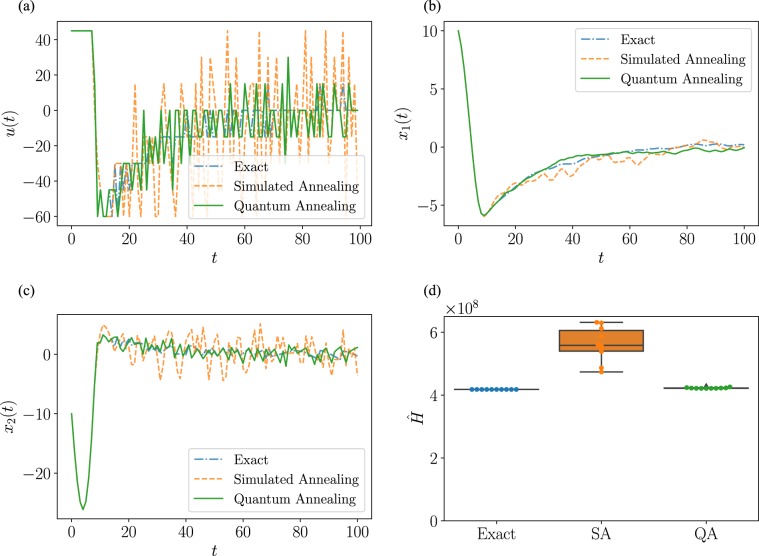
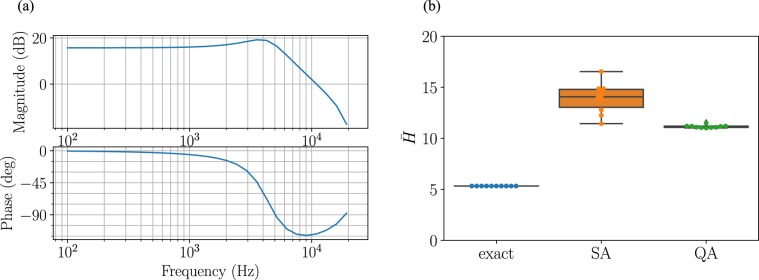
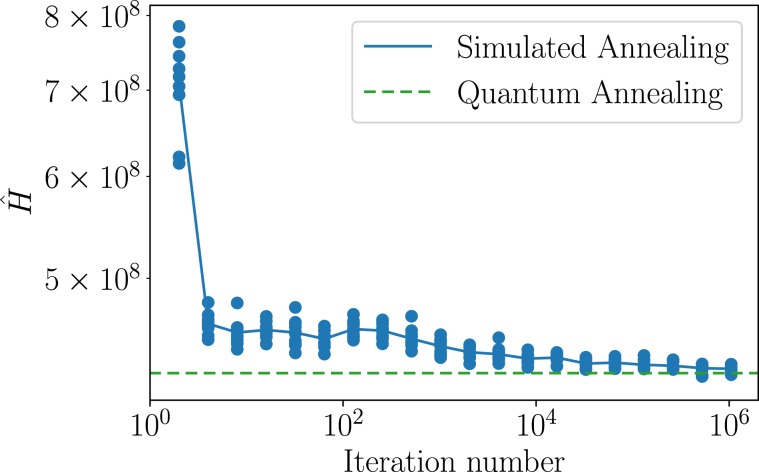
The D-Wave quantum annealer has emerged as a novel computational architecture that is attracting significant interest, but there have been only a few practical algorithms exploiting the power of quantum annealers. Here we present a model predictive control (MPC) algorithm using a quantum annealer for a system allowing a finite number of input values. Such an MPC problem is classified as a non-deterministic polynomial-time-hard combinatorial problem, and thus real-time sequential optimization is difficult to obtain with conventional computational systems. We circumvent this difficulty by converting the original MPC problem into a quadratic unconstrained binary optimization problem, which is then solved by the D-Wave quantum annealer. Two practical applications, namely stabilization of a spring-mass-damper system and dynamic audio quantization, are demonstrated. For both, the D-Wave method exhibits better performance than the classical simulated annealing method. Our results suggest new applications of quantum annealers in the direction of dynamic control problems.
Overview
The claims and statistics of this paper haven’t been checked yet.
Run the check — free, no account needed. It reads the open-access text and checks the sources it cites.
Integrity signals
Registry
Cites
Statistics
Figures
Verification
Claims the paper makes
The claims and statistics of this paper haven’t been checked yet.
Run the check — free, no account needed. It reads the open-access text and checks the sources it cites.
Claims other papers make about this one
Each is checked against this paper’s own text: does it say what the citing paper says it does?
The cited source says what the claim attributes to it.
In the citing paper
“Further problems that have been treated with the standard QA approaches include: max-sum diversification [13], model-predictive control [71], the tiling puzzle problem [41], and image acquisition planning for earth observation satellites [128].”
From Quantum Combinatorial Optimization in the NISQ Era: A Systematic Mapping Study (2024) · cites this paper as [71]
Self-check
Percentages, sums and reported differences re-computed from the paper’s own numbers.
The self-check needs the paper’s full text.
Citations
Cites
An Introduction to Genetic Algorithms
Mitchell, M. (1996) · doi:10.7551/mitpress/3927.001.0001 · Cited by 11,340
Handbook of Genetic Algorithms
Davis, L. D. (1991) · Cumulative Index of Computer Aided Architectural Design · Cited by 7,330
A survey of industrial model predictive control technology
Qin, S. J., & Badgwell, T. A. (2003) · Control Engineering Practice · doi:10.1016/s0967-0661(02)00186-7 · Cited by 5,111
(2002) · Society for Industrial and Applied Mathematics eBooks · doi:10.1137/1.9780898718515 · Cited by 4,049
Stability of networked control systems
Zhang, W., Branicky, M. S., & Phillips, S. M. (2001) · IEEE Control Systems · doi:10.1109/37.898794 · Cited by 3,461
Control of systems integrating logic, dynamics, and constraints
Bemporad, A., & Morari, M. (1999) · Automatica · doi:10.1016/s0005-1098(98)00178-2 · Cited by 3,048
Glover, F., & Laguna, M. (1997) · doi:10.1007/978-1-4615-6089-0 · Cited by 3,001
Psychoacoustics: facts and models
Fastl, H., & Zwicker, E. (1991) · Choice Reviews Online · doi:10.5860/choice.28-5706 · Cited by 2,406
Quantum annealing in the transverse Ising model
Kadowaki, T., & Nishimori, H. (1998) · Physical Review E · doi:10.1103/physreve.58.5355 · Cited by 2,339
Model predictive control: past, present and future
Morari, M., & H. Lee, J. (1999) · Computers & Chemical Engineering · doi:10.1016/s0098-1354(98)00301-9 · Cited by 2,335
Research works printed but not linked: 1
- W. Johnson, M. Future Hardware Directions of Quantum Annealing. In Qubits Europe 2018 D-Wave Users Conference (Munich, 2018).
Cited by
Sorted by citations
Traffic signal optimization on a square lattice with quantum annealing
Inoue, D., Okada, A., MATSUMORI, T., Aihara, K., & Yoshida, H. (2021) · Scientific Reports · doi:10.1038/s41598-021-82740-0 · Cited by 124
Self-citationImplementation of Quantum Annealing: A Systematic Review
Yulianti, L. P., & Surendro, K. (2022) · IEEE Access · doi:10.1109/access.2022.3188117 · Cited by 68
Models in quantum computing: a systematic review
Nimbe, P., Weyori, B. A., & Adekoya, A. F. (2021) · Quantum Information Processing · doi:10.1007/s11128-021-03021-3 · Cited by 55
How to Solve Combinatorial Optimization Problems Using Real Quantum Machines: A Recent Survey
Heng, S., Kim, D., Kim, T.-K., & Han, Y. (2022) · IEEE Access · doi:10.1109/access.2022.3218908 · Cited by 34
Dynamic optimization based on quantum computation-A comprehensive review
Kou, H., Zhang, Y., & Lee, H. P. (2023) · Computers & Structures · doi:10.1016/j.compstruc.2023.107255 · Cited by 21
Metadata
- Authors
- Inoue, D., & Yoshida, H.
- Affiliations
- Toyota Central Research and Development Laboratories (Japan) (JP)
- Corresponding author
- Inoue, Daisuke
- Venue
- Scientific Reports
- Published
- 2020-01-31
- Volume
- 10
- Issue
- 1
- Pages
- 1591-1591
- ISSN
- 2045-2322 (ISSN-L)
- PMC
- PMC6994678
- OpenAlex
- W3004136046
- Cited by
- 39
- References
- 44
- Citations by year
- 2026: 3 · 2025: 5 · 2024: 18 · 2023: 8 · 2022: 3 · 2021: 2
- FWCI
- 1.60
- Type
- journal article
- Language
- en
- Open access
- gold
- doi.org
- Locations
- Scientific Reports (publishedVersion, cc-by)
- PubMed Central (publishedVersion, cc-by)
- PubMed (publishedVersion)
- arXiv (Cornell University) (submittedVersion)
- DOAJ (DOAJ: Directory of Open Access Journals) (submittedVersion)
- arXiv (Cornell University)
- Topics
- Physical Sciences › Engineering › Control and Systems Engineering › Advanced Control Systems Optimization
- Physical Sciences › Computer Science › Artificial Intelligence › Quantum Computing Algorithms and Architecture
- Physical Sciences › Mathematics › Numerical Analysis › Advanced Optimization Algorithms Research
- Keywords
- model predictive control, D-Wave quantum annealer, quantum annealing, QUBO, combinatorial optimization, mass-spring-damper system, simulated annealing comparison, dynamic control
About these checks
Registry, retraction, Cites and statistics results are computed, not judged, with one exception: a printed reference that no index lists is read once by a model before it counts as a citation error. Claims are extracted by a model and kept only when their quote appears verbatim in the text; each cited source is then checked, with a model’s help, for whether it says what the claim relies on. Those verdicts can be wrong — read the claim’s quote and the cited source before relying on one.
Statistics and arithmetic are recomputed, not judged.
Confidence bands are shown only for fields calibrated on our annotated test set. None is calibrated yet, so no band is shown.
What counts as a claim ›How we measure confidence ›How we check this ›
Are you an author, or do you see a problem with this page? Request a review
