

Tracing multi-isotopically labelled CdSe/ZnS quantum dots in biological media
Open accessThe DOI matches its Crossref record; 35 of the 35 references it cites were found in a registry or an index; none of the 26 sources its claims cite is checked for support yet.
Abstract
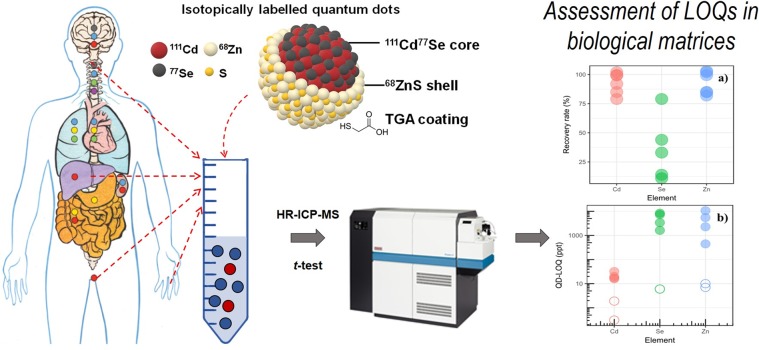
The strengths and limits of isotopically labelled Engineered Nanoparticles (spiked ENPs) spread in biological media have been assessed. Multi-spiked CdSe/ZnS quantum dots (QDs), measuring 7 nm and coated with thioglycolic acid (TGA), were synthesized and enriched in 68 Zn, 77 Se and 111 Cd. These QDs were dispersed at very low concentrations (0.1 to 5000 ppt) in diverse biological matrices (synthetic saliva, synthetic urine, plasma and Dulbecco’s phosphate buffered saline - DPBS growth medium) and the isotopic compositions were determined by HR-ICP-MS. The initial QDs concentrations were calculated to assess the limit of quantification (QD-LOQ) according to the matrix and the isotopically enriched element. The obtained results demonstrated the advantages of the isotopic labelling method in order to work at very low concentrations: the QD-LOQ values for the spiked Zn, Cd and Se originated from the QDs were 10, 0.3 and 6 ppt, respectively, which is below the conventional LOQ of the HR-ICP-MS used (30, 3 and 60 ppt for Zn, Cd and Se, respectively). Conversely, in complex matrices such as saliva, urine, plasma and DPBS growth medium, the QD-LOQ values increased significantly, with values ranging from 16 to 32 ppt for Cd, 446 to 10598 ppt for Zn and 1618 to 8317 ppt for Se. These QD-LOQs are dependent on factors as the elemental background concentration already present in the matrices, and the dilution factor. In this study, the QD-LOQs are expressed for the first time with respect to the background concentration in biological media (QD-RLOQ), which can be used to better assess and then predict the efficiency of the spiking method.
Overview
CoChat Summary
TL;DR
Multi-isotopically labelled CdSe/ZnS quantum dots were synthesized and tested in biological matrices to determine HR-ICP-MS quantification limits. Isotopic labelling enabled detection below conventional LOQs in simple media, but QD-LOQs rose in complex matrices depending on background concentration and dilution.
Key findings
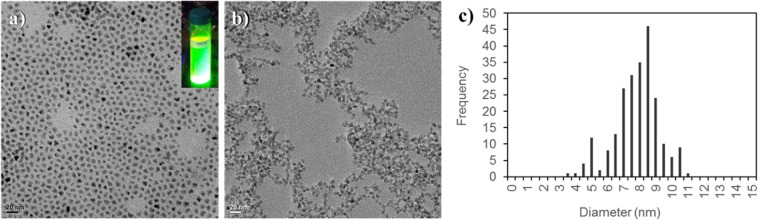
- Multi-spiked CdSe/ZnS QDs enriched in 68Zn, 77Se and 111Cd, TGA-coated and measuring 7.6 ± 1.6 nm (n = 230), were dispersed at 0.1–5000 ppt in synthetic saliva, synthetic urine, rat plasma and DPBS growth medium.
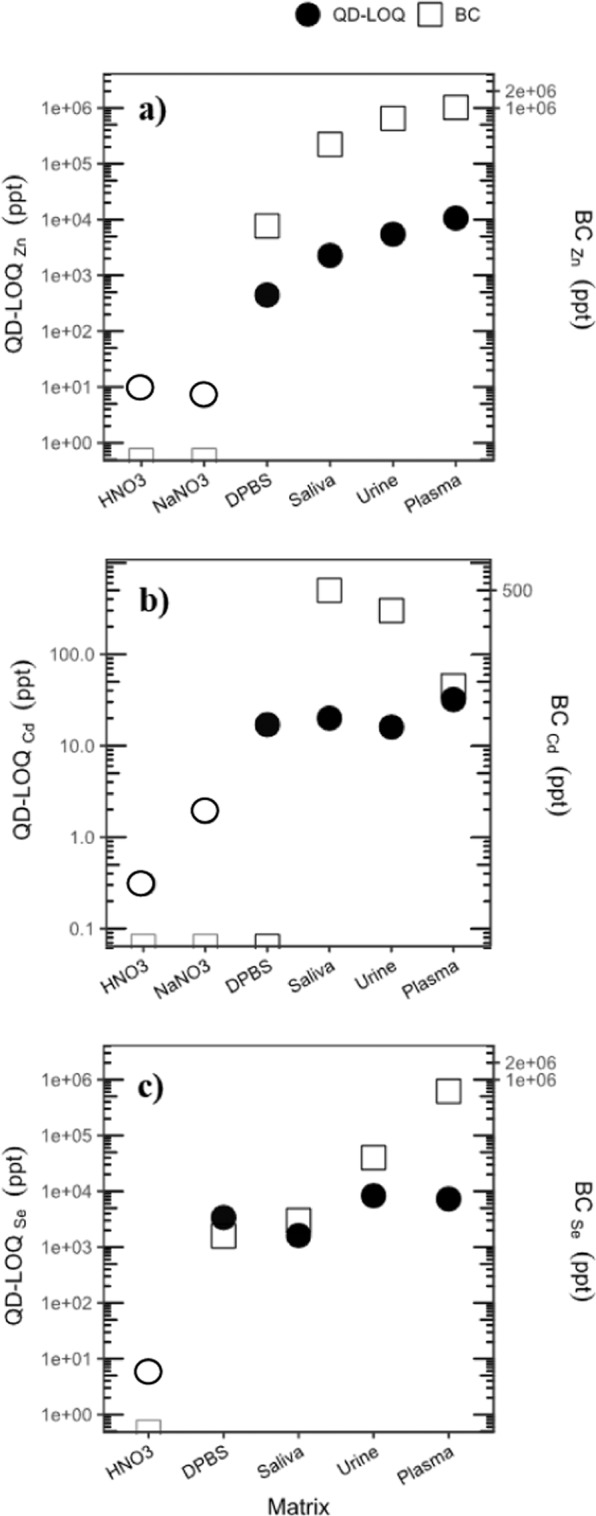
- In simple media, QD-LOQs were 10, 0.3 and 6 ppt for Zn, Cd and Se in HNO3 2%, and 7 and 2 ppt for Zn and Cd in NaNO3 0.01 M, below the conventional HR-ICP-MS LOQs of 30, 3 and 60 ppt for Zn, Cd and Se.
- In biological matrices, QD-LOQs increased to 446–10598 ppt for Zn, 16–32 ppt for Cd and 1618–8317 ppt for Se; specific values were saliva 2275/20/1618 ppt, urine 5459/16/8317 ppt, plasma 10598/32/7291 ppt and DPBS 446/17/3388 ppt for Zn/Cd/Se.
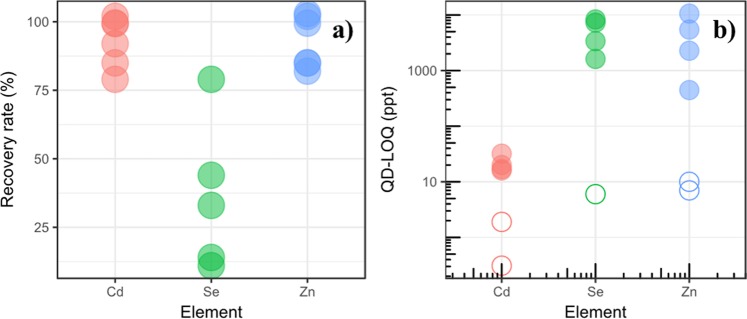
- Recovery rates were 93 ± 9.9% for Cd and 93 ± 10% for Zn, but only 11–79% for Se; QD-RLOQs in biological matrices ranged from 0.8–5.5% for Zn, 4–42% for Cd and 1.0–68% for Se, with Zn QD-LOQ correlated to background concentration (r² = 0.9957) and Cd QD-LOQ correlated to dilution factor (r² = 0.8237).
Methods
- Multi-spiked CdSe/ZnS QDs were synthesized by adapting Bae et al., substituting 68Zn-enriched ZnO, 111Cd-enriched CdO and 77Se-enriched Se, then TGA-functionalized; characterization used UV-Vis, fluorescence, TEM, EDXS, ICP-OES and HR-ICP-MS.
- QDs were added to synthetic saliva, synthetic urine, rat plasma, DPBS and control HNO3 2%/NaNO3 0.01 M at target Zn concentrations of 0.1, 10, 50, 100, 1000 and 5000 ppt (Cd 0.03–1500 ppt; Se 0.02–1000 ppt), with triplicates; samples were acidified and biological matrices diluted 50-fold before HR-ICP-MS analysis with Rh internal standard.
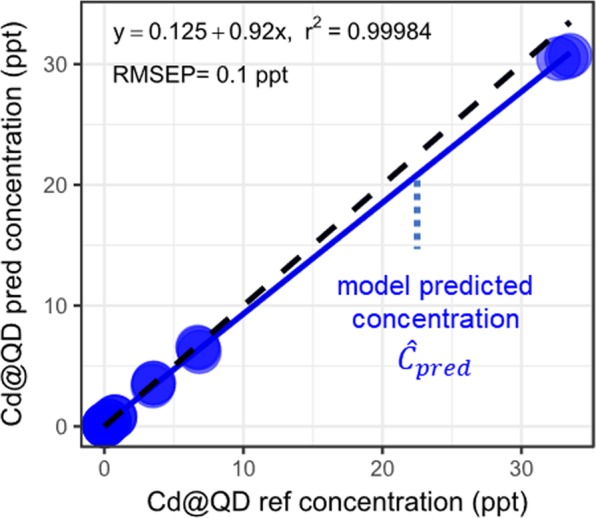
- QD concentrations were calculated from isotopic contrast; recovery plots, RMSEP, t-tests at 99.9% confidence, ANOVA and linear models were used to determine QD-LOQs and factors affecting them, and QD-RLOQ was calculated as QD-LOQ/(QD-LOQ + background concentration) × 100.
Limitations
- Stated: Se recovery was poor (11–79%) because Se required high-resolution ICP-MS and suffered polyatomic interferences, so Se QD-LOQs were not discussed further; QD-LOQ estimates were considered conservative because few experimental points were near the LOQ and RMSEP was calculated over several decades.
- Stated: the study assesses analytical limits in selected matrices rather than in vivo fate or toxicity, and the authors note that the limitations of isotopic labelling for NPs in biological matrices had not previously been studied.
- Evident from the text: only four matrices were tested, including artificial saliva and urine and rat plasma, all biological samples were 50-fold diluted, and the QD-RLOQ for Cd in DPBS could not be calculated because background Cd was below the HR-ICP-MS LOQ.
Model-written summary. Check it against the paper before relying on it.
Integrity signals
Registry
Cites
Statistics
Figures
Verification
Claims the paper makes
0 Valid · 3 Not valid · 13 Not checked · 91 Own results and interpretations
A result the paper states — it cites no source for it, so there is none to check. The quote shows it is in the paper.
In the paper
“The signal measured is then approximately 3% of the total signal measured in LR, which is related to the resolution slit width that defines the mass resolution, R (RLR = 300, RMR = 4000 and RHR = 10000).”
§ Tracing multi-isotopically labelled CdSe/ZnS quantum dots in biological media > Results and Discussion > Analytical performance and limit of quantification of the QDs (QD-LOQ)
plainstates an association- Asserted: passes — The authors put it forward as true.
- Checkable: passes — It can be checked against evidence.
- Load-bearing: passes — The paper’s conclusions depend on it.
- Based: passes — The paper gives a reason why it holds.
A result the paper reports from its own data — it cites no other source for it, so there is none to check. The quote shows it is in the paper.
In the paper
“This is proven by the recovery plot obtained for the blood plasma matrix which has a better recovery rate for Se (79%) when working at higher QD concentrations.”
§ Tracing multi-isotopically labelled CdSe/ZnS quantum dots in biological media > Results and Discussion > Analytical performance and limit of quantification of the QDs (QD-LOQ)
boostedstates an association- Asserted: passes — The authors put it forward as true.
- Checkable: passes — It can be checked against evidence.
- Load-bearing: unclear — It is unclear whether the paper’s conclusions depend on it.
- Based: passes — The paper gives a reason why it holds.
A result the paper reports from its own data — it cites no other source for it, so there is none to check. The quote shows it is in the paper.
In the paper
“They are excellent for Cd and Zn at 93 ± 9.9% and 93 ± 10% on average for the studied biological matrices.”
§ Tracing multi-isotopically labelled CdSe/ZnS quantum dots in biological media > Results and Discussion > Analytical performance and limit of quantification of the QDs (QD-LOQ)
plain- Asserted: passes — The authors put it forward as true.
- Checkable: passes — It can be checked against evidence.
- Load-bearing: passes — The paper’s conclusions depend on it.
- Based: passes — The paper gives a reason why it holds.
A result the paper reports from its own data — it cites no other source for it, so there is none to check. The quote shows it is in the paper.
In the paper
“Conversely, in complex matrices such as saliva, urine, plasma and DPBS growth medium, the QD-LOQ values increased significantly, with values ranging from 16 to 32 ppt for Cd, 446 to 10598 ppt for Zn and 1618 to 8317 ppt for Se.”
§ Tracing multi-isotopically labelled CdSe/ZnS quantum dots in biological media > Abstract
plain- Asserted: passes — The authors put it forward as true.
- Checkable: passes — It can be checked against evidence.
- Load-bearing: passes — The paper’s conclusions depend on it.
- Based: passes — The paper gives a reason why it holds.
A result the paper reports from its own data — it cites no other source for it, so there is none to check. The quote shows it is in the paper.
In the paper
“The count numbers were furthered lowered by the fact that the QD concentrations calculated from Se were lower on average than those for Cd and Zn, respectively.”
§ Tracing multi-isotopically labelled CdSe/ZnS quantum dots in biological media > Results and Discussion > Analytical performance and limit of quantification of the QDs (QD-LOQ)
plain- Asserted: passes — The authors put it forward as true.
- Checkable: passes — It can be checked against evidence.
- Load-bearing: passes — The paper’s conclusions depend on it.
- Based: passes — The paper gives a reason why it holds.
57 more claims
Create a free account to see all 107 claims and to verify the 22 references still open.
- It may state two separate claims as one. 26
- Probably not a substantial claim. 21
- The quote only partly states this claim. 1
Self-check
Percentages, sums and reported differences re-computed from the paper’s own numbers.
Each contradiction between two passages listed here was confirmed by an independent check.
Rated minor: it would not touch a result — a value no result rests on, a p-value that stays on the same side of the significance level, or a conflict that is clerical, resolved elsewhere in the paper, or outside its own findings.
In the paper
§ Tracing multi-isotopically labelled CdSe/ZnS quantum dots in biological media > Experimental Section > Choice of biological matrices
“Cd and Se with natural isotopic compositions were also added into the solution given that their usual concentrations in human urine are 0.5 and 3 ppb, respectively26,27.”
§ Tracing multi-isotopically labelled CdSe/ZnS quantum dots in biological media > Introduction
“human urine contains ca. 650, 0.2 and 40 ppb of Zn, Cd and Se”
Rated minor: it would not touch a result — a value no result rests on, a p-value that stays on the same side of the significance level, or a conflict that is clerical, resolved elsewhere in the paper, or outside its own findings.
In the paper
§ Tracing multi-isotopically labelled CdSe/ZnS quantum dots in biological media > Experimental Section > Choice of biological matrices
“Zn, Cd and Se with natural isotopic compositions were also added into the solution to obtain the average concentrations found in human urine of 650, 0.2 and 40 ppb, respectively11–13.”
§ Tracing multi-isotopically labelled CdSe/ZnS quantum dots in biological media > Results and Discussion > Analytical performance and limit of quantification of the QDs (QD-LOQ)
“| Cd | BC (ppt) | <LOQCd | <LOQCd | 500 | 300 | 45 | <LOQCd |”
Citations
Cites
Murray, C. B., Norris, D. J., & Bawendi, M. G. (1993) · Journal of the American Chemical Society · doi:10.1021/ja00072a025 · Cited by 9,282
In vivo cancer targeting and imaging with semiconductor quantum dots
Gao, X., Cui, Y., Levenson, R. M., Chung, L. W. K., & Nie, S. (2004) · Nature Biotechnology · doi:10.1038/nbt994 · Cited by 4,772
PLAQUE FORMATION AND ISOLATION OF PURE LINES WITH POLIOMYELITIS VIRUSES
Dulbecco, R., & Vogt, M. (1954) · Journal of Experimental Medicine · doi:10.1084/jem.99.2.167 · Cited by 3,824
Industrial production quantities and uses of ten engineered nanomaterials in Europe and the world
Piccinno, F., Gottschalk, F., Seeger, S., & Nowack, B. (2012) · Journal of Nanoparticle Research · doi:10.1007/s11051-012-1109-9 · Cited by 1,280
Yoffe, A. D. (2001) · Advances in Physics · doi:10.1080/00018730010006608 · Cited by 1,253
The Quantum Mechanics of Larger Semiconductor Clusters ("Quantum Dots")
Bawendi, M. G., Steigerwald, M. L., & Brus, L. E. (1990) · Annual Review of Physical Chemistry · doi:10.1146/annurev.pc.41.100190.002401 · Cited by 1,158
Environmental concentrations of engineered nanomaterials: Review of modeling and analytical studies
Gottschalk, F., Sun, T., & Nowack, B. (2013) · Environmental Pollution · doi:10.1016/j.envpol.2013.06.003 · Cited by 1,092
The errant life of a heavy quark in the quark–gluon plasma
Meyer, H. B. (2011) · New Journal of Physics · doi:10.1088/1367-2630/13/3/035008 · Cited by 603
Single-Step Synthesis of Quantum Dots with Chemical Composition Gradients
Bae, W. K., Char, K., Hur, H., & Lee, S. (2008) · Chemistry of Materials · doi:10.1021/cm070754d · Cited by 523
Quantum Dots for Live Cell and In Vivo Imaging
Walling, M. A., Novak, J. A., & Shepard, J. R. E. (2009) · International Journal of Molecular Sciences · doi:10.3390/ijms10020441 · Cited by 511
Gaceur, M., Giraud, M., Hémadi, M., Nowak, S., Menguy, N., Quisefit, J. P., David, K., Jahanbin, T., Benderbous, S., Boissière, M., et al. (2012) · Journal of Nanoparticle Research · doi:10.1007/s11051-012-0932-3 · Cited by 322
Synthesis, Stabilization, and Electronic Structure of Quantum Semiconductor Nanoclusters
Steigerwald, M. L., & Brus, L. E. (1989) · Annual Review of Materials Science · doi:10.1146/annurev.ms.19.080189.002351 · Cited by 310
Wang, D., Du, X., & Zheng, W. (2007) · Toxicology Letters · doi:10.1016/j.toxlet.2007.10.003 · Cited by 173
Viscosity and wettability of animal mucin solutions and human saliva
Park, M., Chung, J., Kim, Y., Chung, S., & Kho, H. (2006) · Oral Diseases · doi:10.1111/j.1601-0825.2006.01263.x · Cited by 133
Urinary selenium concentrations
Sanz Alaejos, M., & Díaz Romero, C. (1993) · Clinical Chemistry · doi:10.1093/clinchem/39.10.2040 · Cited by 123
Quercetin loading CdSe/ZnS nanoparticles as efficient antibacterial and anticancer materials
Yang, X., Zhang, W., Zhao, Z., Li, N., Mou, Z., Sun, D., Cai, Y., Wang, W., & Lin, Y. (2016) · Journal of Inorganic Biochemistry · doi:10.1016/j.jinorgbio.2016.11.023 · Cited by 104
Jackson, B. P., Bugge, D., Ranville, J. F., & Chen, C. Y. (2012) · Environmental Science & Technology · doi:10.1021/es202864r · Cited by 97
Błażewicz, A., Klatka, M., Astel, A., Partyka, M., & Kocjan, R. (2013) · Biological Trace Element Research · doi:10.1007/s12011-013-9783-8 · Cited by 79
Croteau, M.-N., Luoma, S. N., & Pellet, B. (2007) · Aquatic Toxicology · doi:10.1016/j.aquatox.2007.03.016 · Cited by 71
Bourgeault, A., Cousin, C., Geertsen, V., Cassier-Chauvat, C., Chauvat, F., Durupthy, O., Chanéac, C., & Spalla, O. (2015) · Environmental Science & Technology · doi:10.1021/es504638f · Cited by 70
Synthesis of isotopically modified ZnO nanoparticles and their potential as nanotoxicity tracers
Dybowska, A. D., Croteau, M.-N., Misra, S. K., Berhanu, D., Luoma, S. N., Christian, P., O’Brien, P., & Valsami-Jones, E. (2011) · Environmental Pollution · doi:10.1016/j.envpol.2010.08.032 · Cited by 62
Laycock, A., Diez-Ortiz, M., Larner, F., Dybowska, A., Spurgeon, D., Valsami-Jones, E., Rehkämper, M., & Svendsen, C. (2016) · Environmental Science & Technology · doi:10.1021/acs.est.5b03413 · Cited by 62
The influence of humic acid on the toxicity of nano‐ZnO and Zn2+ to the Anabaena sp.
Tang, Y., Li, S., Lu, Y., Li, Q., & Yu, S. (2015) · Environmental Toxicology · doi:10.1002/tox.21964 · Cited by 51
Rabe, S. (2004) · Chemical Senses · doi:10.1093/chemse/bjh020 · Cited by 46
Khan, F. R., Laycock, A., Dybowska, A., Larner, F., Smith, B. D., Rainbow, P. S., Luoma, S. N., Rehkämper, M., & Valsami-Jones, E. (2013) · Environmental Science & Technology · doi:10.1021/es4011465 · Cited by 42
Aggregation, Sedimentation, Dissolution, and Bioavailability of Quantum Dots in Estuarine Systems
Xiao, Y., Ho, K. T., Burgess, R. M., & Cashman, M. (2017) · Environmental Science & Technology · doi:10.1021/acs.est.6b04475 · Cited by 39
Sono-Electroanalytical Determination of Lead in Saliva
West, C. E., Hardcastle, J. L., & Compton, R. G. (2002) · Electroanalysis · doi:10.1002/1521-4109(200211)14:21<1470::aid-elan1470>3.0.co;2-9 · Cited by 35
Cellulosic micelles as nanocapsules of liposoluble CdSe/ZnS quantum dots for bioimaging
Li, Y., Zhang, J., Guo, Y., Chen, M., Wang, L., Sun, R., & Wang, X. (2016) · Journal of Materials Chemistry B · doi:10.1039/c6tb01534d · Cited by 34
Supiandi, N. I., Charron, G., Tharaud, M., Cordier, L., Guigner, J.-M., Benedetti, M. F., & Sivry, Y. (2019) · Environmental Science & Technology · doi:10.1021/acs.est.8b04096 · Cited by 27
Self-citationPatterned mist deposition of tri-colour CdSe/ZnS quantum dot films toward RGB LED devices
Pickering, S., Kshirsagar, A., Ruzyllo, J., & Xu, J. (2012) · Opto-Electronics Review · doi:10.2478/s11772-012-0019-9 · Cited by 26
What is a Convincing Photoluminescence Quantum Yield of Fluorescent Nanocrystals
Xu, S., Wang, C., Xu, Q., Li, R., Shao, H., Zhang, H., Fang, M., Lei, W., & Cui, Y. (2010) · The Journal of Physical Chemistry C · doi:10.1021/jp100696e · Cited by 22
Far, J., Bérail, S., Preud’homme, H., & Łobiński, R. (2010) · Journal of Analytical Atomic Spectrometry · doi:10.1039/c004933f · Cited by 20
Sivry, Y., Riotte, J., Sappin‐Didier, V., Munoz, M., Redon, P.-O., Denaix, L., & Dupré, B. (2011) · Environmental Science & Technology · doi:10.1021/es2006644 · Cited by 20
Self-citationShiotsuki, T., Yoshitome, K., & Moriya, F. (2012) · Forensic Toxicology · doi:10.1007/s11419-012-0142-9 · Cited by 16
Selenium concentration in human saliva
Hadjimarkos, D. M., & Shearer, T. R. (1971) · American Journal of Clinical Nutrition · doi:10.1093/ajcn/24.10.1210 · Cited by 15
Research works printed but not linked: 1
- ATSDR USA, Toxicological Profile for Cadmium. U.S. Department of Health and Human Services Public Health Service Agency for Toxic Substances and Disease Registry, (2012). 24049863
Cited by
Nanoparticle Recognition on Scanning Probe Microscopy Images Using Computer Vision and Deep Learning
Okunev, A. G., Mashukov, M. Y., Nartova, A. V., & Matveev, A. V. (2020) · Nanomaterials · doi:10.3390/nano10071285 · Cited by 205
Bechu, A. M., Liao, J., Huang, C., Ahn, C., McKeague, M., Ghoshal, S., & Moores, A. (2021) · ACS Applied Nano Materials · doi:10.1021/acsanm.1c01659 · Cited by 53
Carboni, A., Slomberg, D. L., Nassar, M., Santaella, C., Masion, A., Rose, J., & Auffan, M. (2021) · Environmental Science & Technology · doi:10.1021/acs.est.1c02221 · Cited by 39
Sheng, X., Li, S., Zhan, Y., Guo, J., Zhou, B., Zhao, J., Li, Z., Liu, M., Li, Y., Qu, T., et al. (2021) · Spectrochimica Acta Part A Molecular and Biomolecular Spectroscopy · doi:10.1016/j.saa.2021.120136 · Cited by 33
El-Barbary, G., Ahmed, M., El-desoky, M. M., Al‐Enizi, A. M., Alothman, A. A., Alotaibi, A. M., & Nafady, A. (2021) · Synthetic Metals · doi:10.1016/j.synthmet.2021.116824 · Cited by 32
Metadata
- Authors
- Supiandi, N. I., Charron, G., Tharaud, M., Benedetti, M. F., & Sivry, Y.
- Affiliations
- Centre National de la Recherche Scientifique (FR)
- Université Paris Cité (FR)
- Corresponding author
- Sivry, Y.
- Venue
- Scientific Reports
- Published
- 2020-02-18
- Volume
- 10
- Issue
- 1
- Pages
- 2866-2866
- ISSN
- 2045-2322 (ISSN-L)
- PMC
- PMC7028726
- OpenAlex
- W3007177044
- Cited by
- 10
- References
- 35
- Citations by year
- 2022: 2 · 2021: 5 · 2020: 3
- FWCI
- 0.98
- Type
- journal article
- Language
- en
- Open access
- gold
- doi.org
- Licence
- cc-by
- creativecommons.org/licenses/by/4.0 (tdm)
- creativecommons.org/licenses/by/4.0 (vor)
- Locations
- Scientific Reports (publishedVersion, cc-by)
- Europe PMC (PubMed Central) (publishedVersion, cc-by)
- PubMed (publishedVersion)
- PubMed Central (publishedVersion, cc-by)
- HAL (submittedVersion, cc-by)
- Funders
- Agence Nationale de Sécurité Sanitaire de l’Alimentation, de l’Environnement et du Travail
- Institut de Physique du Globe de Paris (12015908)
- Topics
- Physical Sciences › Chemistry › Analytical Chemistry › Analytical chemistry methods development
- Physical Sciences › Materials Science › Materials Chemistry › Quantum Dots Synthesis And Properties
- Physical Sciences › Environmental Science › Health, Toxicology and Mutagenesis › Heavy Metal Exposure and Toxicity
- Keywords
- CdSe/ZnS quantum dots, isotopic labeling, engineered nanoparticles, limit of quantification, 68Zn, 77Se, 111Cd, saliva, urine, plasma
About these checks
Registry, retraction, Cites and statistics results are computed, not judged, with one exception: a printed reference that no index lists is read once by a model before it counts as a citation error. Claims are extracted by a model and kept only when their quote appears verbatim in the text; each cited source is then checked, with a model’s help, for whether it says what the claim relies on. Those verdicts can be wrong — read the claim’s quote and the cited source before relying on one.
A language model drew the claims from the paper on 2026-11-19, under version 3 of the claim definition (model deepseek-v4.1-flash, prompt extract-v3).
A second model labelled each claim on 2026-11-19 (model jev-1.13-20260917, definition revision gold-guideline-v0.2).
Statistics and arithmetic are recomputed, not judged.
Confidence bands are shown only for fields calibrated on our annotated test set. None is calibrated yet, so no band is shown.
What counts as a claim ›How we measure confidence ›How we check this ›
Are you an author, or do you see a problem with this page? Request a review
Data sources
Bibliographic data: Semantic Scholar, OpenAlex, Crossref.
Contains information from the Semantic Scholar Academic Graph Datasets, made available under the ODC Attribution License (ODC-BY 1.0).
Semantic Scholar’s data is described in: Kinney, R., et al. (2023). The Semantic Scholar Open Data Platform. arXiv:2301.10140.
