

Cadmium and Mercury phytostabilization from soil using Miscanthus × giganteus
Open accessThe DOI matches its Crossref record; 60 of the 60 references it cites were found in a registry or an index.
Abstract
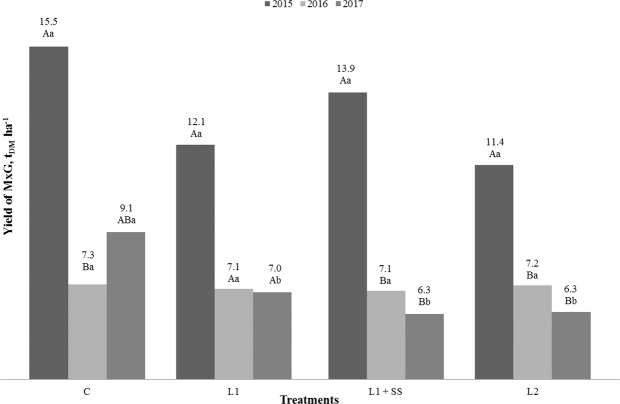
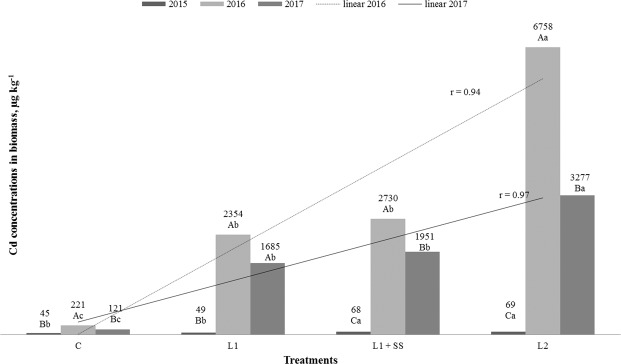
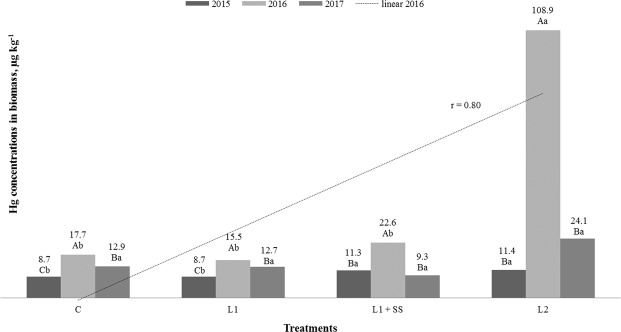
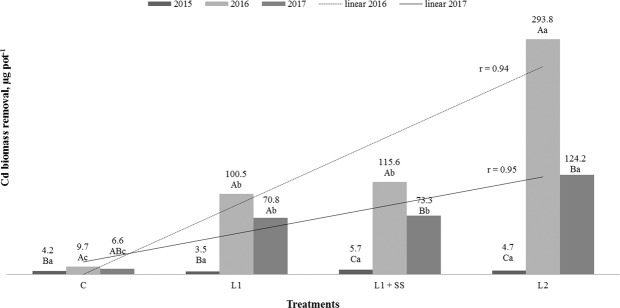
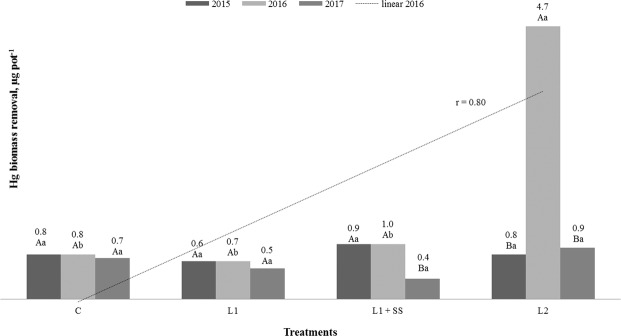
The determination of the effects of cadmium and mercury on the growth, biomass productivity and phytoremediation potential of Miscanthus × giganteus (MxG) grown on contaminated soil was the main aim of this paper. The use of bioenergy plants as an innovative strategy in phytotechnology gives additional benefits, including mitigation and adaptation to climate change, and soil remediation without affecting soil fertility. An experiment was set up as a randomized complete block design with the treatments varied in concentrations of Cd (0, 10 and 100 mg kg−1 soil) and Hg (0, 2 and 20 mg kg−1 soil) added to the soil. Three vegetative years were studied. Yield values ranged from 6.3–15.5 t DM ha−1, cadmium concentration in plants varied from 45–6758 µg kg−1 and Hg varied from 8.7–108.9 µg kg−1. Values between treatments and years were significantly different. MxG can accumulate and remove very modest amount (up to 293.8 µg Cd and 4.7 µg Hg) per pot per year in aboveground biomass. Based on this data it can be concluded that MxG, as a valuable energy crop, is a potential candidate for the phytostabilization and biomass production on soils contaminated with Cd and Hg moderately.
Overview
The claims and statistics of this paper haven’t been checked yet.
Free: it reads the open-access text and checks the first 5 claims that cite a source we can check. Create a free account to check every claim.
Integrity signals
Registry
Cites
Statistics
Figures
Verification
Claims the paper makes
The claims and statistics of this paper haven’t been checked yet.
Free: it reads the open-access text and checks the first 5 claims that cite a source we can check. Create a free account to check every claim.
Claims other papers make about this one
Each is checked against this paper’s own text: does it say what the citing paper says it does?
The cited source says what the claim attributes to it.
In the citing paper
“The last decade witnessed an increasing number of papers demonstrating the capacity of this species to produce energy-dedicated biomass on TE-contaminated soils (Pogrzeba et al., 2013; Jeżowski et al., 2017; Zgorelec et al., 2020).”
From Potentials of Miscanthus x giganteus for phytostabilization of trace element-contaminated soils: Ex situ experiment (2021) · cites this paper as Zgorelec et al., 2020
Self-check
Percentages, sums and reported differences re-computed from the paper’s own numbers.
The self-check needs the paper’s full text.
Citations
Cites
Trace Elements from Soil to Human
Kabata-Pendias, A., & Mukherjee, A. B. (2007) · Springer eBooks · doi:10.1007/978-3-540-32714-1 · Cited by 1,953
Remediation techniques for heavy metal-contaminated soils: principles and applicability
Liu, L., Li, W., Song, W., & Guo, M. (2018) · Science of The Total Environment · doi:10.1016/j.scitotenv.2018.03.161 · Cited by 1,828
Trace elements in agroecosystems and impacts on the environment
He, Z. L., Yang, X. E., & Stoffella, P. J. (2005) · Journal of Trace Elements in Medicine and Biology · doi:10.1016/j.jtemb.2005.02.010 · Cited by 1,772
Biodegradation and bioremediation
(1994) · Choice Reviews Online · doi:10.5860/choice.32-1511 · Cited by 1,663
Phytoremediation of heavy metal-contaminated land by trees—a review
Pulford, I. (2003) · Environment International · doi:10.1016/s0160-4120(02)00152-6 · Cited by 1,399
A comparison of technologies for remediation of heavy metal contaminated soils
Khalid, S., Shahid, M., Niazi, N. K., Murtaza, B., Bibi, I., & Dumat, C. (2017) · Journal of Geochemical Exploration · doi:10.1016/j.gexplo.2016.11.021 · Cited by 1,356
Challenges and opportunities in the phytoremediation of heavy metals contaminated soils: A review
Mahar, A., Wang, P., Ali, A., Awasthi, M. K., Lahori, A. H., Wang, Q., Li, R., & Zhang, Z. (2016) · Ecotoxicology and Environmental Safety · doi:10.1016/j.ecoenv.2015.12.023 · Cited by 1,203
Phytoremediation of metals: using plants to remove pollutants from the environment
Raskin, I., Smith, R. D., & Salt, D. E. (1997) · Current Opinion in Biotechnology · doi:10.1016/s0958-1669(97)80106-1 · Cited by 935
Phytoremediation: Environmentally sustainable way for reclamation of heavy metal polluted soils
Ashraf, S., Ali, Q., Zahir, Z. A., Ashraf, S., & Asghar, H. N. (2019) · Ecotoxicology and Environmental Safety · doi:10.1016/j.ecoenv.2019.02.068 · Cited by 919
A REVIEW ON PHYTOREMEDIATI ON OF HEAVY METALS AND UTILIZATION OF ITS BYPRODUCTS
GHOSH, M. (2005) · Applied Ecology and Environmental Research · doi:10.15666/aeer/0301_001018 · Cited by 905
Research works printed but not linked: 4
- Barbu, C. H., Pavel, B. P., Sand, C. & Pop, M. R. Miscanthus sinensis giganteus behavour on soil polluted with heavy metals: Metal Elements in Environment, Medicine and Biology. Paper presented at 9th International Symposium of Romanian Academy Branch, Cluj-Napoca, Romania (2009).
- Kalembasa D Malinowska E Influence of sewage sludge fertilization on heavy metal content in biomass of Miscanthus sacchariflorus during field experiment. Environ. Protect Engin. 2009 35 149 155
- Kalembasa D Malinowska E Influence of after effect of waste activated sludge used in soil of pot experiment on heavy metals content in Miscanthus sacchariflorus Acta. Agrophys. 2009 13 377 384
- Vasilj, D. Biometrics Experimentation in Plant Growth. University of Zagreb: Croatian Agronomy Society PRESS (In Croatian) (2000).
Cited by
Phytoremediation of Cadmium: Physiological, Biochemical, and Molecular Mechanisms
Raza, A., Habib, M., Kakavand, S. N., Zahid, Z., Zahra, N., Sharif, R., & Hasanuzzaman, M. (2020) · Biology · doi:10.3390/biology9070177 · Cited by 322
“Phyostabilization Organic fertilizers, biochar Immobilization of Cd by using biomolecules Virola surinamensis, Boehmeria nivea [86,91]”
BackgroundMethodPotential environmental pollution from copper metallurgy and methods of management
Izydorczyk, G., Mikula, K., Skrzypczak, D., Moustakas, K., Witek-Krowiak, A., & Chojnacka, K. (2021) · Environmental Research · doi:10.1016/j.envres.2021.111050 · Cited by 275
Bioaccumulation for heavy metal removal: a review
Nnaji, N. D., Onyeaka, H., Miri, T., & Ugwa, C. (2023) · SN Applied Sciences · doi:10.1007/s42452-023-05351-6 · Cited by 230
Poria, V., Dębiec-Andrzejewska, K., Fiodor, A., Lyzohub, M., Ajijah, N., Singh, S., & Pranaw, K. (2022) · Frontiers in Plant Science · doi:10.3389/fpls.2022.999866 · Cited by 121
“It involves a temporary accumulation of contaminants by plants in their belowground parts, which only immobilize and deactivate toxic metal ions instead of permanently removing them from the contaminated soil by forming metal complexes with root exudates, cell wall bonds, precipitates, or reducing HMs in the rhizosphe…”
BackgroundMiscanthus : A fast‐growing crop for environmental remediation and biofuel production
Wang, C., Kong, Y., Hu, R., & Zhou, G. (2021) · GCB Bioenergy · doi:10.1111/gcbb.12761 · Cited by 111
Cadmium toxicity symptoms and uptake mechanism in plants: a review
Shaari, N. E. M., Tajudin, M. T. F. M., Khandaker, M. M., Majrashi, A., Alenazi, M. M., Abdullahi, U. A., & Mohd, K. S. (2024) · Brazilian Journal of Biology · doi:10.1590/1519-6984.252143 · Cited by 148
Liu, A., Wang, W., Zheng, X., Chen, X., Fu, W., Wang, G., Ji, J., Jin, C., & Guan, C. (2022) · Chemosphere · doi:10.1016/j.chemosphere.2022.134900 · Cited by 118
Tiodar, E. D., Văcar, C. L., & Podar, D. (2021) · International Journal of Environmental Research and Public Health · doi:10.3390/ijerph18052435 · Cited by 118
Critical review on biogeochemical dynamics of mercury (Hg) and its abatement strategies
Singh, A. D., Khanna, K., Kour, J., Dhiman, S., Bhardwaj, T., Devi, K., Sharma, N., Kumar, P., Kapoor, N., Sharma, P., et al. (2023) · Chemosphere · doi:10.1016/j.chemosphere.2023.137917 · Cited by 112
Nguyen, T. T. V., Phan, A. N., Nguyen, T.-A., Nguyen, T. K., Nguyen, S. T., Pugazhendhi, A., & Hạ, H. K. P. (2022) · Chemosphere · doi:10.1016/j.chemosphere.2022.135834 · Cited by 98
Kumar, P., Gacem, A., Ahmad, M. T., Yadav, V. K., Singh, S., Yadav, K. K., Alam, M. M., Dawane, V., Piplode, S., Maurya, P., et al. (2022) · Frontiers in Environmental Science · doi:10.3389/fenvs.2022.949581 · Cited by 91
“…Precipitation Fluoride metals Ca(OH)2, Mg(OH)2, and CaCl2 Jadhav et al. (2014) Fe NH₄OH Maila et al. (2014) Zn2+ Lime Ghosh et al. (2011) Mn NaOH Zhang et al. (2010) Sulphide Precipitation Mn, Al, Mg, Zn, Sr, Co, Ni, Sb, Sn, Fe, Cu, Pb, Hg, Ce, and Cd Solid Na2S and Na2S solutions Prokkola et…”
Phytoremediation of Cadmium Polluted Soils: Current Status and Approaches for Enhancing
Subašić, M., Šamec, D., Selović, A., & Karalija, E. (2022) · Soil Systems · doi:10.3390/soilsystems6010003 · Cited by 76
“For Cd, several species could be used for phytostabilisation such as Virola surinamensis [73]; Miscanthus x giganteus [74], oats, white mustard [75].”
BackgroundAre Grasses Really Useful for the Phytoremediation of Potentially Toxic Trace Elements? A Review
Rabêlo, F. H. S., Vangronsveld, J., Baker, A. J. M., van der Ent, A., & Alleoni, L. R. F. (2021) · Frontiers in Plant Science · doi:10.3389/fpls.2021.778275 · Cited by 67
Phytoremediation as a viable ecological and socioeconomic management strategy
Phang, L.-Y., Mingyuan, L., Mohammadi, M., Tee, C.-S., Yuswan, M. H., Cheng, W.-H., & Lai, K.-S. (2024) · Environmental Science and Pollution Research · doi:10.1007/s11356-024-34585-z · Cited by 53
“Miscanthus plants also improved the soil biological factors (acid phosphatase, laccase, urease, basal respiration, fluorescein diacetate hydrolytic activity, and microbial biomass) (Zgorelec et al. 2020; Al Souki et al. 2021).”
Nsanganwimana, F., Al Souki, K. S., Waterlot, C., Douay, F., Pelfrêne, A., Ridošková, A., Louvel, B., & Pourrut, B. (2021) · Ecotoxicology and Environmental Safety · doi:10.1016/j.ecoenv.2021.112125 · Cited by 50
Bravo, G., Vega-Celedón, P., Gentina, J. C., & Seeger, M. (2020) · Microorganisms · doi:10.3390/microorganisms8121952 · Cited by 48
“The hybrid plant Miscanthus × giganteus showed a mercury removal rate of 4 μg year−1 in Hg-polluted soil (20 ppm) [43].”
BackgroundNemati, B., Baneshi, M. M., Akbari, H., Dehghani, R., & Mostafaii, G. R. (2024) · Scientific Reports · doi:10.1038/s41598-024-56214-y · Cited by 53
Yeheyo, H. A., Ealias, A. M., George, G., & Jagannathan, U. (2024) · Journal of Environmental Management · doi:10.1016/j.jenvman.2024.121409 · Cited by 38
Benefits and limitations of phytoremediation: Heavy metal remediation review
Adeoye, A. O., Adebayo, I. A., Afodun, A. M., & Ajijolakewu, K. A. (2021) · Elsevier eBooks · doi:10.1016/b978-0-323-89874-4.00002-9 · Cited by 51
Nguegang, B., Masindi, V., Msagati, T. A. M., & Tekere, M. (2021) · Minerals · doi:10.3390/min11050477 · Cited by 43
“To this end, pollutants are removed by a wetland via (i) phyto-extraction by the plants roots [39], (ii) phyto-stimulation, which is the breaking down of organics contaminants in plant root zone by microbial activity [40], (iii) phyto-degradation, which is the metabolization of contaminants in plant tissue to less tox…”
BackgroundMokrzycki, J., Magdziarz, A., & Rutkowski, P. (2022) · Biomass and Bioenergy · doi:10.1016/j.biombioe.2022.106550 · Cited by 36
Muratova, A. Y., Golubev, S., Romanova, V., Sungurtseva, I., & Nurzhanova, A. A. (2023) · Microorganisms · doi:10.3390/microorganisms11061516 · Cited by 42
Khanna, K., Kohli, S. K., Kaur, R., Handa, N., Bakshi, P., Sharma, P., Ohri, P., & Bhardwaj, R. (2022) · Journal of Plant Growth Regulation · doi:10.1007/s00344-022-10879-9 · Cited by 33
“Miscanthus × giganteus (M × G), is an important energy crop, that has the potential for the stabilization of Hg and Cd due to their less accumulation in aboveground biomass (Zgorelec et al. 2020).”
BackgroundNascimento, C. W. A. D., Biondi, C. M., Silva, F. B. V. D., & Lima, L. H. V. (2021) · Acta Scientiarum. Agronomy · doi:10.4025/actasciagron.v43i1.58283 · Cited by 29
Souki, K. S. A., Burdová, H., Mamirova, A., Kuráň, P., Kříženecká, S., Oravová, L., Tolaszová, J., Nebeská, D., Popelka, J., Usťak, S., et al. (2021) · Environmental Technology & Innovation · doi:10.1016/j.eti.2021.101890 · Cited by 32
Xiao, M.-Z., Sun, R., Du, Z.-Y., Yang, W.-B., Sun, Z., & Yuan, T. (2021) · Industrial Crops and Products · doi:10.1016/j.indcrop.2021.113299 · Cited by 31
Mechanisms of phytoremediation
Tonelli, F. C. P., Tonelli, F. M. P., Lemos, M. S., & Nunes, N. A. D. M. (2021) · Elsevier eBooks · doi:10.1016/b978-0-323-89874-4.00023-6 · Cited by 30
Raveau, R., Fontaine, J., Hijri, M., & Sahraoui, A. L. (2020) · Frontiers in Microbiology · doi:10.3389/fmicb.2020.586050 · Cited by 27
Bioremediation techniques for heavy metal and metalloid removal from polluted lands: a review
Ojha, A., Jaiswal, S., Thakur, P., & Mishra, S. K. (2022) · International Journal of Environmental Science and Technology · doi:10.1007/s13762-022-04502-3 · Cited by 29
“The energy crop of Miscanthus giganteu indicates good phytostabilization efficiency for Hg and Cd (Zgorelec et al. 2020).”
BackgroundHansa, A., Devi, A., Upadhyay, M., Gupta, H., Syam, K., Asgari Lajayer, B., & Sharma, R. (2024) · International Journal of Environmental Science and Technology · doi:10.1007/s13762-023-05012-6 · Cited by 22
“On soils with mild Cd and Hg contamination, Miscanthus > giganteus (MxG) was discovered to be a great energy crop and a potential option for phytostabilisation and biomass production (Zgorelec et al. 2020).”
Mamirova, A., Baubekova, A., Pidlisnyuk, V. V., Shadenova, E. A., Djansugurova, L., & Jurjanz, S. (2022) · Toxics · doi:10.3390/toxics10080465 · Cited by 27
Muratova, A. Y., Lyubun, Y. V., Sungurtseva, I., Turkovskaya, O. V., & Nurzhanova, A. A. (2021) · Journal of Environmental Sciences · doi:10.1016/j.jes.2021.07.013 · Cited by 19
Bilandžija, N., Zgorelec, Ž., Pezo, L. L., Grubor, M., Velaga, A. G., & Krička, T. (2022) · Journal of the Energy Institute · doi:10.1016/j.joei.2022.01.007 · Cited by 20
Song, Y. Q., Shahir, S., & Manan, F. A. (2021) · Biologia · doi:10.1007/s11756-021-00804-y · Cited by 21
Fungal necromass presents a high potential for Mercury immobilization in soil
Maillard, F., Pflender, S., Heckman, K., Chalot, M., & Kennedy, P. G. (2022) · Chemosphere · doi:10.1016/j.chemosphere.2022.136994 · Cited by 18
Bastia, G., Souki, K. S. A., & Pourrut, B. (2023) · Plants · doi:10.3390/plants12071560 · Cited by 21
“i i erous papers have shed light on the ability of Miscanthus × i t s t t ilize areas contaminated by trace elem nts by primarily accumulating them in the underground parts of the plant, decreasing the bioacc ssibility in the aerial p rts nd contributi g to the rest ration of the soil’s agronomic para eters [3,11].”
BackgroundBashir, Z., Raj, D., & Selvasembian, R. (2024) · Chemosphere · doi:10.1016/j.chemosphere.2024.142774 · Cited by 17
Remediating contaminated environmental systems: the role of plants in cadmium removal
Tennakoon, A., Galahitigama, H., Samarakoon, S. M. A. B. K., Perera, I. J. J. U. N., Thakshila, G. P. G. I., Thiruketheeswaranathan, S., Roshana, M. R., Sandamal, S., Sewwandi, G. P. G. S. M., & Bellanthudawa, B. K. A. (2025) · International Journal of Phytoremediation · doi:10.1080/15226514.2025.2456095 · Cited by 20
“…quantities of metals or a combination of multiple metals where hyper-tolerant plants have been used, such as Virola surinamen-sis , Miscanthus giganteus (Zgorelec et al. 2020; Priya et al. 2023), oats and white mustard can be utilized to photostability of the Cd (Boros-Lajszner et al. 2020).”
Oleńska, E., Małek, W., Sujkowska‐Rybkowska, M., Szopa, S., Włostowski, T., Aleksandrowicz, O., Święcicka, I., Wójcik, M., Thijs, S., & Vangronsveld, J. (2022) · Frontiers in Microbiology · doi:10.3389/fmicb.2022.853407 · Cited by 18
Hegedus, C. I., Pașcalău, S.-N., Andronie, L., Rotaru, A.-S., Cucu, A.-A., & Dezmirean, D. S. (2023) · Agriculture · doi:10.3390/agriculture13030735 · Cited by 14
Ugur, K., & Doğan, M. (2024) · Chemosphere · doi:10.1016/j.chemosphere.2024.142064 · Cited by 13
Sun, Y., Shen, J., Sun, Z., Ma, F., Jones, K. C., & Gu, Q. (2022) · Environmental Geochemistry and Health · doi:10.1007/s10653-022-01387-6 · Cited by 15
“For example, a variety of Miscanthus × giganteus has been reported that can reduce metal accumulation in above-ground biomass (Zgorelec et al., 2020).”
Bioremediation: A favorable perspective to eliminate heavy metals from polluted soil
Kaur, S., Midha, T., Verma, H., Muduli, R. R., Dutta, O., Saini, O., Prakash, R., Sharma, S., Mantha, A. K., & Dhiman, M. (2022) · Elsevier eBooks · doi:10.1016/b978-0-323-96113-4.00030-5 · Cited by 12
Newton, R. A., Pidlisnyuk, V. V., Pohl, R., Mamirova, A., & Zschunke, T. (2024) · International Journal of Environmental Science and Technology · doi:10.1007/s13762-024-05604-w · Cited by 9
“At the same time, the crop shows good phytoremediation potential (Nsanganwimana et al. 2014) for trace elements (TEs) (Zgorelec et al. 2020; Nsanganwimana et al. 2021; Nurzhanova et al. 2023), pesticides (Mamirova et al. 2021), hydrocarbons, and oil products (Burdová et al. 2023; Wechtler et al.…”
Pidlisnyuk, V., Newton, R. A., Usťak, S., Souki, K. S. A., Burdová, H., Trögl, J., Grycová, B., Klemencová, K., Leštinský, P., & Mamirova, A. (2025) · Industrial Crops and Products · doi:10.1016/j.indcrop.2025.120971 · Cited by 13
A review of advances in bioremediation of heavy metals by microbes and plants
Kushwaha, P., & Kashyap, P. L. (2021) · Journal of Natural Resource Conservation and Management · doi:10.51396/anrcm.2.1.2021.65-80 · Cited by 12
“More recently, Zgorelec et al. (2020) performed study to determine the effects of cadmium and mercury on the growth, biomass productivity and phytoremediation potential of Miscanthus × giganteus grown on contaminated soil and reported Miscanthus × giganteus as a potential candidate for the…”
BackgroundHarnessing Lignocellulosic Crops for Phytomanagement of Contaminated Soils: A Multi-Country Study
Testa, G., Ciaramella, B. R., Fernando, A. L., Kotoula, D., Scordia, D., Gomes, L. A., Cosentino, S. L., Alexopoulou, E., & Papazoglou, E. G. (2024) · Plants · doi:10.3390/plants13192671 · Cited by 9
“Zgorelec et al. [44] observed similar results for miscanthus in an experimental pot study conducted over three years.”
ResultAdvancements in microbial-mediated radioactive waste bioremediation: A review
Tan, J. P., Clyde, C. W., Ng, C. C., Yeap, S. K., & Yong, C. Y. (2024) · Journal of Environmental Radioactivity · doi:10.1016/j.jenvrad.2024.107530 · Cited by 11
“An example of plants capable of carrying out phytostabilization is Miscanthus × giganteus (giant miscanthus), which can stabilize cadmium and mercury in soil (Zgorelec et al., 2020), where mercury is a heavy metal that might be associated with radioactive waste (Brim et al., 2000).”
BackgroundRemediation of Polluted Soils for Managing Toxicity Stress in Crops of Dryland Ecosystems
Haokip, I. C., Devi, M. H., Mishra, R., Kumar, D., & Dey, P. (2023) · Springer eBooks · doi:10.1007/978-981-19-9159-2_15 · Cited by 9
Radziemska, M., Blazejczyk, A., Gusiatin, Z. M., Cydzik‐Kwiatkowska, A., Majewski, G., & Brtnický, M. (2024) · The Science of The Total Environment · doi:10.1016/j.scitotenv.2024.174917 · Cited by 7
Šestak, I., Bilandžija, N., Perčin, A., Fadljević, I., Hrelja, I., & Zgorelec, Ž. (2022) · Agronomy · doi:10.3390/agronomy12020255 · Cited by 11
“[6], perennial plants with high above-ground biomass yield potential are suitable for cultivation on contaminated soils, during which various soil amendments can be used such as mycorrhiza, waste sludge, and ash.”
BackgroundNemati, B., Akbari, H., Dehghani, R., Fallahizadeh, S., Mostafaii, G. R., & Baneshi, M. M. (2024) · International Journal of Environmental Health Research · doi:10.1080/09603123.2024.2348096 · Cited by 9
“Previous studies on phytoremediation using Miscanthus giganteus, Avena sativa , and Sinapis alba have yielded favorable results in terms of removing Cd (Zgorelec et al. 2020).”
Phytoremediation of Soils Contaminated with Heavy Metals: Techniques and Strategies
Biswal, T. (2022) · Springer eBooks · doi:10.1007/978-3-030-89984-4_3 · Cited by 8
Energy plants as biofuel source and as accumulators of heavy metals
Nikolić, M., Tomašević, V., & Ugrinov, D. (2022) · Hemijska industrija · doi:10.2298/hemind220402017n · Cited by 10
Rai, P. K. (2026) · Biomass Futures · doi:10.1016/j.bmf.2026.100015 · Cited by 6
Pidlisnyuk, V., Herts, А. І., Конончук, О. Б., Khomenchuk, V. O., Horyn, O., Markiv, V., & Mamirova, A. (2025) · Environmental Sciences Europe · doi:10.1186/s12302-025-01118-5 · Cited by 6
Sadeghpour, A., Javid, M., Koduru, S., Babaei, S., & Brevik, E. C. (2025) · Bioresources and Bioproducts · doi:10.3390/bioresourbioprod1010002 · Cited by 7
Szada-Borzyszkowska, A., Krzyżak, J., Rusinowski, S., Sitko, K., & Pogrzeba, M. (2024) · Journal of Trace Elements in Medicine and Biology · doi:10.1016/j.jtemb.2024.127391 · Cited by 5
Tomaškin, J., Tomaškinová, J., & Theuma, H. (2021) · Polish Journal of Environmental Studies · doi:10.15244/pjoes/126874 · Cited by 6
Munyengabe, A., Kamogelo, L. S., Ngmenzuma, T. Y.-A., & Banda, M. F. (2024) · Plants · doi:10.3390/plants13182551 · Cited by 4
“…can provide long-term plant cover, which may reduce surface runoff and erosion, as well as minimize the availability and mobility of trace metals in the environment, therefore preventing their transfer to subsequent links of the food web and the migration of toxic ions into groundwaters [10,17,18].”
BackgroundMethodMlalazi, N., Mbohwa, C., Ramuhaheli, S., & Chimwani, N. (2025) · Environmental Reviews · doi:10.1139/er-2025-0146 · Cited by 6
Cadmium Toxicity in Plants: Uptake, Translocation and Phytoremediation Strategy
Anita, A., Parihar, S. K., & Shekhawat, G. S. (2023) · Springer eBooks · doi:10.1007/978-981-99-0397-9_1 · Cited by 7
Shebanin, V. S., Gamajunova, V., Karpenko, M., & Babych, O. (2024) · Scientific Horizons · doi:10.48077/scihor6.2024.129 · Cited by 10
Murtić, S., Čivić, H., Sijahović, E., Sinanović, Ć. Z., Šahinović, E., & Podrug, A. (2021) · EUROPEAN JOURNAL OF ENVIRONMENTAL SCIENCES · doi:10.14712/23361964.2021.4 · Cited by 5
“Among the different phytoremediation techniques, phytoextraction and phyto stabilization are the most widely used for the rehabilitation of heavy metal polluted soils because these techniques are low cost, environmentally friendly and thus more acceptable to the public (Rai 2008; Zgorelec et al. 2020).”
BackgroundPhytoremediation Potential of Flax Grown on Multimetal Contaminated Soils: A Field Experiment
Kotoula, D., Papazoglou, E. G., Economou, G., Trigas, P., & Bouranis, D. L. (2024) · Plants · doi:10.3390/plants13111541 · Cited by 3
“…166 sorghum accessions, finding that 114 had BCFs greater than 1.52 had BCFs between 0.1 and 1, and none had BCFs below 0.1. ab Additionally, a cadmium BCF < 1 was reported for kenaf [37], hemp [38], corn [39], miscanthus [40–42], and giant reed [43]. a The BCF for the other metals was very low.”
BackgroundInfluentialThe Suitability of Several Grasses for the Remediation of Hotspots Affected by Cadmium Contamination
Korzeniowska, J., & Stanisławska-Glubiak, E. (2024) · Agriculture · doi:10.3390/agriculture14071127 · Cited by 6
Anemana, T. A., Buri, M. M., & Tay, C. K. (2024) · International Journal of Phytoremediation · doi:10.1080/15226514.2024.2386302 · Cited by 3
“These factors can lead to mercury evasion and contamination of surrounding environments (Zgorelec et al .”
Zgorelec, Ž., Zubčić, L., Žužul, S., Kljaković‐Gašpić, Z., Trkmić, M., Galić, M., Hrelja, I., Ćosić, A. Š., Perčin, A., & Bilandžija, N. (2025) · Applied Sciences · doi:10.3390/app15169075 · Cited by 4
Miscanthus × giganteus Implication in Soil Remediation and Quality Enhancement
Souki, K. S. A., Hamade, B., Rouhani, A., Błażałek, L., Newton, R. A., Kwoczynski, Z., Trögl, J., & Pidlisnyuk, V. (2025) · The handbook of environmental chemistry · doi:10.1007/698_2025_1228 · Cited by 4
Goel, S. (2024) · Springer eBooks · doi:10.1007/978-3-031-65611-8_8 · Cited by 2
Radziemska, M., Gusiatin, Z. M., Mazur, Z., Radzevičius, A., Bęś, A., Šadzevičius, R., Holátko, J., Dapkienė, M., Adamonytė, I., & Brtnický, M. (2023) · Energies · doi:10.3390/en16041778 · Cited by 3
Pasumarthi, R., Rao, P. S., & Gopalakrishnan, S. (2024) · Elsevier eBooks · doi:10.1016/b978-0-443-16120-9.00005-4 · Cited by 5
Green Infrastructure: The Multiple Benefits of Green Infrastructure
Osei, G., Pascale, F., Odeleye, N.-D., & Pooley, A. (2022) · Springer eBooks · doi:10.1007/978-3-030-87745-3_260 · Cited by 2
Phytosanitary status of disturbed ecosystems
Vasilyeva, T., Ryabinina, Z. N., & Lebedev, S. V. (2021) · IOP Conference Series Earth and Environmental Science · doi:10.1088/1755-1315/839/4/042042 · Cited by 1
Plants and microbes assisted remediation of cadmium-contaminated soil
Verma, N., Gill, R., Priya, K., & Kumar, A. T. (2022) · Elsevier eBooks · doi:10.1016/b978-0-323-91632-5.00008-2 · Cited by 1
Zakaria, M. Z., Azid, A., Samsudin, M. S., & Yusof, K. M. K. K. (2023) · Malaysian Journal of Applied Sciences · doi:10.37231/myjas.2023.8.2.373 · Cited by 2
Berns, S., Falla, J., Bonnefoy, A., Charrois, L., & Laval-Gilly, P. (2024) · International Journal of Phytoremediation · doi:10.1080/15226514.2024.2419444 · Cited by 2
“Zgorelec et al. (2020) and Pidlisnyuk et al. (2019) have also demonstrated the ability of MxG to stabilize soil contaminated by ME by accumulating or extract them (Grzegórska et al. 2023; Kołodziej et al. 2023) in their underground parts decreasing the accessibility in the aerial parts and does not…”
Plant-based waste treatment methods for environmental sustainability
Verma, K., Kumar, K., Kashyap, V., Sharma, P., & Singh, S. P. (2024) · Elsevier eBooks · doi:10.1016/b978-0-443-22356-3.00013-0 · Cited by 1
Taeprayoon, P., Homyog, K., & Meeinkuirt, W. (2021) · Research Square · doi:10.21203/rs.3.rs-1160309/v1
Sustainability of fiber crop production from polluted land
Pandey, V. C., Mahajan, P., Saikia, P., & Praveen, A. (2022) · Elsevier eBooks · doi:10.1016/b978-0-12-823993-3.00006-1 · Cited by 2
Clean Energy for Environmental Protection: An Outlook Toward Phytoremediation
Sameena, P. P., & Puthur, J. T. (2022) · Springer eBooks · doi:10.1007/978-981-16-9001-3_17
Green Infrastructure: The Multiple Benefits of Green Infrastructure
Osei, G., Pascale, F., Odeleye, N.-D., & Pooley, A. (2022) · Springer eBooks · doi:10.1007/978-3-030-51812-7_260-1 · Cited by 1
Roman, W. J. B., Cruz, J. A. V. D. L., Rojas, J. M. L., Puscán, M. W. V., Fernández, G. I. L., & Alva, F. A. C. (2022) · LACCEI International Multiconference on Entrepreneurship, Innovation and Regional Development (LEIRD) · doi:10.18687/leird2022.1.1.21 · Cited by 2
Berns, S., Falla, J., Bonnefoy, A., Charrois, L., & Laval-Gilly, P. (2023) · Research Square · doi:10.21203/rs.3.rs-3392319/v1
Triyanti, V. R., Rosmayati, Basyuni, M., & Damanik, R. I. M. (2024) · Revista de Gestão Social e Ambiental · doi:10.24857/rgsa.v18n4-153
“…of the plant to exclude absorbed Hg. Research on heavy metal excluders, such as studies on Miscanthus, a plant in the same family as rice (Family: Poaceae), has shown that these plants can secrete heavy metals like Hg and Cd that enter plant tissues (Šestak et al., 2022; Zgorelec et al., 2020).”
BackgroundMartynova, N. A., & Kolombar, T. M. (2025) · Regulatory Mechanisms in Biosystems · doi:10.15421/0225155 · Cited by 6
Metadata
- Authors
- Zgorelec, Z., Bilandzija, N., Knez, K., Galic, M., & Zuzul, S.
- Affiliations
- University of Zagreb (HR)
- ORCID
- Zgorelec, Zeljka
- Venue
- Scientific Reports
- Published
- 2020-04-21
- Volume
- 10
- Issue
- 1
- Pages
- 6685-6685
- ISSN
- 2045-2322 (ISSN-L)
- PMC
- PMC7174394
- OpenAlex
- W3016383530
- Cited by
- 88
- References
- 60
- Citations by year
- 2026: 1 · 2025: 8 · 2024: 22 · 2023: 11 · 2022: 24 · 2021: 17 · 2020: 5
- FWCI
- 3.51
- Type
- journal article
- Language
- en
- Open access
- gold
- doi.org
- Licence
- cc-by
- creativecommons.org/licenses/by/4.0 (tdm)
- creativecommons.org/licenses/by/4.0 (vor)
- Locations
- Scientific Reports (publishedVersion, cc-by)
- PubMed Central (publishedVersion, cc-by)
- PubMed (publishedVersion)
- Funders
- Sveučilište u Zagrebu
- Topics
- Physical Sciences › Environmental Science › Pollution › Heavy metals in environment
- Life Sciences › Agricultural and Biological Sciences › Agronomy and Crop Science › Bioenergy crop production and management
- Physical Sciences › Environmental Science › Water Science and Technology › Environmental and Analytical Chemistry Studies
- Keywords
- Miscanthus × giganteus, phytostabilization, cadmium, mercury, heavy metal-contaminated soil, phytoremediation, energy crops, biomass yield, heavy metal accumulation in plants, soil remediation
About these checks
Registry, retraction, Cites and statistics results are computed, not judged, with one exception: a printed reference that no index lists is read once by a model before it counts as a citation error. Claims are extracted by a model and kept only when their quote appears verbatim in the text; each cited source is then checked, with a model’s help, for whether it says what the claim relies on. Those verdicts can be wrong — read the claim’s quote and the cited source before relying on one.
Statistics and arithmetic are recomputed, not judged.
Confidence bands are shown only for fields calibrated on our annotated test set. None is calibrated yet, so no band is shown.
What counts as a claim ›How we measure confidence ›How we check this ›
Are you an author, or do you see a problem with this page? Request a review
Data sources
Bibliographic data: Semantic Scholar, OpenAlex, Crossref.
Contains information from the Semantic Scholar Academic Graph Datasets, made available under the ODC Attribution License (ODC-BY 1.0).
Semantic Scholar’s data is described in: Kinney, R., et al. (2023). The Semantic Scholar Open Data Platform. arXiv:2301.10140.
