

Clinical Utility of Presacral Neurectomy as an Adjunct to Conservative Endometriosis Surgery: Systematic Review and Meta-Analysis of Controlled Studies
Open accessThe DOI matches its Crossref record; 27 of the 28 references it cites were found in a registry or an index.
Abstract
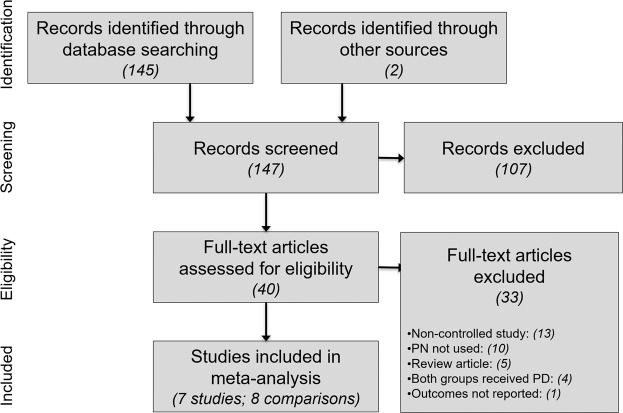
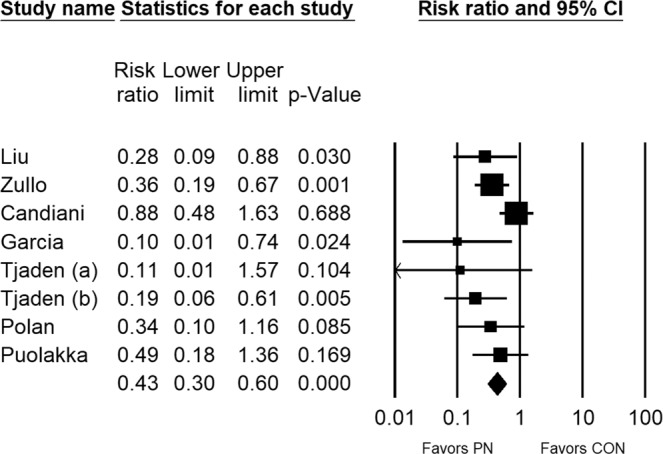
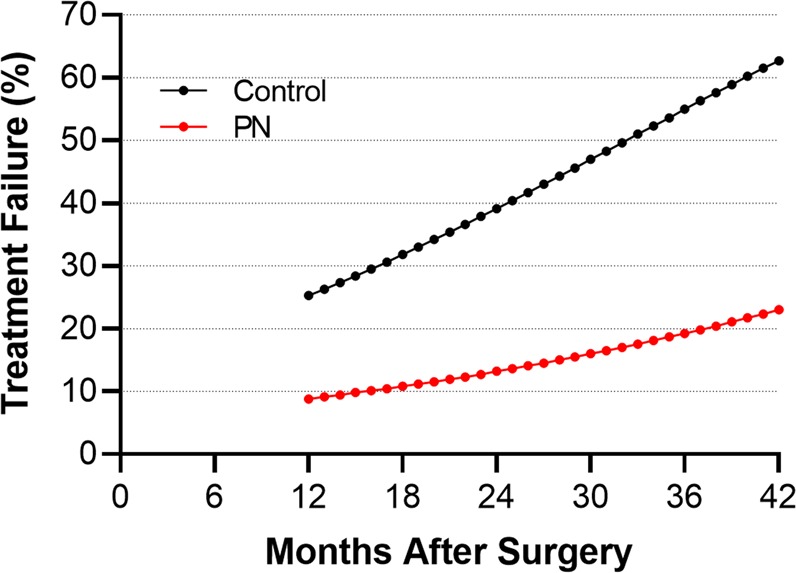
The objective of this review was to compare the efficacy and safety of conservative surgery with or without adjunctive presacral neurectomy (PN) for chronic endometriosis-related pelvic pain. In a systematic review with meta-analysis, randomized or nonrandomized controlled studies of conservative endometriosis surgery with or without adjunctive PN were included. Main outcomes were treatment failure (the proportion of women in which surgery failed to adequately resolve midline pain) and the frequency of operative and postoperative complications. A total of 7 studies with 8 group comparisons (3 randomized) representing 503 women (250 PN; 253 Control) were included. Over 34 months median follow-up, crude rates of treatment failure were 15.0% with PN and 40.9% with Controls (risk ratio = 0.43, 95% CI = 0.30 to 0.60, p < 0.001). The risk of postoperative constipation was higher with PN vs. Controls (12.5% vs. 0%, p = 0.024). No treatment group differences were observed for the risk of operative complications (0.6% vs. 0%, p = 0.498), reoperation (4.1% vs. 3.0%, p = 0.758) or urinary incontinence (5.0% vs. 0%, p = 0.195). Overall, in well-selected patients, conservative surgery with adjunctive PN may provide greater relief from midline pain and a similarly low rate of operative complications relative to conservative surgery alone but may increase the risk of constipation postoperatively. However, results were derived from mainly older and lower quality studies. Since then, surgical techniques to treat endometriosis have been improved and the effect of PN observed in prior studies should be confirmed in future studies in women in whom radical excision of deep infiltrating lesions is obtained.
Overview
The claims and statistics of this paper haven’t been checked yet.
Free: it reads the open-access text and checks the first 5 claims that cite a source we can check. Create a free account to check every claim.
Integrity signals
Registry
Cites
Statistics
Figures
Verification
Claims the paper makes
The claims and statistics of this paper haven’t been checked yet.
Free: it reads the open-access text and checks the first 5 claims that cite a source we can check. Create a free account to check every claim.
Claims other papers make about this one
Each is checked against this paper’s own text: does it say what the citing paper says it does?
The source backs part of the claim, not all of it — or backs it for a different population, condition or comparison.
In the citing paper
“Presacral neurectomy (PSN) is beneficial for treatment of endometriosis-associated midline pain as an adjunct to conventional laparoscopic surgery, but it should be stressed that PSN requires a high degree of skill and is associated with an increased risk of adverse effects such as intraoperative bleeding, and postoperative constipation, urinary urgency and painless first stage of labour (Miller e”
From ESHRE guideline: endometriosis (2022) · cites this paper as Miller et al., 2020
Experimental — accuracy not yet measuredThe source backs part of the claim, not all of it — or backs it for a different population, condition or comparison.
In the citing paper
“Presacral neurectomy (PSN) is beneficial for treatment of endometriosis-associated midline pain as an adjunct to conventional laparoscopic surgery, but it should be stressed that PSN requires a high degree of skill and is associated with an increased risk of adverse effects such as intraoperative bleeding, and postoperative constipation, urinary urgency and painless first stage of labour (Miller e”
From ESHRE guideline: endometriosis (2022) · cites this paper as Miller et al., 2020
Experimental — accuracy not yet measured
Self-check
Percentages, sums and reported differences re-computed from the paper’s own numbers.
The self-check needs the paper’s full text.
Citations
Cites
Measuring inconsistency in meta-analyses
Higgins, J. P. T., Thompson, S. G., Deeks, J. J., & Altman, D. G. (2003) · BMJ · doi:10.1136/bmj.327.7414.557 · Cited by 63,139
Liberati, A., Altman, D. G., Tetzlaff, J., Mulrow, C., Gøtzsche, P. C., Ioannidis, J. P. A., Clarke, M., Devereaux, P. J., Kleijnen, J., & Moher, D. (2009) · PLoS Medicine · doi:10.1371/journal.pmed.1000100 · Cited by 28,164
Stang, A. (2010) · European Journal of Epidemiology · doi:10.1007/s10654-010-9491-z · Cited by 17,396
Liberati, A., Altman, D. G., Tetzlaff, J., Mulrow, C., Gøtzsche, P. C., Ioannidis, J. P. A., Clarke, M., Devereaux, P. J., Kleijnen, J., & Moher, D. (2009) · Annals of Internal Medicine · doi:10.7326/0003-4819-151-4-200908180-00136 · Cited by 10,349
Quantitative Synthesis in Systematic Reviews
Lau, J., Ioannidis, J. P. A., & Schmid, C. H. (1997) · Annals of Internal Medicine · doi:10.7326/0003-4819-127-9-199711010-00008 · Cited by 2,517
A modified test for small‐study effects in meta‐analyses of controlled trials with binary endpoints
Harbord, R. M., Egger, M., & Sterne, J. A. C. (2006) · Statistics in Medicine · doi:10.1002/sim.2380 · Cited by 2,267
Eskenazi, B., & Warner, M. L. (1997) · Obstetrics and Gynecology Clinics of North America · doi:10.1016/s0889-8545(05)70302-8 · Cited by 1,617
Quality of Complication Reporting in the Surgical Literature
Martin, R. C. G., Brennan, M. F., & Jaques, D. P. (2002) · Annals of Surgery · doi:10.1097/00000658-200206000-00007 · Cited by 621
Reevaluating response and failure of medical treatment of endometriosis: a systematic review
Becker, C. M., Gattrell, W. T., Gude, K., & Singh, S. S. (2017) · Fertility and Sterility · doi:10.1016/j.fertnstert.2017.05.004 · Cited by 302
Should Unpublished Data Be Included in Meta-analyses?: Current Convictions and Controversies
Cook, D. J. (1993) · JAMA · doi:10.1001/jama.1993.03500210049030 · Cited by 259
Research works printed but not linked: 2
- National Institute for Health and Care Excellence. Endometriosis: diagnosis and management, https://www.nice.org.uk/guidance/ng73/evidence/full-guideline-pdf-4550371315 (2017). 29787038
- Rosenhein, N. B. & Rock, J. Surgery in the retroperitoneal space. (JB Lippincott, 1988).
Cited by
ESHRE guideline: endometriosis
Becker, C. M., Bokor, A., Heikinheimo, O., Horne, A., Jansen, F., Kiesel, L., King, K., Kvaskoff, M., Nap, A., Petersen, K., et al. (2022) · Human Reproduction Open · doi:10.1093/hropen/hoac009 · Cited by 1,712
Guideline No. 445: Management of Chronic Pelvic Pain
Allaire, C., Yong, P. J., Bajzak, K., Jarrell, J., Lemos, N., Miller, C., Morin, M., Nasr-Esfahani, M., Singh, S. S., & Chen, I. (2024) · Journal of Obstetrics and Gynaecology Canada · doi:10.1016/j.jogc.2023.102283 · Cited by 53
Neuropelveology for Endometriosis Management: A Systematic Review and Multilevel Meta-Analysis
Allahqoli, L., Hakimi, S., Momenimovahed, Z., Mazidimoradi, A., Rezaei, F., Aghamohammadi, S. Z., Rahmani, A., Mansouri, G., Hadavandsiri, F., Salehiniya, H., et al. (2024) · Journal of Clinical Medicine · doi:10.3390/jcm13164676 · Cited by 40
Evaluation and Treatment of Chronic Pelvic Pain
As‐Sanie, S., Ross, W. T., & Till, S. R. (2025) · Obstetrics and Gynecology · doi:10.1097/aog.0000000000006123 · Cited by 24
“…182,183 no benefit of laparoscopic uterosacral nerve ablation, and questionable utility of presacral neurectomy for management of CPP. 183,184 Hysterectomy Multiple professional society guidelines support hysterectomy as an appropriate option for patients with treatment-resistant pelvic…”
O papel da cirurgia na endometriose
Apolinário, P. A., Pinheiro, L. E. G., & de Sousa, M. N. A. (2023) · Revista Eletrônica Acervo Saúde · doi:10.25248/reas.e11772.2023 · Cited by 4
Metadata
- Authors
- Miller, L. E., Bhattacharyya, R., & Miller, V. M.
- Corresponding author
- Miller, Larry E.
- Venue
- Scientific Reports
- Published
- 2020-04-23
- Volume
- 10
- Issue
- 1
- Pages
- 6901-6901
- ISSN
- 2045-2322 (ISSN-L)
- PMC
- PMC7181806
- OpenAlex
- W3018033721
- Cited by
- 12
- References
- 28
- Citations by year
- 2026: 3 · 2025: 2 · 2024: 4 · 2023: 2 · 2022: 1
- FWCI
- 0.11
- Type
- journal article
- Language
- en
- Open access
- gold
- doi.org
- Licence
- cc-by
- creativecommons.org/licenses/by/4.0 (tdm)
- creativecommons.org/licenses/by/4.0 (vor)
- Locations
- Scientific Reports (publishedVersion, cc-by)
- PubMed Central (publishedVersion, cc-by)
- PubMed (publishedVersion)
- Topics
- Health Sciences › Medicine › Reproductive Medicine › Endometriosis Research and Treatment
- Health Sciences › Medicine › Obstetrics and Gynecology › Gynecological conditions and treatments
- Health Sciences › Medicine › Urology › Pelvic floor disorders treatments
- Keywords
- presacral neurectomy, endometriosis, chronic pelvic pain, postoperative constipation, surgical complications, urinary incontinence, reoperation, deep infiltrating endometriosis
- MeSH terms
- Conservative Treatment, Adult, Denervation, Endometriosis, Female, Follow-Up Studies, Humans, Postoperative Complications, Regression Analysis, Risk, Sacrum, Treatment Outcome, Publication Bias
About these checks
Registry, retraction, Cites and statistics results are computed, not judged, with one exception: a printed reference that no index lists is read once by a model before it counts as a citation error. Claims are extracted by a model and kept only when their quote appears verbatim in the text; each cited source is then checked, with a model’s help, for whether it says what the claim relies on. Those verdicts can be wrong — read the claim’s quote and the cited source before relying on one.
Statistics and arithmetic are recomputed, not judged.
Confidence bands are shown only for fields calibrated on our annotated test set. None is calibrated yet, so no band is shown.
What counts as a claim ›How we measure confidence ›How we check this ›
Are you an author, or do you see a problem with this page? Request a review
How to cite
Cite CoChat for the checks on this page, and the paper for its own findings.
- This page
- CoChat. (2026). Citation check: Clinical Utility of Presacral Neurectomy as an Adjunct to Conservative Endometriosis Surgery: Systematic Review and Meta-Analysis of Controlled Studies. https://app.cochat.ai/papers/10.1038/s41598-020-63966-w
- The paper
- Miller, L. E., Bhattacharyya, R., & Miller, V. M. (2020). Clinical Utility of Presacral Neurectomy as an Adjunct to Conservative Endometriosis Surgery: Systematic Review and Meta-Analysis of Controlled Studies. Scientific Reports. https://doi.org/10.1038/s41598-020-63966-w
Data sources
Bibliographic data: Semantic Scholar, OpenAlex, Crossref.
Contains information from the Semantic Scholar Academic Graph Datasets, made available under the ODC Attribution License (ODC-BY 1.0).
Semantic Scholar’s data is described in: Kinney, R., et al. (2023). The Semantic Scholar Open Data Platform. arXiv:2301.10140.
