

Mapping the NFT revolution: market trends, trade networks, and visual features
Open accessThe DOI matches its Crossref record; 26 of the 27 references it cites were found in a registry or an index.
Abstract
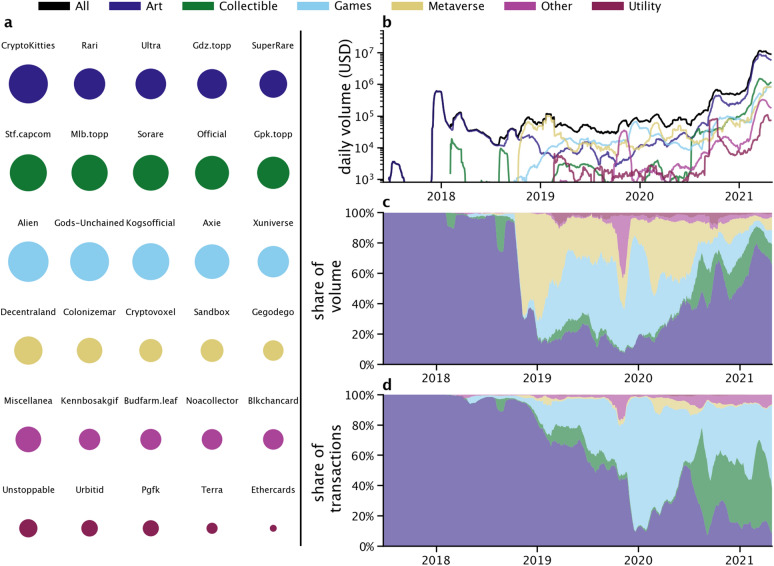
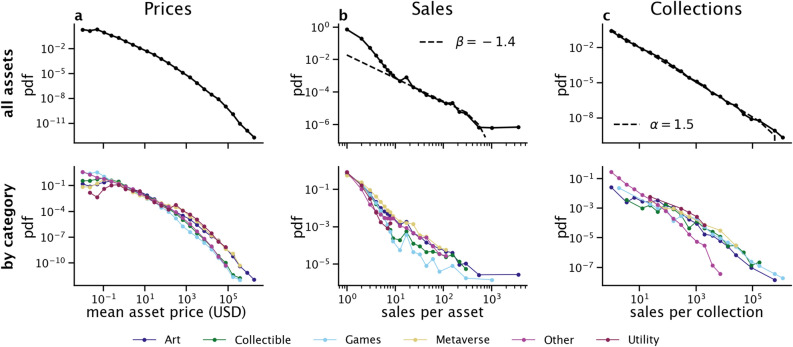
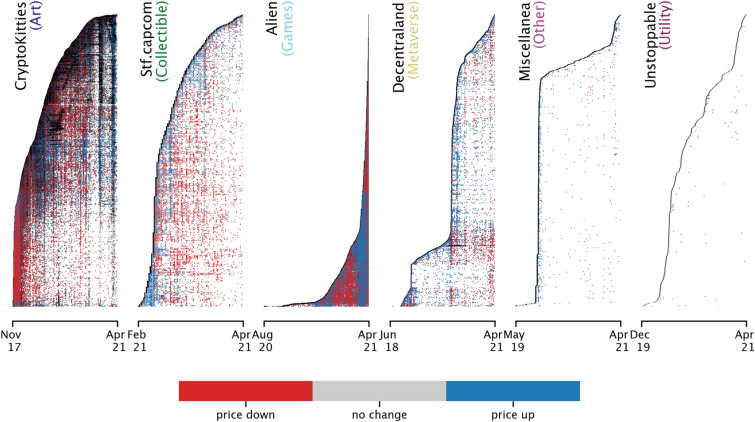
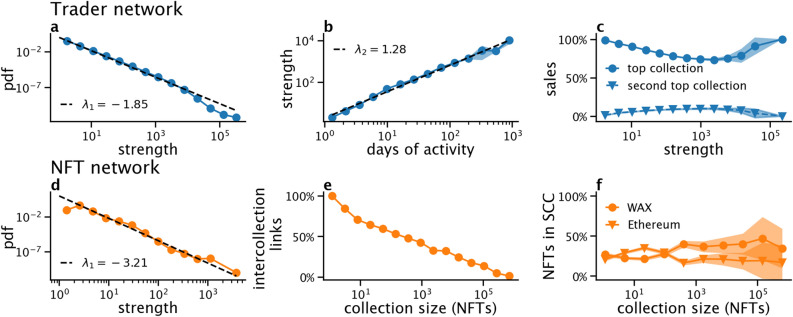
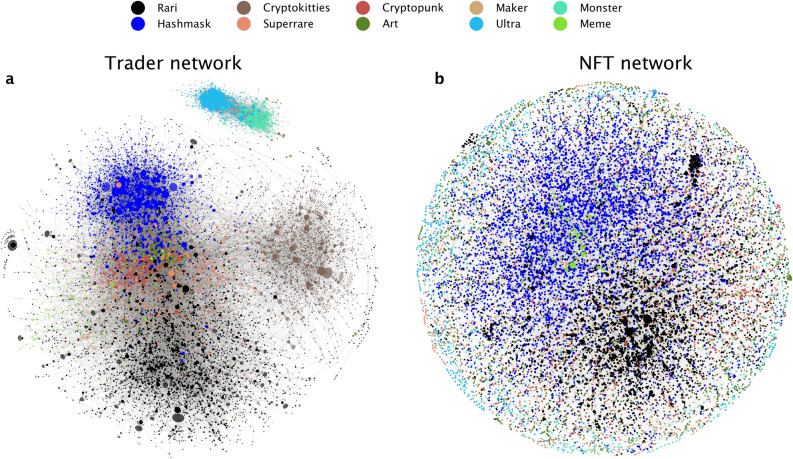
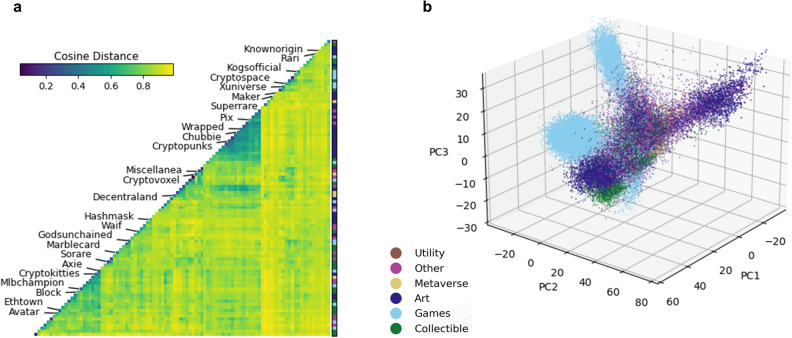
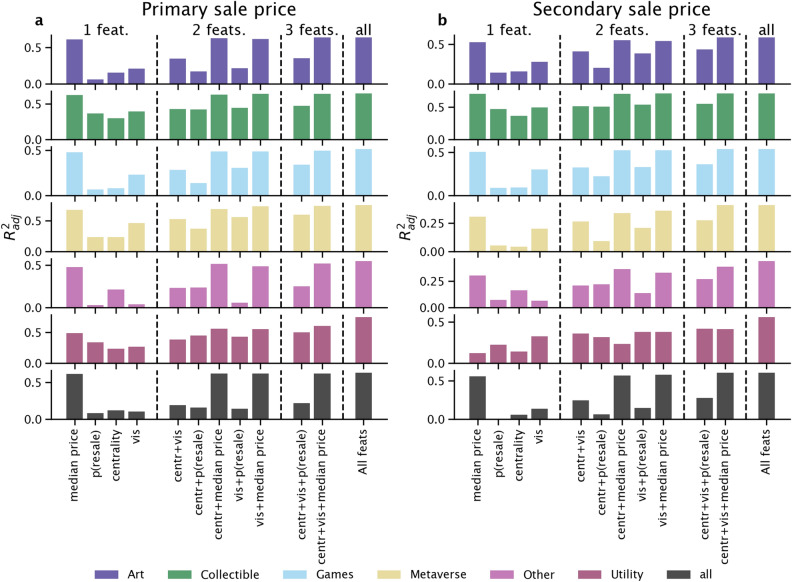
Non Fungible Tokens (NFTs) are digital assets that represent objects like art, collectible, and in-game items. They are traded online, often with cryptocurrency, and are generally encoded within smart contracts on a blockchain. Public attention towards NFTs has exploded in 2021, when their market has experienced record sales, but little is known about the overall structure and evolution of its market. Here, we analyse data concerning 6.1 million trades of 4.7 million NFTs between June 23, 2017 and April 27, 2021, obtained primarily from Ethereum and WAX blockchains. First, we characterize statistical properties of the market. Second, we build the network of interactions, show that traders typically specialize on NFTs associated with similar objects and form tight clusters with other traders that exchange the same kind of objects. Third, we cluster objects associated to NFTs according to their visual features and show that collections contain visually homogeneous objects. Finally, we investigate the predictability of NFT sales using simple machine learning algorithms and find that sale history and, secondarily, visual features are good predictors for price. We anticipate that these findings will stimulate further research on NFT production, adoption, and trading in different contexts.
Overview
The claims and statistics of this paper haven’t been checked yet.
Free: it reads the open-access text and checks the first 5 claims that cite a source we can check. Create a free account to check every claim.
Integrity signals
Registry
Cites
Statistics
Figures
Verification
Claims the paper makes
The claims and statistics of this paper haven’t been checked yet.
Free: it reads the open-access text and checks the first 5 claims that cite a source we can check. Create a free account to check every claim.
Claims other papers make about this one
Each is checked against this paper’s own text: does it say what the citing paper says it does?
The cited source says what the claim attributes to it.
In the citing paper
“Ref. [26] also found the price of an NFT to be correlated to the price of other NFTs sold before in the same collection. They distinguished between primary sales (the first time an asset is sold) and secondary sales, observing that the secondary sale price is strongly correlated to the primary sale one.”
From What Is the Right Price for Non-Fungible Tokens (NFTs)? A Systematic Review of the Current Literature (2025) · cites this paper as [26]
Self-check
Percentages, sums and reported differences re-computed from the paper’s own numbers.
The self-check needs the paper’s full text.
Citations
Cites
ImageNet: A large-scale hierarchical image database
Deng, J., Dong, W., Socher, R., Li, L.-J., Li, K., & Fei-Fei, L. (2009) · 2009 IEEE Conference on Computer Vision and Pattern Recognition · doi:10.1109/cvpr.2009.5206848 · Cited by 65,333 · cited 2×
“We initialize AlexNet with weights pre-trained on ImageNet [47], a widely-used reference dataset of labeled images.”
BackgroundMethodSMOTE synthetic minority over-sampling technique
Chawla, N. V., Bowyer, K. W., Hall, L. O., & Kegelmeyer, W. P. (2002) · Journal of Artificial Intelligence Research · doi:10.1613/jair.953 · Cited by 32,865
PyTorch: An Imperative Style, High-Performance Deep Learning Library
Paszke, A., Gross, S., Massa, F., Lerer, A., Bradbury, J., Chanan, G., Killeen, T., Lin, Z., Gimelshein, N., Antiga, L., et al. (2019) · arXiv · doi:10.48550/arxiv.1912.01703 · Cited by 31,473
Power-Law Distributions in Empirical Data
Clauset, A., Shalizi, C. R., & Newman, M. E. J. (2009) · SIAM Review · doi:10.1137/070710111 · Cited by 8,019 · cited 2×
“[26] Aaron Clauset, Cosma Rohilla Shalizi, and Mark EJ Newman.”
BackgroundInfluentialFinding community structure in very large networks
Clauset, A., Newman, M. E. J., & Moore, C. (2004) · Physical Review E · doi:10.1103/physreve.70.066111 · Cited by 7,390 · cited 3×
“What are the implications of this behaviour on the NFT network structure? We investigate the relation between the structure of the NFT network and NFTs collections, by studying the modularity [29] of the network under the partition of NFTs (nodes) into NFT collections.”
BackgroundInfluentialThe architecture of complex weighted networks
Barrat, A., Barthélemy, M., Pastor-Satorras, R., & Vespignani, A. (2004) · Proceedings of the National Academy of Sciences · doi:10.1073/pnas.0400087101 · Cited by 4,218 · cited 2×
“How do traders interact with each other? Are there central actors? We approach these questions adopting a network science approach [23, 27].”
BackgroundA survey of the recent architectures of deep convolutional neural networks
Khan, A., Sohail, A., Zahoora, U., & Qureshi, A. S. (2020) · Artificial Intelligence Review · doi:10.1007/s10462-020-09825-6 · Cited by 3,137 · cited 2×
“[33] Asifullah Khan, Anabia Sohail, Umme Zahoora, and Aqsa Saeed Qureshi.”
BackgroundNewman, M. E. J. (2003) · Physical Review E · doi:10.1103/physreve.67.026126 · Cited by 3,087
On the properties of small-world network models
Barrat, A., & Weigt, M. (2000) · The European Physical Journal B · doi:10.1007/s100510050067 · Cited by 888 · cited 2×
“How do traders interact with each other? Are there central actors? We approach these questions adopting a network science approach [23, 27].”
BackgroundNon-Fungible Token (NFT): Overview, Evaluation, Opportunities and Challenges
Wang, Q., Li, R., Wang, Q., & Chen, S. (2021) · arXiv (Cornell University) · doi:10.48550/arxiv.2105.07447 · Cited by 577
Research works printed but not linked: 6
- 2. Team, N. Non-fungible tokens quarterly report Q1 2021. (2021). https:// nonfu ngible. com/ subsc ribe/ nft-report-q1-2021. (Accessed 4 May 2021). (NonFungible Corporation).
- 3. Evans, T. M. Cryptokitties, cryptography, and copyright. AIPLA QJ 47, 219-247 (2019).
- 8. Riegelhaupt, R. Results: Beeple's purely digital NFT-based work of Art achieves \$69.3 million at Christie's. (2021). https:// www. chris ties. com/ about-us/ press-archi ve/ detai ls? Press Relea seID= 9970& lid=1. (Accessed 4 May 2021). (Christie's Press Release).
- 32. Freund, Y., Schapire, R. & Abe, N. A short introduction to boosting. J.-Japan. Soc. Artif. Intell. 14, 1612 (1999).
- 37. Preis, T., Moat, H. S. & Stanley, H. E. Quantifying trading behavior in financial markets using google trends. Sci. Rep. 3, 1-6 (2013).
- 46. Krizhevsky, A., Sutskever, I. & Hinton, G. E. Imagenet classification with deep convolutional neural networks. Adv. Neural Inf. Process. Syst. 25, 1097-1105 (2012).
Cited by
Items 801–817 of 817
การแปลงสภาพสินทรัพย์ในโลกจริง: โทเค็นของภาพวาดและงานศิลปะ
Watanapalachaikul, S. (2026) · Journal of Social Science Development
Minting NFTs on OpenSea Marketplace
Savia, M., & Troka, L. (2023) · International Journal of Art, Design, and Metaverse
Babić, M., & Grgić, T. (2025) · International Journal of Educational Technology and Artificial Intelligence
Literature Review on the Most Popular of NFTs Types
Wlasinsky, O. (2023) · International Journal of Educational Technology and Artificial Intelligence
Romano, L., & Marchetti, S. (2025) · International Journal of Art, Design, and Metaverse
Development of Simple NFT Marketplace Using Free Coding from GitHub
Tung, S., & Chang, A. (2023) · International Journal of Art, Design, and Metaverse
The Impact of Social Media on Sports Memorabilia Collecting Trends
Nannaware, S. C., & Phadtare, P. (2026) · Emerald Group Publishing Limited eBooks · doi:10.1108/978-1-83742-746-820261004
Korkmaz, Ö. (2026) · İnönü University International Journal of Social Sciences (INIJOSS) · doi:10.54282/inijoss.1768909
A cross-protocol dataset of blockchain oracle incentives and accountabilityPreprint
Jia, H., Li, S., Cong, L. W., & Zhang, L. (2026) · Research Square · doi:10.21203/rs.3.rs-11382560/v1
Цифровая трансформация арт-рынка как социокультурного института: социально-философский анализ
Олеговна, С. О. (n.d.) · CyberLeninK (CyberLeninka)
Evaluating image embeddings and metadata for NFT price prediction using temporal validation
Lee, G.-C., Koo, H.-Y., & Lee, H. (2026) · Scientific Reports · doi:10.1038/s41598-026-77082-8
AURA’DAN ALGORİTMAYA: DİJİTAL ÇAĞDA SANAT ESERİNİN ONTOLOJİSİ VE “ONTOLOJİK-İLİŞKİSEL ÖZGÜNLÜK”
Erdoğan, E. (2026) · Kilikya felsefe dergisi · doi:10.67011/kilikya.1958846
Essays in cryptocurrency markets
Almershed, S. F. N. A. (2026) · Open Access at Essex (University of Essex) · doi:10.5526/err-00044059
Forecasting Non-Fungible Token (NFT) Market Volatility Through Hybrid GARCH–LSTM Models
Zhang, J., Liu, S., & Ma, M. (2026) · Mathematics · doi:10.3390/math14214024
Chen, Z., & Huang, Q. (2026) · Asian Journal of Education and Social Studies · doi:10.9734/ajess/2026/v52i113458
白, 相., & Wang, D. (2026) · Communications in computer and information science · doi:10.1007/978-981-92-7537-3_41
Liking variety as a signal: How NFT creators’ liking variety increases buyers’ willingness to pay
Shuang, Y., Liu, Y., & Zhao, X. (2026) · Electronic Markets · doi:10.1007/s12525-026-00946-4
Metadata
- Authors
- Nadini, M., Alessandretti, L., Di Giacinto, F., Martino, M., Aiello, L. M., & Baronchelli, A.
- Affiliations
- City, University of London (GB)
- Technical University of Denmark (DK)
- IBM Research - Cambridge (United States) (US)
- IT University of Copenhagen (DK)
- Corresponding author
- Baronchelli, Andrea
- Venue
- Scientific Reports
- Published
- 2021-10-22
- Volume
- 11
- Issue
- 1
- Pages
- 20902-20902
- ISSN
- 2045-2322 (ISSN-L)
- PMC
- PMC8536724
- OpenAlex
- W3169156335
- Semantic Scholar
- f8a30a36507374efc512399f027b0fc2ed799cdc
- Cited by
- 715
- References
- 24
- Citations by year
- 2026: 100 · 2025: 139 · 2024: 160 · 2023: 183 · 2022: 122 · 2021: 11
- FWCI
- 107.61
- Type
- journal article
- Language
- en
- Open access
- gold
- doi.org
- Licence
- cc-by
- creativecommons.org/licenses/by/4.0 (tdm)
- creativecommons.org/licenses/by/4.0 (vor)
- Locations
- Scientific Reports (publishedVersion, cc-by)
- Europe PMC (PubMed Central) (publishedVersion, other-oa)
- PubMed Central (publishedVersion, cc-by)
- PubMed (publishedVersion)
- City Research Online (City University London) (acceptedVersion)
- arXiv (Cornell University) (submittedVersion)
- DOAJ (DOAJ: Directory of Open Access Journals) (submittedVersion, cc-by-sa)
- Funders
- The research was partly supported by The Alan Turing Institute.
- Topics
- Physical Sciences › Computer Science › Information Systems › Blockchain Technology Applications and Security
- Social Sciences › Arts and Humanities › Visual Arts and Performing Arts › Art History and Market Analysis
- Physical Sciences › Physics and Astronomy › Statistical and Nonlinear Physics › Complex Network Analysis Techniques
- Keywords
- non-fungible tokens, trade networks, blockchain, Ethereum, NFT collections, price predictability, digital art
About these checks
Registry, retraction, Cites and statistics results are computed, not judged, with one exception: a printed reference that no index lists is read once by a model before it counts as a citation error. Claims are extracted by a model and kept only when their quote appears verbatim in the text; each cited source is then checked, with a model’s help, for whether it says what the claim relies on. Those verdicts can be wrong — read the claim’s quote and the cited source before relying on one.
Statistics and arithmetic are recomputed, not judged.
Confidence bands are shown only for fields calibrated on our annotated test set. None is calibrated yet, so no band is shown.
What counts as a claim ›How we measure confidence ›How we check this ›
Are you an author, or do you see a problem with this page? Request a review
Data sources
Bibliographic data: Semantic Scholar, OpenAlex, Crossref.
Contains information from the Semantic Scholar Academic Graph Datasets, made available under the ODC Attribution License (ODC-BY 1.0).
Semantic Scholar’s data is described in: Kinney, R., et al. (2023). The Semantic Scholar Open Data Platform. arXiv:2301.10140.
