

Improving prognostic performance in resectable pancreatic ductal adenocarcinoma using radiomics and deep learning features fusion in CT images
Open accessThe DOI matches its Crossref record; 60 of the 60 references it cites were found in a registry or an index.
Abstract
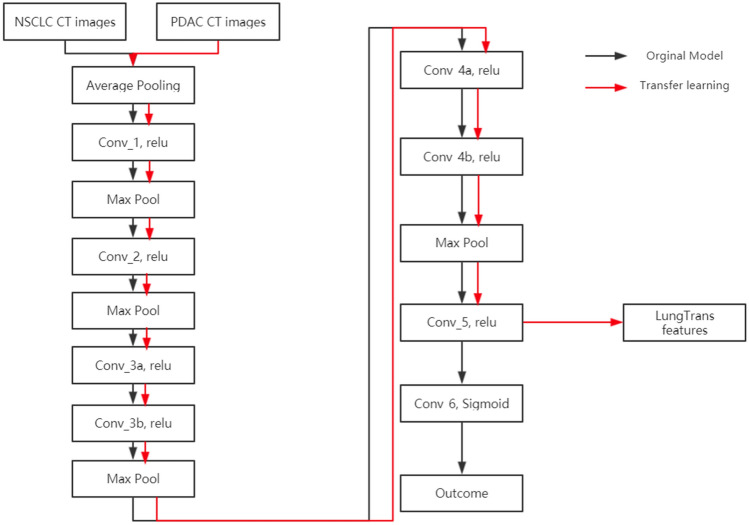
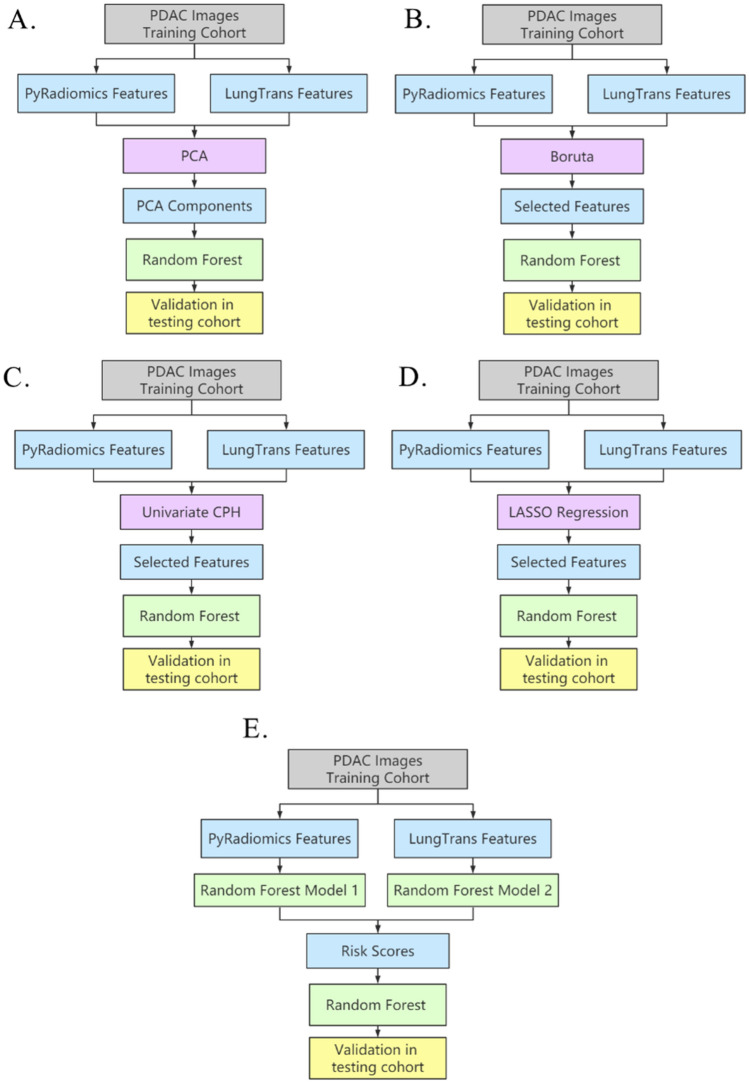
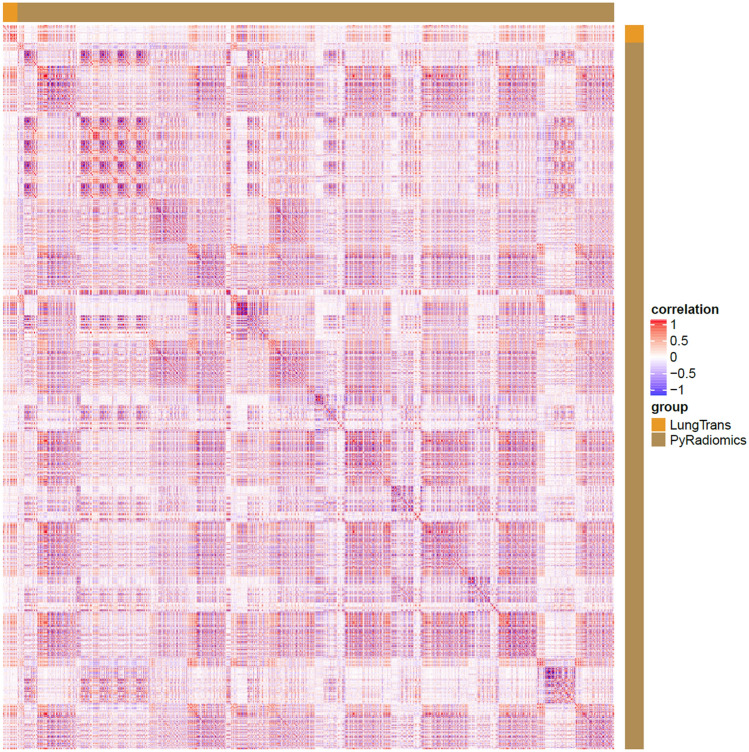
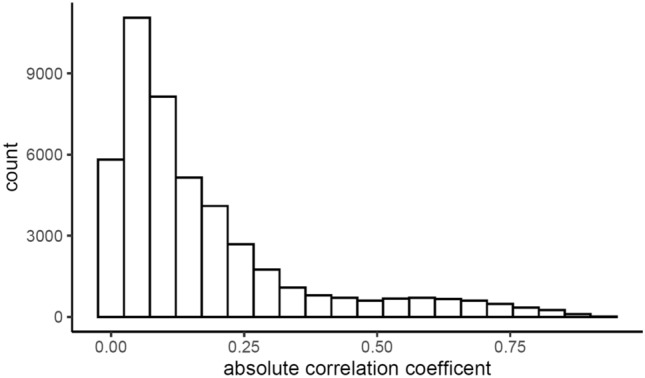
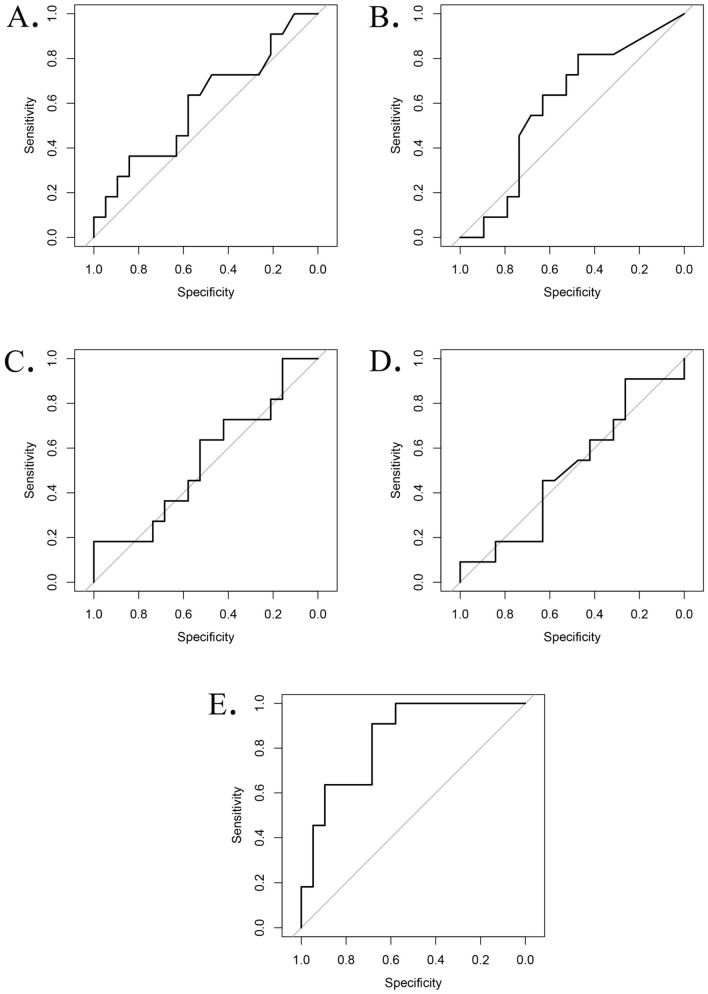
As an analytic pipeline for quantitative imaging feature extraction and analysis, radiomics has grown rapidly in the past decade. On the other hand, recent advances in deep learning and transfer learning have shown significant potential in the quantitative medical imaging field, raising the research question of whether deep transfer learning features have predictive information in addition to radiomics features. In this study, using CT images from Pancreatic Ductal Adenocarcinoma (PDAC) patients recruited in two independent hospitals, we discovered most transfer learning features have weak linear relationships with radiomics features, suggesting a potential complementary relationship between these two feature sets. We also tested the prognostic performance for overall survival using four feature fusion and reduction methods for combining radiomics and transfer learning features and compared the results with our proposed risk score-based feature fusion method. It was shown that the risk score-based feature fusion method significantly improves the prognosis performance for predicting overall survival in PDAC patients compared to other traditional feature reduction methods used in previous radiomics studies (40% increase in area under ROC curve (AUC) yielding AUC of 0.84).
Overview
The claims and statistics of this paper haven’t been checked yet.
Free: it reads the open-access text and checks the first 5 claims that cite a source we can check. Create a free account to check every claim.
Integrity signals
Registry
Cites
Statistics
Figures
Verification
Claims the paper makes
The claims and statistics of this paper haven’t been checked yet.
Free: it reads the open-access text and checks the first 5 claims that cite a source we can check. Create a free account to check every claim.
Claims other papers make about this one
Each is checked against this paper’s own text: does it say what the citing paper says it does?
The source backs part of the claim, not all of it — or backs it for a different population, condition or comparison.
In the citing paper
“Due to its excellent computational power, AI was used to analyze PC prognoses, including survival time 204-221, recurrence risk 78,221-224, metastasis 225-230, therapy response 79-81,231-240, etc.”
From Artificial intelligence in pancreatic cancer (2022) · cites this paper as [210]
Experimental — accuracy not yet measuredThe cited source says what the claim attributes to it.
In the citing paper
“Radiomics can also be applied alone for prognosis prediction.”
From Artificial intelligence in pancreatic cancer (2022) · cites this paper as [210]
Self-check
Percentages, sums and reported differences re-computed from the paper’s own numbers.
The self-check needs the paper’s full text.
Citations
Cites
Deep Residual Learning for Image Recognition
He, K., Zhang, X., Ren, S., & Sun, J. (2016) · 2016 IEEE Conference on Computer Vision and Pattern Recognition (CVPR) · doi:10.1109/cvpr.2016.90 · Cited by 235,474
Breiman, L. (2001) · Machine Learning · doi:10.1023/a:1010933404324 · Cited by 133,538
ImageNet classification with deep convolutional neural networks
Krizhevsky, A., Sutskever, I., & Hinton, G. E. (2017) · Communications of the ACM · doi:10.1145/3065386 · Cited by 112,155
ImageNet: A large-scale hierarchical image database
Deng, J., Dong, W., Socher, R., Li, L.-J., Li, K., & Fei-Fei, L. (2009) · 2009 IEEE Conference on Computer Vision and Pattern Recognition · doi:10.1109/cvpr.2009.5206848 · Cited by 65,333
Regression shrinkage and selection via the lasso
Tibshirani, R. (1996) · Journal of the Royal Statistical Society Series B: Statistical Methodology · doi:10.1111/j.2517-6161.1996.tb02080.x · Cited by 51,482
Pan, S. J., & Yang, Q. (2010) · IEEE Transactions on Knowledge and Data Engineering · doi:10.1109/tkde.2009.191 · Cited by 23,387
An introduction to ROC analysis
Fawcett, T. (2006) · Pattern Recognition Letters · doi:10.1016/j.patrec.2005.10.010 · Cited by 21,879
Ror2 signaling regulates Golgi structure and transport through IFT20 for tumor invasiveness
Nishita, M., Park, S.-Y., Nishio, T., Kamizaki, K., Wang, Z., Tamada, K., Takumi, T., Hashimoto, R., Otani, H., Pazour, G. J., et al. (2017) · Scientific Reports · doi:10.1038/s41598-016-0028-x · Cited by 15,947
pROC: an open-source package for R and S+ to analyze and compare ROC curves
Robin, X., Turck, N., Hainard, A., Tiberti, N., Lisacek, F., Sanchez, J.-C., & Müller, M. (2011) · BMC Bioinformatics · doi:10.1186/1471-2105-12-77 · Cited by 13,697
Receptive fields, binocular interaction and functional architecture in the cat’s visual cortex
Hubel, D. H., & Wiesel, T. N. (1962) · The Journal of Physiology · doi:10.1113/jphysiol.1962.sp006837 · Cited by 13,680
Cited by
Predicting cancer outcomes with radiomics and artificial intelligence in radiology
Bera, K., Braman, N., Gupta, A., Velcheti, V., & Madabhushi, A. (2022) · Nature Reviews Clinical Oncology · doi:10.1038/s41571-021-00560-7 · Cited by 819
Atasever, S., Azgınoğlu, N., Terzi, D. S., & Terzi, R. (2022) · Clinical Imaging · doi:10.1016/j.clinimag.2022.11.003 · Cited by 149
Artificial intelligence in pancreatic cancer
Huang, B., Huang, H., Zhang, S., Zhang, D., Shi, Q., Liu, J., & Guo, J. (2022) · Theranostics · doi:10.7150/thno.77949 · Cited by 142
“Due to its excellent computational power, AI was used to analyze PC prognoses, including survival time [204-221], recurrence risk [78,221-224], metastasis [225-230], therapy response [79-81,231-240], etc.”
MethodWang, W., Liang, H., Zhang, Z., Xu, C., Wei, D., Li, W., Ye, Q., Zhang, L., Liu, J., & Lei, D. (2024) · EClinicalMedicine · doi:10.1016/j.eclinm.2023.102385 · Cited by 122
Breast ultrasound tumour classification: A Machine Learning—Radiomics based approach
Mishra, A. K., Roy, P., Bandyopadhyay, S., & Das, S. K. (2021) · Expert Systems · doi:10.1111/exsy.12713 · Cited by 119
Metadata
- Authors
- Zhang, Y., Lobo-Mueller, E. M., Karanicolas, P., Gallinger, S., Haider, M. A., & Khalvati, F.
- Affiliations
- University of Toronto (CA)
- University of Alberta (CA)
- Sunnybrook Health Science Centre (CA)
- University Health Network (CA)
- Corresponding author
- Khalvati, Farzad
- Venue
- Scientific Reports
- Published
- 2021-01-14
- Volume
- 11
- Issue
- 1
- Pages
- 1378-1378
- ISSN
- 2045-2322 (ISSN-L)
- PMC
- PMC7809062
- OpenAlex
- W3121939634
- Cited by
- 62
- References
- 57
- Citations by year
- 2026: 7 · 2025: 22 · 2024: 8 · 2023: 7 · 2022: 12 · 2021: 6
- FWCI
- 4.36
- Type
- journal article
- Language
- en
- Open access
- gold
- doi.org
- Licence
- cc-by
- creativecommons.org/licenses/by/4.0 (tdm)
- creativecommons.org/licenses/by/4.0 (vor)
- Locations
- Scientific Reports (publishedVersion, cc-by)
- PubMed Central (publishedVersion, cc-by)
- PubMed (publishedVersion)
- arXiv (Cornell University) (submittedVersion)
- DOAJ (DOAJ: Directory of Open Access Journals) (submittedVersion, cc-by-sa)
- arXiv (Cornell University)
- Funders
- Princess Margaret Cancer Foundation
- Ontario Institute for Cancer Research
- Government of Ontario
- Pancreatic Cancer Canada Foundation
- Hebrew University of Jerusalem
- Terry Fox Research Institute
- Canadian Cancer Society Research Institute
- Topics
- Health Sciences › Medicine › Radiology, Nuclear Medicine and Imaging › Radiomics and Machine Learning in Medical Imaging
- Physical Sciences › Computer Science › Computer Vision and Pattern Recognition › Image Retrieval and Classification Techniques
- Physical Sciences › Computer Science › Artificial Intelligence › AI in cancer detection
- Keywords
- pancreatic ductal adenocarcinoma, radiomics, feature fusion, feature reduction, overall survival prediction, prognostic performance, computed tomography, resectable pancreatic cancer
- MeSH terms
- Deep Learning, Adult, Female, Follow-Up Studies, Humans, Male, Pancreatic Neoplasms, Retrospective Studies, Tomography, X-Ray Computed, Survival Rate, Disease-Free Survival, Carcinoma, Pancreatic Ductal
About these checks
Registry, retraction, Cites and statistics results are computed, not judged, with one exception: a printed reference that no index lists is read once by a model before it counts as a citation error. Claims are extracted by a model and kept only when their quote appears verbatim in the text; each cited source is then checked, with a model’s help, for whether it says what the claim relies on. Those verdicts can be wrong — read the claim’s quote and the cited source before relying on one.
Statistics and arithmetic are recomputed, not judged.
Confidence bands are shown only for fields calibrated on our annotated test set. None is calibrated yet, so no band is shown.
What counts as a claim ›How we measure confidence ›How we check this ›
Are you an author, or do you see a problem with this page? Request a review
How to cite
Cite CoChat for the checks on this page, and the paper for its own findings.
- This page
- CoChat. (2026). Citation check: Improving prognostic performance in resectable pancreatic ductal adenocarcinoma using radiomics and deep learning features fusion in CT images. https://app.cochat.ai/papers/10.1038/s41598-021-80998-y
- The paper
- Zhang, Y., Lobo-Mueller, E. M., Karanicolas, P., Gallinger, S., Haider, M. A., & Khalvati, F. (2021). Improving prognostic performance in resectable pancreatic ductal adenocarcinoma using radiomics and deep learning features fusion in CT images. Scientific Reports. https://doi.org/10.1038/s41598-021-80998-y
Data sources
Bibliographic data: Semantic Scholar, OpenAlex, Crossref.
Contains information from the Semantic Scholar Academic Graph Datasets, made available under the ODC Attribution License (ODC-BY 1.0).
Semantic Scholar’s data is described in: Kinney, R., et al. (2023). The Semantic Scholar Open Data Platform. arXiv:2301.10140.
