

European cephalopods distribution under climate-change scenarios
Open accessThe DOI matches its Crossref record; 101 of the 101 references it cites were found in a registry or an index.
Abstract
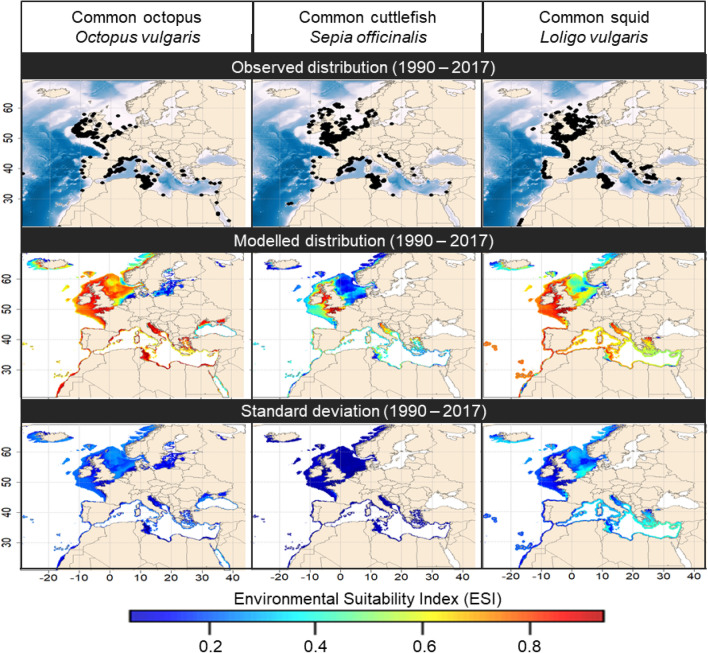
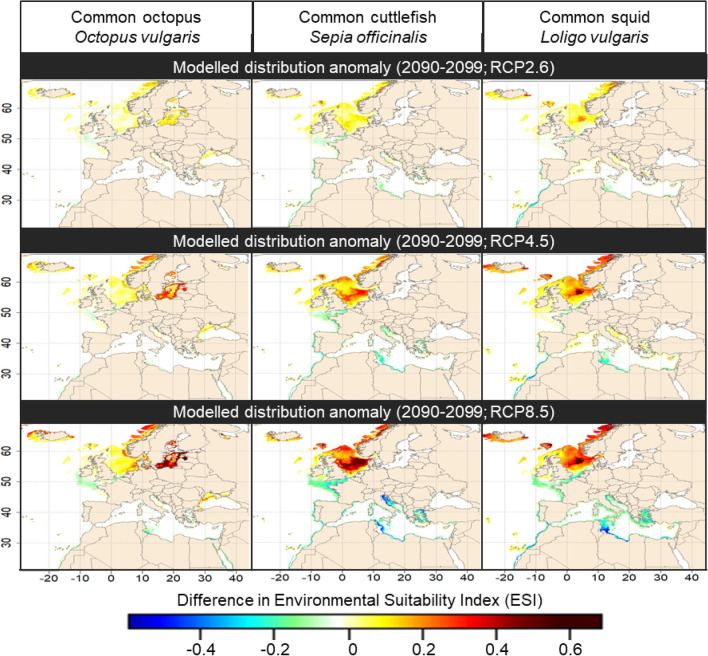
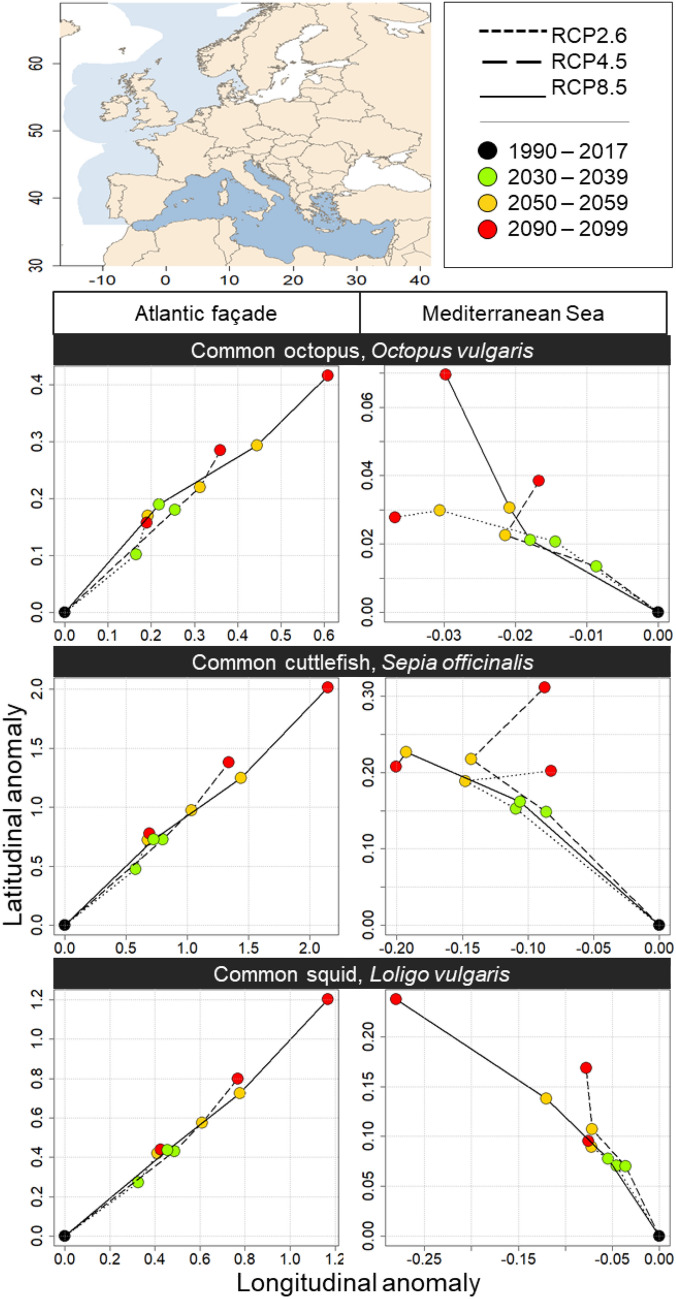
In a context of increasing anthropogenic pressure, projecting species potential distributional shifts is of major importance for the sustainable exploitation of marine species. Despite their major economical (i.e. important fisheries) and ecological (i.e. central position in food-webs) importance, cephalopods literature rarely addresses an explicit understanding of their current distribution and the potential effect that climate change may induce in the following decades. In this study, we focus on three largely harvested and common cephalopod species in Europe: Octopus vulgaris, Sepia officinalis and Loligo vulgaris. Using a recently improved species ensemble modelling framework coupled with five atmosphere-ocean general circulation models, we modelled their contemporary and potential future distributional range over the twenty-first century. Independently of global warming scenarios, we observed a decreasing in the suitability of environmental conditions in the Mediterranean Sea and the Bay of Biscay. Conversely, we projected a rapidly increasing environmental suitability in the North, Norwegian and Baltic Seas for all species. This study is a first broad scale assessment and identification of the geographical areas, fisheries and ecosystems impacted by climate-induced changes in cephalopods distributional range.
Overview
The claims and statistics of this paper haven’t been checked yet.
Free: it reads the open-access text and checks the first 5 claims that cite a source we can check. Create a free account to check every claim.
Integrity signals
Registry
Cites
Statistics
Figures
Verification
Claims the paper makes
The claims and statistics of this paper haven’t been checked yet.
Free: it reads the open-access text and checks the first 5 claims that cite a source we can check. Create a free account to check every claim.
Claims other papers make about this one
Each is checked against this paper’s own text: does it say what the citing paper says it does?
The cited source doesn’t support the claim as written.
In the citing paper
“In terms of future changes, the present study projected a decrease in habitat suitability for the Mediterranean and the eastern Atlantic, exacerbated with scenario severity, but did not predict increasing habitat suitability and consequent northward distribution gains in the Baltic Sea (Schickele et al., 2021).”
From Projecting future climate change impacts on the distribution of the ‘Octopus vulgaris species complex’ (2022) · cites this paper as Schickele et al., 2021
Checked by a reasoning model — may be wrong.
Experimental — accuracy not yet measured
Self-check
Percentages, sums and reported differences re-computed from the paper’s own numbers.
The self-check needs the paper’s full text.
Citations
Cites
Dormann, C. F., Elith, J., Bacher, S., Buchmann, C., Carl, G., Carré, G., Marquéz, J. R. G., Gruber, B., Lafourcade, B., Leitão, P. J., et al. (2013) · Ecography · doi:10.1111/j.1600-0587.2012.07348.x · Cited by 9,998
Summarizing multiple aspects of model performance in a single diagram
Taylor, K. E. (2001) · Journal of Geophysical Research: Atmospheres · doi:10.1029/2000jd900719 · Cited by 8,477
The representative concentration pathways: an overview
van Vuuren, D. P., Edmonds, J., Kainuma, M., Riahi, K., Thomson, A., Hibbard, K., Hurtt, G. C., Kram, T., Krey, V., Lamarque, J.-F., et al. (2011) · Climatic Change · doi:10.1007/s10584-011-0148-z · Cited by 7,741
Hutchinson, G. E. (1957) · Cold Spring Harbor Symposia on Quantitative Biology · doi:10.1101/sqb.1957.022.01.039 · Cited by 6,228
Global Sea Floor Topography from Satellite Altimetry and Ship Depth Soundings
Smith, W. H. F., & Sandwell, D. T. (1997) · Science · doi:10.1126/science.277.5334.1956 · Cited by 4,709
Ensemble forecasting of species distributions
ARAUJO, M., & NEW, M. (2007) · Trends in Ecology & Evolution · doi:10.1016/j.tree.2006.09.010 · Cited by 3,640
The RCP greenhouse gas concentrations and their extensions from 1765 to 2300
Meinshausen, M., Smith, S. J., Calvin, K., Daniel, J. S., Kainuma, M. L. T., Lamarque, J.-F., Matsumoto, K., Montzka, S. A., Raper, S. C. B., Riahi, K., et al. (2011) · Climatic Change · doi:10.1007/s10584-011-0156-z · Cited by 3,584
Climatological Atlas of the World Ocean
Levitus, S. (1983) · Eos, Transactions American Geophysical Union · doi:10.1029/eo064i049p00962-02 · Cited by 3,078
BIOMOD – a platform for ensemble forecasting of species distributions
Thuiller, W., Lafourcade, B., Engler, R., & Araújo, M. B. (2009) · Ecography · doi:10.1111/j.1600-0587.2008.05742.x · Cited by 2,749
Climate change projections using the IPSL-CM5 Earth System Model: from CMIP3 to CMIP5
Dufresne, J.-L., Foujols, M.-A., Denvil, S., Caubel, A., Marti, O., Aumont, O., Balkanski, Y., Bekki, S., Bellenger, H., Benshila, R., et al. (2013) · Climate Dynamics · doi:10.1007/s00382-012-1636-1 · Cited by 1,755
Research works printed but not linked: 4
- Vidal EAG DiMarco FP Wormuth JH Lee PG Influence of temperature and food availability on survival, growth and yolk utilization in hatchling squid Bull. Mar. Sci. 2002 71 915 931
- Badjeck M-C Perry A Renn S Brown D Poulain F The vulnerability of fishing-dependent economies to disasters FAO Fish. Aquac. Circ. 2013 1081 1 19
- Bouchaud O Energy consumption of the cuttlefish Sepia officinalis L. (Mollusca: Cephalopoda) during embryonic development, preliminary results Bull. Mar. Sci. 1991 49 333 340
- FAO. Review of the state of world marine fishery resources. FAO Fish. Aquac. Tech. Pap.334 (2011).
Cited by
RNA recoding in cephalopods tailors microtubule motor protein function
Rangan, K. J., & Reck‐Peterson, S. L. (2023) · Cell · doi:10.1016/j.cell.2023.04.032 · Cited by 50
Klaassen, M., Marques, T. A., Alves, F., & Fernández, M. (2025) · Ecography · doi:10.1002/ecog.07702 · Cited by 56
Borges, F. O., Guerreiro, M., Santos, C. P., Paula, J. R., & Rosa, R. (2022) · Frontiers in Marine Science · doi:10.3389/fmars.2022.1018766 · Cited by 28
“However, research employing this modelling approach to project potential biogeographical impacts of marine climate change on octopuses remains very scarce (Hermosilla et al., 2011; Lima et al., 2020; Ángeles-González et al., 2021; Schickele et al., 2021; Boavida-Portugal et al., 2022), with few studies focusing on spe…”
BackgroundResultInfluentialSchickele, A., Guidetti, P., Giakoumi, S., Zenetos, A., Francour, P., & Raybaud, V. (2021) · Global Change Biology · doi:10.1111/gcb.15896 · Cited by 35
Guerreiro, M. F., Borges, F. O., Santos, C. P., Xavier, J. C., Hoving, H., & Rosa, R. (2023) · Marine Biology · doi:10.1007/s00227-023-04261-w · Cited by 30
Climate-Change Impacts on Cephalopods: A Meta-Analysis
Borges, F. O., Sampaio, E., Santos, C. P., & Rosa, R. (2023) · Integrative and Comparative Biology · doi:10.1093/icb/icad102 · Cited by 31
Farahmand, S., Hilmi, N., Cinar, M., Safa, A., Lam, V. W. Y., Djoundourian, S. S., Shahin, W. N., Lamine, E. B., Schickele, A., Guidetti, P., et al. (2022) · Ecological Economics · doi:10.1016/j.ecolecon.2023.107889 · Cited by 29
Ecological sensitivity and vulnerability of fishing fleet landings to climate change across regions
Albo‐Puigserver, M., Bueno‐Pardo, J., Pinto, M., Monteiro, J. N., Ovelheiro, A., Teodósio, M. A., & Leitão, F. (2022) · Scientific Reports · doi:10.1038/s41598-022-21284-3 · Cited by 17
Anthropogenic footprints are invading global habitats of Indo-Pacific humpback dolphins
Lu, Y., Liu, G., Cheung, W. W. L., Xian, Y., Chen, W., & Yu, D. (2022) · Geography and sustainability · doi:10.1016/j.geosus.2022.12.001 · Cited by 17
Environmental Stressors and Pathology of Marine Molluscs
Esposito, G., Pastorino, P., & Prearo, M. (2022) · Journal of Marine Science and Engineering · doi:10.3390/jmse10030313 · Cited by 17
Lamine, E. B., Schickele, A., Guidetti, P., Allemand, D., Hilmi, N., & Raybaud, V. (2023) · The Science of The Total Environment · doi:10.1016/j.scitotenv.2023.163055 · Cited by 16
Global sustainability assessment of cephalopod fisheries based on pressure-state-response framework
Peng, D., Liu, H., Zhang, W., Xu, L., Jiang, R., Zhu, Y., García–Lorenzo, I., Chu, J., & Sumaila, U. R. (2024) · iScience · doi:10.1016/j.isci.2024.110986 · Cited by 14
Future distribution patterns of nine cuttlefish species under climate change
Guerreiro, M. F., Borges, F. O., Santos, C. P., & Rosa, R. (2023) · Marine Biology · doi:10.1007/s00227-023-04310-4 · Cited by 13
“Species distribution models (SDMs), which allow for the estimation of species habitat suitability, have been used to predict and project cephalopod distributions (Schickele et al. 2021; Boavida-Portugal et al. 2022; Borges et al. 2022).”
BackgroundSzalaj, D., Silva, A., Ré, P., & Cabral, H. N. (2022) · Marine Pollution Bulletin · doi:10.1016/j.marpolbul.2022.113594 · Cited by 13
Systematic evaluation of oxygen isotopes in cephalopod statoliths as thermal proxies
Martino, J. C., Chung, M., Chiang, C.-I., Wang, C., Shirai, K., & Doubleday, Z. A. (2022) · ICES Journal of Marine Science · doi:10.1093/icesjms/fsac102 · Cited by 10
Christou, E. D., Dailianis, T., Chatzinikolaou, E., Karachle, P. K., Damalas, D., Tsagarakis, K., Strogyloudi, E., Karris, G., Zervoudaki, S., Giannakourou, A., et al. (2025) · Marine Environmental Research · doi:10.1016/j.marenvres.2025.107390 · Cited by 12
Liang, J., Zhou, Y., Wu, T. Y., Chen, F., Xu, K., Fang, G., & Zhang, Y. (2025) · Frontiers in Marine Science · doi:10.3389/fmars.2025.1510574 · Cited by 9
Veloy, C., Coll, M., Pennino, M. G., García, E., Esteban, A., García‐Ruíz, C., Certain, G., Vaz, S., Jadaud, A., González, M., et al. (2024) · Marine Environmental Research · doi:10.1016/j.marenvres.2024.106478 · Cited by 10
Huang, H., Zhou, Z., Peng, D., & Chu, J. (2024) · The Science of The Total Environment · doi:10.1016/j.scitotenv.2024.175794 · Cited by 9
Biomass and trait biogeography of cephalopods on the European and North American continental shelves
Ottmann, D., Andersen, K. H., & van Denderen, P. D. (2024) · Global Ecology and Biogeography · doi:10.1111/geb.13803 · Cited by 6
A checklist of cephalopods from continental shelf of Sarawak, Malaysian Borneo
Morni, W. Z. W., Hassan, R., Abit, L. Y., & Latif, K. (2022) · Biodiversitas Journal of Biological Diversity · doi:10.13057/biodiv/d230647 · Cited by 4
“…or recreational fishing gear (with the exception of squid jigs and nets), however, the development of specific harvesting techniques could in the future provide a more consistent supply of high-quality cephalopod including currently under-exploited species of potential (Schickele et al. 2021).”
BackgroundMeza-Buendia, A. K., Aparicio‐Trejo, O. E., Díaz, F., Caamal‐Monsreal, C., Pedraza-Chaverrí, J., Álvarez‐Delgado, C., Paschke, K., & Rosas, C. (2022) · PLoS ONE · doi:10.1371/journal.pone.0273554 · Cited by 4
Projecting future climate change impacts on the distribution of pelagic squid in the Southern Ocean
Guerreiro, M. F., Santos, C., Borges, F., Santos, C., Xavier, J., & Rosa, R. (2025) · Marine Ecology Progress Series · doi:10.3354/meps14814 · Cited by 3
Li, J., Chen, F., Zhou, Y., Zhang, H., Jiang, R., Zhu, W., & Zhu, K. (2025) · Marine Environmental Research · doi:10.1016/j.marenvres.2025.107108 · Cited by 4
Suay, A., Tena‐Medialdea, J., Silva, L., Duque, M., & García‐March, J. R. (2025) · Fisheries Research · doi:10.1016/j.fishres.2025.107472 · Cited by 2
Cubillos, L. A., Mora, P., Olguín, A., Barahona, N., Miguel Araya, C., & Ibáñez, C. M. (2025) · Fisheries Research · doi:10.1016/j.fishres.2025.107578 · Cited by 2
Jin, Y., Chen, Y., Wu, Q., Han, Q., Shi, Y., Jin, X., & Shan, X. (2026) · Global Ecology and Conservation · doi:10.1016/j.gecco.2026.e04074 · Cited by 6
Chiang, C.-I., Chung, M., Shiao, J., Wang, P., & Wang, C. (2023) · ICES Journal of Marine Science · doi:10.1093/icesjms/fsad187 · Cited by 2
Kamaruzzaman, Y. N., Din, W. A. W., Mohamad, A., Taib, M. I. M., & Nasir, A. B. (2025) · Fisheries Management and Ecology · doi:10.1111/fme.70018 · Cited by 1
Wang, X., Zheng, J., Li, J., Xiao, S., & Zheng, X. (2025) · Journal of Environmental Management · doi:10.1016/j.jenvman.2025.128242 · Cited by 2
Sulanke, E., Döring, R., & Oesterwind, D. (2025) · Regional Studies in Marine Science · doi:10.1016/j.rsma.2025.104738 · Cited by 2
Vu, N., Bourlakis, M., & Manikas, I. (2026) · Agriculture & Food Security · doi:10.1186/s40066-025-00585-6 · Cited by 2
Editorial: Cephalopod Research Across Scales - Molecules to Ecosystems
Vidal, É. A. G., Rosa, R., & Fiorito, G. (2021) · Frontiers in Physiology · doi:10.3389/fphys.2021.752075
Modeling piezoelectricity’s impact on environmental parameters with real-life applications
Seshadri, S., & Sayyad, A. (2022) · Journal of Student Research · doi:10.47611/jsrhs.v11i4.3609
de Araujo, C. C. (2023) · Digital Library of Theses and Dissertations (Universidade de São Paulo) · doi:10.11606/t.21.2023.tde-20102023-163817
Environmental DNA Metabarcoding of Cephalopod Diversity in the Tyrrhenian Deep Sea
Torre, M. L., Cussigh, A., Crobe, V., Spiga, M., Ferrari, A., Cariani, A., Piattoni, F., Costantini, F., Franzellitti, S., Pallavicini, A., et al. (2024) · Journal of Marine Science and Engineering · doi:10.3390/jmse12111897
Exploring How Climate Change Scenarios Shape the Future of Alboran Sea Fisheries
Uzategui, I., García-Tiscar, S., & Alcorlo, P. (2025) · Water · doi:10.3390/w17152313 · Cited by 1
Oesterwind, D., Power, A., Abad, E., Certain, G., Fotiadis, N., Golikov, A. V., González, Á. F., Laptikhovsky, V., (23811786), S. S. M., Montero‐Castaño, C., et al. (2026) · Marine Biology · doi:10.1007/s00227-026-04892-9 · Cited by 1
“Here, Schickele et al. (2021) failed to take account of the salinity tolerances of O. vulgaris , although they considered this variable for two other cephalopod species ( Sepia officinalis and Loligo vulgaris ).”
Belmar-Salinas, K., Garcés, E., Plaza, F., & Ibáñez, C. M. (2026) · Deep Sea Research Part II Topical Studies in Oceanography · doi:10.1016/j.dsr2.2026.105697
Metadata
- Authors
- Schickele, A., Francour, P., & Raybaud, V.
- Affiliations
- Centre National de la Recherche Scientifique (FR)
- Corresponding author
- Schickele, Alexandre
- Venue
- Scientific Reports
- Published
- 2021-02-16
- Volume
- 11
- Issue
- 1
- Pages
- 3930-3930
- ISSN
- 2045-2322 (ISSN-L)
- PMC
- PMC7886854
- OpenAlex
- W3132334061
- Cited by
- 40
- References
- 101
- Citations by year
- 2026: 4 · 2025: 11 · 2024: 5 · 2023: 8 · 2022: 9 · 2021: 2
- FWCI
- 4.54
- Type
- journal article
- Language
- en
- Open access
- gold
- doi.org
- Licence
- cc-by
- creativecommons.org/licenses/by/4.0 (tdm)
- creativecommons.org/licenses/by/4.0 (vor)
- Locations
- Scientific Reports (publishedVersion, cc-by)
- PubMed Central (publishedVersion, cc-by)
- PubMed (publishedVersion)
- HAL (submittedVersion, cc-by)
- DOAJ (DOAJ: Directory of Open Access Journals) (submittedVersion, cc-by-sa)
- Funders
- Prince Albert II of Monaco Foundation (CLIM-ECO²)
- Provence-Alpes-Côte-d’Azur (PACA) Region
- Topics
- Life Sciences › Agricultural and Biological Sciences › Ecology, Evolution, Behavior and Systematics › Cephalopods and Marine Biology
- Physical Sciences › Environmental Science › Ecological Modeling › Species Distribution and Climate Change
- Physical Sciences › Earth and Planetary Sciences › Oceanography › Marine Biology and Ecology Research
- Keywords
- cephalopods, climate change, species distribution modeling, Octopus vulgaris, Sepia officinalis, Loligo vulgaris, ensemble modelling, global climate models, Mediterranean Sea, Bay of Biscay, North Sea, Norwegian Sea, Baltic Sea, fisheries impacts, environmental suitability
About these checks
Registry, retraction, Cites and statistics results are computed, not judged, with one exception: a printed reference that no index lists is read once by a model before it counts as a citation error. Claims are extracted by a model and kept only when their quote appears verbatim in the text; each cited source is then checked, with a model’s help, for whether it says what the claim relies on. Those verdicts can be wrong — read the claim’s quote and the cited source before relying on one.
Statistics and arithmetic are recomputed, not judged.
Confidence bands are shown only for fields calibrated on our annotated test set. None is calibrated yet, so no band is shown.
What counts as a claim ›How we measure confidence ›How we check this ›
Are you an author, or do you see a problem with this page? Request a review
Data sources
Bibliographic data: Semantic Scholar, OpenAlex, Crossref.
Contains information from the Semantic Scholar Academic Graph Datasets, made available under the ODC Attribution License (ODC-BY 1.0).
Semantic Scholar’s data is described in: Kinney, R., et al. (2023). The Semantic Scholar Open Data Platform. arXiv:2301.10140.
