

The DOI matches its Crossref record; 40 of the 40 references it cites were found in a registry or an index.
Pancancer survival analysis of cancer hallmark genes
Open accessAbstract
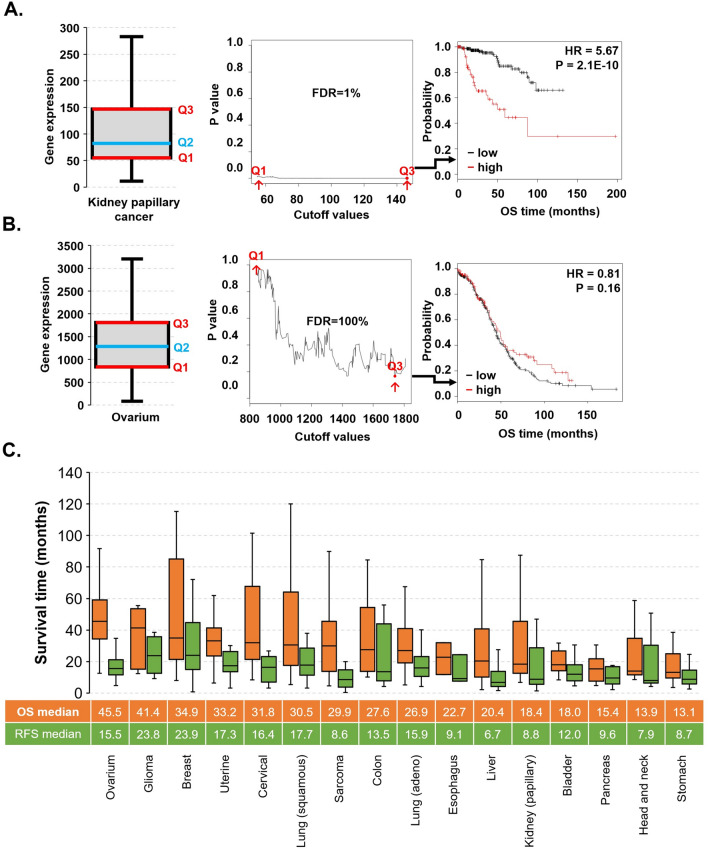
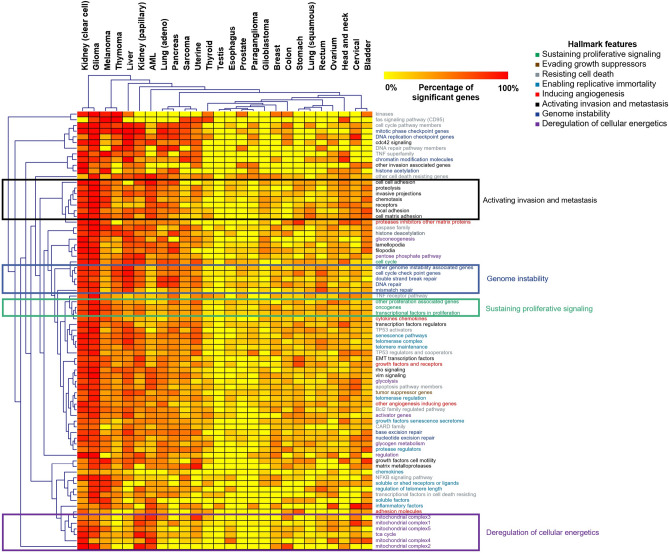
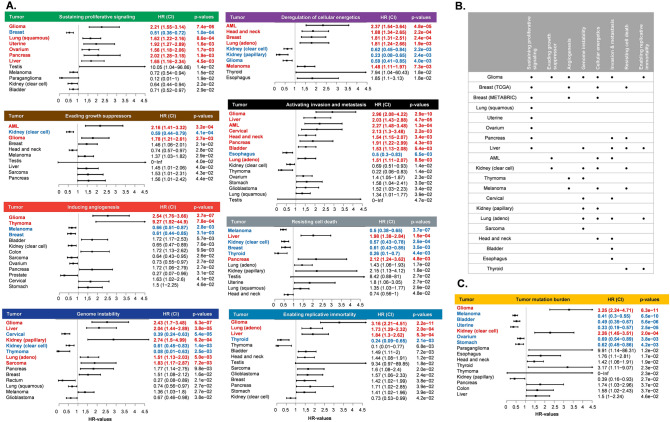
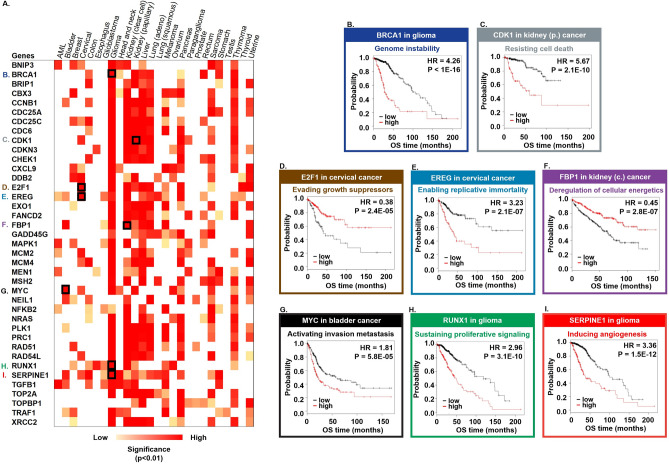
Cancer hallmark genes are responsible for the most essential phenotypic characteristics of malignant transformation and progression. In this study, our aim was to estimate the prognostic effect of the established cancer hallmark genes in multiple distinct cancer types. RNA-seq HTSeq counts and survival data from 26 different tumor types were acquired from the TCGA repository. DESeq was used for normalization. Correlations between gene expression and survival were computed using the Cox proportional hazards regression and by plotting Kaplan–Meier survival plots. The false discovery rate was calculated to correct for multiple hypothesis testing. Signatures based on genes involved in genome instability and invasion reached significance in most individual cancer types. Thyroid and glioblastoma were independent of hallmark genes (61 and 54 genes significant, respectively), while renal clear cell cancer and low grade gliomas harbored the most prognostic changes (403 and 419 genes significant, respectively). The eight genes with the highest significance included BRCA1 (genome instability, HR 4.26, p < 1E−16), RUNX1 (sustaining proliferative signaling, HR 2.96, p = 3.1E−10) and SERPINE1 (inducing angiogenesis, HR 3.36, p = 1.5E−12) in low grade glioma, CDK1 (cell death resistance, HR = 5.67, p = 2.1E−10) in kidney papillary carcinoma, E2F1 (tumor suppressor, HR 0.38, p = 2.4E−05) and EREG (enabling replicative immortality, HR 3.23, p = 2.1E−07) in cervical cancer, FBP1 (deregulation of cellular energetics, HR 0.45, p = 2.8E−07) in kidney renal clear cell carcinoma and MYC (invasion and metastasis, HR 1.81, p = 5.8E−05) in bladder cancer. We observed unexpected heterogeneity and tissue specificity when correlating cancer hallmark genes and survival. These results will help to prioritize future targeted therapy development in different types of solid tumors.
Overview
The claims and statistics of this paper haven’t been checked yet.
Run the check — free, no account needed. It reads the open-access text and checks the sources it cites.
Integrity signals
Registry
Cites
Statistics
Figures
Verification
Claims the paper makes
The claims and statistics of this paper haven’t been checked yet.
Run the check — free, no account needed. It reads the open-access text and checks the sources it cites.
Claims other papers make about this one
Each is checked against this paper’s own text: does it say what the citing paper says it does?
In the citing paper
“Kaplan–Meier analysis using public breast cancer meta-analysis database11,30 reveals that TNBC patients with higher hypoxia gene signature are associated with worse disease outcomes, including both overall survival (OS) and distant metastasis-free survival (DMFS), compared to those with lower expression of hypoxia gene signature (Fig. 1h).”
Self-check
Percentages, sums and reported differences re-computed from the paper’s own numbers.
The self-check needs the paper’s full text.
Citations
Cites
Hallmarks of Cancer: The Next Generation
Hanahan, D., & Weinberg, R. A. (2011) · Cell · doi:10.1016/j.cell.2011.02.013 · Cited by 66,590
Subramanian, A., Tamayo, P., Mootha, V. K., Mukherjee, S., Ebert, B. L., Gillette, M. A., Paulovich, A., Pomeroy, S. L., Golub, T. R., Lander, E. S., et al. (2005) · Proceedings of the National Academy of Sciences · doi:10.1073/pnas.0506580102 · Cited by 53,625
Hanahan, D., & Weinberg, R. A. (2000) · Cell · doi:10.1016/s0092-8674(00)81683-9 · Cited by 29,219
Differential expression analysis for sequence count data
Anders, S., & Huber, W. (2010) · Genome Biology · doi:10.1186/gb-2010-11-10-r106 · Cited by 15,581
The genomic and transcriptomic architecture of 2,000 breast tumours reveals novel subgroups
METABRIC Group, Curtis, C., Shah, S. P., Chin, S.-F., Turashvili, G., Rueda, O. M., Dunning, M. J., Speed, D., Lynch, A. G., Samarajiwa, S., et al. (2012) · Nature · doi:10.1038/nature10983 · Cited by 6,097
Trastuzumab plus Adjuvant Chemotherapy for Operable HER2-Positive Breast Cancer
Romond, E. H., Perez, E. A., Bryant, J., Suman, V. J., Geyer, C. E., Davidson, N. E., Tan-Chiu, E., Martino, S., Paik, S., Kaufman, P. A., et al. (2005) · New England Journal of Medicine · doi:10.1056/nejmoa052122 · Cited by 5,438
Trastuzumab after Adjuvant Chemotherapy in HER2-Positive Breast Cancer
Piccart-Gebhart, M. J., Procter, M., Leyland-Jones, B., Goldhirsch, A., Untch, M., Smith, I., Gianni, L., Baselga, J., Bell, R., Jackisch, C., et al. (2005) · New England Journal of Medicine · doi:10.1056/nejmoa052306 · Cited by 5,084
Tamoxifen for early breast cancer: an overview of the randomised trials
Abe, O., Bartholomeus, S., & Piccart, M. J. (1998) · The Lancet · doi:10.1016/s0140-6736(97)11423-4 · Cited by 4,180
Gene-expression profiles to predict distant metastasis of lymph-node-negative primary breast cancer
Wang, Y., Klijn, J. G. M., Zhang, Y., Sieuwerts, A. M., Look, M. P., Yang, F., Talantov, D., Timmermans, M. A. M., Gelder, M. E. M., Yu, J. X., et al. (2005) · The Lancet · doi:10.1016/s0140-6736(05)17947-1 · Cited by 2,831
Focan, C., Steinberg, S. M., Blichert-Toft, M., Forbes, J., Collins, R. D., Anderson, S., Margreiter, R., Harwood, C. S., Andersen, K., Beighton, G., et al. (1998) · PubMed · Cited by 2,146
Cited by
Sorted by citations
Kumar, V., Ramnarayanan, K., Sundar, R., Padmanabhan, N., Srivastava, S., Koiwa, M., Yasuda, T., Koh, V., Huang, K. K., Tay, S. T., et al. (2022) · Cancer Discovery · doi:10.1158/2159-8290.cd-21-0683 · Cited by 573
Sublethal cytochrome c release generates drug-tolerant persister cells
Kalkavan, H., Chen, J., Crawford, J. C., Quarato, G., FITZGERALD, P. J., Tait, S. W. G., Goding, C. R., & Green, D. R. (2022) · Cell · doi:10.1016/j.cell.2022.07.025 · Cited by 271
The Role of EREG/EGFR Pathway in Tumor Progression
Cheng, W., Feng, P., Lee, K., Chen, K.-Y., Sun, W.-L., Hiệp, N. V., Luo, C.-S., & Wu, S. (2021) · International Journal of Molecular Sciences · doi:10.3390/ijms222312828 · Cited by 246
Ma, S., Zhao, Y., Lee, W. C., Ong, L.-T., Lee, P. L., Jiang, Z., Oguz, G., Niu, Z., Liu, M., Goh, J. Y., et al. (2022) · Nature Communications · doi:10.1038/s41467-022-31764-9 · Cited by 200
Transient loss of Polycomb components induces an epigenetic cancer fate
Parreno, V., Loubière, V., Schuettengruber, B., Fritsch, L., Rawal, C. C., Erokhin, M., Győrffy, B., Normanno, D., Stefano, M. D., Moreaux, J., et al. (2024) · Nature · doi:10.1038/s41586-024-07328-w · Cited by 180
Self-citation
Metadata
- Authors
- Nagy, Á., Munkácsy, G., & Győrffy, B.
- Affiliations
- Semmelweis University (HU)
- Corresponding author
- Győrffy, Balázs
- Venue
- Scientific Reports
- Published
- 2021-03-15
- Volume
- 11
- Issue
- 1
- Pages
- 6047-6047
- ISSN
- 2045-2322 (ISSN-L)
- PMC
- PMC7961001
- OpenAlex
- W3139511935
- Cited by
- 1,381
- References
- 40
- Citations by year
- 2026: 38 · 2025: 84 · 2024: 145 · 2023: 504 · 2022: 311 · 2021: 298
- FWCI
- 101.01
- Type
- journal article
- Language
- en
- Open access
- gold
- doi.org
- Locations
- Scientific Reports (publishedVersion, cc-by)
- bioRxiv (Cold Spring Harbor Laboratory) (acceptedVersion)
- PubMed Central (publishedVersion, cc-by)
- PubMed (publishedVersion)
- DOAJ (DOAJ: Directory of Open Access Journals) (submittedVersion, cc-by-sa)
- Funders
- Semmelweis Egyetem
- Innovációs és Technológiai Minisztérium (ÚNKP-19-3, 2018-2.1.17-TET-KR-00001)
- Topics
- Life Sciences › Biochemistry, Genetics and Molecular Biology › Molecular Biology › Gene expression and cancer classification
- Life Sciences › Biochemistry, Genetics and Molecular Biology › Cancer Research › Breast Cancer Treatment Studies
- Life Sciences › Biochemistry, Genetics and Molecular Biology › Cancer Research › Cancer Genomics and Diagnostics
- Keywords
- prognostic gene signature, survival analysis, genomic instability, invasion and metastasis, replicative immortality, cell death resistance, angiogenesis, tumor suppressor, BRCA1, RUNX1, SERPINE1, CDK1, E2F1, epiregulin, c-Myc, clear cell renal cell carcinoma, low-grade glioma, cervical cancer, bladder cancer, thyroid cancer, glioblastoma, tissue specificity, targeted therapy
- MeSH terms
- RNA-Seq, Humans, Neoplasms, Biomarkers, Tumor, Survival Rate, Disease-Free Survival, Databases, Nucleic Acid, Kaplan-Meier Estimate
About these checks
Registry, retraction, Cites and statistics results are computed, not judged, with one exception: a printed reference that no index lists is read once by a model before it counts as a citation error. Claims are extracted by a model and kept only when their quote appears verbatim in the text; each cited source is then checked, with a model’s help, for whether it says what the claim relies on. Those verdicts can be wrong — read the claim’s quote and the cited source before relying on one.
Statistics and arithmetic are recomputed, not judged.
Confidence bands are shown only for fields calibrated on our annotated test set. None is calibrated yet, so no band is shown.
What counts as a claim ›How we measure confidence ›How we check this ›
Are you an author, or do you see a problem with this page? Request a review
