

Occurrence of comorbidities in newly diagnosed type 2 diabetes patients and their impact after 11 years’ follow-up
Open accessThe DOI matches its Crossref record; 33 of the 33 references it cites were found in a registry or an index.
Abstract
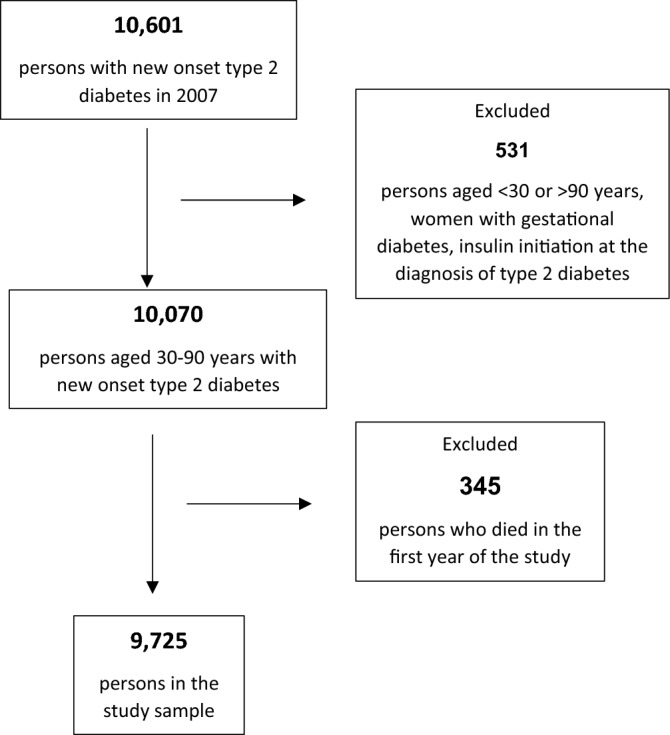
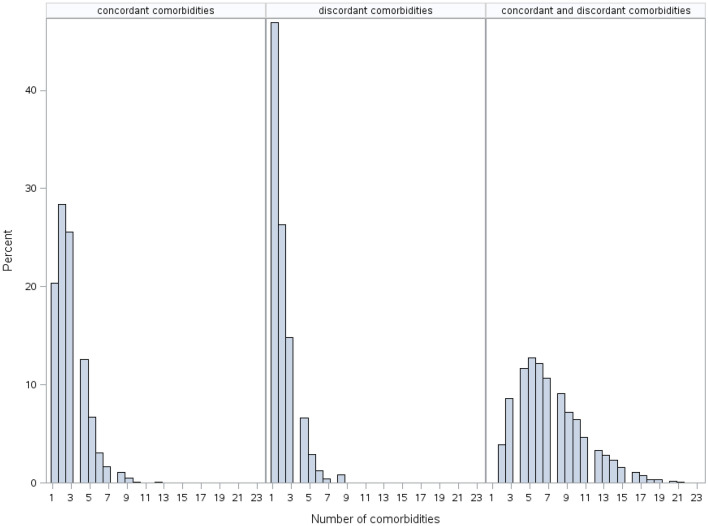
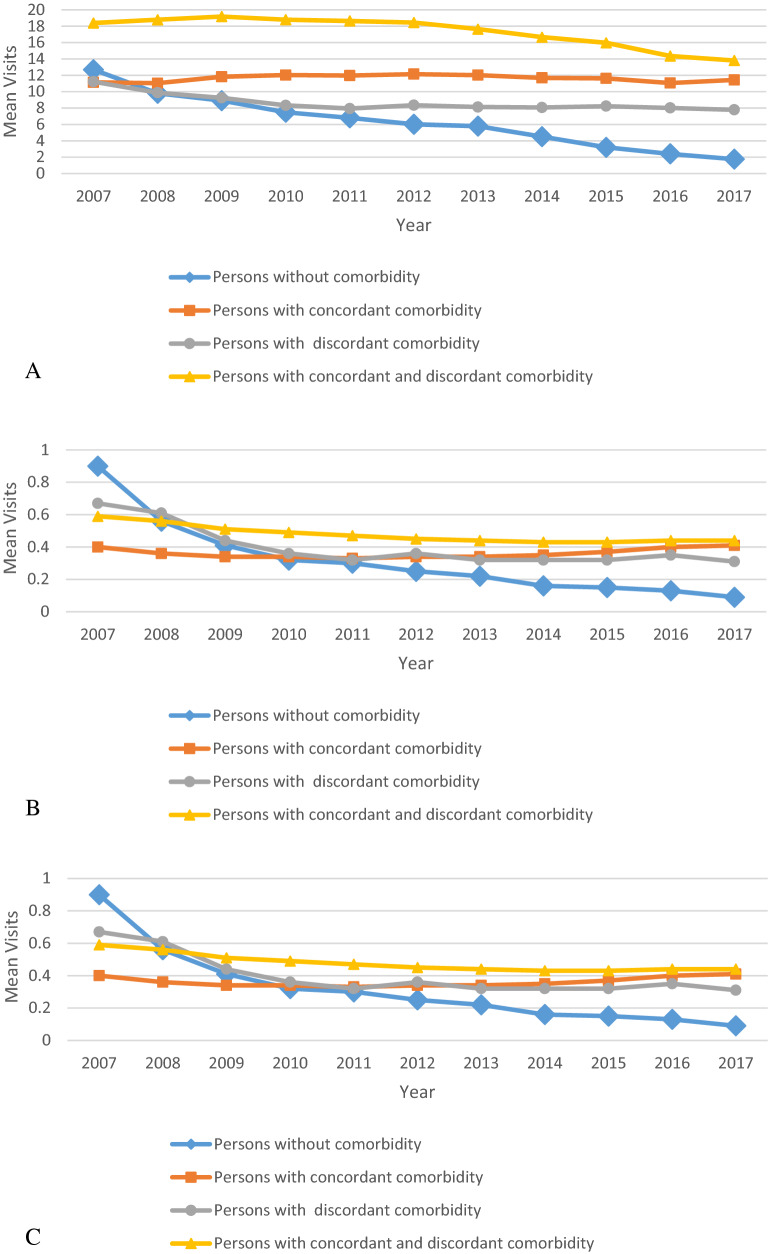
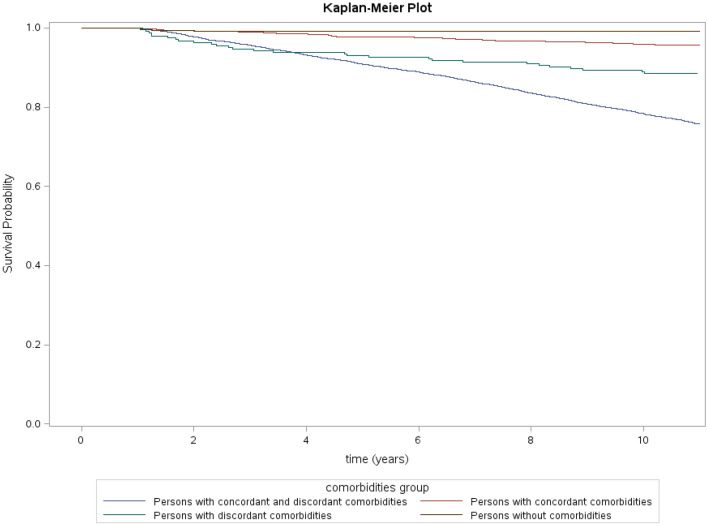
The burden of type 2 diabetes is growing, not only through increased incidence, but also through its comorbidities. Concordant comorbidities for type 2 diabetes, such as cardiovascular diseases, are considered expected outcomes of the disease or disease complications, while discordant comorbidities are not considered to be directly related to type 2 diabetes and are less extensively addressed under diabetes management. Here we show that the combination of concordant and discordant comorbidities appears frequently in persons with diabetes (75%). Persons with combined comorbidities visited family physicians more than persons with discordant, concordant or no comorbidity (17.3 ± 10.2, 11.6 ± 6.5, 8.7 ± 6.8, 6.3 ± 6.6 visits/person/year respectively, p < 0.0001). The risk of death during the study period was highest in persons with combined comorbidities and discordant only comorbidities (HR = 33.4; 95% CI 12.5–89.2 and HR = 33.5; 95% CI 11.7–95.8), emphasizing the contribution of discordant comorbidities to the outcome. Our study is unique as a long-term follow-up of an 11-year cohort of 9725 persons with new-onset type 2 diabetes. The findings highlight the contribution of discordant comorbidity to the burden of the disease. The high prevalence of the combination of both concordant and discordant comorbidities, and their appearance before the onset of type 2 diabetes, indicates a continuum of morbidity.
Overview
The claims and statistics of this paper haven’t been checked yet.
Free: it reads the open-access text and checks the first 5 claims that cite a source we can check. Create a free account to check every claim.
Integrity signals
Registry
Cites
Statistics
Figures
Verification
Claims the paper makes
The claims and statistics of this paper haven’t been checked yet.
Free: it reads the open-access text and checks the first 5 claims that cite a source we can check. Create a free account to check every claim.
Claims other papers make about this one
Each is checked against this paper’s own text: does it say what the citing paper says it does?
In the citing paper
“Nevertheless, sustained weight reduction can help to defer the onset and reduce the progression of these co-morbidities [68-71].”
From Recent advances in peptide-based therapies for obesity and type 2 diabetes (2024) · cites this paper as [70]
Self-check
Percentages, sums and reported differences re-computed from the paper’s own numbers.
The self-check needs the paper’s full text.
Citations
Cites
Global estimates of the prevalence of diabetes for 2010 and 2030
Shaw, J. E., Sicree, R. A., & Zimmet, P. Z. (2010) · Diabetes Research and Clinical Practice · doi:10.1016/j.diabres.2009.10.007 · Cited by 7,216
Giovannucci, E., Harlan, D. M., Archer, M. C., Bergenstal, R. M., Gapstur, S. M., Habel, L. A., Pollak, M., Regensteiner, J. G., & Yee, D. (2010) · Diabetes Care · doi:10.2337/dc10-0666 · Cited by 2,366
Excess Mortality among Persons with Type 2 Diabetes
Tancredi, M., Rosengren, A., Svensson, A.-M., Kosiborod, M., Pivodic, A., Gudbjörnsdottir, S., Wedel, H., Clements, M., Dahlqvist, S., & Lind, M. (2015) · New England Journal of Medicine · doi:10.1056/nejmoa1504347 · Cited by 996
Samson, S. L., & Garber, A. J. (2014) · Endocrinology and Metabolism Clinics of North America · doi:10.1016/j.ecl.2013.09.009 · Cited by 746
The Impact of Comorbid Chronic Conditions on Diabetes Care
Piette, J. D., & Kerr, E. A. (2006) · Diabetes Care · doi:10.2337/diacare.29.03.06.dc05-2078 · Cited by 731
Gregg, E. W., Cheng, Y. J., Srinivasan, M., Lin, J., Geiss, L. S., Albright, A. L., & Imperatore, G. (2018) · The Lancet · doi:10.1016/s0140-6736(18)30314-3 · Cited by 480
Dall, T. M., Yang, W., Gillespie, K., Mocarski, M., Byrne, E., Cintina, I., Beronja, K., Semilla, A. P., Iacobucci, W., & Hogan, P. F. (2019) · Diabetes Care · doi:10.2337/dc18-1226 · Cited by 438
Evidence on multimorbidity from definition to intervention: An overview of systematic reviews
Xu, X., Mishra, G. D., & Jones, M. (2017) · Ageing Research Reviews · doi:10.1016/j.arr.2017.05.003 · Cited by 397
Dall, T. M., Yang, W., Halder, P., Pang, B., Massoudi, M., Wintfeld, N., Semilla, A. P., Franz, J., & Hogan, P. F. (2014) · Diabetes Care · doi:10.2337/dc14-1036 · Cited by 382
Kerr, E. A., Heisler, M., Krein, S. L., Kabeto, M., Langa, K. M., Weir, D., & Piette, J. D. (2007) · Journal of General Internal Medicine · doi:10.1007/s11606-007-0313-2 · Cited by 330
Research works printed but not linked: 1
- Cohen R Rabin G National Insurance Institute R and PA. Membership in sick funds 2016 [Hebrew] Period Surv. 2017 289 4
Cited by
Yang, S., Sun, Y., & Yan, C. (2024) · Journal of Nanobiotechnology · doi:10.1186/s12951-024-02603-4 · Cited by 128
Recent advances in peptide-based therapies for obesity and type 2 diabetes
Bailey, C. J., Flatt, P. R., & Conlon, J. M. (2024) · Peptides · doi:10.1016/j.peptides.2024.171149 · Cited by 25
The Effect of Diabetes on Complications after Spinal Fusion: A Systematic Review and Meta-Analysis
Ruggiero, N., Soliman, M. A. R., Kuo, C. C., Aguirre, A. O., Quiceno, E., Saleh, J., Yeung, K., Khan, A., Hess, R. M., Lim, J., et al. (2024) · World Neurosurgery · doi:10.1016/j.wneu.2024.03.008 · Cited by 12
Wamil, M., Hassaïne, A., Rao, S., Li, Y., Mamouei, M., Canoy, D., Nazarzadeh, M., Bidel, Z., Copland, E., Rahimi, K., et al. (2023) · Scientific Reports · doi:10.1038/s41598-023-38251-1 · Cited by 14
“As a chronic condition, diabetes frequently occurs in the context of other diseases, which cumulatively have a more substantial impact on a patient’s quality of life and the risks of developing severe complications and mortality than when diabetes is considered in the separation 29–31 .”
Negussie, Y. M., Getahun, M. S., & Bekele, N. T. (2023) · Frontiers in Clinical Diabetes and Healthcare · doi:10.3389/fcdhc.2023.1307463 · Cited by 9
Mapping the Diabetes Comorbidome: A New Frontier in Personalised Medicine
Pachauri, A. (2025) · Preventive Medicine Research & Reviews · doi:10.4103/pmrr.pmrr_39_25 · Cited by 8
Ferede, Y. M., Erlandsson, K., Gebrie, M. H., Beshah, D. T., Mohammed, O. Y., Azagew, A. W., & Westerbotn, M. (2025) · BMC Public Health · doi:10.1186/s12889-025-25570-3 · Cited by 189
Liu, X., Li, C., Huo, X., Liu, J., Liu, J., Cao, W., & Zheng, J. (2026) · Scientific Reports · doi:10.1038/s41598-026-36923-2 · Cited by 5
Letta, S., Aga, F., Yadeta, T. A., Geda, B., & Dessie, Y. (2022) · Frontiers in Endocrinology · doi:10.3389/fendo.2022.939804 · Cited by 8
“The risk of premature death is usually higher in people with comorbidity (26).”
BackgroundDiabetes Distress in Adults with Type 2 Diabetes and Multimorbidity: A Scoping Review
Aziz, M. A., Juniarti, N., Kurniawan, T., & Afriana, R. (2026) · Journal of Multidisciplinary Healthcare · doi:10.2147/jmdh.s588965 · Cited by 3
“10 The presence of each additional comorbidity markedly elevates the likelihood of experiencing diabetes distress, potentially initiating a detrimental cycle characterized by diminished medication adherence and suboptimal glycemic control.”
Kintzoglanakis, K., Pavlou-Skantzis, L., Themeli, T., Kyprianou, M., & Paschou, S. Α. (2024) · HORMONES · doi:10.1007/s42000-024-00545-y · Cited by 5
“Thus, discordant MM should not be over-looked in favor of concordant MM, namely, cardiovascular disease [15, 21], especially since recent data highlight the fact that discordant MM mainly contributes to mortality in T2D [33].”
Noriega, R. X., Nañez, J., Hartmann, E., Beard, J. D., Sloan-Aagard, C. D., & Thacker, E. L. (2025) · International Journal of Environmental Research and Public Health · doi:10.3390/ijerph22050673 · Cited by 4
“The higher prevalence of comorbidities among persons with type 2 diabetes than those who are normoglycemic is well documented [8,10,12–14].”
Adegbosin, O. T., Olamoyegun, M. A., & Olarewaju, S. O. (2025) · Journal of Diabetes & Metabolic Disorders · doi:10.1007/s40200-025-01586-9 · Cited by 2
Tripathi, P., KADAM, N. S., Kathrikolly, T., Tiwari, D., VYAWAHARE, A. R., Sharma, B., GANLA, M. H., Kuppusamy, M., Vijayakumar, V., & Saboo, B. (2025) · Scientific Reports · doi:10.1038/s41598-025-94694-8 · Cited by 8
Armando, L. G., Miglio, G., Parisi, R. B., Esiliato, M., Rolando, C., Vinciguerra, V., Diarassouba, A., & Cena, C. (2023) · Healthcare · doi:10.3390/healthcare11111655 · Cited by 2
YILMAZ, Z. K., & BULUT, K. (2023) · Journal of Research in Pharmacy · doi:10.29228/jrp.473 · Cited by 3
“According to the findings in the literature, diabetes mellitus is a disease accompanied by many comorbidities [21].”
Tibballs, K. L. B., Kirkebøen, L. J., Jenum, A. K., Straand, J., Berg, T. J., & Buhl, E. S. (2025) · BMJ Open · doi:10.1136/bmjopen-2024-096521 · Cited by 1
“As greater parts of the population have tertiary degrees, having only compulsory education becomes more strongly associated with social adversity, with fewer job opportunities for these individuals than in the past.”
Nguyen, T. H., Leo, G. D., & Barefield, A. C. (2023) · Healthcare · doi:10.3390/healthcare12010026 · Cited by 3
Tripathi, P., KADAM, N. S., Kathrikolly, T., Tiwari, D., VYAWAHARE, A. R., Sharma, B., GANLA, M. H., Kuppusamy, M., Vijayakumar, V., & Saboo, B. (2024) · SSRN Electronic Journal · doi:10.2139/ssrn.4822458
Vera-Ponce, V. J., Loayza-Castro, J. A., Tapia‐Limonchi, R., & Vigil-Ventura, E. (2024) · medRxiv · doi:10.1101/2024.06.15.24308977
“This combination can result in an even greater need for monitoring and treatment adjustment, significantly increasing the frequency of medical consultations (33) .”
BackgroundAulia, S. S., Decroli, E., & Nurhayati, N. (2024) · Jurnal Ilmu Kesehatan Indonesia · doi:10.25077/jikesi.v5i2.1281
(2023) · Jurnal Biostatistik Kependudukan dan Informatika Kesehatan · doi:10.7454/bikfokes.v3i3.1046
Larimer-Picciani, A. M., Brown, R. B., Ruan, H., Jones, C. E., Deblasio, R. N., Burns, P. R., Williams, A. M., & Waxman, E. L. (2025) · Clinical ophthalmology · doi:10.2147/opth.s499098
“18 19–21 We further hypothesized that this high comorbidity burden contributes to inadequate ophthalmic follow-up and a higher prevalence of undiagnosed DR among these patients.”
Radić, J., Vučković, M., Đogaš, H., Ødeverp, A., Grubić, M., & Radić, M. (2025) · Biomedicines · doi:10.3390/biomedicines13102418 · Cited by 1
“A long-term follow-up study on the cumulative effect of the comorbid nature of the disease and complications show the importance of intensive and extensive monitoring to reduce the continuum of morbidity [25].”
Hajiuni, K., Salehi, S., Rajabli, Z., Azadnajafabad, S., Akbarpour, S., Asgari, S., & Rezaei, N. (2026) · PLoS ONE · doi:10.1371/journal.pone.0343690
“Although these differences are modest, they suggest a trend consistent with prior studies that have shown that comorbidities complicate diabetes management [40,41].”
Finlayson, M. L., Akbar, N., Snelgrove‐Clarke, E., Ross‐White, A., Fakolade, A. O., & Marrie, R. A. (2026) · JBI Evidence Synthesis · doi:10.11124/jbies-25-00410
Karami, M., Nazari, F., Hashemi, N., & Dehkordi, L. M. (2026) · Health Science Reports · doi:10.1002/hsr2.72302 · Cited by 2
Onufrak, S. J., Zaganjor, I., Choi, D., Han, S., Holliday, C. S., & Pavkov, M. E. (2026) · Diabetes Research and Clinical Practice · doi:10.1016/j.diabres.2026.113530 · Cited by 1
“Other research from Israel found the co-occurrence of concordant and discordant comorbidities increased mortality 33-fold compared to no comorbidities among people with type 2 diabetes [8], underscoring the concerning trends we observed.”
Influential
Metadata
- Authors
- Eilat-Tsanani, S., Margalit, A., & Golan, L. N.
- Affiliations
- Bar-Ilan University (IL)
- Venue
- Scientific Reports
- Published
- 2021-05-26
- Volume
- 11
- Issue
- 1
- Pages
- 11071-11071
- ISSN
- 2045-2322 (ISSN-L)
- PMC
- PMC8155151
- OpenAlex
- W3165029143
- Cited by
- 28
- References
- 33
- Citations by year
- 2026: 6 · 2025: 8 · 2024: 7 · 2023: 6 · 2022: 1
- FWCI
- 2.52
- Type
- journal article
- Language
- en
- Open access
- gold
- doi.org
- Licence
- cc-by
- creativecommons.org/licenses/by/4.0 (tdm)
- creativecommons.org/licenses/by/4.0 (vor)
- Locations
- Scientific Reports (publishedVersion, cc-by)
- PubMed Central (publishedVersion, cc-by)
- PubMed (publishedVersion)
- DOAJ (DOAJ: Directory of Open Access Journals) (submittedVersion, cc-by-sa)
- Funders
- Clalit Health Services
- Topics
- Health Sciences › Medicine › Epidemiology › Chronic Disease Management Strategies
- Health Sciences › Medicine › Endocrinology, Diabetes and Metabolism › Diabetes, Cardiovascular Risks, and Lipoproteins
- Health Sciences › Medicine › Endocrinology, Diabetes and Metabolism › Diabetes Treatment and Management
- Keywords
- type 2 diabetes, comorbidities, cardiovascular disease, mortality risk, family physician visits, newly diagnosed diabetes, long-term follow-up, disease burden
- MeSH terms
- Adult, Aged, Diabetes Mellitus, Type 2, Female, Follow-Up Studies, Humans, Male, Middle Aged, Retrospective Studies, Comorbidity, Incidence, Prevalence, Age of Onset, Diabetes Complications
About these checks
Registry, retraction, Cites and statistics results are computed, not judged, with one exception: a printed reference that no index lists is read once by a model before it counts as a citation error. Claims are extracted by a model and kept only when their quote appears verbatim in the text; each cited source is then checked, with a model’s help, for whether it says what the claim relies on. Those verdicts can be wrong — read the claim’s quote and the cited source before relying on one.
Statistics and arithmetic are recomputed, not judged.
Confidence bands are shown only for fields calibrated on our annotated test set. None is calibrated yet, so no band is shown.
What counts as a claim ›How we measure confidence ›How we check this ›
Are you an author, or do you see a problem with this page? Request a review
Data sources
Bibliographic data: Semantic Scholar, OpenAlex, Crossref.
Contains information from the Semantic Scholar Academic Graph Datasets, made available under the ODC Attribution License (ODC-BY 1.0).
Semantic Scholar’s data is described in: Kinney, R., et al. (2023). The Semantic Scholar Open Data Platform. arXiv:2301.10140.
