

A network approach to the five-facet model of mindfulness
Open accessThe DOI matches its Crossref record; 62 of the 62 references it cites were found in a registry or an index.
Abstract
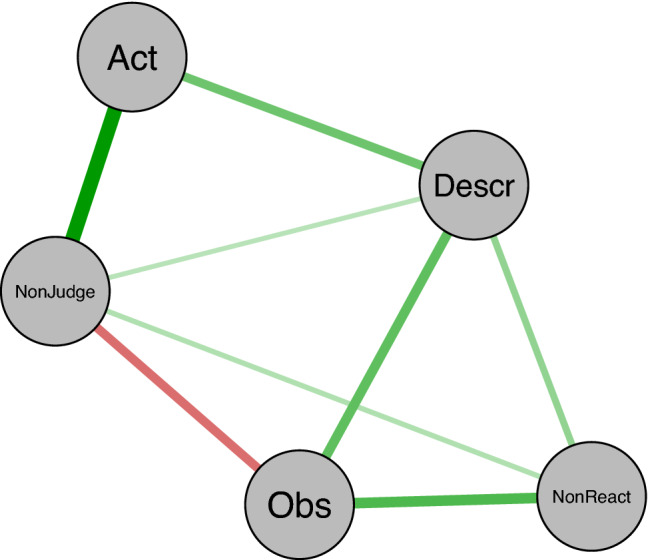
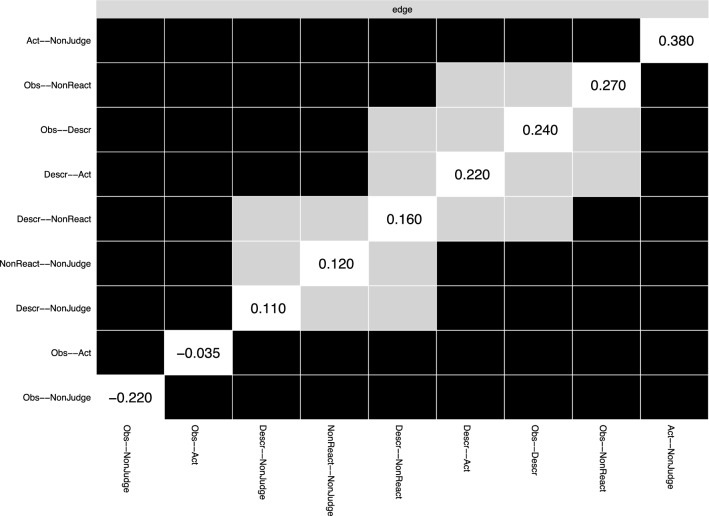
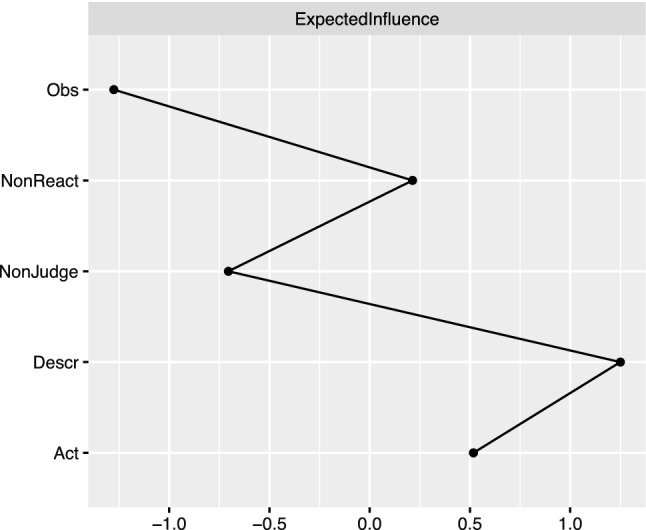
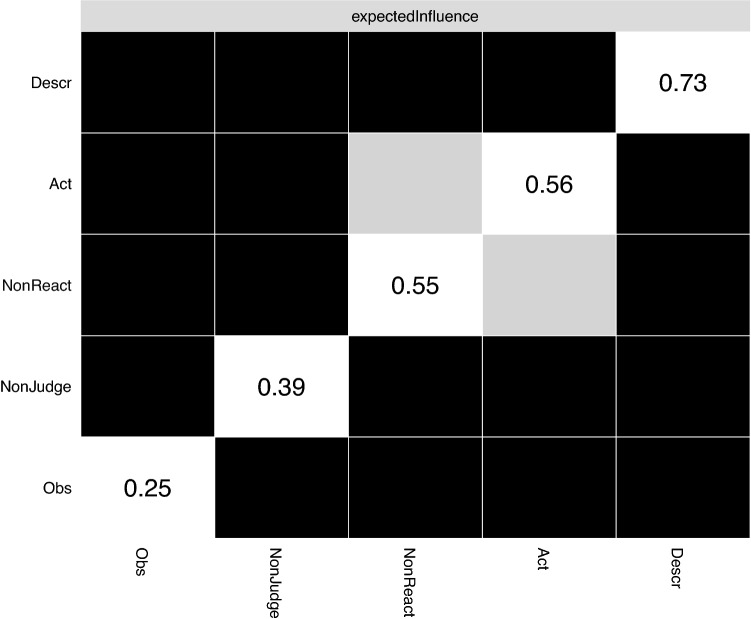
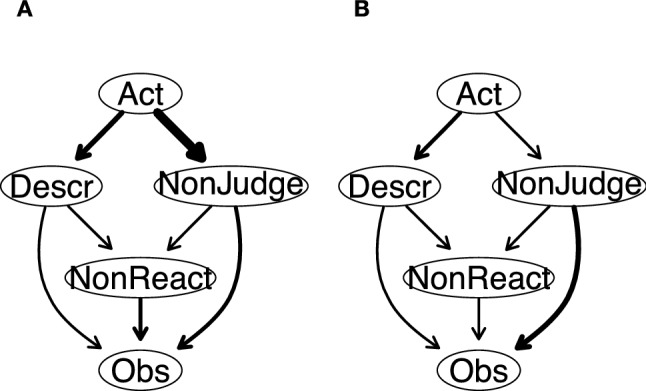
Despite the large-scale dissemination of mindfulness-based interventions, debates persist about the very nature of mindfulness. To date, one of the dominant views is the five-facet approach, which suggests that mindfulness includes five facets (i.e., Observing, Describing, Nonjudging, Nonreactivity, and Acting with Awareness). However, uncertainty remains regarding the potential interplay between these facets. In this study, we investigated the five-facet model via network analysis in an unselected sample (n = 1704). We used two distinct computational network approaches: a Gaussian graphical model (i.e., undirected) and a directed acyclic graph, with each model determining the relations between the facets and their relative importance in the network. Both computational approaches pointed to the facet denoting Acting with Awareness as playing an especially potent role in the network system. Altogether, our findings offer novel data-driven clues for the field's larger quest to ascertain the very foundations of mindfulness.
Overview
The claims and statistics of this paper haven’t been checked yet.
Free: it reads the open-access text and checks the first 5 claims that cite a source we can check. Create a free account to check every claim.
Integrity signals
Registry
Cites
Statistics
Figures
Verification
Claims the paper makes
The claims and statistics of this paper haven’t been checked yet.
Free: it reads the open-access text and checks the first 5 claims that cite a source we can check. Create a free account to check every claim.
Claims other papers make about this one
Each is checked against this paper’s own text: does it say what the citing paper says it does?
The cited source says what the claim attributes to it.
In the citing paper
“The network perspective can also provide insight into complex interrelations between different features of mindfulness cross-sectionally (Heeren et al., 2021) as well as before and after an intervention (mindfulness-based stress reduction; Roca et al., 2019).”
From Exploratory and Confirmatory Bayesian Networks Identify the Central Role of Non-judging in Symptoms of Depression (2021) · cites this paper as Heeren et al., 2021
Self-check
Percentages, sums and reported differences re-computed from the paper’s own numbers.
The self-check needs the paper’s full text.
Citations
Cites
The benefits of being present: Mindfulness and its role in psychological well-being
Brown, K. W., & Ryan, R. M. (2003) · Journal of Personality and Social Psychology · doi:10.1037/0022-3514.84.4.822 · Cited by 13,448
(2008) · Medical Entomology and Zoology · Cited by 7,477
Mindfulness: A proposed operational definition.
Bishop, S. R., Lau, M., Shapiro, S., Carlson, L., Anderson, N. D., Carmody, J., Segal, Z. V., Abbey, S., Speca, M., Velting, D., et al. (2004) · Clinical Psychology: Science and Practice · doi:10.1093/clipsy.bph077 · Cited by 7,234
(2001) · Cited by 3,666
(2005) · Medical Entomology and Zoology · Cited by 3,197
Baer, R. A., Smith, G. T., Lykins, E., Button, D., Krietemeyer, J., Sauer, S., Walsh, E., Duggan, D., & Williams, J. M. G. (2008) · Assessment · doi:10.1177/1073191107313003 · Cited by 2,930
A tutorial on regularized partial correlation networks
Epskamp, S., & Fried, E. I. (2018) · Psychological Methods · doi:10.1037/met0000167 · Cited by 2,918
Wherever you go, there you are: Mindfulness meditation in everyday life
Kwee, M. (1995) · Behaviour Research and Therapy · doi:10.1016/0005-7967(95)90133-7 · Cited by 2,896
Assessment of Mindfulness by Self-Report: The Kentucky Inventory of Mindfulness Skills
Baer, R. A., Smith, G. T., & Allen, K. B. (2004) · Assessment · doi:10.1177/1073191104268029 · Cited by 2,298
Mindfulness-based therapy: a comprehensive meta-analysis
Khoury, B., Lecomte, T., Fortin, G., Masse, M., Therien, P., Bouchard, V., Chapleau, M.-A., Paquin, K., & Hofmann, S. G. (2013) · Clinical Psychology Review · doi:10.1016/j.cpr.2013.05.005 · Cited by 2,003
Cited by
Ponder, W. N., Walters, K. J., Simons, J. S., Simons, R. M., Jetelina, K. K., & Carbajal, J. (2022) · Journal of Affective Disorders · doi:10.1016/j.jad.2022.09.097 · Cited by 49
Lee, C.-W., & Hung, H.-H. (2024) · Sustainability · doi:10.3390/su16208832 · Cited by 44
Zheng, Y., Gu, X., Jiang, M., & Zeng, X. (2022) · Mindfulness · doi:10.1007/s12671-022-01927-2 · Cited by 33
“The prominent role of acting with awareness among the five facets of mindfulness was in line with a recent network analysis study on the Five Facets Mindfulness Questionnaire (Heeren et al., 2021).”
ResultInfluentialSaqr, M. (2023) · Computers in Human Behavior · doi:10.1016/j.chb.2023.107991 · Cited by 33
Five Facet Mindfulness Questionnaire (FFMQ)
Baer, R. A., Gu, J., & Strauss, C. (2022) · Springer eBooks · doi:10.1007/978-3-030-77644-2_15-1 · Cited by 36
Moszeik, E. N., Rohleder, N., & Renner, K. (2025) · Stress and Health · doi:10.1002/smi.70049 · Cited by 18
“‘Acting with awareness’ is considered a critical facet of mindfulness, particularly effective for mental health (Heeren et al. 2021).”
Network analysis of risk and protective factors for suicidal ideation in adolescents
Peng, X., Tang, T., Wu, M., Tan, L., & Pan, Y. (2024) · Children and Youth Services Review · doi:10.1016/j.childyouth.2024.107458 · Cited by 15
Rubin, M., Papini, S., Dainer-Best, J., Zaizar, E. D., Smits, J. A. J., & Telch, M. J. (2021) · Mindfulness · doi:10.1007/s12671-021-01726-1 · Cited by 13
Network of Mindfulness and Difficulties in Regulating Emotions in Firefighters
Chiang, H. N., Medvedev, O. N., Ponder, W. N., Carbajal, J., & Vujanovic, A. A. (2024) · Mindfulness · doi:10.1007/s12671-024-02348-z · Cited by 13
“Our findings extend the directional network analysis of the FFMQ by Heeren et al. (2021).”
Chalmers, R. A., Cervin, M., & Medvedev, O. N. (2022) · Springer eBooks · doi:10.1007/978-3-030-77644-2_70-1 · Cited by 13
A Network Investigation of Core Mindfulness Processes
Sala, M., Aslan, M., Gueorguieva, R. V., Schupak, M., & Garrison, K. A. (2023) · Mindfulness · doi:10.1007/s12671-023-02109-4 · Cited by 13
“The current finding is again in line with other recent network analysis studies suggesting that processes related to Describing are core to mindfulness (Heeren et al., 2021; Sala et al., 2022).”
BackgroundResultYe, H., Shi, X., Li, Y., Huang, Y., You, R., Zhang, X., Yu, Z., Li, H., & Fan, F. (2024) · British Journal of Psychology · doi:10.1111/bjop.12736 · Cited by 10
Measuring Virtue: An Aristotelian Perspective on Advancing Positive Psychology
McManus, J., Medvedev, O. N., Zyl, L. L. V., & Weijers, D. (2024) · International Journal of Applied Positive Psychology · doi:10.1007/s41042-024-00167-0 · Cited by 9
“Directional network plots display probability estimates about the expected direction of casualty between these variables (Heeren et al., 2021), thereby helping us to determine whether per - forming virtuous acts causes increases in virtuous motivation.”
Dixon, H. C., Reynolds, L., & Consedine, N. S. (2022) · The Journal of Sex Research · doi:10.1080/00224499.2022.2043229 · Cited by 10
“A recent network analysis evaluating the probabilistic dependencies between mindfulness facets showed that acting with awareness mind-fulness was the most potent facet, from which other facets were derived (Heeren et al., 2021).”
Five Facet Mindfulness Questionnaire (FFMQ)
Baer, R. A., Gu, J., & Strauss, C. (2025) · Springer eBooks · doi:10.1007/978-3-031-47219-0_15 · Cited by 10
Yan, V. Y.-X., Vujanovic, A. A., Ponder, W. N., Carbajal, J., & Medvedev, O. N. (2024) · Mindfulness · doi:10.1007/s12671-024-02352-3 · Cited by 8
“Numerous empirical studies have successfully employed directed network analysis in health psychology science and practice (Christensen et al., 2020; Heeren et al., 2021; Hevey, 2018).”
Identifying the association of hyperarousal and insomnia symptoms: A network perspective
Zhu, K., & Xue, S. (2025) · Journal of Psychiatric Research · doi:10.1016/j.jpsychires.2025.06.017 · Cited by 5
Psychological risk and protective factors of immunity: a cross-cultural network analysis
Chalmers, R., Cervin, M., Choo, C. C., Sutton, A., Barcaccia, B., Couyoumdjian, A., Pallini, S., Iqbal, N., Reid, V. M., Singh, N. N., et al. (2024) · Current Psychology · doi:10.1007/s12144-024-07178-9 · Cited by 4
“…other symptoms of major depressive disorder in adult women (Moradi et al., 2022); energy dysregulation was the key driver in symptom structure of bipolar disorder (McNally et al., 2022); and acting with awareness was the key driver of mindfulness within the five facet model (Heeren et al., 2021).”
Mindfulness and Interoceptive Awareness: A Network Analysis
Sala, M., Schanzer, S., & Morris, C. (2024) · The Journal of Nervous and Mental Disease · doi:10.1097/nmd.0000000000001779 · Cited by 6
A Network Analysis of Symptoms of Post-Traumatic Stress Disorder and Facets of Mindfulness
Rubin, M. (2024) · Trauma Care · doi:10.3390/traumacare4020013 · Cited by 3
“While network analyses have also examined facets of mindfulness alone [6] and in relation to mental health concerns like depression [7], to the best of our knowledge no research has examined PTSD symptoms and the facets of mindfulness in the context of network analysis.”
BackgroundLi, P., Fang, Y., Zhou, Y., Chen, Z., & Luo, H. (2025) · Current Psychology · doi:10.1007/s12144-025-07477-9 · Cited by 2
“Building on the findings of Heeren et al. (2021),”
Chalmers, R. A., Cervin, M., & Medvedev, O. N. (2025) · Springer eBooks · doi:10.1007/978-3-031-47219-0_70 · Cited by 1
Chen, M., Xin, Z., He, M., Wang, Z., Li, Y., Hofmann, S. G., & Liu, X. (2025) · Mindfulness · doi:10.1007/s12671-025-02656-y · Cited by 1
“These findings align with previous cross-sectional studies (Alexandre Heeren et al., 2021).”
Liu, B., Zou, M., Ren, L., Ma, Z., Qin, N., Liu, S., Yang, Q., Fan, Y., Hou, L., 杨志萍, et al. (2026) · Comprehensive Psychiatry · doi:10.1016/j.comppsych.2026.152699 · Cited by 1
Sirotiak, Z., Adamowicz, J. L., & Thomas, E. B. K. (2024) · Adolescent Psychiatry · doi:10.2174/0122106766288982240509041026 · Cited by 1
Williams, M. A., Eadeh, H., Markon, K. E., Adamowicz, J. L., & Thomas, E. B. K. (2025) · Journal of Contextual Behavioral Science · doi:10.1016/j.jcbs.2025.100917 · Cited by 2
Moszeik, E. N., Renner, K., Leipold, B., & Deutschland (2023) · Cited by 4
Krägeloh, C. U., & Medvedev, O. N. (2024) · Springer eBooks · doi:10.1007/978-981-97-0821-5_6-1
Qi, H., Liu, X., Jiang, F., & Qu, D. (2025) · Mindfulness · doi:10.1007/s12671-025-02679-5
“This result may be due to describing and acting with awareness playing the most important role in connecting the five-facet mindfulness network (Heeren et al., 2021).”
A Systematic Review of Mindfulness Network Analysis Studies
Kahn, D. L., Martin, A., Morris, C., & Sala, M. (2025) · Mindfulness · doi:10.1007/s12671-025-02722-5
“Regarding facet findings, acting with awareness (Bron-chain & Chabrol, 2020; Heeren et al., 2021; Sala et al., 2023) and describing (Bronchain & Chabrol, 2020; Heeren et al., 2021; Sala et al., 2023) have been identified as core facets in mindfulness networks across multiple studies.”
InfluentialNetwork Analysis for Assessment in International Contexts
Adu, P., & Medvedev, O. N. (2026) · Springer eBooks · doi:10.1007/978-3-030-89738-3_6-1 · Cited by 1
Moszeik, E. N., & El-Mahdy, C. (2026) · Mindfulness · doi:10.1007/s12671-026-02773-2
Liu, Y., Zeng, J. Z., & Gong, J. (2026) · Mindfulness · doi:10.1007/s12671-026-02833-7
“Greater Observing may facilitate pausing before reacting, but its negative link with Non-judging dovetails with prior cross-sectional research (Heeren et al., 2021; Medvedev et al., 2021; Sugi-ura et al., 2012), indicating that heightened Observing can coincide with a judgmental tendency (e.g., “I…”
Inflammation, sleep, and trait mindfulness in pregnancy
Schmid, L., Etzel, L. C., Short, S. J., Propper, C., Mills-Koonce, R., Lee, V. K., & Garrett-Peters, P. (2026) · Sleep Health · doi:10.1016/j.sleh.2026.04.004 · Cited by 1
He, Y., Takács, Z. K., Brodie, Z. P., & Goodall, K. (2026) · Psychological Reports · doi:10.1177/00332941261450512
Network analyses identify critical factors for facilitating future-oriented decision-making
Wu, H., Xue, Z., Xiao, X., Ma, J., Xiao, Z., Chen, K., Jiang, Y., & Guo, Y. (2026) · Cognitive Psychology · doi:10.1016/j.cogpsych.2026.101815
Zhang, H., & Li, X. (2026) · International Journal of Human-Computer Interaction · doi:10.1080/10447318.2026.2674839
Siew, S. K. H., & Yu, J. (2026) · PLoS ONE · doi:10.1371/journal.pone.0352195
Investigating stroke risk factors: A cross-cultural network analysis
Olsen, K. (2026) · Research Commons (University of Waikato)
Virtue in measurement: An interdisciplinary study of conscientiousness through Aristotelian theory
McManus, J. (2026) · Research Commons (University of Waikato)
Mapping mental health complexity in esports: an exploratory psychosocial network approach
Ruysevelt, L. V., Heel, M. V., Trotter, M. G., Watson, M., Pedraza-Ramirez, I., Bonilla, I., Davis, P., Ragnarsson, J., Maîresse, O., & Kegelaers, J. J. (2026) · BMC Psychology · doi:10.1186/s40359-026-05800-y
“The current study applies these network approaches in a primarily exploratory, hypothesis-generating manner [33] to provide insight into the complex, interconnected structure among esports-specific stressors, psychosocial factors (basic psychological needs, social support, emotion regulation),…”
Metadata
- Authors
- Heeren, A., Lannoy, S., Coussement, C., Hoebeke, Y., Verschuren, A., Blanchard, M. A., Chakroun-Baggioni, N., Philippot, P., & Gierski, F.
- Affiliations
- UCLouvain (BE)
- Virginia Commonwealth University (US)
- Inserm (FR)
- Corresponding author
- Heeren, Alexandre
- ORCID
- Venue
- Scientific Reports
- Published
- 2021-07-23
- Volume
- 11
- Issue
- 1
- Pages
- 15094-15094
- ISSN
- 2045-2322 (ISSN-L)
- PMC
- PMC8302557
- OpenAlex
- W3174918083
- Cited by
- 39
- References
- 62
- Citations by year
- 2026: 11 · 2025: 9 · 2024: 11 · 2023: 2 · 2022: 5 · 2021: 1
- FWCI
- 3.24
- Type
- journal article
- Language
- en
- Open access
- gold
- doi.org
- Licence
- cc-by
- creativecommons.org/licenses/by/4.0 (tdm)
- creativecommons.org/licenses/by/4.0 (vor)
- Locations
- Scientific Reports (publishedVersion, cc-by)
- PubMed Central (publishedVersion, cc-by)
- PubMed (publishedVersion)
- Lirias (submittedVersion, other-oa)
- HAL (submittedVersion, cc-by)
- Digital Access to Libraries (Université catholique de Louvain (UCL), l'Université de Namur (UNamur) and the Université Saint-Louis (USL-B)) (submittedVersion, other-oa)
- DOAJ (DOAJ: Directory of Open Access Journals) (submittedVersion, cc-by-sa)
- Funders
- Fonds De La Recherche Scientifique - FNRS (Grant “1.C.059.18F”)
- Belgian American Educational Foundation
- research fellowship from the “Beau Vallon Psychiatric Hospital”
- "Special Research Funds” — FSR Research Grant from the Université catholique de Louvain
- Coordinated Research Grant from the French Community of Belgium ((ARC Grant 19/24-100))
- Topics
- Social Sciences › Psychology › Clinical Psychology › Mindfulness and Compassion Interventions
- Social Sciences › Psychology › Experimental and Cognitive Psychology › Mental Health Research Topics
- Social Sciences › Psychology › Social Psychology › Psychological Well-being and Life Satisfaction
- Keywords
- mindfulness, network analysis, Gaussian graphical models, directed acyclic graphs, acting with awareness, observation, description, non-judgment, non-reactivity
About these checks
Registry, retraction, Cites and statistics results are computed, not judged, with one exception: a printed reference that no index lists is read once by a model before it counts as a citation error. Claims are extracted by a model and kept only when their quote appears verbatim in the text; each cited source is then checked, with a model’s help, for whether it says what the claim relies on. Those verdicts can be wrong — read the claim’s quote and the cited source before relying on one.
Statistics and arithmetic are recomputed, not judged.
Confidence bands are shown only for fields calibrated on our annotated test set. None is calibrated yet, so no band is shown.
What counts as a claim ›How we measure confidence ›How we check this ›
Are you an author, or do you see a problem with this page? Request a review
Data sources
Bibliographic data: Semantic Scholar, OpenAlex, Crossref.
Contains information from the Semantic Scholar Academic Graph Datasets, made available under the ODC Attribution License (ODC-BY 1.0).
Semantic Scholar’s data is described in: Kinney, R., et al. (2023). The Semantic Scholar Open Data Platform. arXiv:2301.10140.
