

The DOI matches its Crossref record; 1 of the 1 references it cites were found in a registry or an index.
Seasonal and temporal patterns of rainfall shape arthropod community composition and multi-trophic interactions in an arid environment
Open accessAbstract
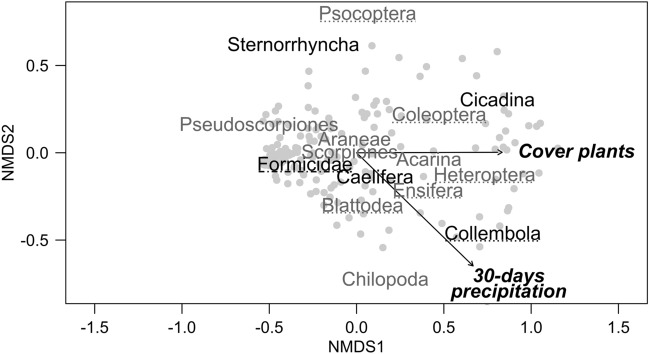
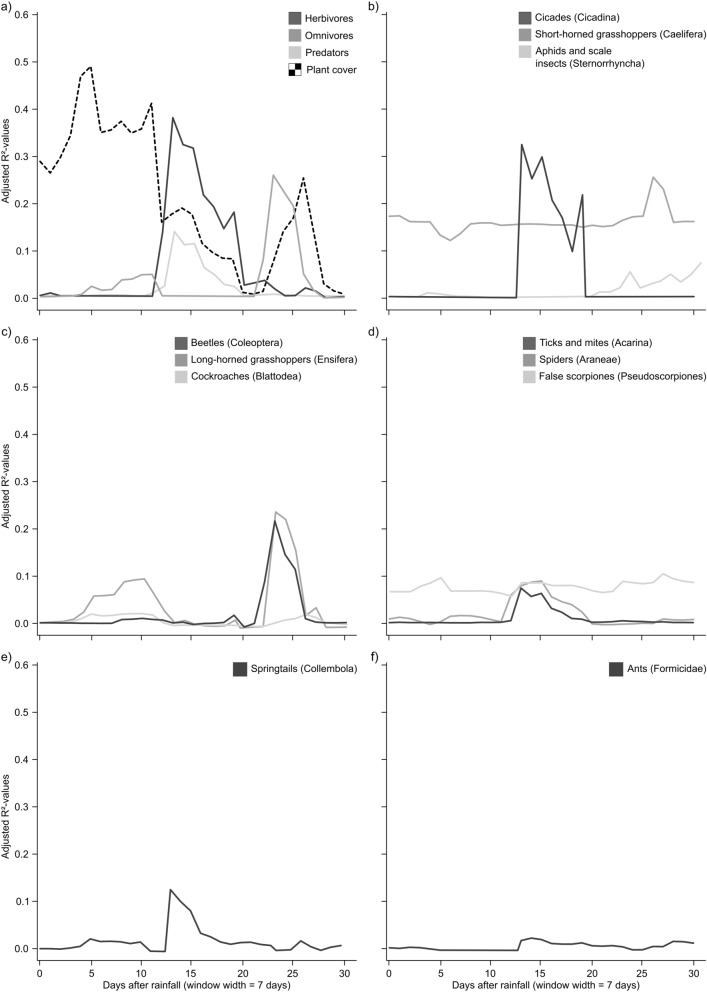
In arid and semi-arid ecosystems, rainfall and rainfall temporal distribution shape species communities and multi-trophic interactions. Whereas the relationship between climate change-induced decline of precipitation and plants is well know, there is little knowledge of these relationships with consumers, such as arthropods of different trophic levels. In a 6-year period we studied precipitation effects and microhabitat conditions on multi-trophic interactions of ground-dwelling arthropods in an arid savannah. We analysed the effects of seasonal rainfall, plant cover and soil texture on community composition and activity density of arthropods of different trophic levels and investigated the critical window of vegetation and occurrence arthropods in relation to rainfall. Our result show, that arthropod community composition was determined by seasonal rainfall and plant cover. Soil texture did not explain arthropod response sufficiently. Especially detritivorous arthropods were strongly affected by precipitation and can therefore serve as indicators of droughts. Further, multi-trophic interactions can better be explained by short-term rainfall pulses, rather than by seasonal patterns, with a window of seven days being most suitable to explain the influence of rainfall. Plant cover responded immediately after the rainfall, followed by herbivorous and predatory arthropods, and with a lag of 23 days omnivorous arthropods. This highlights the importance of short-term rain pulses for multi-trophic interactions among arthropods and emphasized the relevance of studying detailed precipitation effects for the arthropod diversity and ecosystem stability in arid ecosystems.
Overview
The claims and statistics of this paper haven’t been checked yet.
Run the check — free, no account needed. It reads the open-access text and checks the sources it cites.
Integrity signals
Registry
Cites
Statistics
Figures
Verification
Claims the paper makes
The claims and statistics of this paper haven’t been checked yet.
Run the check — free, no account needed. It reads the open-access text and checks the sources it cites.
Claims other papers make about this one
Each is checked against this paper’s own text: does it say what the citing paper says it does?
The source backs part of the claim, not all of it — or backs it for a different population, condition or comparison.
In the citing paper
“Similarly, for many terrestrial arthropods, seasonally intense precipitation is a key determining factor of abundance [95, 96].”
From The ecology of Archaeopteryx (2026) · cites this paper as [96]
Experimental — accuracy not yet measuredThe source backs part of the claim, not all of it — or backs it for a different population, condition or comparison.
In the citing paper
“Semi-arid and periodically wet (i.e., rainy season) conditions can significantly impact both seeding plant and insect diversity and abundance [94-98].”
From The ecology of Archaeopteryx (2026) · cites this paper as [96]
Experimental — accuracy not yet measured
Self-check
Percentages, sums and reported differences re-computed from the paper’s own numbers.
The self-check needs the paper’s full text.
Citations
Cites
Ecologically meaningful transformations for ordination of species data
Legendre, P., & Gallagher, E. D. (2001) · Oecologia · doi:10.1007/s004420100716 · Cited by 5,556
Research works printed but not linked: 53
- Holmgren, M. et al. Extreme climatic events shape arid and semiarid ecosystems. Front. Ecol. Environ. 4, 87–95 (2006). · DOI
- Ummenhofer, C. C. & Meehl, G. A. Extreme weather and climate events with ecological relevance: a review. Philos. Trans. R. Soc. B-Biol. Sci. 372, 20160135. https://doi.org/10.1098/rstb.2016.0135 (2017). · DOI
- Chesson, P. et al. Resource pulses, species interactions, and diversity maintenance in arid and semi-arid environments. Oecologia 141, 236–253 (2004). · DOI
- McCluney, K. E. et al. Shifting species interactions in terrestrial dryland ecosystems under altered water availability and climate change. Biol. Rev. 87, 563–582 (2012). · DOI
- Reyer, C. P. O. et al. A plant’s perspective of extremes: Terrestrial plant responses to changing climatic variability. Glob. Change Biol. 19, 75–89 (2013). · DOI
- Scheffer, M., Carpenter, S., Foley, J. A., Folke, C. & Walker, B. Catastrophic shifts in ecosystems. Nature 413, 591–596 (2001). · DOI · Paper page
- Schwinning, S. & Sala, O. E. Hierarchy of responses to resource pulses in and and semi-arid ecosystems. Oecologia 141, 211–220 (2004). · DOI
- Borer, E. T., Seabloom, E. W. & Tilman, D. Plant diversity controls arthropod biomass and temporal stability. Ecol. Lett. 15, 1457–1464 (2012). · DOI
- Kwok, A. B. C., Wardle, G. M., Greenville, A. C. & Dickman, C. R. Long-term patterns of invertebrate abundance and relationships to environmental factors in arid Australia. Austral Ecol. 41, 480–491 (2016). · DOI
- Prugh, L. R. et al. Ecological winners and losers of extreme drought in California. Nat. Climate Change 8, 819–824 (2018). · DOI
- Deguines, N., Brashares, J. S. & Prugh, L. R. Precipitation alters interactions in a grassland ecological community. J. Anim. Ecol. 86, 262–272 (2017). · DOI
- Ripple, W. J. et al. What is a trophic cascade?. Trends Ecol. Evol. 31, 842–849 (2016). · DOI
- Greenville, A. C., Wardle, G. M. & Dickman, C. R. Extreme climatic events drive mammal irruptions: regression analysis of 100-year trends in desert rainfall and temperature. Ecol. Evol. 2, 2645–2658 (2012). · DOI
- Molyneux, J., Pavey, C. R., James, A. I. & Carthew, S. M. Persistence of ground-dwelling invertebrates in desert grasslands during a period of low rainfall—Part 2. J. Arid. Environ. 157, 39–47 (2018). · DOI
- Seymour, C. L., Simmons, R. E., Joseph, G. S. & Slingsby, J. A. On bird functional diversity: Species richness and functional differentiation show contrasting responses to rainfall and vegetation structure in an arid landscape. Ecosystems 18, 971–984 (2015). · DOI
- Prather, C. M. et al. Invertebrates, ecosystem services and climate change. Biol. Rev. 88, 327–348 (2013). · DOI
- Del Toro, I., Ribbons, R. R. & Pelini, S. L. The little things that run the world revisited: a review of ant-mediated ecosystem services and disservices (Hymenoptera: Formicidae). Myrmecol. News 17, 133–146 (2012).
- Gerlach, J., Samways, M. & Pryke, J. Terrestrial invertebrates as bioindicators: an overview of available taxonomic groups. J. Insect Conserv. 17, 831–850 (2013). · DOI
- Doblas-Miranda, E., Sanchez-Pinero, F. & Gonzalez-Megias, A. Different microhabitats affect soil macroinvertebrate assemblages in a Mediterranean arid ecosystem. Appl. Soil Ecol. 41, 329–335 (2009). · DOI
- Hadley, N. F. & Szarek, S. R. Productivity of desert ecosystems. Bioscience 31, 747–753 (1981). · DOI
- Barnett, K. L. & Facey, S. L. Grasslands, invertebrates, and precipitation: A review of the effects of climate change. Front. Plant Sci. 7, 1196 (2016). · DOI
- Zhu, H. et al. Effects of altered precipitation on insect community composition and structure in a meadow steppe. Ecol. Entomol. 39, 453–461 (2014). · DOI
- Palmer, C. M. Chronological changes in terrestrial insect assemblages in the arid zone of Australia. Environ. Entomol. 39, 1775–1787 (2010). · DOI
- Liu, R. T., Zhu, F. & Steinberger, Y. Ground-active arthropod responses to rainfall-induced dune microhabitats in a desertified steppe ecosystem, China. J. Arid Land 8, 632–646 (2016). · DOI
- Theron, L. Temporal and spatial composition of arboreal insects along the Omaruru river, Namibia Magister scientiae thesis, University of the Free State Bloemfontein, (2010).
- Wagner, T. C., Richter, J., Joubert, D. F. & Fischer, C. A dominance shift in arid savanna: An herbaceous legume outcompetes local C4 grasses. Ecol. Evol. 8, 6779–6787 (2018). · DOI
- Wagner, T. C., Hane, S., Joubert, D. F. & Fischer, C. Herbaceous legume encroachment reduces grass productivity and density in arid rangelands. PLoS ONE 11, e0166743; https://doi.org/10.1371/journal.pone.0166743 (2016). · DOI
- Blaum, N., Seymour, C., Rossmanith, E., Schwager, M. & Jeltsch, F. Changes in arthropod diversity along a land use driven gradient of shrub cover in savanna rangelands: identification of suitable indicators. Biodivers. Conserv. 18, 1187–1199 (2009). · DOI
- Franca, L. F., Figueiredo-Paixao, V. H., Duarte-Silva, T. A. & dos Santos, K. B. The effects of rainfall and arthropod abundance on breeding season of insectivorous birds, in a semi-arid neotropical environment. Zoologia-Curitiba. https://doi.org/10.3897/zoologia.37.e37716 (2020). · DOI
- Wagner, T. C., Uiseb, K. & Fischer, C. Rolling pits of Hartmann’s mountain zebra (Zebra equus hartmannae) increase vegetation diversity and landscape heterogeneity in the Pre-Namib. Ecol. Evol. 11, 13036–13051 (2021). · DOI
- Dormann, C. F. et al. Collinearity: A review of methods to deal with it and a simulation study evaluating their performance. Ecography 36, 27–46 (2013). · DOI · Paper page
- Anderson, M. J. & Walsh, D. C. I. PERMANOVA, ANOSIM, and the Mantel test in the face of heterogeneous dispersions: What null hypothesis are you testing?. Ecol. Monogr. 83, 557–574 (2013). · DOI
- Anderson, M. J. in Wiley StatsRef: Statistics Reference Online (eds N. Balakrishnan et al.) (2017).
- Stopher, K. V., Bento, A. I., Clutton-Brock, T. H., Pemberton, J. M. & Kruuk, L. E. B. Multiple pathways mediate the effects of climate change on maternal reproductive traits in a red deer population. Ecology 95, 3124–3138 (2014). · DOI
- Bolker, B. M. et al. Generalized linear mixed models: A practical guide for ecology and evolution. Trends Ecol. Evol. 24, 127–135 (2009). · DOI · Paper page
- Bates, D., Mächler, M., Bolker, B. & Walker, S. Fitting linear mixed-effects models using lme4. J. Stat. Softw. 67, 1–48 (2015). · DOI · Paper page
- Pinheiro, J. C. & Bates, D. M. Mixed-Effects Models in S and S-PLUS. (Springer Verlag, 2000). · DOI · Paper page
- Barnes, A. D. et al. Direct and cascading impacts of tropical land-use change on multi-trophic biodiversity. Nat. Ecol. Evol. 1, 1511–1519 (2017). · DOI
- Henschel, J. R. Long-term population dynamics of Namib desert Tenebrionid beetles reveal complex relationships to pulse-reserve conditions. Insects 12, 804. https://doi.org/10.3390/insects12090804 (2021). · DOI
- Cloudsley-Thompson, J. L. The adaptational diversity of desert biota. Environ. Conserv. 20, 227–231 (1993). · DOI
- Sømme, L. in Invertebrates in Hot and Cold Arid Environments 135–157 (Springer, 1995). · DOI
- Suttle, K. B., Thomsen, M. A. & Power, M. E. Species interactions reverse grassland responses to changing climate. Science 315, 640–642 (2007). · DOI
- Henschel, J., Klintenberg, P., Roberts, C. & Seely, M. Long-term ecological research from an arid, variable, drought-prone environment. Sécheresse 18, 342–347 (2007).
- Cloudsley-Thompson, J. L. Adaptations of arthropoda to arid environments. Annu. Rev. Entomol. 20, 261–283 (1975). · DOI
- Schuldt, A. et al. Belowground top-down and aboveground bottom-up effects structure multitrophic community relationships in a biodiverse forest. Sci. Rep. 7 (2017). · DOI
- Vidal, M. C. & Murphy, S. M. Bottom-up vs. top-down effects on terrestrial insect herbivores: a meta-analysis. Ecol. Lett. 21, 138–150 (2018). · DOI
- Báez, S., Collins, S. L., Lightfoot, D. & Koontz, T. L. Bottom-up regulation of plant community structure in an aridland ecosystem. Ecology 87, 2746–2754 (2006). · DOI
- Gibb, H. et al. Testing top-down and bottom-up effects on arid zone beetle assemblages following mammal reintroduction. Austral Ecol. 43, 288–300 (2018). · DOI
- Coll, M. & Guershon, M. Omnivory in terrestrial arthropods: Mixing plant and prey diets. Annu. Rev. Entomol. 47, 267–297 (2002). · DOI
- Karolyi, F., Hansal, T., Krenn, H. W. & Colville, J. F. Comparative morphology of the mouthparts of the megadiverse South African monkey beetles (Scarabaeidae: Hopliini): feeding adaptations and guild structure. PeerJ 4, e1597; https://doi.org/10.7717/peerj.1597 (2016). · DOI
- Greenslade, P. Survival of Collembola in arid environments: Observations in South Australia and the Sudan. J. Arid. Environ. 4, 219–228 (1981). · DOI
- Fattorini, S. Effects of fire on tenebrionid communities of a Pinus pinea plantation: A case study in a Mediterranean site. Biodivers. Conserv. 19, 1237–1250 (2009). · DOI
- Sanders, N. J., Moss, J. & Wagner, D. Patterns of ant species richness along elevational gradients in an arid ecosystem. Glob. Ecol. Biogeogr. 12, 93–102 (2003). · DOI
Cited by
Sorted by citations
O’Connor, J. K., & Clark, A. D. (2026) · Discover Ecology · doi:10.1007/s44396-026-00026-z
Metadata
- Authors
- Fischer, C., Gerstmeier, R., & Wagner, T. C.
- Affiliations
- Anhalt University of Applied Sciences (DE)
- Technical University of Munich (DE)
- Corresponding author
- Fischer, Christina
- Venue
- Scientific Reports
- Published
- 2022-03-08
- Volume
- 12
- Issue
- 1
- Pages
- 3742-3742
- ISSN
- 2045-2322 (ISSN-L)
- PMC
- PMC8904780
- OpenAlex
- W4220814666
- Cited by
- 45
- References
- 1
- Citations by year
- 2026: 16 · 2025: 14 · 2024: 7 · 2023: 7 · 2022: 1
- FWCI
- 4.37
- Type
- journal article
- Language
- en
- Open access
- gold
- doi.org
- Locations
- Scientific Reports (publishedVersion, cc-by)
- PubMed Central (publishedVersion, cc-by)
- PubMed (publishedVersion)
- DOAJ (DOAJ: Directory of Open Access Journals) (submittedVersion, cc-by-sa)
- mediaTUM (Technical University of Munich) (submittedVersion)
- mediaTUM – the media and publications repository of the Technical University Munich (Technical University Munich) (submittedVersion, other-oa)
- Funders
- Hochschule Anhalt
- Topics
- Life Sciences › Agricultural and Biological Sciences › Insect Science › Insect and Arachnid Ecology and Behavior
- Physical Sciences › Environmental Science › Nature and Landscape Conservation › Ecology and Vegetation Dynamics Studies
- Life Sciences › Agricultural and Biological Sciences › Ecology, Evolution, Behavior and Systematics › Study of Mite Species
- Keywords
- rainfall pulses, seasonal rainfall, arthropod community composition, multitrophic interactions, ground-dwelling arthropods, vegetation cover, soil texture, drought indices, herbivorous arthropods, predatory arthropods, microhabitat, ecosystem stability
- MeSH terms
- Animals, Arthropods, Plants, Rain, Seasons, Soil, Ecosystem
About these checks
Registry, retraction, Cites and statistics results are computed, not judged, with one exception: a printed reference that no index lists is read once by a model before it counts as a citation error. Claims are extracted by a model and kept only when their quote appears verbatim in the text; each cited source is then checked, with a model’s help, for whether it says what the claim relies on. Those verdicts can be wrong — read the claim’s quote and the cited source before relying on one.
Statistics and arithmetic are recomputed, not judged.
Confidence bands are shown only for fields calibrated on our annotated test set. None is calibrated yet, so no band is shown.
What counts as a claim ›How we measure confidence ›How we check this ›
Are you an author, or do you see a problem with this page? Request a review
