

Heterogeneous rarity patterns drive price dynamics in NFT collections
Open accessThe DOI matches its Crossref record; 25 of the 25 references it cites were found in a registry or an index.
Abstract
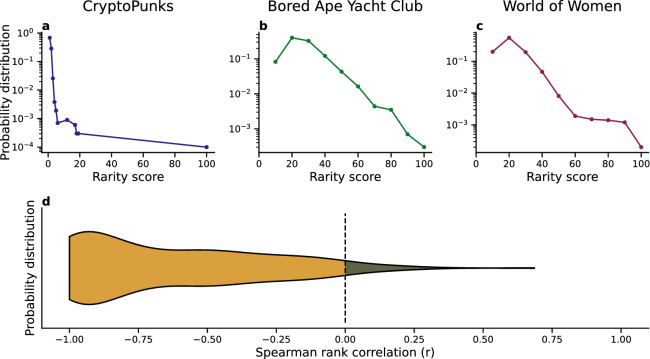
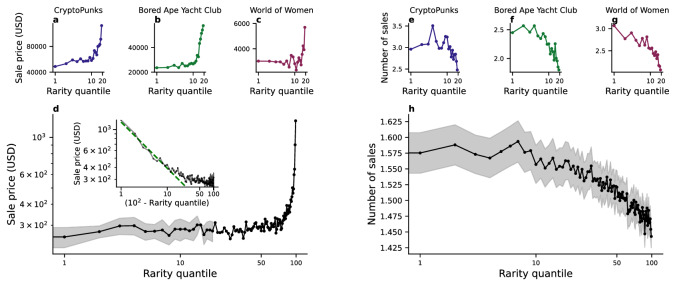
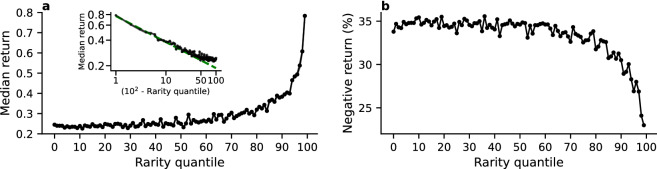
We quantify Non Fungible Token (NFT) rarity and investigate how it impacts market behaviour by analysing a dataset of 3.7M transactions collected between January 2018 and June 2022, involving 1.4M NFTs distributed across 410 collections. First, we consider the rarity of an NFT based on the set of human-readable attributes it possesses and show that most collections present heterogeneous rarity patterns, with few rare NFTs and a large number of more common ones. Then, we analyze market performance and show that, on average, rarer NFTs: (i) sell for higher prices, (ii) are traded less frequently, (iii) guarantee higher returns on investment, and (iv) are less risky, i.e., less prone to yield negative returns. We anticipate that these findings will be of interest to researchers as well as NFT creators, collectors, and traders.
Overview
The claims and statistics of this paper haven’t been checked yet.
Free: it reads the open-access text and checks the first 5 claims that cite a source we can check. Create a free account to check every claim.
Integrity signals
Registry
Cites
Statistics
Figures
Verification
Claims the paper makes
The claims and statistics of this paper haven’t been checked yet.
Free: it reads the open-access text and checks the first 5 claims that cite a source we can check. Create a free account to check every claim.
Claims other papers make about this one
Each is checked against this paper’s own text: does it say what the citing paper says it does?
The cited source says what the claim attributes to it.
In the citing paper
“Rarity also leads to higher returns on investments and lower risk in the case of secondary sales.”
From What Is the Right Price for Non-Fungible Tokens (NFTs)? A Systematic Review of the Current Literature (2025) · cites this paper as [42]
The cited source says what the claim attributes to it.
In the citing paper
“They found that rarity is positively correlated with the sale price and negatively correlated with the number of sales of an NFT (i.e., rare NFTs are less traded but sell for more).”
From What Is the Right Price for Non-Fungible Tokens (NFTs)? A Systematic Review of the Current Literature (2025) · cites this paper as [42]
Self-check
Percentages, sums and reported differences re-computed from the paper’s own numbers.
The self-check needs the paper’s full text.
Citations
Cites
AIC model selection using Akaike weights
Wagenmakers, E.-J., & Farrell, S. (2004) · Psychonomic Bulletin & Review · doi:10.3758/bf03206482 · Cited by 2,684 · cited 4×
“[52] Eric-Jan Wagenmakers and Simon Farrell.”
MethodInfluentialThe Biological Aspects of Rare Plant Conservation.
Grimes, J., & Synge, H. (1982) · Brittonia · doi:10.2307/2806387 · Cited by 843
Mapping the NFT revolution: Market trends, trade networks, and visual features
Nadini, M., Alessandretti, L., Di Giacinto, F., Martino, M., Aiello, L. M., & Baronchelli, A. (2021) · Scientific Reports · doi:10.1038/s41598-021-00053-8 · Cited by 715
Self-citationNon-Fungible Token (NFT): Overview, Evaluation, Opportunities and Challenges
Wang, Q., Li, R., Wang, Q., & Chen, S. (2021) · arXiv (Cornell University) · doi:10.48550/arxiv.2105.07447 · Cited by 577
Fusing Blockchain and AI With Metaverse: A Survey
Yang, Q., Zhao, Y., Huang, H., Xiong, Z., Kang, J., & Zheng, Z. (2022) · IEEE Open Journal of the Computer Society · doi:10.1109/ojcs.2022.3188249 · Cited by 554
Functional Rarity: The Ecology of Outliers
Violle, C., Thuiller, W., Mouquet, N., Munoz, F., Kraft, N. J. B., Cadotte, M. W., Livingstone, S. W., & Mouillot, D. (2017) · Trends in Ecology & Evolution · doi:10.1016/j.tree.2017.02.002 · Cited by 446
The non-fungible token (NFT) market and its relationship with Bitcoin and Ethereum
Ante, L. (2021) · SSRN Electronic Journal · doi:10.2139/ssrn.3861106 · Cited by 362
NFTs and asset class spillovers: Lessons from the period around the COVID-19 pandemic
Aharon, D. Y., & Demir, E. (2022) · Finance Research Letters · doi:10.1016/j.frl.2021.102515 · Cited by 274 · cited 1×
“Other lines of research include the analysis of illicit transactions connected to NFT trading [32, 33] and of their connections with financial indicators [34, 35, 36].”
BackgroundWhen creators meet the metaverse: a survey on computational arts in user-centric perspectives
Lee, L., Li, S., Lin, Z., Hu, R., Gong, Z., Li, T., Kumar, A., & Hui, P. (2026) · Foundations and Trends® in Human–Computer Interaction · doi:10.13140/rg.2.2.36609.17761/2 · Cited by 161
Quantifying NFT-driven networks in crypto art
Vasan, K., Janosov, M., & Barabási, A.-L. (2022) · Scientific Reports · doi:10.1038/s41598-022-05146-6 · Cited by 156
Alternative investments in the Fintech era: The risk and return of Non-Fungible Token (NFT)
Kong, D.-R., & Lin, T.-C. (2021) · SSRN Electronic Journal · doi:10.2139/ssrn.3914085 · Cited by 142
TweetBoost: Influence of Social Media on NFT Valuation
Kapoor, A., Guhathakurta, D., Mathur, M., Yadav, R., Gupta, M., & Kumaraguru, P. (2022) · Companion Proceedings of the Web Conference 2022 · doi:10.1145/3487553.3524642 · Cited by 115
The Economics of Non-Fungible Tokens
Borri, N., Liu, Y., & Tsyvinski, A. (2022) · SSRN Electronic Journal · doi:10.2139/ssrn.4052045 · Cited by 104
When Creators Meet the Metaverse: A Survey on Computational ArtsPreprint
Lee, L., Lin, Z., Hu, R., et al. (2021) · arXiv (Cornell University) · doi:10.48550/arxiv.2111.13486 · Cited by 95
NFT Wash Trading: Quantifying Suspicious Behaviour in NFT marketsPreprint
von Wachter, V., Jensen, J. R., Regner, F., & Ross, O. (2021) · SSRN Electronic Journal · doi:10.2139/ssrn.4037143 · Cited by 75
Koford, K., & Tschoegl, A. E. (1998) · Journal of Economic Behavior & Organization · doi:10.1016/s0167-2681(97)00084-x · Cited by 71
Non-fungible Tokens as an Alternative Investment – Evidence from CryptoPunks
Kampakis, S. (2022) · The Journal of The British Blockchain Association · doi:10.31585/jbba-5-1-(2)2022 · Cited by 71
Recent Development in Fintech: Non-Fungible Token
Bao, H., & Roubaud, D. (2021) · FinTech · doi:10.3390/fintech1010003 · Cited by 62
Preference-Driven Herding in Primary Markets: Evidence from Non-Fungible TokensPreprint
Oh, S., Rosen, S., & Zhang, A. L. (2022) · SSRN Electronic Journal · doi:10.2139/ssrn.4042901 · Cited by 35
Spotting anomalous trades in NFT markets: The case of NBA Topshot
Pelechrinis, K., Liu, X., Krishnamurthy, P. V., & Babay, A. (2023) · PLoS ONE · doi:10.1371/journal.pone.0287262 · Cited by 34
Franceschet, M. (2021) · Blockchain Research and Applications · doi:10.1016/j.bcra.2021.100038 · Cited by 30
Measuring the Impact of Rarity on Price: Evidence from NBA Top Shot
Lee, Y. (2021) · Marketing Letters · doi:10.1007/s11002-022-09636-5 · Cited by 23
Fusing Blockchain and AI with Metaverse: A SurveyPreprint
Yang, Q., Zhao, Y., Huang, H., et al. (2022) · arXiv (Cornell University) · doi:10.48550/arxiv.2201.03201 · Cited by 8
Measuring the Impact of Rarity on Price: Evidence from NBA Top ShotPreprint
Lee, Y. (2021) · SSRN Electronic Journal · doi:10.2139/ssrn.3906231 · Cited by 3
Preference for ScarcityPreprint
Ghazi, S., & Schneider, M. (2021) · SSRN Electronic Journal · doi:10.2139/ssrn.4031091 · Cited by 3
Cited by
Virtual luxury in the metaverse: NFT-enabled value recreation in luxury brands
Bao, W., Hudders, L., Yu, S., & Beuckels, E. (2024) · International Journal of Research in Marketing · doi:10.1016/j.ijresmar.2024.01.002 · Cited by 98
Probably something: a multi-layer taxonomy of non-fungible tokens
Hartwich, E., Ollig, P., Fridgen, G., & Rieger, A. (2023) · Internet Research · doi:10.1108/intr-08-2022-0666 · Cited by 93
Determinants of the purchase intention of non‐fungible token collectibles
Fortagne, M. A., & Lis, B. (2023) · Journal of Consumer Behaviour · doi:10.1002/cb.2264 · Cited by 71
Behind the bubble: Exploring the motivations of NFT buyers
Griffiths, P., Costa, C. J. D. C., & Crespo, N. F. (2024) · Computers in Human Behavior · doi:10.1016/j.chb.2024.108307 · Cited by 59
Sutikno, T., & Aisyahrani, A. I. B. (2023) · Journal of Education and Learning (EduLearn) · doi:10.11591/edulearn.v17i1.20657 · Cited by 56
Metadata
- Authors
- Mekacher, A., Bracci, A., Nadini, M., Martino, M., Alessandretti, L., Aiello, L. M., & Baronchelli, A.
- Affiliations
- University of London (GB)
- IBM Research - Cambridge (United States) (US)
- Technical University of Denmark (DK)
- IT University of Copenhagen (DK)
- Corresponding author
- Baronchelli, Andrea
- ORCID
- Venue
- Scientific Reports
- Published
- 2022-08-16
- Volume
- 12
- Issue
- 1
- Pages
- 13890-13890
- ISSN
- 2045-2322 (ISSN-L)
- PMC
- PMC9381539
- OpenAlex
- W4292174909
- Cited by
- 110
- References
- 24
- Citations by year
- 2026: 13 · 2025: 41 · 2024: 21 · 2023: 33 · 2022: 2
- FWCI
- 24.02
- Type
- journal article
- Language
- en
- Update notices
- correction (2022-09-12)
- Open access
- gold
- doi.org
- Licence
- cc-by
- creativecommons.org/licenses/by/4.0 (tdm)
- creativecommons.org/licenses/by/4.0 (vor)
- Locations
- Scientific Reports (publishedVersion, cc-by)
- PubMed Central (publishedVersion, cc-by)
- PubMed (publishedVersion)
- City Research Online (City University London) (acceptedVersion)
- RePEc: Research Papers in Economics (submittedVersion)
- arXiv (Cornell University) (submittedVersion)
- IT University Of Copenhagen (IT University of Copenhagen) (submittedVersion, other-oa)
- DOAJ (DOAJ: Directory of Open Access Journals) (submittedVersion, cc-by-sa)
- Technical University of Denmark, DTU Orbit (Technical University of Denmark, DTU) (submittedVersion, other-oa)
- arXiv (Cornell University)
- Funders
- Alan Turing Institute
- Topics
- Physical Sciences › Computer Science › Information Systems › Blockchain Technology Applications and Security
- Social Sciences › Arts and Humanities › Visual Arts and Performing Arts › Art History and Market Analysis
- Social Sciences › Economics, Econometrics and Finance › Finance › Financial Markets and Investment Strategies
- Keywords
- non-fungible tokens, price dynamics, NFT collections, market behavior, trading frequency, return on investment, risk, digital collectibles
- MeSH terms
- Humans, Investments, Neurofibrillary Tangles
About these checks
Registry, retraction, Cites and statistics results are computed, not judged, with one exception: a printed reference that no index lists is read once by a model before it counts as a citation error. Claims are extracted by a model and kept only when their quote appears verbatim in the text; each cited source is then checked, with a model’s help, for whether it says what the claim relies on. Those verdicts can be wrong — read the claim’s quote and the cited source before relying on one.
Statistics and arithmetic are recomputed, not judged.
Confidence bands are shown only for fields calibrated on our annotated test set. None is calibrated yet, so no band is shown.
What counts as a claim ›How we measure confidence ›How we check this ›
Are you an author, or do you see a problem with this page? Request a review
Data sources
Bibliographic data: Semantic Scholar, OpenAlex, Crossref.
Contains information from the Semantic Scholar Academic Graph Datasets, made available under the ODC Attribution License (ODC-BY 1.0).
Semantic Scholar’s data is described in: Kinney, R., et al. (2023). The Semantic Scholar Open Data Platform. arXiv:2301.10140.
