

The DOI matches its Crossref record; 23 of the 23 references it cites were found in a registry or an index.
One-Step Preparation of Deep Eutectic Solvents/Reduced Graphene Oxide Composite Materials for the Removal of Dibenzothiophene in Fuel Oil
Open accessAbstract
Deep eutectic solvents (DES)/reduced graphene oxide (rGO) composite materials can remove dibenzothiophene (DBT) from fuel oil by adsorption desulfurization. However, the whole synthesis process is complicated, and the DES/rGO is high-cost and not strong enough, which limits its application in industry. Therefore, a one-step method to produce DES/rGO composite materials is proposed. The performance of desulfurization was studied and the feasibility of industrial application was analyzed. First, the proposed method can improve the single extraction efficiency to 94.8% without a complicated process. Secondly, the DES/rGO can also be reused and recycled. Third, the proposed method overcomes the inconvenient storage and transportation of liquid DES. Finally, the proposed method could effectively reduce the cost of desulphurization in the industry.
Overview
The claims and statistics of this paper haven’t been checked yet.
Run the check — free, no account needed. It reads the open-access text and checks the sources it cites.
Integrity signals
Registry
Cites
Statistics
Figures

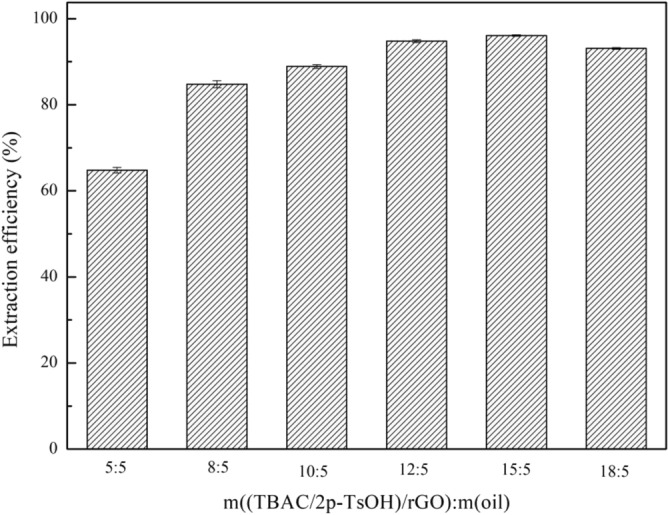
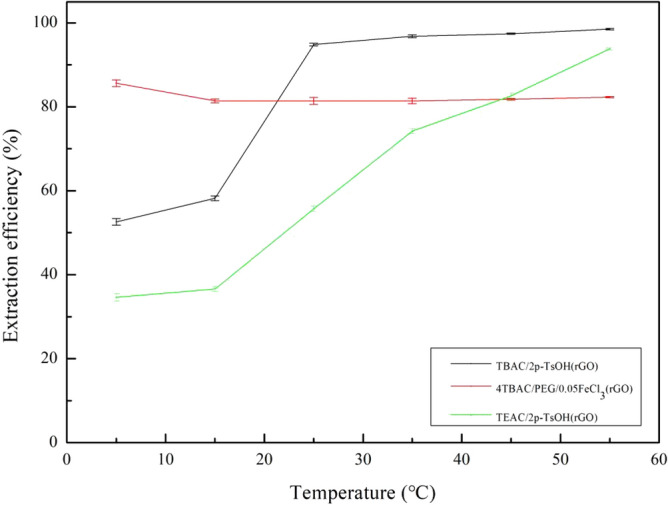
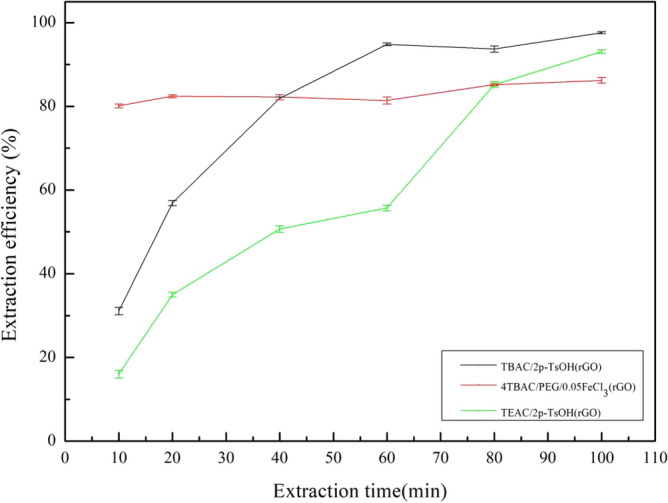
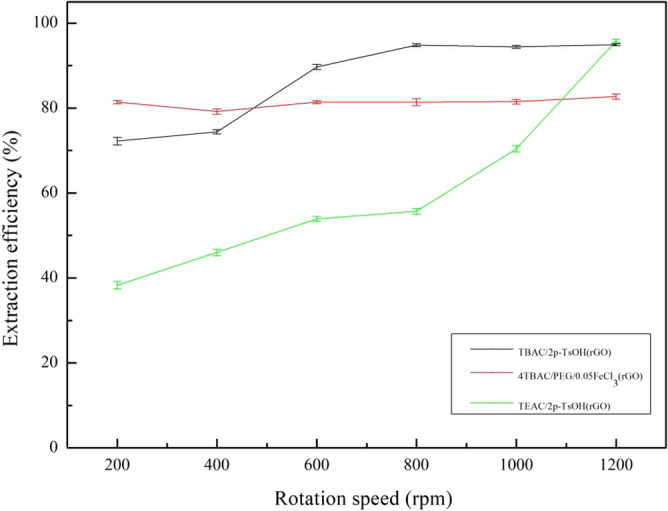
Verification
Claims the paper makes
The claims and statistics of this paper haven’t been checked yet.
Run the check — free, no account needed. It reads the open-access text and checks the sources it cites.
Claims other papers make about this one
Each is checked against this paper’s own text: does it say what the citing paper says it does?
In the citing paper
“highlighting the potential of DES-graphene hybrid materials to improve adsorption capacity and overall separation performance [114].”
From Eco-Friendly Deep Eutectic Solvent-Based Extraction Technologies: A Comprehensive Review of Principles, Applications, and Comparative Insights (2026) · cites this paper as [114]
In the citing paper
“Liu et al. synthesized DES/reduced graphene oxide composites and demonstrated their high efficiency in the adsorptive removal of dibenzothiophene from fuel oil, highlighting the potential of DES-graphene hybrid materials to improve adsorption capacity and overall separation performance [114].”
From Eco-Friendly Deep Eutectic Solvent-Based Extraction Technologies: A Comprehensive Review of Principles, Applications, and Comparative Insights (2026) · cites this paper as [114]
Self-check
Percentages, sums and reported differences re-computed from the paper’s own numbers.
The self-check needs the paper’s full text.
Citations
Cites
Song, C. (2003) · Catalysis Today · doi:10.1016/s0920-5861(03)00412-7 · Cited by 2,032
New design approaches to ultra-clean diesel fuels by deep desulfurization and deep dearomatization
Song, C., & Ma, X. (2003) · Applied Catalysis B: Environmental · doi:10.1016/s0926-3373(02)00212-6 · Cited by 1,144
Desulfurization of Transportation Fuels by Adsorption
Hernández‐Maldonado, A. J., & Yang, R. T. (2004) · Catalysis Reviews · doi:10.1081/cr-200032697 · Cited by 229
Efficient oxidative desulfurization of diesel fuel using amide-based ionic liquids
Jiang, B., Yang, H., Zhang, L., Zhang, R., Sun, Y., & Huang, Y. D. (2015) · Chemical Engineering Journal · doi:10.1016/j.cej.2015.07.070 · Cited by 199
Jiang, W., Jia, H., Li, H., Zhu, L., Tao, R., Zhu, W., Li, H., & Dai, S. (2019) · Green Chemistry · doi:10.1039/c9gc01004a · Cited by 194
Yin, J., Wang, J., Li, Z., Li, D., Yang, G., Cui, Y., Wang, A., & Li, C. (2015) · Green Chemistry · doi:10.1039/c5gc00709g · Cited by 188
Self-citationNiquille-Röthlisberger, A., & Prins, R. (2006) · Journal of Catalysis · doi:10.1016/j.jcat.2006.06.009 · Cited by 179
Dharaskar, S. A., Varma, M. N., Shende, D. Z., Yoo, C., & Wasewar, K. L. (2013) · The Scientific World JOURNAL · doi:10.1155/2013/395274 · Cited by 162
Extraction desulfurization of fuels with ‘metal ions’ based deep eutectic solvents (MDESs)
Li, C., Zhang, J., Li, Z., Yin, J., Cui, Y., Liu, Y., & Yang, G. (2016) · Green Chemistry · doi:10.1039/c6gc00366d · Cited by 155
Self-citationZaid, H. F. M., Chong, F. K., & Mutalib, M. I. A. (2016) · Fuel · doi:10.1016/j.fuel.2016.11.112 · Cited by 140
Extraction of dibenzothiophene from dodecane using ionic liquids
Wilfred, C. D., Kiat, C. F., Man, Z. B., Bustam, M. A., Mutalib, M. I. A., & Chan, Z. P. (2011) · Fuel Processing Technology · doi:10.1016/j.fuproc.2011.09.018 · Cited by 131
Lima, F., Gouvenaux, J., Branco, L. C., Silvestre, A. J. D., & Marrucho, I. M. (2018) · Fuel · doi:10.1016/j.fuel.2018.07.043 · Cited by 125
Hadj-Kali, M. K., Mulyono, S., Hizaddin, H. F., Wazeer, I., Blidi, L. E., Ali, E. M., Hashim, M. A., & AlNashef, I. M. (2016) · Industrial & Engineering Chemistry Research · doi:10.1021/acs.iecr.6b01654 · Cited by 115
Williamson, S. T., Shahbaz, K., Mjalli, F. S., AlNashef, I. M., & Farid, M. M. (2017) · Renewable Energy · doi:10.1016/j.renene.2017.07.046 · Cited by 95
Rahma, W. S. A., Mjalli, F. S., Al-Wahaibi, T., & Al-Hashmi, A. R. (2017) · Process Safety and Environmental Protection · doi:10.1016/j.cherd.2017.02.025 · Cited by 90
Seeberger, A., & Jess, A. (2010) · Green Chemistry · doi:10.1039/b918724c · Cited by 85
Lü, H., Li, P., Liu, Y., Hao, L., Ren, W., Zhu, W., Deng, C., & Yang, F. (2016) · Chemical Engineering Journal · doi:10.1016/j.cej.2016.10.140 · Cited by 69
Self-citation“Nanowire catalysts for ultra-deep hydro-desulfurization and aromatic hydrogenation”
Gupta, M., He, J., Nguyen, T., Petzold, F. G., Fonseca, D. A., Jasinski, J. B., & Sunkara, M. K. (2015) · Applied Catalysis B: Environmental · doi:10.1016/j.apcatb.2015.06.029 · Cited by 58
Bağda, E., Altundağ, H., Tüzen, M., & Soylak, M. (2017) · Bulletin of Environmental Contamination and Toxicology · doi:10.1007/s00128-017-2065-y · Cited by 46
Mohammadian, M., Ahmadi, M. F., & Nikou, M. R. K. (2017) · Petroleum Science and Technology · doi:10.1080/10916466.2016.1265562 · Cited by 35
Fazlali, A., Shahebrahimi, Y., Aliyari, N., & Mohammadi, A. H. (2017) · Journal of Molecular Liquids · doi:10.1016/j.molliq.2017.04.101 · Cited by 32
Removal of thiophene from model diesel oil with nitrate based ionic liquids at several temperatures
Mafi, M., Mokhtarani, B., & Dehghani, M. R. (2016) · Journal of Molecular Liquids · doi:10.1016/j.molliq.2016.06.078 · Cited by 30
Liu, Y., Li, X., Zhou, X., & Cui, Y. (2021) · New Journal of Chemistry · doi:10.1039/d1nj02447g · Cited by 10
Self-citation
Cited by
Potential applications of deep eutectic solvents in nanotechnology: Part II
Azzouz, A., & Hayyan, M. (2023) · Chemical Engineering Journal · doi:10.1016/j.cej.2023.143563 · Cited by 68
New Adsorption Materials for Deep Desulfurization of Fuel Oil
Qiu, X., Wang, B., Wang, R., & Kozhevnikov, I. V. (2024) · Materials · doi:10.3390/ma17081803 · Cited by 46
Ibukun, A. E., Yahaya, N., Mohamed, A. H., Semail, N., Hamid, M. A. A., Zain, N. N. M., Kamaruddin, M. A., Loh, S. H., & Kamaruzaman, S. (2024) · Microchemical Journal · doi:10.1016/j.microc.2024.110111 · Cited by 27
Khaleghi, F., & Behroozi, M. (2025) · Fuel · doi:10.1016/j.fuel.2025.135219 · Cited by 20
Muzio, S. D., Ramondo, F., & Fioravanti, G. (2025) · The Journal of Physical Chemistry B · doi:10.1021/acs.jpcb.5c03461 · Cited by 9
Metadata
- Authors
- Liu, Y., Su, X., Cui, Y., & Zhou, X.
- Affiliations
- Dalian University (CN)
- Corresponding author
- Liu, Yue
- Venue
- Scientific Reports
- Published
- 2023-01-16
- Volume
- 13
- Issue
- 1
- Pages
- 832-832
- ISSN
- 2045-2322 (ISSN-L)
- PMC
- PMC9842677
- OpenAlex
- W4316469838
- Cited by
- 14
- References
- 23
- Citations by year
- 2026: 3 · 2025: 5 · 2024: 4 · 2023: 2
- FWCI
- 1.38
- Type
- journal article
- Language
- en
- Open access
- gold
- doi.org
- Licence
- cc-by
- creativecommons.org/licenses/by/4.0 (tdm)
- creativecommons.org/licenses/by/4.0 (vor)
- Locations
- Scientific Reports (publishedVersion, cc-by)
- PubMed Central (publishedVersion, cc-by)
- PubMed (publishedVersion)
- DOAJ (DOAJ: Directory of Open Access Journals) (submittedVersion, cc-by-sa)
- Funders
- National Natural Science Foundation of China (21606031, 21473183)
- Topics
- Physical Sciences › Chemical Engineering › Catalysis › Catalysis and Hydrodesulfurization Studies
- Physical Sciences › Environmental Science › Environmental Engineering › Industrial Gas Emission Control
- Physical Sciences › Chemistry › Physical and Theoretical Chemistry › Ionic liquids properties and applications
- Keywords
- deep eutectic solvents, reduced graphene oxide, composite adsorbent, dibenzothiophene, fuel oil desulfurization, adsorptive desulfurization, one-step synthesis, adsorbent reusability
About these checks
Registry, retraction, Cites and statistics results are computed, not judged, with one exception: a printed reference that no index lists is read once by a model before it counts as a citation error. Claims are extracted by a model and kept only when their quote appears verbatim in the text; each cited source is then checked, with a model’s help, for whether it says what the claim relies on. Those verdicts can be wrong — read the claim’s quote and the cited source before relying on one.
Statistics and arithmetic are recomputed, not judged.
Confidence bands are shown only for fields calibrated on our annotated test set. None is calibrated yet, so no band is shown.
What counts as a claim ›How we measure confidence ›How we check this ›
Are you an author, or do you see a problem with this page? Request a review
Data sources
Bibliographic data: Semantic Scholar, OpenAlex, Crossref.
Contains information from the Semantic Scholar Academic Graph Datasets, made available under the ODC Attribution License (ODC-BY 1.0).
Semantic Scholar’s data is described in: Kinney, R., et al. (2023). The Semantic Scholar Open Data Platform. arXiv:2301.10140.
