

The DOI matches its Crossref record; 7 of the 7 references it cites were found in a registry or an index.
Fast and accurate object detector for autonomous driving based on improved YOLOv5
Open accessAbstract
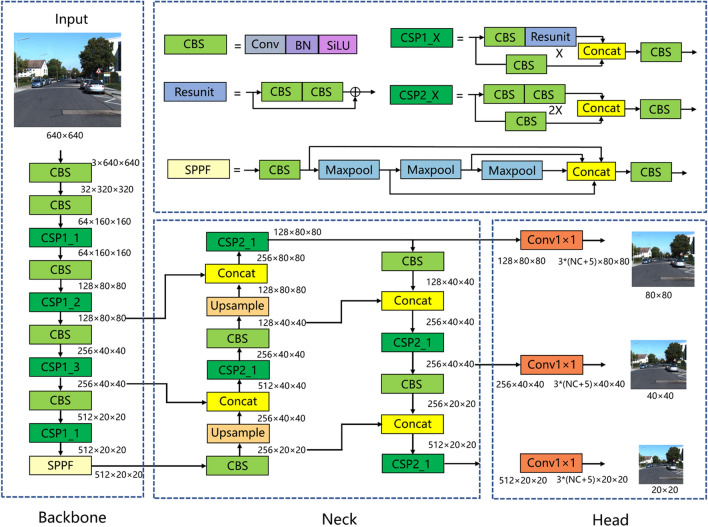
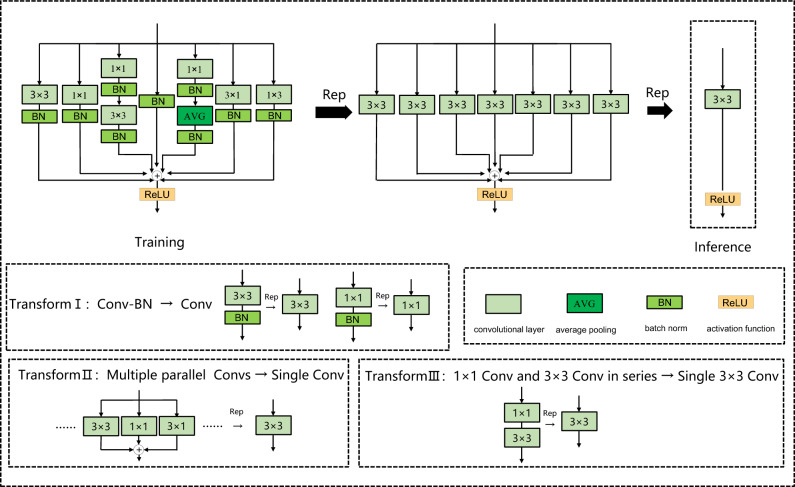
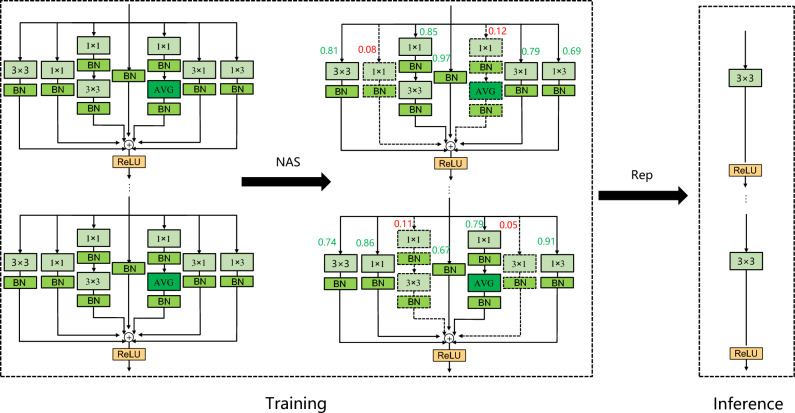
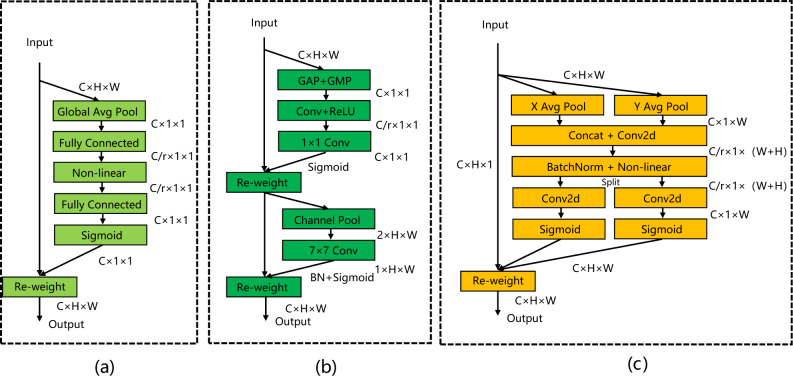
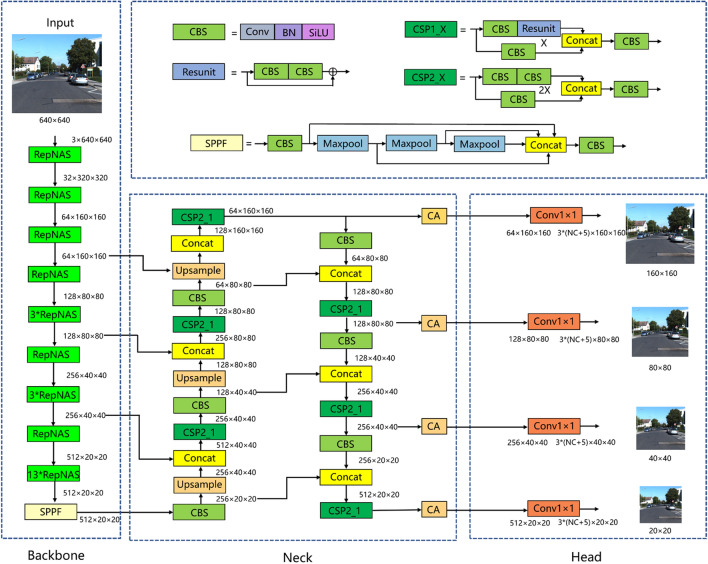
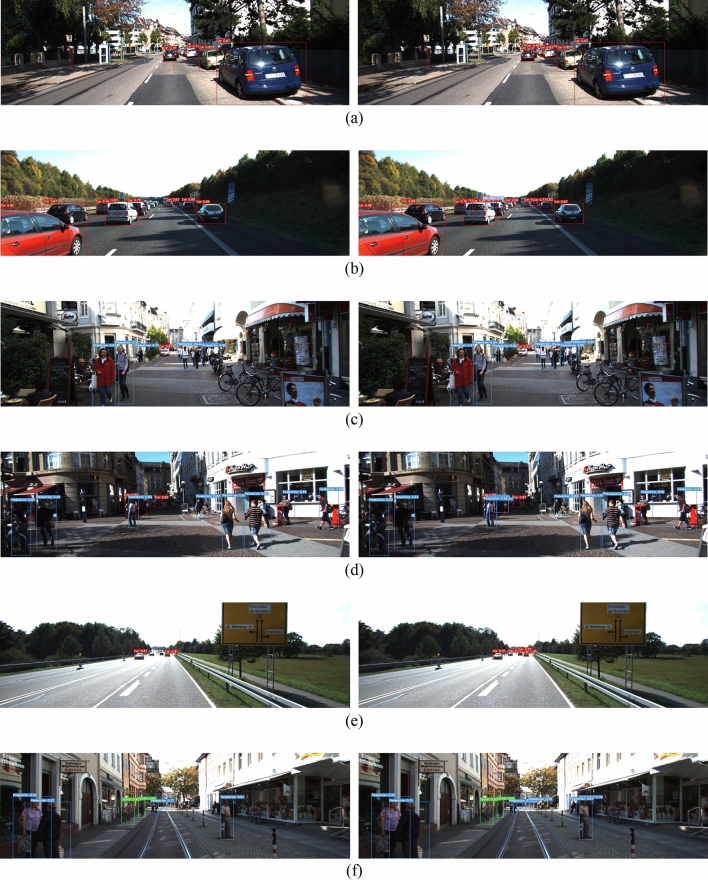
Autonomous driving is an important branch of artificial intelligence, and real-time and accurate object detection is key to ensuring the safe and stable operation of autonomous vehicles. To this end, this paper proposes a fast and accurate object detector for autonomous driving based on improved YOLOv5. First, the YOLOv5 algorithm is improved by using structural re-parameterization (Rep), enhancing the accuracy and speed of the model through training-inference decoupling. Additionally, the neural architecture search method is introduced to cut redundant branches in the multi-branch re-parameterization module during the training phase, which ameliorates the training efficiency and accuracy. Finally, a small object detection layer is added to the network and the coordinate attention mechanism is added to all detection layers to improve the recognition rate of the model for small vehicles and pedestrians. The experimental results show that the detection accuracy of the proposed method on the KITTI dataset reaches 96.1%, and the FPS reaches 202, which is superior to many current mainstream algorithms and effectively improves the accuracy and real-time performance of unmanned driving object detection.
Overview
The claims and statistics of this paper haven’t been checked yet.
Run the check — free, no account needed. It reads the open-access text and checks the sources it cites.
Integrity signals
Registry
Cites
Statistics
Figures
Verification
Claims the paper makes
The claims and statistics of this paper haven’t been checked yet.
Run the check — free, no account needed. It reads the open-access text and checks the sources it cites.
Claims other papers make about this one
Each is checked against this paper’s own text: does it say what the citing paper says it does?
The source backs part of the claim, not all of it — or backs it for a different population, condition or comparison.
In the citing paper
“| YOLOv5 [82] | mAP | Added structural re-parameterization and small object detection layers, achieving 96.1% mAP. | KITTI Dataset (8 classes) |”
From The YOLO Framework: A Comprehensive Review of Evolution, Applications, and Benchmarks in Object Detection (2024) · cites this paper as [82]
Experimental — accuracy not yet measured
Self-check
Percentages, sums and reported differences re-computed from the paper’s own numbers.
The self-check needs the paper’s full text.
Citations
Cites
Faster R-CNN: Towards Real-Time Object Detection with Region Proposal Networks
Ren, S., He, K., Girshick, R., & Sun, J. (2017) · IEEE Transactions on Pattern Analysis and Machine Intelligence · doi:10.1109/tpami.2016.2577031 · Cited by 73,472
YOLOv7: Trainable bag-of-freebies sets new state-of-the-art for real-time object detectors
Wang, C.-Y., Bochkovskiy, A., & Liao, H.-Y. M. (2022) · arXiv · doi:10.48550/arxiv.2207.02696 · Cited by 13,205
YOLOv7: Trainable Bag-of-Freebies Sets New State-of-the-Art for Real-Time Object Detectors
Wang, C.-Y., Bochkovskiy, A., & Liao, H.-Y. M. (2023) · 2023 IEEE/CVF Conference on Computer Vision and Pattern Recognition (CVPR) · doi:10.1109/cvpr52729.2023.00721 · Cited by 13,198
Cascade R-CNN: Delving Into High Quality Object Detection
Cai, Z., & Vasconcelos, N. (2018) · 2018 IEEE/CVF Conference on Computer Vision and Pattern Recognition · doi:10.1109/cvpr.2018.00644 · Cited by 7,370
Coordinate Attention for Efficient Mobile Network Design
Hou, Q., Zhou, D., & Feng, J. (2021) · 2021 IEEE/CVF Conference on Computer Vision and Pattern Recognition (CVPR) · doi:10.1109/cvpr46437.2021.01350 · Cited by 6,961
Liang, S., Wu, H., Zhen, L., Hua, Q., Garg, S., Kaddoum, G., Hassan, M. M., & Yu, K. (2022) · IEEE Transactions on Intelligent Transportation Systems · doi:10.1109/tits.2022.3158253 · Cited by 367
Adaptive Fusion of Multi-Scale YOLO for Pedestrian Detection
Hsu, W.-Y., & Lin, W.-Y. (2021) · IEEE Access · doi:10.1109/access.2021.3102600 · Cited by 80
Research works printed but not linked: 28
- Jagannathan, P., Rajkumar, S., Frnda, J., Divakarachari, P. B. & Subramani, P. Moving vehicle detection and classification using gaussian mixture model and ensemble deep learning technique. In Wirel. Commun. Mob. Com. 1–15 (2021). · DOI
- Li, K., Xiong, H., Liu, J., Xu, Q. & Wang, J. Real-time monocular joint perception network for autonomous driving. IEEE Trans. Intell. Transp. Syst. 23, 15864–15877 (2022). · DOI
- Zhang, J. et al. Object relocation visual tracking based on histogram filter and Siamese network in intelligent transportation. Sensors 22, 8591 (2022). · DOI
- Chen, L. et al. Deep neural network based vehicle and pedestrian detection for autonomous driving: a survey. IEEE Trans. Intell. Transp. Syst. 22, 3234–3246 (2021). · DOI
- Rozsa, Z., Golarits, M. & Sziranyi, T. Immediate vehicle movement estimation and 3D reconstruction for Mono cameras by utilizing epipolar geometry and direction prior. IEEE Trans. Intell. Transp. Syst. 23, 23548–23558 (2022). · DOI
- Qin, L. et al. ID-YOLO: real-time salient object detection based on the driver’s fixation region. IEEE Trans. Intell. Transp. Syst. 23, 15898–15908 (2022). · DOI
- Cui, Y., An, Y., Sun, W., Hu, H. & Song, X. Lightweight attention module for deep learning on classification and segmentation of 3-D point clouds. IEEE Trans. Instrum. Meas. 70, 1–12 (2020).
- Rasib, M., Butt, M. A., Riaz, F., Sulaiman, A. & Akram, M. Pixel level segmentation based drivable road region detection and steering angle estimation method for autonomous driving on unstructured roads. IEEE Access 9, 167855–167867 (2021). · DOI
- Liang, T., Bao, H., Pan, W. & Pan, F. ALODAD: An anchor-free lightweight object detector for autonomous driving. IEEE Access 10, 40701–40714 (2022). · DOI
- Khanum, A., Lee, C. Y. & Yang, C. S. Deep-learning-based network for lane following in autonomous vehicles. Electronics 11, 3084 (2022). · DOI
- Dong, X., Yan, S. & Duan, C. A lightweight vehicles detection network model based on YOLOv5. Eng. Appl. Artif. Intell. 113, 104914 (2022). · DOI
- Chen, Z. et al. Fast vehicle detection algorithm in traffic scene based on improved SSD. Measurement 201, 111655 (2022). · DOI
- Zarei, N., Moallem, P. & Shams, M. Fast-Yolo-Rec: incorporating yolo-base detection and recurrent-base prediction networks for fast vehicle detection in consecutive images. IEEE Access 10, 120592–120605 (2022). · DOI
- Mittal, U., Chawla, P. & Tiwari, R. EnsembleNet: A hybrid approach for vehicle detection and estimation of traffic density based on faster R-CNN and YOLO models. Neural. Comput. Appl. 1–20 (2022). · DOI
- Liu, L., Ke, C., Lin, H. & Xu, H. Research on pedestrian detection algorithm based on MobileNet-YOLO. Comput. Intell. Neurosci. https://doi.org/10.1155/2022/8924027 (2022). · DOI
- Wang, Z. Z. et al. Small-object detection based on yolo and dense block via image super-resolution. IEEE Access 9, 56416–56429 (2021). · DOI
- Shao, Y. et al. AIR-YOLOv3: Aerial infrared pedestrian detection via an improved YOLOv3 with network pruning. Appl. Sci. 12, 3627 (2022). · DOI
- Zhang, X., Yang, W., Tang, X. & Liu, J. A fast-learning method for accurate and robust lane detection using two-stage feature extraction with YOLO v3. Sensors 18, 4308 (2018). · DOI
- Haris, M., Hou, J. & Wang, X. Lane lines detection under complex environment by fusion of detection and prediction models. Transport. Res. Rec. 2676, 342–359 (2022). · DOI
- Huu, P. N., Pham-Thi, Q. & Tong-Thi-Quynh, P. Proposing lane and obstacle detection algorithm using YOLO to control self-driving cars on advanced networks. Adv. Multimedia https://doi.org/10.1155/2022/3425295 (2022). · DOI
- Ding, X., Zhang, X., Ma, N., Han, J., Ding, G. & Sun, J. Repvgg: Making vgg-style convnets great again. In Proceedings of the 2021 IEEE/CVF Conference on Computer Vision and Pattern Recognition (CVPR), 13733–13742. https://doi.org/10.1109/CVPR46437.2021.01352 (2021). · DOI · Paper page
- Ding, X., Zhang, X., Han, J. & Ding, G. Diverse branch block: Building a convolution as an inception-like unit. In Proceedings of the 2021 IEEE/CVF Conference on Computer Vision and Pattern Recognition (CVPR), 10886–10895. https://doi.org/10.1109/CVPR46437.2021.01074 (2021). · DOI
- Zhang, M., Yu, X., Rong, J. & Ou, L. Repnas: Searching for efficient re-parameterizing blocks. Preprint at https://arxiv.org/abs/2109.03508 (2021). · arXiv
- Hu, J., Shen, L. & Sun, G. Squeeze-and-excitation networks. In Proceedings of the 2018 IEEE/CVF Conference on Computer Vision and Pattern Recognition (CVPR), 7132–7141. https://doi.org/10.1109/CVPR.2018.00745 (2018) · DOI · Paper page
- Woo, S., Park, J., Lee, J. Y. & Kweon, I. S. Cbam: Convolutional block attention module. In Proceedings of the European Conference on Computer Vision (ECCV), 3–19. https://doi.org/10.1007/978-3-030-01234-2_1 (2018). · DOI · Paper page
- Lin, T. Y., Goyal, P., Girshick, R., He, K., & Dollár, P. Focal loss for dense object detection. In Proceedings of the IEEE International Conference on Computer Vision (ICCV), 2980–2988. https://doi.org/10.1109/ICCV.2017.324 (2017) · DOI · Paper page
- Liu, W., Anguelov, D., Erhan, D., Szegedy, C., Reed, S., Fu, C.Y. & Berg, A.C. SSD: Single shot multibox detector. In Proceedings of the European Conference on Computer Vision (ECCV), 21–37. https://doi.org/10.1007/978-3-319-46448-0_2 (2016). · DOI · Paper page
- Redmon, J. & Farhadi, A. Yolov3: An incremental improvement. Preprint at https://arxiv.org/abs/1804.02767 (2018). · arXiv
Cited by
Sorted by citations
Ali, M. L., & Zhang, Z. (2024) · Computers · doi:10.3390/computers13120336 · Cited by 383
Metadata
- Authors
- Jia, X., Tong, Y., Qiao, H., Li, M., Tong, J., & Liang, B.
- Affiliations
- China Telecom (China) (CN)
- China Telecom (CN)
- Corresponding author
- Jia, Xiang
- Venue
- Scientific Reports
- Published
- 2023-06-15
- Volume
- 13
- Issue
- 1
- Pages
- 9711-9711
- ISSN
- 2045-2322 (ISSN-L)
- PMC
- PMC10272162
- OpenAlex
- W4380870677
- Cited by
- 123
- References
- 7
- Citations by year
- 2026: 21 · 2025: 49 · 2024: 45 · 2023: 8
- FWCI
- 11.16
- Type
- journal article
- Language
- en
- Open access
- gold
- doi.org
- Locations
- Scientific Reports (publishedVersion, cc-by)
- PubMed Central (publishedVersion, cc-by)
- PubMed (publishedVersion)
- DOAJ (DOAJ: Directory of Open Access Journals) (submittedVersion, cc-by-sa)
- Topics
- Physical Sciences › Computer Science › Computer Vision and Pattern Recognition › Advanced Neural Network Applications
- Physical Sciences › Engineering › Automotive Engineering › Autonomous Vehicle Technology and Safety
- Physical Sciences › Computer Science › Artificial Intelligence › Domain Adaptation and Few-Shot Learning
- Keywords
- object detection, autonomous driving, YOLOv5, reparameterization, neural architecture search, small object detection, coordinate attention, real-time detection, KITTI dataset
- MeSH terms
- Pedestrians, Autonomous Vehicles, Algorithms, Artificial Intelligence, Excipients, Humans
About these checks
Registry, retraction, Cites and statistics results are computed, not judged, with one exception: a printed reference that no index lists is read once by a model before it counts as a citation error. Claims are extracted by a model and kept only when their quote appears verbatim in the text; each cited source is then checked, with a model’s help, for whether it says what the claim relies on. Those verdicts can be wrong — read the claim’s quote and the cited source before relying on one.
Statistics and arithmetic are recomputed, not judged.
Confidence bands are shown only for fields calibrated on our annotated test set. None is calibrated yet, so no band is shown.
What counts as a claim ›How we measure confidence ›How we check this ›
Are you an author, or do you see a problem with this page? Request a review
