

A previous champagne tap reduces the probability of traumatic lumbar puncture in the following procedure
Open accessThe DOI matches its Crossref record; 30 of the 31 references it cites were found in a registry or an index.
Abstract
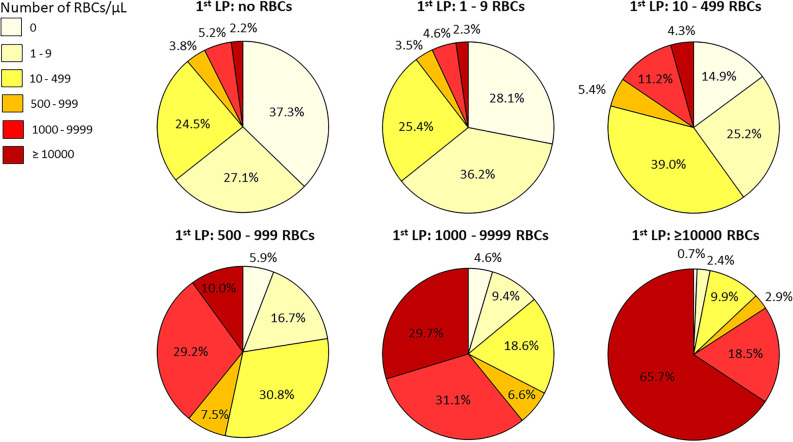
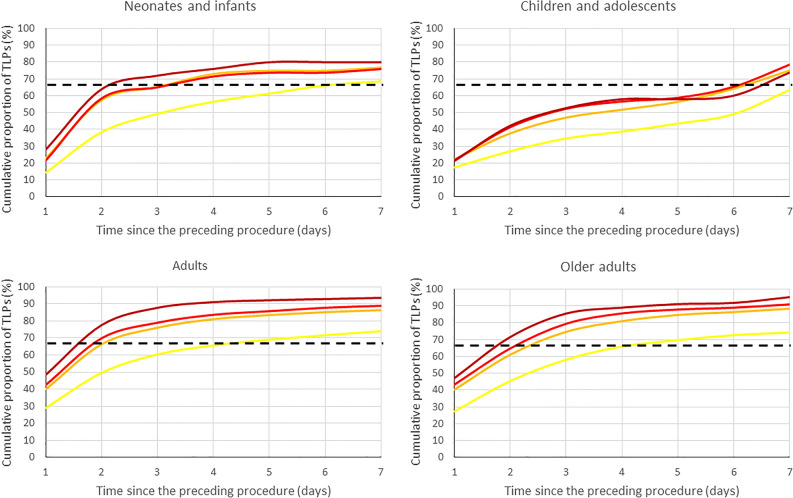
A cerebrospinal fluid (CSF) sample containing no red blood cells (RBC), colloquially known as a champagne tap, is an ideal outcome of a lumbar puncture (LP). In this pseudoprospective study of 2573 patients aged from 0 days to 95 years, we examined in four different age categories (neonates and infants, children and adolescents, adults, and older adults) whether a champagne tap in the patient’s first LP procedure and a shorter time than 1 week between the two successive procedures are independently associated with fewer blood-contaminated CSF samples (traumatic LP) in the following procedure. One out of five CSF samples from the patient’s first LP procedures were RBC-free on average, varying from about 9% in neonates and infants to about 36% in children and adolescents. The mean incidence of champagne taps was 19.5%. According to binary logistic regression, a champagne tap in the previous LP procedure significantly determined whether the following procedure was not blood-contaminated. The odds of traumatic LP were halved or even reduced tenfold after a champagne tap. Less than a week between the two successive procedures, in turn, multiplied the odds of traumatic LP in the latter even more than tenfold. A champagne tap was not significantly associated with traumatic LP in the following procedure among pediatric patients. If the patient’s condition or therapy plan permits and the blood contamination can compromise the reliability of the CSF-based analysis and consequent diagnosis, postponing the LP procedure by several days is advisable to improve the odds of receiving a high-quality CSF sample.
Overview
The claims and statistics of this paper haven’t been checked yet.
Free: it reads the open-access text and checks the first 5 claims that cite a source we can check. Create a free account to check every claim.
Integrity signals
Registry
Cites
Statistics
Figures
Verification
Claims the paper makes
The claims and statistics of this paper haven’t been checked yet.
Free: it reads the open-access text and checks the first 5 claims that cite a source we can check. Create a free account to check every claim.
Claims other papers make about this one
Each is checked against this paper’s own text: does it say what the citing paper says it does?
The check wasn’t confident either way, so it gives no verdict — never disputed.
In the citing paper
“CSF cell count and protein were adjusted according to the correction formula [14, 15].”
From Clinical utility of a cerebrospinal fluid multiplex PCR meningitis/encephalitis panel in children: a retrospective review of positive results (2026) · cites this paper as [14]
Experimental — accuracy not yet measured
Self-check
Percentages, sums and reported differences re-computed from the paper’s own numbers.
The self-check needs the paper’s full text.
Citations
Cites
Atraumatic versus conventional lumbar puncture needles: a systematic review and meta-analysis
Nath, S., Koziarz, A., Badhiwala, J. H., Alhazzani, W., Jaeschke, R., Sharma, S., Banfield, L., Shoamanesh, A., Singh, S., Nassiri, F., et al. (2018) · The Lancet · doi:10.1016/s0140-6736(17)32451-0 · Cited by 180
Risk Factors for Traumatic and Bloody Lumbar Puncture in Children With Acute Lymphoblastic Leukemia
Howard, S. C. (2002) · JAMA · doi:10.1001/jama.288.16.2001 · Cited by 166
Incidence of Traumatic Lumbar Puncture
Shah, K. H., Richard, K. M., Nicholas, S., & Edlow, J. A. (2003) · Academic Emergency Medicine · doi:10.1111/j.1553-2712.2003.tb00033.x · Cited by 131
S1 guidelines “lumbar puncture and cerebrospinal fluid analysis” (abridged and translated version)
Tumani, H., Petereit, H.-F., Gerritzen, A., Groß, C. C., Huss, A. M., Isenmann, S., Jesse, S., Khalil, M., Lewczuk, P., Lewerenz, J., et al. (2020) · Neurological Research and Practice · doi:10.1186/s42466-020-0051-z · Cited by 114
Incidence of Traumatic Lumbar Puncture
Shah, K. H., Richard, K. M., Nicholas, S., et al. (2003) · Academic Emergency Medicine · doi:10.1197/aemj.10.2.151 · Cited by 85
Incidence of Traumatic Lumbar Puncture: Experience of a Large, Tertiary Care Pediatric Hospital
Glatstein, M. M., Zucker‐Toledano, M., Alper, A., Scolnik, D., Oren, A., & Reif, S. S. (2011) · Clinical Pediatrics · doi:10.1177/0009922811410309 · Cited by 78
Pingree, E. W., Kimia, A. A., & Nigrovic, L. E. (2015) · Academic Emergency Medicine · doi:10.1111/acem.12582 · Cited by 76
Lumbar Puncture in the Neonate: Challenges in Decision Making and Interpretation
Srinivasan, L., Harris, M. C., & Shah, S. S. (2012) · Seminars in Perinatology · doi:10.1053/j.semperi.2012.06.007 · Cited by 73
Association of Lumbar Puncture With Spinal Hematoma in Patients With and Without Coagulopathy
Bodilsen, J., Mariager, T., Vestergaard, H. H., Christiansen, M. H., Kunwald, M., Lüttichau, H. R., Kristensen, B. T., Bjarkam, C. R., & Nielsen, H. I. (2020) · JAMA · doi:10.1001/jama.2020.14895 · Cited by 65
Lyons, T. W., Cruz, A. T., Freedman, S. B., Neuman, M. I., Balamuth, F., Mistry, R. D., Mahajan, P., Aronson, P. L., Thomson, J. E., Pruitt, C. M., et al. (2017) · Annals of Emergency Medicine · doi:10.1016/j.annemergmed.2016.10.008 · Cited by 56
Research works printed but not linked: 1
- 30. Gholampour S, Nguyen A, Chaudry S. Intracranial compliance, resistance to CSF-Outflow, and pressure-volume index in hydrocephalus patients: A systematic review and meta-analysis. Innov. Res. Biomed. Eng. 2023;44:100785.
Cited by
Medical fear of children with leukemia and its influencing factors: a qualitative study from China
Wu, X., Chen, C., Chen, S., Wang, R., Chen, Q., Jiang, K., & Zhang, C. (2026) · European Journal of Pediatrics · doi:10.1007/s00431-026-06745-5 · Cited by 2
Tengsupakul, S., Mulekar, M., Bista, B. R., Maertens, P., & Sharma, K. (2026) · BMC Infectious Diseases · doi:10.1186/s12879-026-12996-2
“CSF cell count and protein were adjusted according to the correction formula [14, 15].”
Nay, S., Konen, F. F., Bachhuber, F., Dressel, A., Erhart, D. K., Gerritzen, A., Groß, C. C., Harrer, A., Hinger, A., Lewczuk, P., et al. (2026) · Acta Neuropathologica · doi:10.1007/s00401-026-03101-7
“(ii) Blood contamination and correction formulas: Traumatic taps are common in neonates [116].”
(2025) · doi:10.21203/rs.3.rs-7871089/v1
Metadata
- Authors
- Sievänen, H., Kari, J., Huurre, A., & Palmu, S.
- Affiliations
- University of Turku (FI)
- Tampere University (FI)
- Corresponding author
- Sievänen, Harri
- Palmu, Sauli
- Venue
- Scientific Reports
- Published
- 2023-11-10
- Volume
- 13
- Issue
- 1
- Pages
- 19626-19626
- ISSN
- 2045-2322 (ISSN-L)
- PMC
- PMC10638277
- OpenAlex
- W4388566735
- Cited by
- 2
- References
- 31
- Citations by year
- 2026: 2
- FWCI
- 0.34
- Type
- journal article
- Language
- en
- Open access
- gold
- doi.org
- Licence
- cc-by
- creativecommons.org/licenses/by/4.0 (tdm)
- creativecommons.org/licenses/by/4.0 (vor)
- Locations
- Scientific Reports (publishedVersion, cc-by)
- PubMed Central (publishedVersion, cc-by)
- PubMed (publishedVersion)
- DOAJ (DOAJ: Directory of Open Access Journals) (submittedVersion, cc-by-sa)
- Tampere University Institutional Repository (Tampere University) (submittedVersion, cc-by)
- Topics
- Health Sciences › Medicine › Clinical Neurology › Neurosurgical Procedures and Complications
- Health Sciences › Health Professions › Medical Laboratory Technology › Clinical Laboratory Practices and Quality Control
- Health Sciences › Medicine › Clinical Neurology › Cerebrospinal fluid and hydrocephalus
- Keywords
- lumbar puncture, cerebrospinal fluid, blood contamination, traumatic lumbar puncture, pediatric patients, neonates and infants
- MeSH terms
- Adolescent, Aged, Child, Humans, Infant, Infant, Newborn, Probability, Spinal Puncture, Reproducibility of Results, Incidence
About these checks
Registry, retraction, Cites and statistics results are computed, not judged, with one exception: a printed reference that no index lists is read once by a model before it counts as a citation error. Claims are extracted by a model and kept only when their quote appears verbatim in the text; each cited source is then checked, with a model’s help, for whether it says what the claim relies on. Those verdicts can be wrong — read the claim’s quote and the cited source before relying on one.
Statistics and arithmetic are recomputed, not judged.
Confidence bands are shown only for fields calibrated on our annotated test set. None is calibrated yet, so no band is shown.
What counts as a claim ›How we measure confidence ›How we check this ›
Are you an author, or do you see a problem with this page? Request a review
How to cite
Cite CoChat for the checks on this page, and the paper for its own findings.
- This page
- CoChat. (2026). Citation check: A previous champagne tap reduces the probability of traumatic lumbar puncture in the following procedure. https://app.cochat.ai/papers/10.1038/s41598-023-46407-2
- The paper
- Sievänen, H., Kari, J., Huurre, A., & Palmu, S. (2023). A previous champagne tap reduces the probability of traumatic lumbar puncture in the following procedure. Scientific Reports. https://doi.org/10.1038/s41598-023-46407-2
Data sources
Bibliographic data: Semantic Scholar, OpenAlex, Crossref.
Contains information from the Semantic Scholar Academic Graph Datasets, made available under the ODC Attribution License (ODC-BY 1.0).
Semantic Scholar’s data is described in: Kinney, R., et al. (2023). The Semantic Scholar Open Data Platform. arXiv:2301.10140.
