

The DOI matches its Crossref record; the references it cites are not checked yet.
A multi-scale lifecycle and technoeconomic framework for higher education fleet electrification
Open accessAbstract
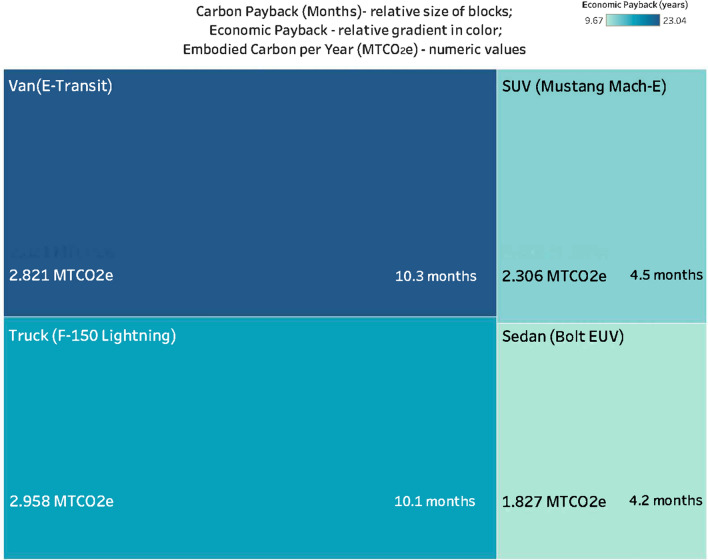
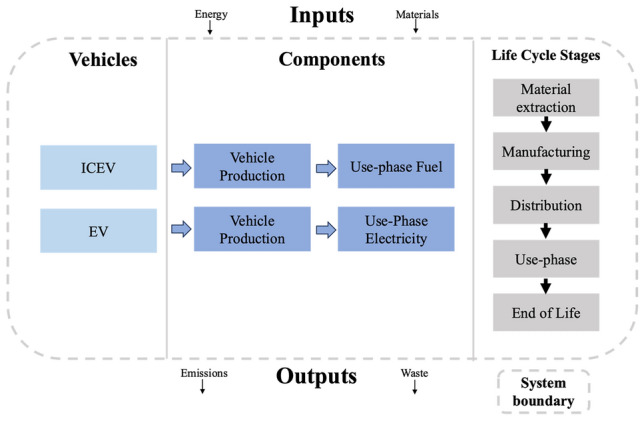
Transportation accounts for one-quarter of all energy related greenhouse gas emissions. As it pertains to transport electrification, higher education institutions—such as universities—can model solutions that affect broader society. Despite this, higher education’s role in fleet electrification adoption has been understudied. We, therefore, modeled an archetypical higher education institution to analyze the carbon and economic payback periods of three electrification scenarios (Business-as-Usual, Targeted Electrification, and Full Electrification) using a cradle-to-grave lifecycle and technoeconomic approach. Given the archetypical higher education institution fleet of 368 vehicles, results show an economic ratio plateau point of about 8 years at 20 fuel-based cars replaced by electric vehicles and a carbon payback period peak of roughly 10 months at 50 fuel-based cars replaced. We then performed a multi-scalar analysis by leveraging implementation theory. We find that higher education institutions that adhere to the tenets of implementation theory are poised to be pro-environmental change agents in many regions and countries. The methods and findings herein can be adapted to other institutions, regardless of fleet size, and can bolster relevant decision-making outcomes now.
Overview
The claims and statistics of this paper haven’t been checked yet.
Free: it reads the open-access text and checks the first 5 claims that cite a source we can check. Create a free account to check every claim.
Integrity signals
Registry
Cites
Statistics
Figures




Verification
Claims the paper makes
The claims and statistics of this paper haven’t been checked yet.
Free: it reads the open-access text and checks the first 5 claims that cite a source we can check. Create a free account to check every claim.
Claims other papers make about this one
Each is checked against this paper’s own text: does it say what the citing paper says it does?
The cited source says what the claim attributes to it.
In the citing paper
“The multi-scale analysis by Juang [170] of institutional fleet transitions to EVs within the context of higher education showcases the broader implications of such moves for sustainability. This study provides a template for other institutions and organizations looking to transition their fleets, highlighting the dual benefits of reduced carbon footprints and economic viability.”
From Electric Vehicle Adoption: A Comprehensive Systematic Review of Technological, Environmental, Organizational and Policy Impacts (2024) · cites this paper as [170]
Self-check
Percentages, sums and reported differences re-computed from the paper’s own numbers.
The self-check needs the paper’s full text.
Citations
The citation lists are queued
They are fetched later and appear here then.
References 34 · Cited by 9
Research works printed but not linked: 2
- Shea, R. P., Worsham, M. O., Chiasson, A. D., Kelly Kissock, J. & McCall, B. J. A lifecycle cost analysis of transitioning to a fully-electrified, renewably powered, and carbon-neutral campus at the University of Dayton. Sustain. Energy Technol. Assess. 37, 100576 (2020).
- Rial, M. & Pérez, J. Environmental performance of four different heavy-duty propulsion technologies using life cycle assessment. Transp. Res. Interdiscip. Perspect. 11, 100428 (2021).
Metadata
- Authors
- Juang, J., Williams, W. G., Ramshankar, A. T., Schmidt, J., Xuan, K., & Bozeman, J. F.
- Affiliations
- Georgia Institute of Technology (US)
- Corresponding author
- Bozeman, Joe F.
- Venue
- Scientific Reports
- Published
- 2024-02-28
- Volume
- 14
- Issue
- 1
- Pages
- 4938-4938
- ISSN
- 2045-2322 (ISSN-L)
- PMC
- PMC10901860
- OpenAlex
- W4392230032
- Cited by
- 9
- References
- 34
- Citations by year
- 2026: 4 · 2025: 4 · 2024: 1
- FWCI
- 0.93
- Type
- journal article
- Language
- en
- Open access
- gold
- doi.org
- Licence
- cc-by
- creativecommons.org/licenses/by/4.0 (tdm)
- creativecommons.org/licenses/by/4.0 (vor)
- Locations
- Scientific Reports (publishedVersion, cc-by)
- PubMed Central (publishedVersion, cc-by)
- PubMed (publishedVersion)
- DOAJ (DOAJ: Directory of Open Access Journals) (submittedVersion)
- Funders
- Division of Chemical, Bioengineering, Environmental, and Transport Systems (2115453)
- Topics
- Physical Sciences › Engineering › Electrical and Electronic Engineering › Electric Vehicles and Infrastructure
- Physical Sciences › Environmental Science › Environmental Engineering › Environmental Impact and Sustainability
- Social Sciences › Education › Sustainability in Higher Education
- Keywords
- electric vehicles, carbon payback period, payback period, techno-economic analysis, implementation theory, multiscale analysis, transportation greenhouse gas emissions
About these checks
Registry, retraction, Cites and statistics results are computed, not judged, with one exception: a printed reference that no index lists is read once by a model before it counts as a citation error. Claims are extracted by a model and kept only when their quote appears verbatim in the text; each cited source is then checked, with a model’s help, for whether it says what the claim relies on. Those verdicts can be wrong — read the claim’s quote and the cited source before relying on one.
Statistics and arithmetic are recomputed, not judged.
Confidence bands are shown only for fields calibrated on our annotated test set. None is calibrated yet, so no band is shown.
What counts as a claim ›How we measure confidence ›How we check this ›
Are you an author, or do you see a problem with this page? Request a review
How to cite
Cite CoChat for the checks on this page, and the paper for its own findings.
- This page
- CoChat. (2026). Citation check: A multi-scale lifecycle and technoeconomic framework for higher education fleet electrification. https://app.cochat.ai/papers/10.1038/s41598-024-54752-z
- The paper
- Juang, J., Williams, W. G., Ramshankar, A. T., Schmidt, J., Xuan, K., & Bozeman, J. F. (2024). A multi-scale lifecycle and technoeconomic framework for higher education fleet electrification. Scientific Reports. https://doi.org/10.1038/s41598-024-54752-z
Data sources
Bibliographic data: Semantic Scholar, OpenAlex, Crossref.
Contains information from the Semantic Scholar Academic Graph Datasets, made available under the ODC Attribution License (ODC-BY 1.0).
Semantic Scholar’s data is described in: Kinney, R., et al. (2023). The Semantic Scholar Open Data Platform. arXiv:2301.10140.
