

The DOI matches its Crossref record; 12 of the 12 references it cites were found in a registry or an index.
Super-resolution deep neural network (SRDNN) based multi-image steganography for highly secured lossless image transmission
Open accessAbstract
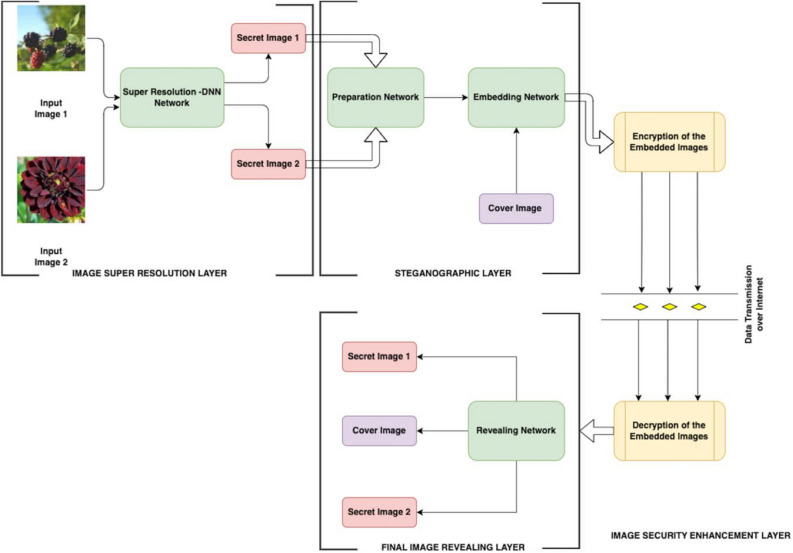
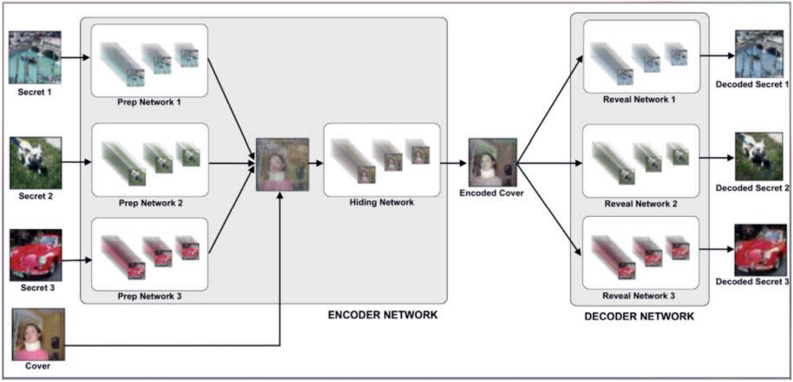
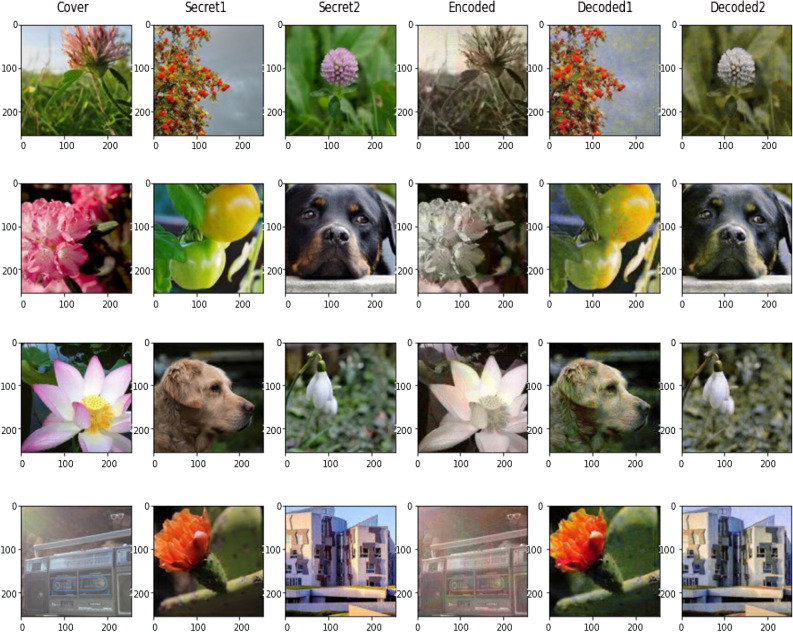
Information exchange and communication through the Internet are one of the most crucial aspects of today’s information technology world. The security of information transmitted online has grown to be a critical concern, particularly in the transfer of medical data. To overcome this, the data must be delivered securely without being altered or lost. This can be possibly done by combining the principles of cryptography and steganography. In the recent past, steganography is used with simpler methods like the least significant bit manipulation technique, in order to encode a lower-resolution image into a higher-resolution image. Here, we attempt to use deep neural networks to combine many two-dimensional colour images of the same resolution into a single cover image with the same resolution. In this technique, many secret images are concealed inside a single cover image using deep neural networks. The embedded cover image is then encrypted using a 3D chaotic map for diffusion and elliptic curve cryptography (ECC) for confusion to increase security.Supporting the fact that neural networks experience losses, the proposed system recovers up to 93% of the hidden image concealed in the original image. As the secret image features are identified and combined along with the cover image, the time complexity involved in the security process is minimized by 78% compared to securing the original data.
Overview
The claims and statistics of this paper haven’t been checked yet.
Free: it reads the open-access text and checks the first 5 claims that cite a source we can check. Create a free account to check every claim.
Integrity signals
Registry
Cites
Statistics
Figures


Verification
Claims the paper makes
The claims and statistics of this paper haven’t been checked yet.
Free: it reads the open-access text and checks the first 5 claims that cite a source we can check. Create a free account to check every claim.
Claims other papers make about this one
Each is checked against this paper’s own text: does it say what the citing paper says it does?
The source backs part of the claim, not all of it — or backs it for a different population, condition or comparison.
In the citing paper
“In particular, the ability to detect complex dependency structures and identify long-term data relationships makes the integration of CNNs into cryptographic security systems important (Priya et al. 2024).”
From A novel deep learning-based statistical randomness evaluation test methodology for cryptographic applications (2025) · cites this paper as Priya et al. 2024
Experimental — accuracy not yet measuredThe check wasn’t confident either way, so it gives no verdict — never disputed.
In the citing paper
“The use of CNN in randomness testing offers significant advantages in overcoming the shortcomings of traditional statistical tests.”
From A novel deep learning-based statistical randomness evaluation test methodology for cryptographic applications (2025) · cites this paper as Priya et al. 2024
Experimental — accuracy not yet measured
Self-check
Percentages, sums and reported differences re-computed from the paper’s own numbers.
The self-check needs the paper’s full text.
Citations
Cites
Local Shannon entropy measure with statistical tests for image randomness
Wu, Y., Zhou, Y., Saveriades, G., Agaian, S., Noonan, J. P., & Natarajan, P. (2013) · Information Sciences · doi:10.1016/j.ins.2012.07.049 · Cited by 722 · cited 1×
“…several shortcomings of the traditional global Shannon entropy measure, such as unfair randomness comparisons between images of varying sizes, the inability to distinguish between image randomness before and during image shuffling, and potentially erroneous results for synthetic images 15 .”
BackgroundImage Steganography: A Review of the Recent Advances
Subramanian, N., Elharrouss, O., Al-Maadeed, S., & Bouridane, A. (2021) · IEEE Access · doi:10.1109/access.2021.3053998 · Cited by 352
An Image Encryption Method Based on Elliptic Curve Elgamal Encryption and Chaotic Systems
Luo, Y., Ouyang, X., Liu, J., & Cao, L. (2019) · IEEE Access · doi:10.1109/access.2019.2906052 · Cited by 172
A robust medical image encryption in dual domain: chaos-DNA-IWT combined approach
Banu S, A., & Amirtharajan, R. (2020) · Medical & Biological Engineering & Computing · doi:10.1007/s11517-020-02178-w · Cited by 147
An Image Security Model Based on Chaos and DNA Cryptography for IIoT Images
Singh, A. K., Chatterjee, K., & Singh, A. P. (2022) · IEEE Transactions on Industrial Informatics · doi:10.1109/tii.2022.3176054 · Cited by 109
The secure steganography for hiding images via GAN
Fu, Z., Wang, F., & Cheng, X. (2020) · EURASIP Journal on Image and Video Processing · doi:10.1186/s13640-020-00534-2 · Cited by 64
Multi-Image Steganography Using Deep Neural NetworksPreprint
Das, A., Wahi, J. S., Anand, M., & Rana, Y. (2021) · arXiv (Cornell University) · doi:10.48550/arxiv.2101.00350 · Cited by 50
Text to image encryption technique using RGB substitution and AES
Joshy, A., Baby, K., Padma, S., & Fasila, K. A. (2017) · International Conference on Inventive Computing and Informatics (ICICI) · doi:10.1109/icici.2017.8365317 · Cited by 18
Secure and Light Weight Elliptic Curve Cipher Suites in SSL/TLS
Arunkumar, B., & Kousalya, G. (2021) · Computer Systems Science and Engineering · doi:10.32604/csse.2022.018166 · Cited by 12
Self-citationImage Encryption based on Advanced Encryption Standard (AES)
Saudagar, S. I., Kulkarni, M., Giramkar, A. A., Godse, S. R., Gupta, S., Patil, G., & Gunjal, S. (2023) · International Conference for Advancement in Technology (ICONAT) · doi:10.1109/iconat57137.2023.10080243 · Cited by 12
Research works printed but not linked: 8
- Baluja, S. Hiding images in plain sight: Deep steganography. Adv. Neural Inf. Process. Syst. 30, 1–11 (2017).
- Deshmukh, P. An image encryption and decryption using aes algorithm. Int. J. Sci. Eng. Res. 7(2), 210–213 (2016).
- Sharma, P. & Sabharwal, H. A new image encryption using modified aes algorithm and its comparision with aes. Int. J. Eng. Res. Technol. (IJERT) 9(8), 194–197 (2020).
- Saini, R. Comparative study of current image steganography techniques. Int. J. Recent Res. Asp. 5, 308–310 (2018).
- Ansari, A. S., Mohammadi, M. S. & Parvez, M. T. A comparative study of recent steganography techniques for multiple image formats. Int. J. Comput. Netw. Inf. Secur. 11(1), 11–25 (2019).
- Kumar, M., Lahcen, R. A. M., Mohapatra, R., Alwala, C. & Kurella, S. V. K. Review of image encryption techniques. J. Comput. Eng. 14(1), 31–37 (2020).
- Hamid, N., Yahya, A., Ahmad, R. B. & Al-Qershi, O. M. Image steganography techniques: An overview. Int. J. Comput. Sci. Secur. (IJCSS) 6(3), 168–187 (2012).
- Anushiadevi, R. & Amirtharajan, R. Separable reversible data hiding in an encrypted image using the adjacency pixel difference histogram. J. Inf. Secur. Appl. 72, 103407 (2023).
Cited by
Sykot, A., Azad, M. S., Tanha, W. R., Morshed, B. M. M., Shubha, S. E. U., & Mahdy, M. R. C. (2025) · Alexandria Engineering Journal · doi:10.1016/j.aej.2025.02.056 · Cited by 30
Belmer Gladson, V., Deepa, G. G., Jothi, S. F. E., & Mahalakshmi, L. (2025) · Cybernetics & Systems · doi:10.1080/01969722.2025.2566662 · Cited by 16
Invisible Injections: Exploiting Vision-Language Models Through Steganographic Prompt EmbeddingPreprint
Pathade, C. (2025) · arXiv (Cornell University) · doi:10.48550/arxiv.2507.22304 · Cited by 15
Kaner, S., Garipcan, A. M., & Erdem, E. (2025) · Journal of King Saud University Computer and Information Sciences · doi:10.1007/s44443-025-00271-4 · Cited by 11
“In particular, the ability to detect complex dependency structures and identify long-term data relationships makes the integration of CNNs into cryptographic security systems important (Priya et al. 2024).”
DL-Steg: a deep learning-based steganography model for improving image security
Aljarf, A., & Rashidi, Y. (2025) · Journal of Umm Al-Qura University for Engineering and Architecture · doi:10.1007/s43995-025-00266-2 · Cited by 11
Metadata
- Authors
- Priya, S., Abirami, S. P., Arunkumar, B., & Mishachandar, B.
- Affiliations
- Coimbatore Institute of Technology (IN)
- VIT-AP University (IN)
- Corresponding author
- Arunkumar, B.
- Venue
- Scientific Reports
- Published
- 2024-03-13
- Volume
- 14
- Issue
- 1
- Pages
- 6104-6104
- ISSN
- 2045-2322 (ISSN-L)
- PMC
- PMC10937672
- OpenAlex
- W4392761726
- Cited by
- 22
- References
- 11
- Citations by year
- 2026: 9 · 2025: 10 · 2024: 3
- FWCI
- 3.07
- Type
- journal article
- Language
- en
- Open access
- gold
- doi.org
- Licence
- cc-by
- creativecommons.org/licenses/by/4.0 (tdm)
- creativecommons.org/licenses/by/4.0 (vor)
- Locations
- Scientific Reports (publishedVersion, cc-by)
- PubMed Central (publishedVersion, cc-by)
- PubMed (publishedVersion)
- DOAJ (DOAJ: Directory of Open Access Journals) (submittedVersion, cc-by-sa)
- Greater South Information System
- Topics
- Physical Sciences › Computer Science › Computer Vision and Pattern Recognition › Advanced Steganography and Watermarking Techniques
- Physical Sciences › Computer Science › Computer Vision and Pattern Recognition › Chaos-based Image/Signal Encryption
- Physical Sciences › Computer Science › Computer Vision and Pattern Recognition › Digital Media Forensic Detection
- Keywords
- medical data security, elliptic curve cryptography, image encryption, secret image reconstruction
About these checks
Registry, retraction, Cites and statistics results are computed, not judged, with one exception: a printed reference that no index lists is read once by a model before it counts as a citation error. Claims are extracted by a model and kept only when their quote appears verbatim in the text; each cited source is then checked, with a model’s help, for whether it says what the claim relies on. Those verdicts can be wrong — read the claim’s quote and the cited source before relying on one.
Statistics and arithmetic are recomputed, not judged.
Confidence bands are shown only for fields calibrated on our annotated test set. None is calibrated yet, so no band is shown.
What counts as a claim ›How we measure confidence ›How we check this ›
Are you an author, or do you see a problem with this page? Request a review
How to cite
Cite CoChat for the checks on this page, and the paper for its own findings.
- This page
- CoChat. (2026). Citation check: Super-resolution deep neural network (SRDNN) based multi-image steganography for highly secured lossless image transmission. https://app.cochat.ai/papers/10.1038/s41598-024-54839-7
- The paper
- Priya, S., Abirami, S. P., Arunkumar, B., & Mishachandar, B. (2024). Super-resolution deep neural network (SRDNN) based multi-image steganography for highly secured lossless image transmission. Scientific Reports. https://doi.org/10.1038/s41598-024-54839-7
Data sources
Bibliographic data: Semantic Scholar, OpenAlex, Crossref.
Contains information from the Semantic Scholar Academic Graph Datasets, made available under the ODC Attribution License (ODC-BY 1.0).
Semantic Scholar’s data is described in: Kinney, R., et al. (2023). The Semantic Scholar Open Data Platform. arXiv:2301.10140.
