

Periodicity, Elliott waves, and fractals in the NFT market
Open accessThe DOI matches its Crossref record; 69 of the 69 references it cites were found in a registry or an index.
Abstract
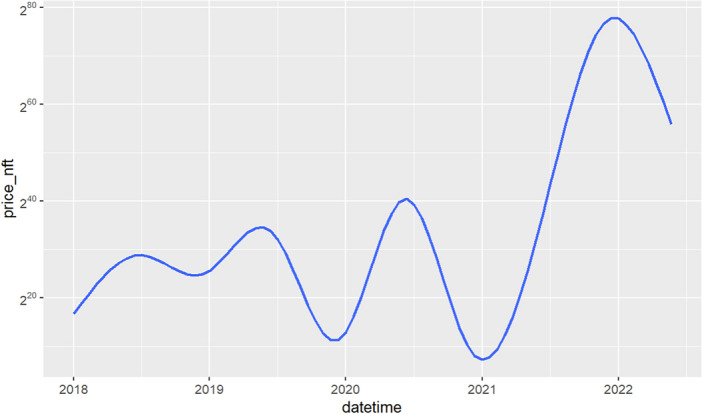
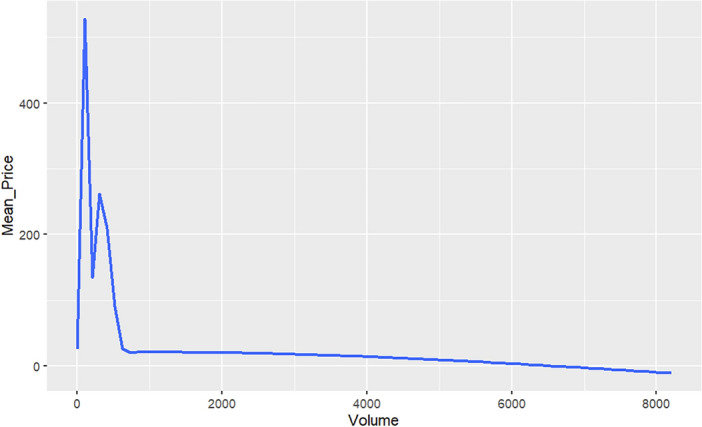
Non-fungible tokens (NFTs) are unique digital assets that exist on a blockchain and have provided new revenue streams for creators. This research investigates NFT market inefficiencies to identify claimed cyclic behavior and cryptocurrency influences on NFT prices. The research found that while linear models are not useful in modeling NFT price series, models that extract periodic behavior can provide explanations and predictions of price behavior. The investigation of autocycles in cryptocurrency and NFT markets did not support the existence of Elliott Wave behavior in any of these blockchain enabled assets. Rather NFT price behavior is strongly tied to the underlying asset and its community of fans. These fans commit to periodic bouts of idiosyncratic trading which cools for a while, and then restarts. The research found no evidence supporting whole market effects across the full price series of individual NFTs. The research strongly supports prior findings that the offsetting movements significantly influence NFT prices and trading volume in Bitcoin and Ether. The research found NFT markets exhibit characteristics resembling a social media platform rather than more traditional asset markets like stock exchanges. It found that traditional linear econometric models cannot predict or explain NFT price series, only that NFT price and volume were weakly correlated. Fractal models consistent with Elliott wave theory do explain some of NFT price behavior, but are not consistent or stable over time. This research confirmed prior research findings that Bitcoin and Ether price movements are correlated with general NFT price and volume series in periods of between 24 and 48 h, with significant numbers of trades into and out of cryptocurrencies at 2 and 8 h.
Overview
The claims and statistics of this paper haven’t been checked yet.
Free: it reads the open-access text and checks the first 5 claims that cite a source we can check. Create a free account to check every claim.
Integrity signals
Registry
Cites
Statistics
Figures
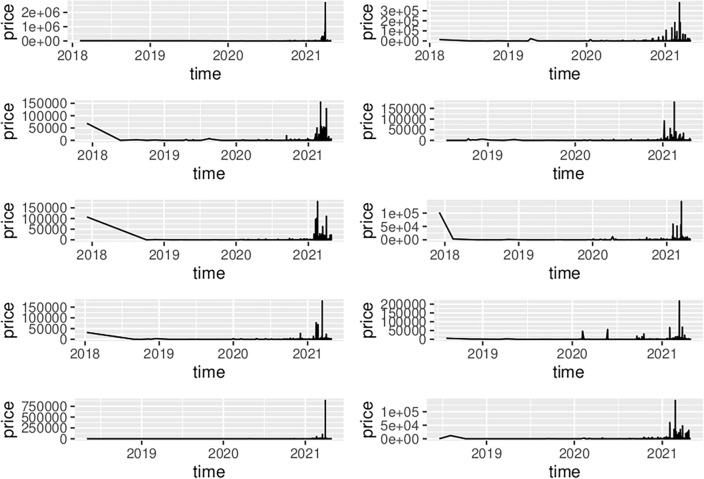
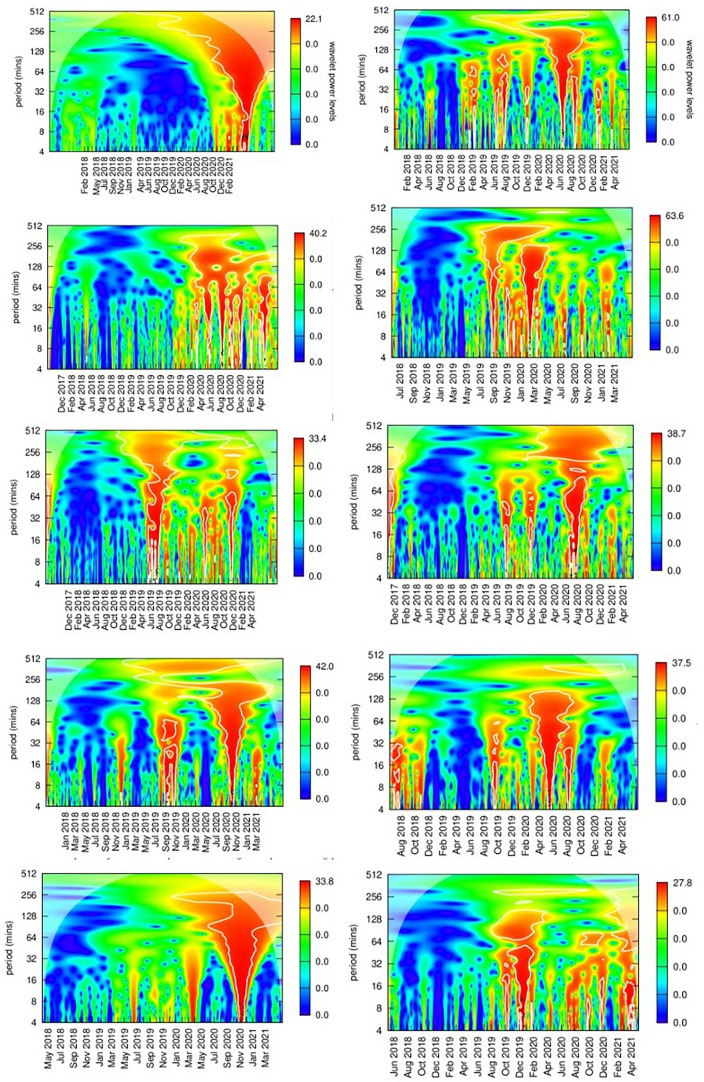

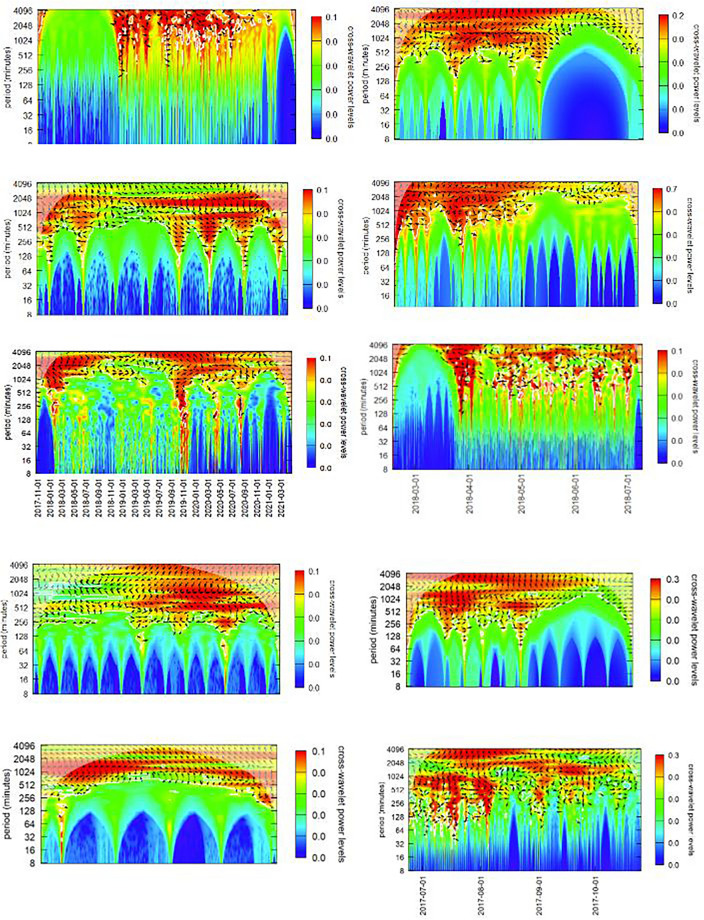
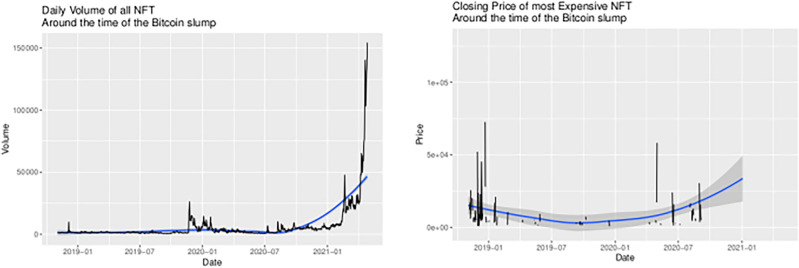


Verification
Claims the paper makes
The claims and statistics of this paper haven’t been checked yet.
Free: it reads the open-access text and checks the first 5 claims that cite a source we can check. Create a free account to check every claim.
Claims other papers make about this one
Each is checked against this paper’s own text: does it say what the citing paper says it does?
The cited source says what the claim attributes to it.
In the citing paper
“The influence of price and volume movements of Bitcoin and Ether over NFT prices and trading volumes is confirmed over time periods longer than a day.”
From What Is the Right Price for Non-Fungible Tokens (NFTs)? A Systematic Review of the Current Literature (2025) · cites this paper as [72]
Self-check
Percentages, sums and reported differences re-computed from the paper’s own numbers.
The self-check needs the paper’s full text.
Citations
Cites
A Wavelet Tour of Signal Processing
(1999) · Elsevier eBooks · doi:10.1016/b978-0-12-466606-1.x5000-4 · Cited by 16,227
The black swan: the impact of the highly improbable
(2007) · Choice Reviews Online · doi:10.5860/choice.45-1430 · Cited by 3,454
Daugman, J. G. (1985) · Journal of the Optical Society of America A · doi:10.1364/josaa.2.001160 · Cited by 3,219 · cited 1×
“It is additionally important that the Morlet wavelets applied here are closely related to human perception, hearing and vision, which is consistent with Elliott waves having their basis in human perception 80,81 .”
BackgroundSelf-Affine Fractals and Fractal Dimension
Mandelbrot, B. B. (1985) · Physica Scripta · doi:10.1088/0031-8949/32/4/001 · Cited by 1,009 · cited 1×
“The values of the Hurst exponent vary between 0 and 1 , with higher values indicating a smoother trend, less volatility, and less roughness 84 .”
BackgroundMapping the NFT revolution: Market trends, trade networks, and visual features
Nadini, M., Alessandretti, L., Di Giacinto, F., Martino, M., Aiello, L. M., & Baronchelli, A. (2021) · Scientific Reports · doi:10.1038/s41598-021-00053-8 · Cited by 715 · cited 1×
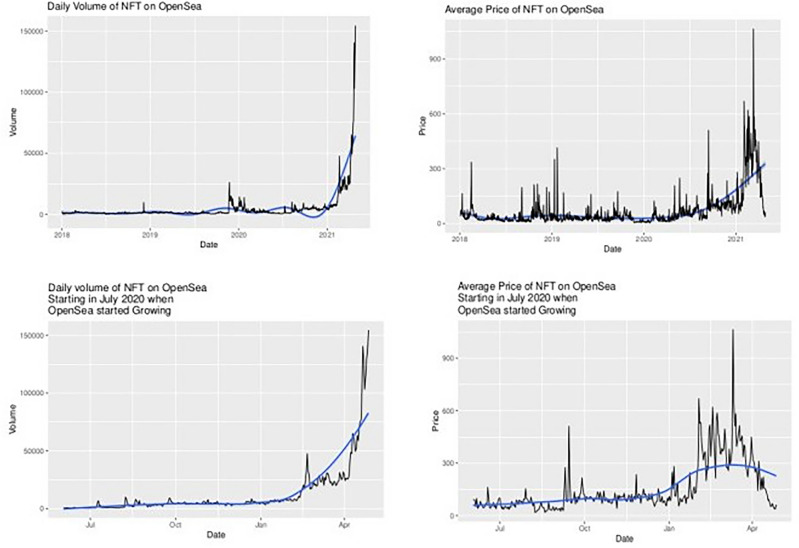
“The research uses a curated database of 6,071,027 NFT transactions of 4,337,718 unique NFTs on OpenSea, the world’s largest NFT marketplace, between 6:44 pm UTC on November 11, 2017 and midnight on April 28, 2021 82 .”
MethodNon-Fungible Token (NFT): Overview, Evaluation, Opportunities and Challenges
Wang, Q., Li, R., Wang, Q., & Chen, S. (2021) · arXiv (Cornell University) · doi:10.48550/arxiv.2105.07447 · Cited by 577 · cited 1×
“Beyond this, there is a substantial strain of semi-speculative academic literature that questions whether NFTs are an asset at all, or merely a mathematical oddity and perhaps the most recent fad in market profiteering 61–68 .”
BackgroundIs non-fungible token pricing driven by cryptocurrencies?
Dowling, M. (2022) · Finance Research Letters · doi:10.1016/j.frl.2021.102097 · Cited by 550 · cited 1×
“Economic models of NFT markets have been developed and explored in 6,11 and 12 who found support for the nonfungibility of NFTs. Found low to nonexistent correlation between NFTs and cryptocurrencies 13 and 14 .”
BackgroundThe non-fungible token (NFT) market and its relationship with Bitcoin and Ethereum
Ante, L. (2021) · SSRN Electronic Journal · doi:10.2139/ssrn.3861106 · Cited by 362
Singularity spectrum of fractal signals from wavelet analysis: Exact results
Bacry, E., Muzy, J. F., & Arn�odo, A. (1993) · Journal of Statistical Physics · doi:10.1007/bf01053588 · Cited by 359 · cited 1×
“In this research I take advantage of wavelets methods that allow perusing the local structure of a fractal 75–79 .”
MethodWilson, K. B., Karg, A., & Ghaderi, H. (2022) · Business Horizons · doi:10.1016/j.bushor.2021.10.007 · Cited by 318 · cited 1×
“Literature reviews appear in 14,53–56 for general literature reviews.”
Background
Research works printed but not linked: 19
- Klein NK Lattermann F Schiereck D Investment in non-fungible tokens (NFTs): The return of ethereum secondary market NFT sales J. Asset Manag. 2023 2023 1 14
- Jiang M Xia Y What drives the volatility of non-fungible tokens (NFTs): Macroeconomic fundamentals or investor attention? Appl. Econ. Lett. 2023 2023 1 10
- Elliott R The Wave Principle 2019 Lulu Press Inc
- Chatterjee A Ayadi OF Maniam B The applications of the fibonacci sequence and elliott wave theory in predicting the security price movements: A survey J. Commerc. Bank. Financ. 2002 1 65 76
- Seif S Jamshidinavid B Ghanbari M Esmaeilpour M Predicting stock market trends of iran using elliott wave oscillation and relative strength index Financ. Res. J. 2021 23 134 157
- Satari R Akbari-Dehkharghani A Ahangari K Copper price prediction using wave count with contribution of elliott waves J. Min. Env. 2020 11 825 835
- Nurlana B Using elliott wave theory predictions as inputs in equilibrium portfolio models with views Rev. Business Econ. Stud. 2015 2015 33 45
- Vaghela V Gor R Chavda N Elliott wave formation using combination of CCI and DEMA IOSR J. Math. 2022 17 14 21
- Vantuch T Zelinka I Vasant P An algorithm for elliott waves pattern detection Intell. Dec. Technol. 2018 12 15 24
- Manjunath K Sekhar M Elliott wave principle with recurrent neual network for stock market prediction J. Theor. Appl. Inf. Technol. 2022 100 1456
- Swannell R Refining the elliott wave principle with wave analysis Futures 2002 31 48 48
- Swannell R Refining elliott wave triangle patterns Futures 2003 32 50 50
- Dharmaraj C Balaji G A study on effectiveness of elliott wave theory forecasts for precious metals with reference to gold & silver Indian J. Financ. 2011 5 3 11
- Elliott RN Nature’s law: The secret of the universe 1982 Institute for Economic & Financial Research
- Sornette D Johansen A Bouchaud J-P Stock market crashes, precursors and replicas J. Phys. 1996 I 6 167 175
- Sharpe WF Capital asset prices: A theory of market equilibrium under conditions of risk J. Financ. 1964 19 425 442
- Fama EF Efficient capital markets: Reply J. Financ. 1976 31 143 145
- Ko K Jeong T Woo J Hong JW-K Survey on blockchain-based non-fungible tokens: History, technologies, standards, and open challenges Int. J. Netw. Manag. 2023 2023 e2245
- Mandelbrot B Hudson RL The Misbehavior of Markets: A Fractal View of Financial Turbulence 2007 Basic books
Cited by
Cryptocurrency Market Efficiency Revisited: A Bibliometric Analysis
Abdeljawad, I., Tina, A., Hassan, M. K., & Rashid, M. (2025) · International Journal of Financial Engineering · doi:10.1142/s2424786325500215 · Cited by 11
Delisle, L., Hi, D. P., & Jaouadi, A. (2026) · Nonlinear Dynamics · doi:10.1007/s11071-025-12210-z · Cited by 2
NFT Pricing via Machine Learning
Wang, Q. (2024) · International Symposium on Computational Intelligence and Design · doi:10.1109/iscid63852.2024.00042 · Cited by 2
“[11] used quantitative models to describe the NFT prices.”
9NFTMANIA: Catalyzing Innovation and Community in NFT Culture and the Metaverse
Payal, & Garg, S. (2024) · Scientific Journal of Metaverse and Blockchain Technologies · doi:10.36676/sjmbt.v2.i2.28 · Cited by 2
Flamini, M., & Naldi, M. (2025) · FinTech · doi:10.3390/fintech4040073 · Cited by 1
Has the fan economy affected the price of non-fungible tokens (NFTs)?
Cao, Q., Ding, Y., Ye, Y., & Wen, R. (2025) · Frontiers in Blockchain · doi:10.3389/fbloc.2025.1588837 · Cited by 4
“While recent studies have pointed to the volatility, sentiment cycles, and reputational risks associated with fan-driven markets (e.g., Principe et al., 2024; Westland, 2024; Ouvrein, 2024), they tend to emphasize the unpredictability of these effects rather than deny their existence.”
InfluentialGavrilenko, O. V., & Мягкий, М. (2024) · Innovative technologies and scientific solutions for industries · doi:10.30837/itssi.2024.27.018
ФОНДОВИЙ РИНОК: ПРОГНОЗУВАННЯ РУХУ ЦІН ЗА ДОПОМОГОЮ ТЕОРІЇ ЕЛЛІОТТА
Ганусич, В. О. (2025) · Економіка та суспільство · doi:10.32782/2524-0072/2025-74-19
Wang, Q. (2025) · International Conference on Information Communication and Software Engineering (ICICSE) · doi:10.1109/icicse66971.2025.11429820
“Paper [11] used quantitative models to describe NFT prices.”
NFT Pricing via Long-Short-Term Memory Model
Wang, Q. (2025) · International Symposium on Computational Intelligence and Design · doi:10.1109/iscid68789.2025.00027
“[11] used quantitative models to describe the NFT prices.”
Metadata
- Authors
- Christopher Westland, J.
- Venue
- Scientific Reports
- Published
- 2024-02-23
- Volume
- 14
- Issue
- 1
- Pages
- 4480-4480
- ISSN
- 2045-2322 (ISSN-L)
- PMC
- PMC10891072
- OpenAlex
- W4392093181
- Cited by
- 10
- References
- 67
- Citations by year
- 2026: 1 · 2025: 6 · 2024: 3
- FWCI
- 3.76
- Type
- journal article
- Language
- en
- Open access
- gold
- doi.org
- Licence
- cc-by
- creativecommons.org/licenses/by/4.0 (tdm)
- creativecommons.org/licenses/by/4.0 (vor)
- Locations
- Scientific Reports (publishedVersion, cc-by)
- PubMed Central (publishedVersion, cc-by)
- PubMed (publishedVersion)
- DOAJ (DOAJ: Directory of Open Access Journals) (submittedVersion)
- Topics
- Physical Sciences › Computer Science › Information Systems › Blockchain Technology Applications and Security
- Social Sciences › Economics, Econometrics and Finance › Finance › Financial Markets and Investment Strategies
- Social Sciences › Decision Sciences › Management Science and Operations Research › Stock Market Forecasting Methods
- Keywords
- non-fungible tokens, Elliott wave theory, fractal model, Bitcoin, Ethereum, trading volume, market inefficiency, blockchain assets, price forecasting
About these checks
Registry, retraction, Cites and statistics results are computed, not judged, with one exception: a printed reference that no index lists is read once by a model before it counts as a citation error. Claims are extracted by a model and kept only when their quote appears verbatim in the text; each cited source is then checked, with a model’s help, for whether it says what the claim relies on. Those verdicts can be wrong — read the claim’s quote and the cited source before relying on one.
Statistics and arithmetic are recomputed, not judged.
Confidence bands are shown only for fields calibrated on our annotated test set. None is calibrated yet, so no band is shown.
What counts as a claim ›How we measure confidence ›How we check this ›
Are you an author, or do you see a problem with this page? Request a review
Data sources
Bibliographic data: Semantic Scholar, OpenAlex, Crossref.
Contains information from the Semantic Scholar Academic Graph Datasets, made available under the ODC Attribution License (ODC-BY 1.0).
Semantic Scholar’s data is described in: Kinney, R., et al. (2023). The Semantic Scholar Open Data Platform. arXiv:2301.10140.
