

The DOI matches its Crossref record; 2 of the 2 references it cites were found in a registry or an index.
Comparing deep learning and pathologist quantification of cell-level PD-L1 expression in non-small cell lung cancer whole-slide images
Open accessAbstract
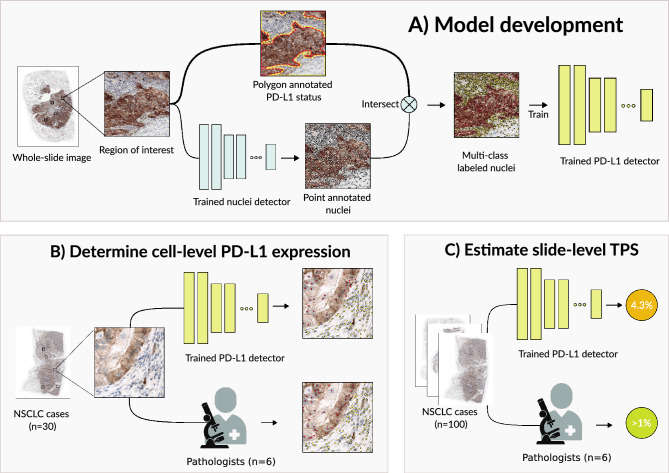
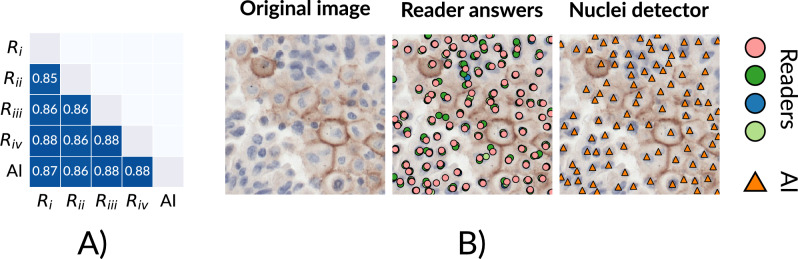
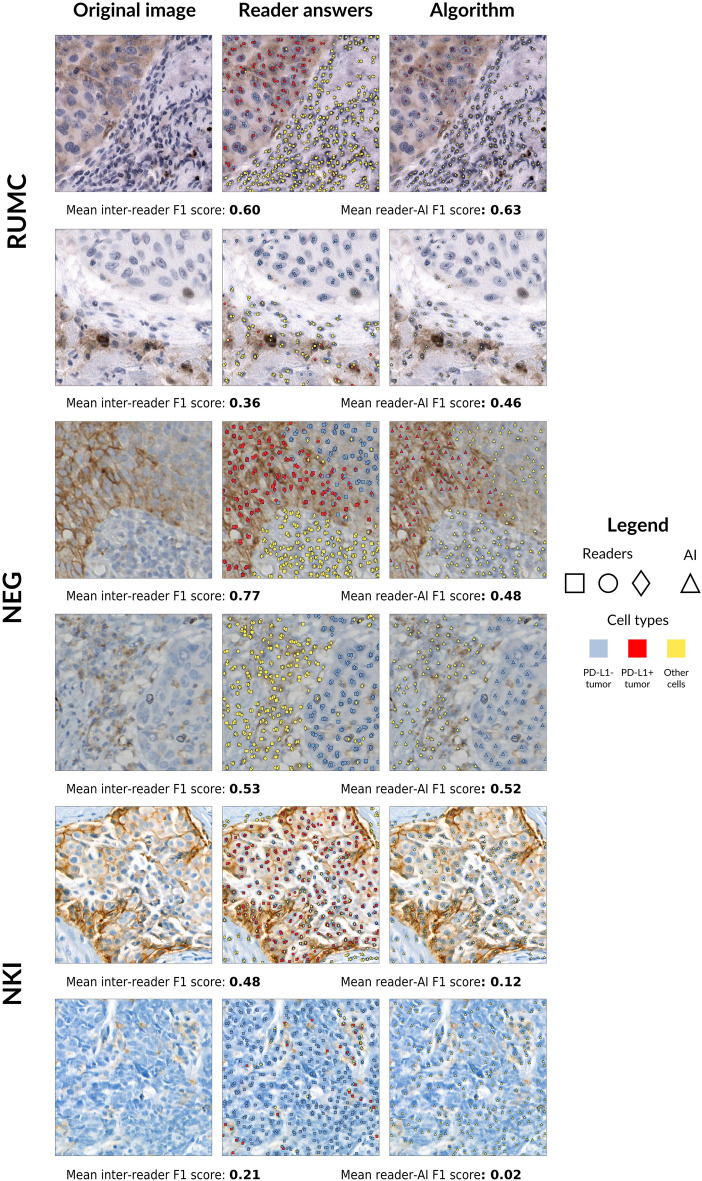
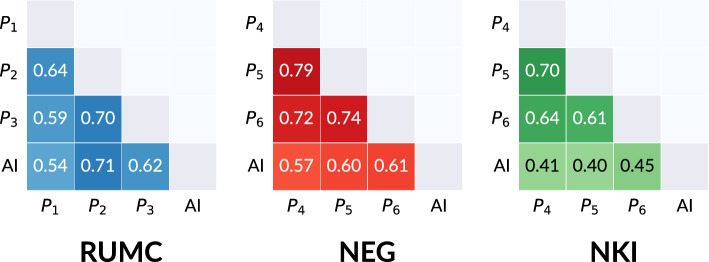
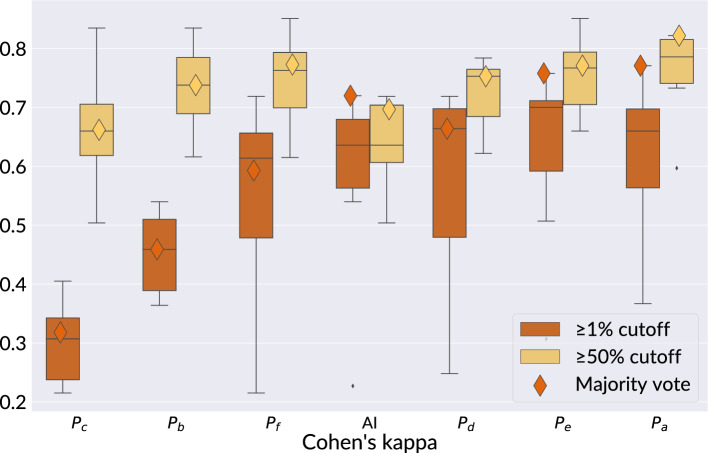
Programmed death-ligand 1 (PD-L1) expression is currently used in the clinic to assess eligibility for immune-checkpoint inhibitors via the tumor proportion score (TPS), but its efficacy is limited by high interobserver variability. Multiple papers have presented systems for the automatic quantification of TPS, but none report on the task of determining cell-level PD-L1 expression and often reserve their evaluation to a single PD-L1 monoclonal antibody or clinical center. In this paper, we report on a deep learning algorithm for detecting PD-L1 negative and positive tumor cells at a cellular level and evaluate it on a cell-level reference standard established by six readers on a multi-centric, multi PD-L1 assay dataset. This reference standard also provides for the first time a benchmark for computer vision algorithms. In addition, in line with other papers, we also evaluate our algorithm at slide-level by measuring the agreement between the algorithm and six pathologists on TPS quantification. We find a moderately low interobserver agreement at cell-level level (mean reader-reader F1 score = 0.68) which our algorithm sits slightly under (mean reader-AI F1 score = 0.55), especially for cases from the clinical center not included in the training set. Despite this, we find good AI-pathologist agreement on quantifying TPS compared to the interobserver agreement (mean reader-reader Cohen’s kappa = 0.54, 95% CI 0.26–0.81, mean reader-AI kappa = 0.49, 95% CI 0.27—0.72). In conclusion, our deep learning algorithm demonstrates promise in detecting PD-L1 expression at a cellular level and exhibits favorable agreement with pathologists in quantifying the tumor proportion score (TPS). We publicly release our models for use via the Grand-Challenge platform.
Overview
The claims and statistics of this paper haven’t been checked yet.
Run the check — free, no account needed. It reads the open-access text and checks the sources it cites.
Integrity signals
Registry
Cites
Statistics
Figures
Verification
Claims the paper makes
The claims and statistics of this paper haven’t been checked yet.
Run the check — free, no account needed. It reads the open-access text and checks the sources it cites.
Claims other papers make about this one
Each is checked against this paper’s own text: does it say what the citing paper says it does?
The source backs part of the claim, not all of it — or backs it for a different population, condition or comparison.
In the citing paper
“While numerous deep learning studies have emerged for predicting ICI responses in NSCLC from H&E images, they are primarily focused on refining PD-L1 quantification56–58.”
From Predicting the tumor microenvironment composition and immunotherapy response in non-small cell lung cancer from digital histopathology images (2024) · cites this paper as [56]
Experimental — accuracy not yet measured
Self-check
Percentages, sums and reported differences re-computed from the paper’s own numbers.
The self-check needs the paper’s full text.
Citations
Cites
Jocher, G., Stoken, A., Borovec, J., NanoCode012, ChristopherSTAN, Changyu, L., Laughing, Hogan, A., Lorenzomammana, Tkianai, et al. (2020) · Zenodo · doi:10.5281/zenodo.3983579 · Cited by 2,738
Tellez, D., Litjens, G., Bándi, P., Bulten, W., Bokhorst, J.-M., Ciompi, F., & van der Laak, J. (2019) · Medical Image Analysis · doi:10.1016/j.media.2019.101544 · Cited by 649
Self-citation
Research works printed but not linked: 23
- Onoi, K. et al. Immune checkpoint inhibitors for lung cancer treatment: A review. J. Clin. Med. 9, 1362 (2020). · DOI
- Nasser, N. J., Gorenberg, M. & Agbarya, A. First line immunotherapy for non-small cell lung cancer. Pharmaceuticals 13, 373 (2020). · DOI
- Prelaj, A. et al. Predictive biomarkers of response for immune checkpoint inhibitors in non–small-cell lung cancer. Eur. J. Cancer 106, 144–159 (2019). · DOI
- Paolino, G. et al. PD-L1 evaluation in head and neck squamous cell carcinoma: Insights regarding specimens, heterogeneity and therapy. Pathol. Res. Pract. 226, 153605 (2021). · DOI
- Uruga, H. & Mino-Kenudson, M. Predictive biomarkers for response to immune checkpoint inhibitors in lung cancer: PD-L1 and beyond. Virchows Arch. 478, 31–44 (2021). · DOI
- Girolami, I. et al. Challenges facing pathologists evaluating PD-L1 in head & neck squamous cell carcinoma. J. Oral Pathol. 50, 864–873 (2021). · DOI
- Butter, R. et al. The impact of a pathologist’s personality on the interobserver variability and diagnostic accuracy of predictive PD-L1 immunohistochemistry in lung cancer. Lung Cancer 166, 143–149 (2022). · DOI
- Cooper, W. A. et al. Intra- and interobserver reproducibility assessment of PD-L1 biomarker in non–small cell lung cancer. Clin. Cancer Res. 23, 4569–4577 (2017). · DOI
- Lu, S. et al. Comparison of biomarker modalities for predicting response to PD-1/PD-L1 checkpoint blockade: A systematic review and meta-analysis. JAMA Oncol. 5, 1195–1204 (2019). · DOI
- Graham, S. et al. Hover-Net: Simultaneous segmentation and classification of nuclei in multi-tissue histology images. Med. Image Anal. 58, 101563 (2019). · DOI
- Verma, R. et al. MoNuSAC2020: A multi-organ nuclei segmentation and classification challenge. IEEE Trans. Med. Imaging 40, 3413–3423 (2021). · DOI
- Hondelink, L. M. et al. Development and validation of a supervised deep learning algorithm for automated whole-slide programmed death-ligand 1 tumour proportion score assessment in non-small cell lung cancer. Histopathology 80, 635–647 (2022). · DOI
- Liu, J. et al. Automated tumor proportion score analysis for PD-L1 (22C3) expression in lung squamous cell carcinoma. Sci. Rep. 11, 1–9 (2021). · DOI
- Taylor, C. R. et al. A multi-institutional study to evaluate automated whole slide scoring of immunohistochemistry for assessment of programmed death-ligand 1 (PD-L1) expression in non-small cell lung cancer. Appl. Immunohistochem. Mol. Morphol. 27, 263 (2019). · DOI
- Choi, S. et al. Artificial intelligence–powered programmed death ligand 1 analyser reduces interobserver variation in tumour proportion score for non–small cell lung cancer with better prediction of immunotherapy response. Eur. J. Cancer 170, 17–26 (2022). · DOI
- Widmaier, M. et al. Comparison of continuous measures across diagnostic PD-L1 assays in non-small cell lung cancer using automated image analysis. Mod. Pathol. 33, 380–390 (2020). · DOI
- Wu, J. et al. Artificial intelligence-assisted system for precision diagnosis of PD-L1 expression in non-small cell lung cancer. Mod. Pathol. 35, 403–411 (2021). · DOI
- Munari, E. et al. PD-L1 assays 22C3 and SP263 are not interchangeable in non-small cell lung cancer when considering clinically relevant cutoffs. Am. J. Surg. Pathol. 42, 1384–1389 (2018). · DOI
- Munari, E. et al. Impact of PD-L1 and PD-1 expression on the prognostic significance of CD8+ tumor-infiltrating lymphocytes in non-small cell lung cancer. Front. Immunol. 1, 1971 (2021).
- Theelen, W. S. M. E. et al. Effect of pembrolizumab after stereotactic body radiotherapy vs pembrolizumab alone on tumor response in patients with advanced non-small cell lung cancer: Results of the PEMBRO-RT phase 2 randomized clinical trial. JAMA Oncol. 5, 1276–1282 (2019). · DOI
- Bándi, P., Balkenhol, M., Van Ginneken, B., Van Der Laak, J. & Litjens, G. Resolution-agnostic tissue segmentation in whole-slide histopathology images with convolutional neural networks. PeerJ 2019, 7 (2019).
- De-Bel, T. et al. Residual cyclegan for robust domain transformation of histopathological tissue slides. Med. Image Anal. 70, 102004 (2021). · DOI
- Kapil, A. et al. Domain adaptation-based deep learning for automated tumor cell (TC) scoring and survival analysis on PD-L1 stained tissue images. IEEE Trans. Med. Imaging 40, 2513–2523 (2021). · DOI
Cited by
Sorted by citations
Patkar, S., Chen, A., Basnet, A., Bixby, A., Rajendran, R., Chernet, R., Faso, S., Kumar, P. A., Desai, D., El-Zammar, O., et al. (2024) · npj Precision Oncology · doi:10.1038/s41698-024-00765-w · Cited by 41
“Whilenumerous deep learning studieshave emerged for predicting ICI responses in NSCLC from H&E images, they are primarily focused on re fi ning PD-L1 quanti fi cation 56 – 58 .”
Metadata
- Authors
- van Eekelen, L., Spronck, J., Looijen-Salamon, M., Vos, S., Munari, E., Girolami, I., Eccher, A., Acs, B., Boyaci, C., de Souza, G. S., Demirel-Andishmand, M., Meesters, L. D., Zegers, D., van der Woude, L., Theelen, W., van den Heuvel, M., Grünberg, K., van Ginneken, B., van der Laak, J., & Ciompi, F.
- Affiliations
- Radboud University Medical Center (NL)
- University of Brescia (IT)
- Ospedale di Bolzano (IT)
- University of Verona (IT)
- The Netherlands Cancer Institute (NL)
- Corresponding author
- van Eekelen, Leander
- ORCID
- Venue
- Scientific Reports
- Published
- 2024-03-26
- Volume
- 14
- Issue
- 1
- Pages
- 7136-7136
- ISSN
- 2045-2322 (ISSN-L)
- PMC
- PMC10965947
- OpenAlex
- W4393192862
- Cited by
- 21
- References
- 2
- Citations by year
- 2026: 5 · 2025: 11 · 2024: 5
- FWCI
- 3.10
- Type
- journal article
- Language
- en
- Open access
- gold
- doi.org
- Locations
- Scientific Reports (publishedVersion, cc-by)
- PubMed Central (publishedVersion, cc-by)
- PubMed (publishedVersion)
- Radboud Repository (Radboud University) (submittedVersion)
- DOAJ (DOAJ: Directory of Open Access Journals) (submittedVersion, cc-by-sa)
- Funders
- Nederlandse Organisatie voor Wetenschappelijk Onderzoek (18388)
- Topics
- Physical Sciences › Computer Science › Artificial Intelligence › AI in cancer detection
- Health Sciences › Medicine › Radiology, Nuclear Medicine and Imaging › Radiomics and Machine Learning in Medical Imaging
- Health Sciences › Medicine › Oncology › Cancer Immunotherapy and Biomarkers
- Keywords
- PD-L1 expression, non-small cell lung cancer, tumor proportion score, whole slide images, deep learning, interobserver variability, immune checkpoint inhibitors
- MeSH terms
- Pathologists, Deep Learning, Carcinoma, Non-Small-Cell Lung, Humans, Immunohistochemistry, Lung Neoplasms, Biomarkers, Tumor, B7-H1 Antigen
About these checks
Registry, retraction, Cites and statistics results are computed, not judged, with one exception: a printed reference that no index lists is read once by a model before it counts as a citation error. Claims are extracted by a model and kept only when their quote appears verbatim in the text; each cited source is then checked, with a model’s help, for whether it says what the claim relies on. Those verdicts can be wrong — read the claim’s quote and the cited source before relying on one.
Statistics and arithmetic are recomputed, not judged.
Confidence bands are shown only for fields calibrated on our annotated test set. None is calibrated yet, so no band is shown.
What counts as a claim ›How we measure confidence ›How we check this ›
Are you an author, or do you see a problem with this page? Request a review
