

Quantifying the uncertainty of LLM hallucination spreading in complex adaptive social networks
Open accessThe DOI matches its Crossref record; 30 of the 30 references it cites were found in a registry or an index.
Abstract
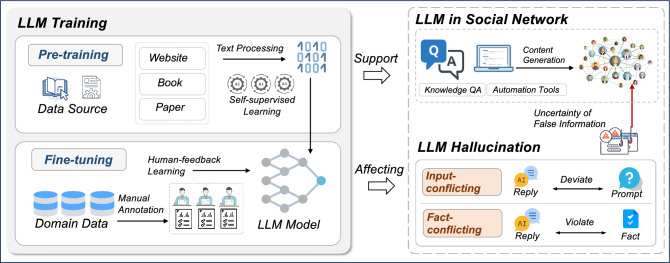
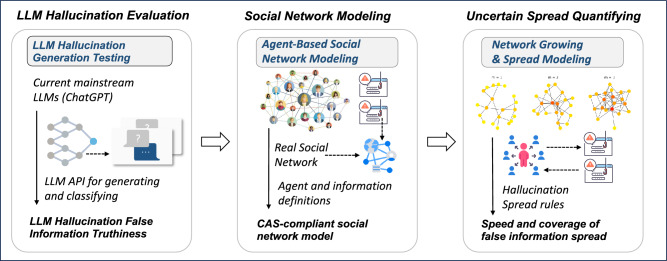
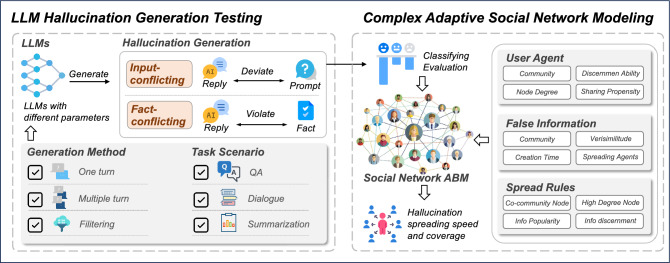
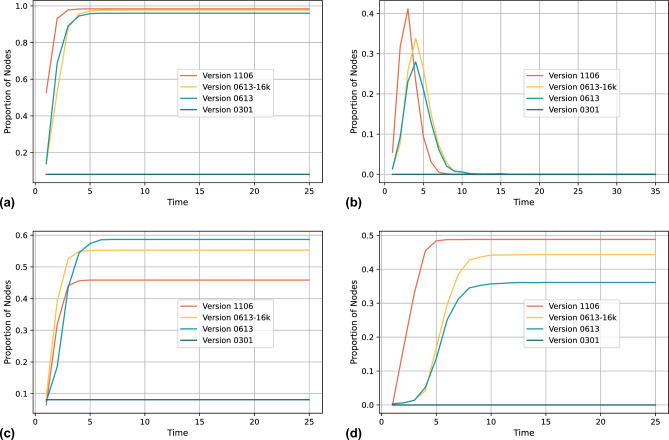
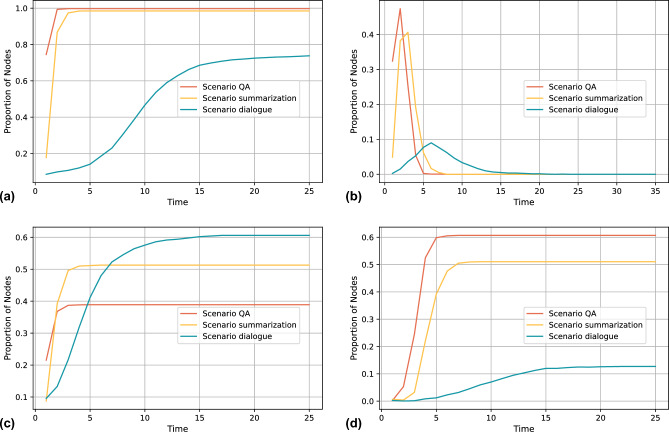
Large language models (LLMs) are becoming a significant source of content generation in social networks, which is a typical complex adaptive system (CAS). However, due to their hallucinatory nature, LLMs produce false information that can spread through social networks, which will impact the stability of the whole society. The uncertainty of LLMs false information spread within social networks is attributable to the diversity of individual behaviors, intricate interconnectivity, and dynamic network structures. Quantifying the uncertainty of false information spread by LLMs in social networks is beneficial for preemptively devising strategies to defend against threats. To address these challenges, we propose an LLMs hallucination-aware dynamic modeling method via agent-based probability distributions, spread popularity and community affiliation, to quantify the uncertain spreading of LLMs hallucination in social networks. We set up the node attributes and behaviors in the model based on real-world data. For evaluation, we consider the spreaders, informed people, discerning and unwilling non-spreaders as indicators, and quantified the spreading under different LLMs task situations, such as QA, dialogue, and summarization, as well as LLMs versions. Furthermore, we conduct experiments using real-world LLM hallucination data combined with social network features to ensure the validity of the proposed quantifying scheme.
Overview
The claims and statistics of this paper haven’t been checked yet.
Free: it reads the open-access text and checks the first 5 claims that cite a source we can check. Create a free account to check every claim.
Integrity signals
Registry
Cites
Statistics
Figures
Verification
Claims the paper makes
The claims and statistics of this paper haven’t been checked yet.
Free: it reads the open-access text and checks the first 5 claims that cite a source we can check. Create a free account to check every claim.
Claims other papers make about this one
Each is checked against this paper’s own text: does it say what the citing paper says it does?
The source backs part of the claim, not all of it — or backs it for a different population, condition or comparison.
In the citing paper
“Hao et al.20 cautioned about the spread of false outputs in social networks, posing risks for both experts and non-experts.”
From Multi-model assurance analysis showing large language models are highly vulnerable to adversarial hallucination attacks during clinical decision support (2025) · cites this paper as [20]
Experimental — accuracy not yet measured
Self-check
Percentages, sums and reported differences re-computed from the paper’s own numbers.
The self-check needs the paper’s full text.
Citations
Cites
LLaMA: Open and Efficient Foundation Language Models
Touvron, H., Lavril, T., Izacard, G., Martinet, X., Lachaux, M.-A., Lacroix, T., Rozière, B., Goyal, N., Hambro, E., Azhar, F., et al. (2023) · arXiv · doi:10.48550/arxiv.2302.13971 · Cited by 4,602
Training language models to follow instructions with human feedback
Ouyang, L., Wu, J., Jiang, X., Almeida, D., Wainwright, C. L., Mishkin, P., Zhang, C., Agarwal, S., Slama, K., Ray, A., et al. (2022) · arXiv · doi:10.48550/arxiv.2203.02155 · Cited by 4,208
Self-citationGet To The Point: Summarization with Pointer-Generator Networks
See, A., Liu, P. J., & Manning, C. D. (2017) · Proceedings of the 55th Annual Meeting of the Association for Computational Linguistics (Volume 1: Long Papers) · doi:10.18653/v1/p17-1099 · Cited by 3,775 · cited 1×
“The data for the summarization comes from the database CNN-Dailymail 26 .”
MethodHotpotQA: A Dataset for Diverse, Explainable Multi-hop Question Answering
Yang, Z., Qi, P., Zhang, S., Bengio, Y., Cohen, W., Salakhutdinov, R., & Manning, C. D. (2018) · Proceedings of the 2018 Conference on Empirical Methods in Natural Language Processing · doi:10.18653/v1/d18-1259 · Cited by 1,804 · cited 2×
“In task QA, LLM will give the user knowledge question answers based on the knowledge from HotpotQA, such as “It is a hygroscopic solid that is highly soluble in water and slightly soluble in alcohol.”
MethodEvaluating Large Language Models Trained on Code
Chen, M., Tworek, J., Jun, H., Yuan, Q., Pinto, H. P. D. O., Kaplan, J., Edwards, H., Burda, Y., Joseph, N., Brockman, G., et al. (2021) · arXiv · doi:10.48550/arxiv.2107.03374 · Cited by 1,436
A Comprehensive Overview of Large Language Models
Naveed, H., Khan, A. U., Qiu, S., Saqib, M., Anwar, S., Usman, M., Akhtar, N., Barnes, N., & Mian, A. (2023) · arXiv · doi:10.48550/arxiv.2307.06435 · Cited by 1,259
Clustering in weighted networks
Opsahl, T., & Panzarasa, P. (2009) · Social Networks · doi:10.1016/j.socnet.2009.02.002 · Cited by 1,037
Structural investigation of supply networks: A social network analysis approach
Kim, Y., Choi, T. Y., Yan, T., & Dooley, K. (2011) · Journal of Operations Management · doi:10.1016/j.jom.2010.11.001 · Cited by 771
Preiser, R., Biggs, R., De Vos, A., & Folke, C. (2018) · Ecology and Society · doi:10.5751/es-10558-230446 · Cited by 575
Siren's Song in the AI Ocean: A Survey on Hallucination in Large Language Models
Zhang, Y., Li, Y., Cui, L., Cai, D., Liu, L., Fu, T., Huang, X., Zhao, E., Zhang, Y., Xu, C., et al. (2023) · arXiv · doi:10.48550/arxiv.2309.01219 · Cited by 544
Cited by
Omar, M., Sorin, V., Collins, J. D., Reich, D., Freeman, R., Gavin, N., Charney, A., Stump, L., Bragazzi, N. L., Nadkarni, G. N., et al. (2025) · Communications Medicine · doi:10.1038/s43856-025-01021-3 · Cited by 204
“Hao et al. 20 cautioned about the spread of false outputs in social networks, posing risks for both experts and non-experts.”
MegaAgent: A Large-Scale Autonomous LLM-based Multi-Agent System Without Predefined SOPs
Wang, Q., Wang, T., Tang, Z., Li, Q., Chen, N., Liang, J., & He, B. (2025) · Findings of the Association for Computational Linguistics: ACL (Findings of ACL) · doi:10.18653/v1/2025.findings-acl.259 · Cited by 113
Challenges of Implementing LLMs in Clinical Practice: Perspectives
Artsi, Y., Sorin, V., Glicksberg, B. S., Korfiatis, P. D., Freeman, R., Nadkarni, G. N., & Klang, E. (2025) · Journal of Clinical Medicine · doi:10.3390/jcm14176169 · Cited by 68
An intelligent guided troubleshooting method for aircraft based on HybirdRAG
Xie, X., Tang, X., Gu, S., & Cui, L. (2025) · Scientific Reports · doi:10.1038/s41598-025-02643-2 · Cited by 26
DefAn: Definitive Answer Dataset for LLM Hallucination Evaluation
Rahman, A., Anwar, S., Usman, M., Ahmad, I., & Mian, A. S. (2025) · Information · doi:10.3390/info16110937 · Cited by 24
Characterizing an LLM-driven Social Network: The Case of Chirper.ai
Zhu, Y., He, Y., Haq, E.-U., Tyson, G., & Hui, P. (2026) · Proceedings of the ACM on Human-Computer Interaction · doi:10.1145/3816910 · Cited by 23
Wasilewski, A. (2025) · Computer Standards & Interfaces · doi:10.1016/j.csi.2025.104012 · Cited by 23
González‐Bustamante, B. (2024) · arXiv (Cornell University) · doi:10.48550/arxiv.2409.09741 · Cited by 17
NoisyEQA: Benchmarking Embodied Question Answering Against Noisy QueriesPreprint
Wu, T., Zhou, C., Wong, Y. H., Gu, L., & Yang, J. (2024) · arXiv (Cornell University) · doi:10.48550/arxiv.2412.10726 · Cited by 16
Hamed, A. A., Crimi, A., Misiak, M., & Lee, B. S. (2025) · iScience · doi:10.1016/j.isci.2025.112492 · Cited by 13
Wisdom is Knowing What not to Say: Hallucination-Free LLMs Unlearning via Attention Shifting
Tan, C., Qu, Y., Li, X., Zhang, H., Cui, S., Chen, C., & Gao, L. (2025) · neural information processing systems · doi:10.52202/085713-3311 · Cited by 13
Large language models show Dunning-Kruger-like effects in multilingual fact-checking
Qazi, I. A., Khan, Z., Ghani, A., Raza, A. A., Qazi, I. A., Sajjad, W., Ali, A., Javaid, A., Sohail, M. A., & Azeemi, A. H. (2026) · Scientific Reports · doi:10.1038/s41598-026-39046-w · Cited by 12
Large language models for spreading dynamics in complex systems
Jiang, S., Ren, H., Gao, Y., Zhang, Y., Li, Q., Xiao, D., Fan, J., Tang, R., & Wang, W. (2026) · Physics Reports · doi:10.1016/j.physrep.2026.01.006 · Cited by 11
Hallucinations in LLMs: Types, Causes, and Approaches for Enhanced ReliabilityPreprint
Cleti, M., & Jano, P. (2024) · OSF Preprints (OSF Preprints) · doi:10.31219/osf.io/tj93u · Cited by 11
Xu, X., & Wu, J. (2026) · IEEE Transactions on Neural Networks and Learning Systems · doi:10.1109/tnnls.2026.3655508 · Cited by 10
Self-citationLabadie, R., Slijepčević, D., Chen, X., Böck, A. J., Babic, A., Freimann, L., Atzmüller, C., & Zeppelzauer, M. (2025) · Information Processing & Management · doi:10.1016/j.ipm.2025.104309 · Cited by 10
Decision-Making Framework for Autonomous Vehicles in Complex Scenarios Using Large Language Models
Song, Z., Xu, N., & Ding, H. (2026) · Automotive Innovation · doi:10.1007/s42154-025-00408-1 · Cited by 10
LLMs prompted for graphs: hallucinations and generative capabilities
Richardeau, G., Chali, S., Merrer, E. L., Penzo, C., & Trédan, G. (2025) · Applied Network Science · doi:10.1007/s41109-025-00754-3 · Cited by 8
Towards Evaluting Fake Reasoning Bias in Language ModelsPreprint
Wang, Q., Tang, Z., Lou, Z., Chen, N., Wang, W., & He, B. (2025) · arXiv (Cornell University) · doi:10.48550/arxiv.2507.13758 · Cited by 8
CommCP: Efficient Multi-Agent Coordination via LLM-Based Communication with Conformal Prediction
Zhang, X., Wang, Z., Li, Z., Yao, J., & Li, J. (2026) · Proceedings - IEEE International Conference on Robotics and Automation/Proceedings · doi:10.1109/icra57385.2026.11696967 · Cited by 8
Li, X., Li, G., Zhao, Y., Liang, Y., Dong, Y., & Zhang, J. (2025) · Clinical Interventions in Aging · doi:10.2147/cia.s551572 · Cited by 6
Hallucination Detection: A Probabilistic Framework Using Embeddings Distance AnalysisPreprint
Ricco, E., Cima, L., & Pietro, R. D. (2025) · King Abdullah University of Science and Technology Repository (King Abdullah University of Science and Technology) · doi:10.48550/arxiv.2502.08663 · Cited by 6
TextClass Benchmark: A Continuous Elo Rating of LLMs in Social SciencesPreprint
González‐Bustamante, B. (2024) · arXiv (Cornell University) · doi:10.48550/arxiv.2412.00539 · Cited by 6
Generative AI in Virtual Reality Communities: A Preliminary Analysis of the VRChat Discord Community
Zhang, H., Zha, S., Cai, J., Wohn, D. Y., & Carroll, J. M. (2025) · CHI Conference Extended Abstracts on Human Factors in Computing Systems (CHI EA) · doi:10.1145/3706599.3720120 · Cited by 5
Flanagan, C. P., Gerstley, L. D., Okuhn, S. P., McLenon, M., Lancaster, E. M., Hull, M. M., Bulbule, M. S., Sivamurthy, N., & Chang, R. W. (2025) · Journal of Vascular Surgery · doi:10.1016/j.jvs.2025.10.044 · Cited by 5
LLMs Hallucinate Graphs Too: A Structural Perspective
Merrer, E. L., & Trédan, G. (2025) · Studies in computational intelligence · doi:10.1007/978-3-031-82427-2_20 · Cited by 5
KORAL: Knowledge Graph Guided LLM Reasoning for SSD Operational Analysis
Akewar, M., Madireddy, S., Luo, D., & Bhimani, J. (2026) · IEEE International Parallel and Distributed Processing Symposium (IPDPS) · doi:10.1109/ipdps65963.2026.00085 · Cited by 4
Shao, M., & Zhang, H. (2025) · npj Digital Medicine · doi:10.1038/s41746-025-02146-4 · Cited by 4
Kim, S. H., Shin, J.-S., Lee, H., Shin, S. Y., Kang, K. M., & Song, S. Y. (2025) · Orthopaedic Journal of Sports Medicine · doi:10.1177/23259671251385127 · Cited by 4
Where Confabulation Lives: Latent Feature Discovery in LLMs
Ardoin, T., Cai, Y., & Wunder, G. (2025) · Conference on Empirical Methods in Natural Language Processing (EMNLP) · doi:10.18653/v1/2025.emnlp-main.1515 · Cited by 4
Large Language Model Reasoning Failures
Song, P., Han, P., & Goodman, N. (2026) · arXiv · doi:10.48550/arxiv.2602.06176 · Cited by 3
Evaluating Psychological Competency via Chinese Q&A in Large Language Models
Gao, F., He, Y., Chen, Q., & Liu, F. (2025) · Applied Sciences · doi:10.3390/app15169089 · Cited by 3
In Good Faith: Generative AI’s Plausible Falsehoods and Their Implications for Trust
Kodish, S. (2025) · Atlantic Journal of Communication · doi:10.1080/15456870.2025.2533224 · Cited by 3
Thamrin, S. A., & Chen, A. L. P. (2026) · Health Information Science and Systems · doi:10.1007/s13755-026-00446-x · Cited by 3
LLM and Knowledge Graph-Based Intelligent Control Framework for Smart Manufacturing
Yang, M., Yang, X., Dai, Z., Pan, T., & Morkos, B. W. (2025) · Journal of Computing and Information Science in Engineering · doi:10.1115/1.4071921 · Cited by 3
iS2C2: a cointelligent platform for mechanistic discovery of disease cellular crosstalk
Sheng, J., Ahn, J. Y., Yang, L., Wan, Z., Qi, S., Yu, X., Xu, Z., Cao, Y., Vasquez, M., Irfan, A., et al. (2026) · Signal Transduction and Targeted Therapy · doi:10.1038/s41392-026-02691-8 · Cited by 2
Gabriel, A., Antonoglou, G., Langley, S. E. M., & Gabriel, J. (2026) · Cureus · doi:10.7759/cureus.103457 · Cited by 2
A Geometric Analysis of Small-sized Language Model HallucinationsPreprint
Ricco, E., Onofri, E., Cima, L., Cresci, S., & Pietro, R. D. (2026) · arXiv (Cornell University) · doi:10.48550/arxiv.2602.14778 · Cited by 2
Neves, J. S., Pereira, M. C., & Bacalhau, L. M. (2026) · Studies in systems, decision and control · doi:10.1007/978-3-031-85398-2_44 · Cited by 1
Khan, M. S., Chen, H., & Ma, X. (2026) · Cluster Computing · doi:10.1007/s10586-026-06098-6 · Cited by 1
AI for ESG Governance in South Africa: A Systematic Review of Financial Intelligence ApproachesPreprint
Mathebula, M., Modupe, A., Marivate, V. N., & du Toit, E. (2025) · SSRN Electronic Journal · doi:10.2139/ssrn.5443142 · Cited by 1
A Systematic Survey on Generative Models for Graph GenerationPreprint
Ji, J., Wang, W., Lei, R., Bi, J., Wang, L., Wang, R., Wang, Q., Tong, B., Chen, X., & Wei, Z. (2025) · Preprints.org · doi:10.20944/preprints202512.0114.v1 · Cited by 1
VerifierBench: Trace-evidence Verification of Tool-use Claim Faithfulness in Agentic Workflows
Alniemi, O., Saadoon, A., Alhusseny, S., & Mahmood, H. (2026) · International journal of intelligent engineering and systems · doi:10.22266/ijies2026.0831.73 · Cited by 1
Investigating Security Implications of Automatically Generated Code on the Software Supply ChainPreprint
Li, X., & Gao, X. H. (2025) · arXiv (Cornell University) · doi:10.48550/arxiv.2509.20277 · Cited by 1
Transformative Play for Building Resilience to Misinformation
Konzack, L., & Coward, C. (2026) · International Journal of Role-Playing · doi:10.33063/ijrp.vi19.1249 · Cited by 1
Shen, S., Wang, S., Gao, M., Yang, Y., Wu, X., Wu, J., Zhou, D., & Wang, N. (2026) · Scientific Reports · doi:10.1038/s41598-026-36322-7
Self-citationYou, X., Yu, Z., Wu, D., Shi, L., Wang, G., Cao, Z., Jiang, Q., Yan, X., Zhong, W., & Huang, B. (2026) · Digital Chemical Engineering · doi:10.1016/j.dche.2026.100318
Choudhary, Y., & Sharaff, A. (2026) · Lecture notes in networks and systems · doi:10.1007/978-3-032-22289-3_4
Unsupervised Hallucination Detection via Generalized Semantic Entropy
Yang, J., Chen, X. M., & Dai, G. (2026) · Lecture notes in computer science · doi:10.1007/978-981-92-3417-2_50
Advanced Methodologies and Technologies for Innovative Information Systems
Cecil, R. R., de Miranda, J. L., Nagy, M., Silveira, M. D., & Zanin, M. (2024) · IEEE International Conference on Bioinformatics and Biomedicine (BIBM) · doi:10.1109/bibm62325.2024.10822796
JIANG, X., Zhang, Z., & Wu, J. (2026) · IEEE Transactions on Consumer Electronics · doi:10.1109/tce.2026.3683776
Self-citationWang, C.-C., Liu, F.-C., Xie, J., Lai, C.-M., & Lin, C.-S. (2026) · Education and Information Technologies · doi:10.1007/s10639-026-14086-x
Sun, M., Chen, Y., & Bai, J. F. (2026) · Fire Technology · doi:10.1007/s10694-025-01837-4
When Should a Human Take Back Control? Optimal Delegation under Turbulent AI RiskPreprint
Haoze, Y., Rozé, J., Upadhyay, V., Tatar, U., & Mastrolia, T. (2026) · arXiv (Cornell University) · doi:10.48550/arxiv.2609.32083
Hean, A. C., & Chang, Y. (2026) · Pharmacotherapy The Journal of Human Pharmacology and Drug Therapy · doi:10.1002/phar.70100
Enhancing the Quality of English–Indonesian Subtitle Translation Using Prompt Engineering in ChatGPT
Wicaksono, G. B., Yulianto, W. E., & Junining, E. (2026) · Jurnal Bahasa Inggris Terapan · doi:10.35313/jbit.v12i1.6823
Simulating Spectroscopy Measuring Processes and Results Using Large Language Models
Ren, G. (2025) · International Conference on Artificial Intelligence, Human-Computer Interaction and Robotics (AIHCIR) · doi:10.1109/aihcir67580.2025.11405289
吉川, 和., Yoshikawa, H., 岡崎, 直., & Okazaki, N. (2022) · Institutional Repositories DataBase (IRDB)
Discussion on the Sensitivity of Input to Large Language Models
Yuan, B. (2026) · Academic Journal of Science and Technology · doi:10.54097/h3b84g79
Darra, T., & Wu, M. (2025) · KTH Publication Database DiVA (KTH Royal Institute of Technology)
PerHalluEval: Persian Hallucination Evaluation Benchmark for Large Language Models
Hosseini, M., Hosseini, K., Bali, S., Zanjani, Z., & Momtazi, S. (2026) · Language Resources and Evaluation Conference (LREC) · doi:10.63317/3xhrjewfcyrm
Hasan, M. M., Chowdhury, I. K., Akondo, M. E., Ahammad, T., & Uddin, K. M. M. (2026) · Research Square · doi:10.21203/rs.3.rs-9986071/v1
Hong, Y., & Wang, W. (2026) · Academic Journal of Science and Technology · doi:10.54097/qzn9b238
MotionPhysics: Learnable Motion Distillation for Text-Guided SimulationPreprint
Wang, M., Zadrożny, J., Aodha, O. M., & Vaxman, A. (2026) · arXiv (Cornell University) · doi:10.48550/arxiv.2601.00504
Shi, X. (2026) · Academic Journal of Science and Technology · doi:10.54097/hw85q020
Metadata
- Authors
- Hao, G., Wu, J., Pan, Q., & Morello, R.
- Affiliations
- Waseda University (JP)
- University of Reggio Calabria (IT)
- Corresponding author
- Wu, Jun
- Venue
- Scientific Reports
- Published
- 2024-07-16
- Volume
- 14
- Issue
- 1
- Pages
- 16375-16375
- ISSN
- 2045-2322 (ISSN-L)
- PMC
- PMC11252443
- OpenAlex
- W4400688542
- Cited by
- 36
- References
- 20
- Citations by year
- 2026: 19 · 2025: 16 · 2024: 1
- FWCI
- 25.74
- Type
- journal article
- Language
- en
- Open access
- gold
- doi.org
- Licence
- cc-by
- creativecommons.org/licenses/by/4.0 (tdm)
- creativecommons.org/licenses/by/4.0 (vor)
- Locations
- Scientific Reports (publishedVersion, cc-by)
- PubMed Central (publishedVersion, cc-by)
- PubMed (publishedVersion)
- DOAJ (DOAJ: Directory of Open Access Journals) (submittedVersion)
- Funders
- National Natural Science Foundation of China (61972255, U21B2019)
- China Scholarship Council (202308050021)
- Topics
- Social Sciences › Sociology and Political Science › Misinformation and Its Impacts
- Physical Sciences › Physics and Astronomy › Statistical and Nonlinear Physics › Complex Network Analysis Techniques
- Physical Sciences › Computer Science › Information Systems › Spam and Phishing Detection
- Keywords
- LLM hallucination, social networks, complex adaptive systems, uncertainty quantification, agent-based modeling, dynamic network modeling, community affiliation, misinformation
About these checks
Registry, retraction, Cites and statistics results are computed, not judged, with one exception: a printed reference that no index lists is read once by a model before it counts as a citation error. Claims are extracted by a model and kept only when their quote appears verbatim in the text; each cited source is then checked, with a model’s help, for whether it says what the claim relies on. Those verdicts can be wrong — read the claim’s quote and the cited source before relying on one.
Statistics and arithmetic are recomputed, not judged.
Confidence bands are shown only for fields calibrated on our annotated test set. None is calibrated yet, so no band is shown.
What counts as a claim ›How we measure confidence ›How we check this ›
Are you an author, or do you see a problem with this page? Request a review
Data sources
Bibliographic data: Semantic Scholar, OpenAlex, Crossref.
Contains information from the Semantic Scholar Academic Graph Datasets, made available under the ODC Attribution License (ODC-BY 1.0).
Semantic Scholar’s data is described in: Kinney, R., et al. (2023). The Semantic Scholar Open Data Platform. arXiv:2301.10140.
