

Optimizing compressive strength prediction using adversarial learning and hybrid regularization
Open accessThe DOI matches its Crossref record; 33 of the 33 references it cites were found in a registry or an index; none of the 24 sources its claims cite is checked for support yet.
Abstract
The infrastructure industry consumes natural resources and produces construction waste, which has a detrimental impact on the environment. To mitigate these adverse effects and reduce raw material consumption, waste materials can be repurposed to achieve sustainability. However, recycled materials deteriorate the intrinsic properties of concrete. A suitable ratio of natural resources and recycled aggregates can produce the desired compressive strength. Compiling sufficient data in civil engineering laboratories to make reliable conclusions is time-consuming and costly. Therefore, this research proposes a novel approach for predicting compressive strengths using limited data. The generative adversarial network was employed to generate synthetic data. Hybrid training, utilizing either conventional loss or heuristic loss, prevents the model from overfitting by adaptively adjusting the regularization term. Random noise from a multivariate normal distribution is embedded heuristically into the training samples to capture intricate data variations. Sensitivity analysis indicated that the size of recycled coarse aggregate and water are the most significant features, aligning with their correlations. Interestingly, superplasticizer, density of recycled coarse aggregate, and water absorption ratio of recycled coarse aggregate contributed significantly to predictions despite their low correlations. The propounded method outperforms random forest, support vector regression, artificial neural network, and adaptive boosting by scoring a mean squared error of 7.97, a root mean squared error of 2.82, a mean absolute error of 2.13, and a coefficient of determination of 0.96. These results suggest that the proposed technique can effectively contribute to sustainable construction practices by accurately predicting compressive strengths.
Overview
CoChat Summary
TL;DR
The paper proposes a GAN-based data augmentation and hybrid regularization approach to predict concrete compressive strength from 344 samples with nine input parameters. It reports lower error and higher R² than RF, SVR, ANN, and AdaBoost, with MSE 7.97, RMSE 2.82, MAE 2.13, and R² 0.964.
Key findings
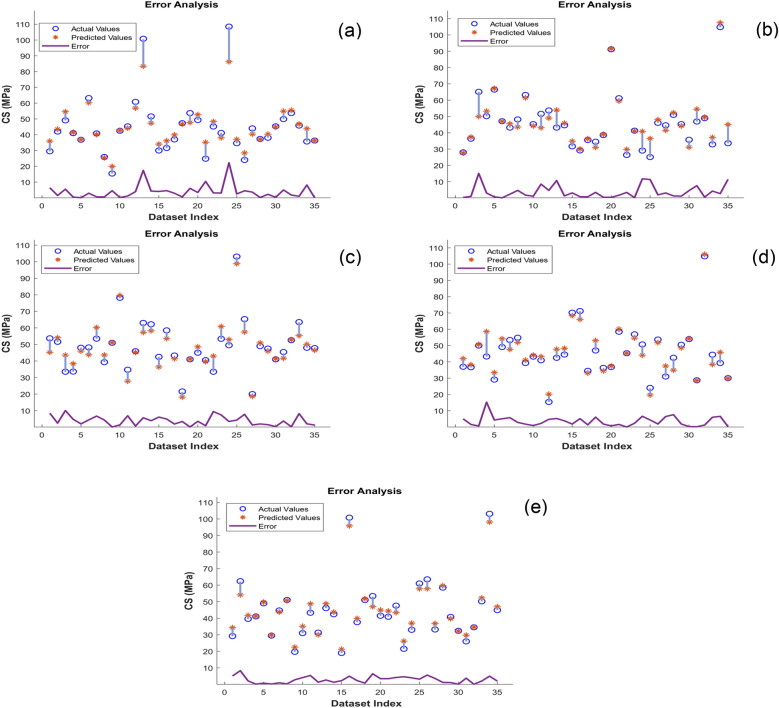
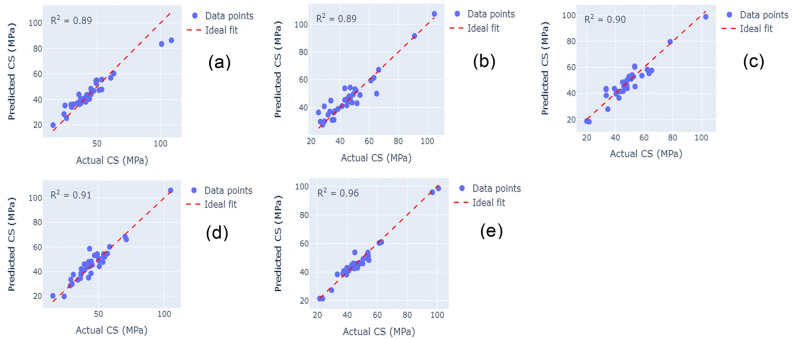
- The proposed method achieved MSE 7.97, RMSE 2.82, MAE 2.13, and R² 0.964, outperforming RF (MSE 36.96, RMSE 6.08, MAE 3.97, R² 0.885), SVR (29.59, 5.44, 3.75, 0.894), NN (23.00, 4.80, 3.88, 0.901), and AdaBoost (21.34, 4.62, 3.51, 0.911).
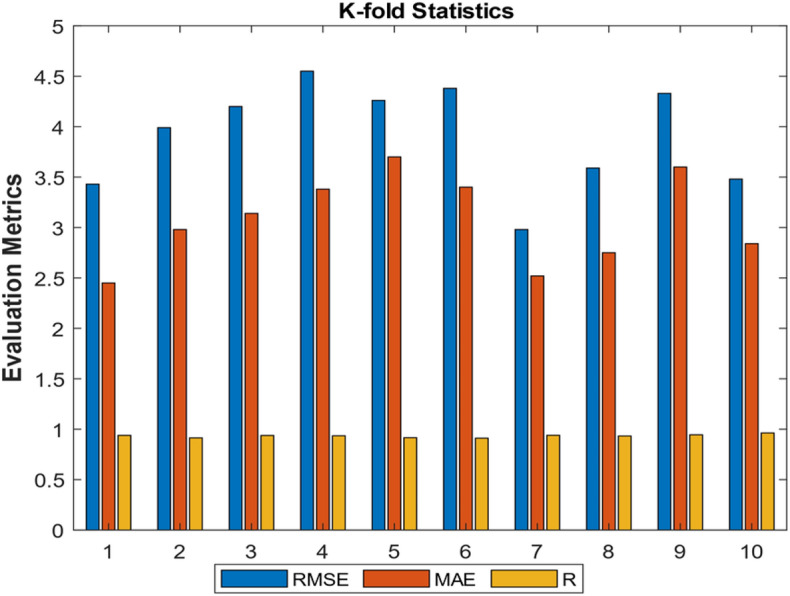
- In 10-fold cross-validation, R² maximum, minimum, and average were 0.963, 0.911, and 0.933; MSE maximum, minimum, and average were 20.73, 8.88, and 15.61.
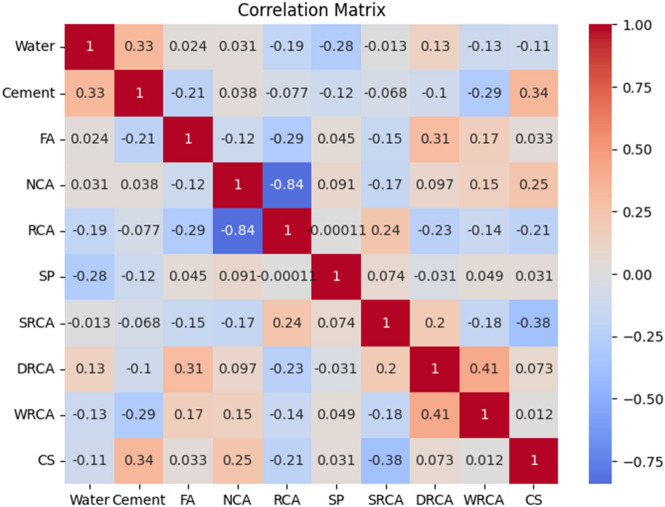
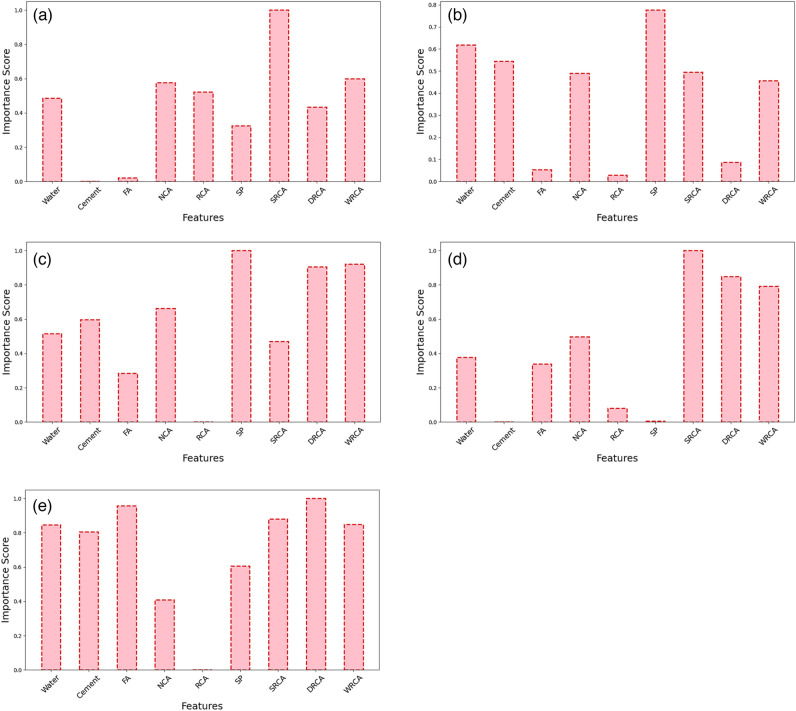
- Sensitivity analysis identified water, cement, superplasticizer, size of recycled coarse aggregate, density of recycled coarse aggregate, and water absorption ratio of recycled coarse aggregate as critical features; SRCA had a negative correlation of −0.38 with CS, water −0.11, and cement +0.34, while SP, DRCA, and WRCA had weak correlations of 0.03, 0.07, and 0.012 but were still deemed important.
- None of the compared models identified natural coarse aggregate as an essential feature.
Methods
- Dataset: 344 samples with nine input parameters—recycled coarse aggregate, natural coarse aggregate, water, cement, fine aggregate, size of RCA, superplasticizer, water absorption ratio of RCA, and density of RCA—used to predict compressive strength; inputs were min-max normalized.
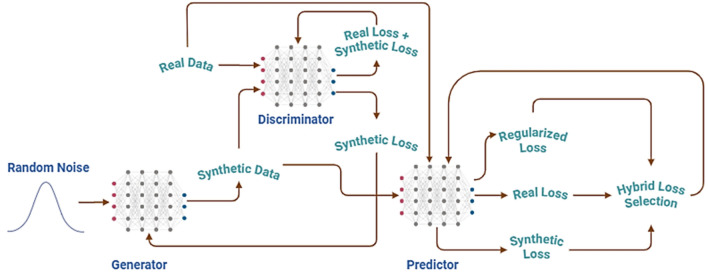
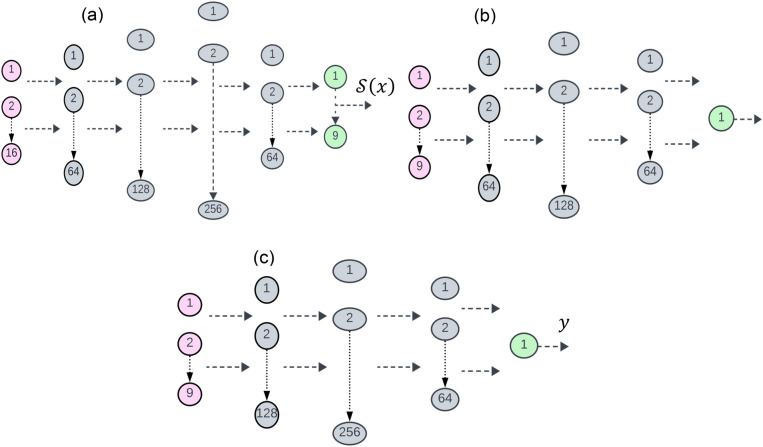
- Proposed model: a GAN generator and discriminator plus a predictor trained sequentially; hybrid training alternates conventional loss (real and synthetic) with a regularized loss combining real, synthetic, and heuristic loss, using adaptive regularization and random noise from a multivariate normal distribution embedded heuristically based on normalized error; ADAM optimization was used.
- Comparison: random forest, support vector regression, artificial neural network, and AdaBoost were tuned by grid search and evaluated with MSE, RMSE, MAE, and R²; 10-fold cross-validation assessed robustness.
Limitations
- The paper states that physical validation of superplasticizer, density of recycled coarse aggregate, and water absorption ratio of recycled coarse aggregate in real-world applications remains limited, requiring empirical studies with civil engineers; it also states that more sophisticated methods for embedding random noise should be considered.
- The paper notes that the generated random distribution R(x) is not statistically identical to the real data distribution Rd(x) but only somewhat related to it, because obtaining enough samples for convergence is impractical.
- Evident from the text: the study relies on a limited dataset of 344 samples and reports no physical laboratory validation; the sensitivity analysis finds weak-correlation features important, which the paper itself says warrants further physical experiments.
Model-written summary. Check it against the paper before relying on it.
Integrity signals
Registry
Cites
Statistics
Figures
Verification
Claims the paper makes
0 Valid · 4 Not valid · 22 Not checked · 61 Own results and interpretations
A result the paper states — it cites no source for it, so there is none to check. The quote shows it is in the paper.
In the paper
“Interestingly, superplasticizer, density of recycled coarse aggregate, and water absorption ratio of recycled coarse aggregate contributed significantly to predictions despite their low correlations.”
§ Optimizing compressive strength prediction using adversarial learning and hybrid regularization > Abstract
plainstates an association- Asserted: passes — The authors put it forward as true.
- Checkable: passes — It can be checked against evidence.
- Load-bearing: passes — The paper’s conclusions depend on it.
- Based: passes — The paper gives a reason why it holds.
A result the paper reports from its own data — it cites no other source for it, so there is none to check. The quote shows it is in the paper.
In the paper
“Sensitivity analysis indicated that the size of recycled coarse aggregate and water are the most significant features, aligning with their correlations.”
§ Optimizing compressive strength prediction using adversarial learning and hybrid regularization > Abstract
hedgedstates an association- Asserted: passes — The authors put it forward as true.
- Checkable: passes — It can be checked against evidence.
- Load-bearing: unclear — It is unclear whether the paper’s conclusions depend on it.
- Based: passes — The paper gives a reason why it holds.
A result the paper reports from its own data — it cites no other source for it, so there is none to check. The quote shows it is in the paper.
In the paper
“A notable finding is the strong positive correlation between cement and CS, with a correlation coefficient of 0.34.”
§ Optimizing compressive strength prediction using adversarial learning and hybrid regularization > Dataset description
boostedstates an association- Asserted: passes — The authors put it forward as true.
- Checkable: passes — It can be checked against evidence.
- Load-bearing: unclear — It is unclear whether the paper’s conclusions depend on it.
- Based: passes — The paper gives a reason why it holds.
In the paper
“AdaBoost performs well by scoring an MSE of 21.34, RMSE of 4.62, MAE of 3.51, and R2 of 0.911”
- Also stated in: § Discussion · plain
“AdaBoost is a powerful ensemble learning algorithm that shows promising results in CS prediction with an MSE of 21.34, RMSE of 4.62, MAE of 3.51, and R2 of 0.911”
§ Optimizing compressive strength prediction using adversarial learning and hybrid regularization > Evaluation and results > Results and comparison
What the sources say
- Not checked yetcites [32] Pakzad, S. S., Roshan, N. & Ghalehnovi, M. Comparison of various machine learning algorithms used for compressive strength prediction of steel fiber-reinforced concrete. Sci. Rep. 13 (1), 3646 (2023). 36871074 10.1038/s41598-023-30606-y PMC9985652 source
plain- Asserted: passes — The authors put it forward as true.
- Checkable: passes — It can be checked against evidence.
- Load-bearing: passes — The paper’s conclusions depend on it.
- Based: passes — The paper gives a reason why it holds.
- Also stated in: § Discussion · plain
A result the paper reports from its own data — it cites no other source for it, so there is none to check. The quote shows it is in the paper.
In the paper
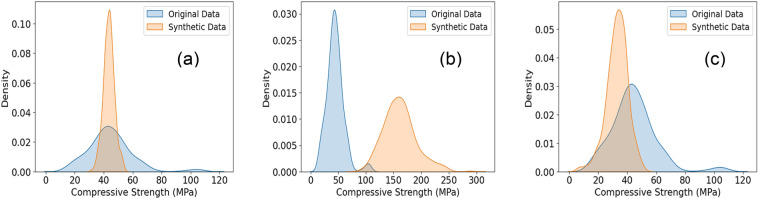
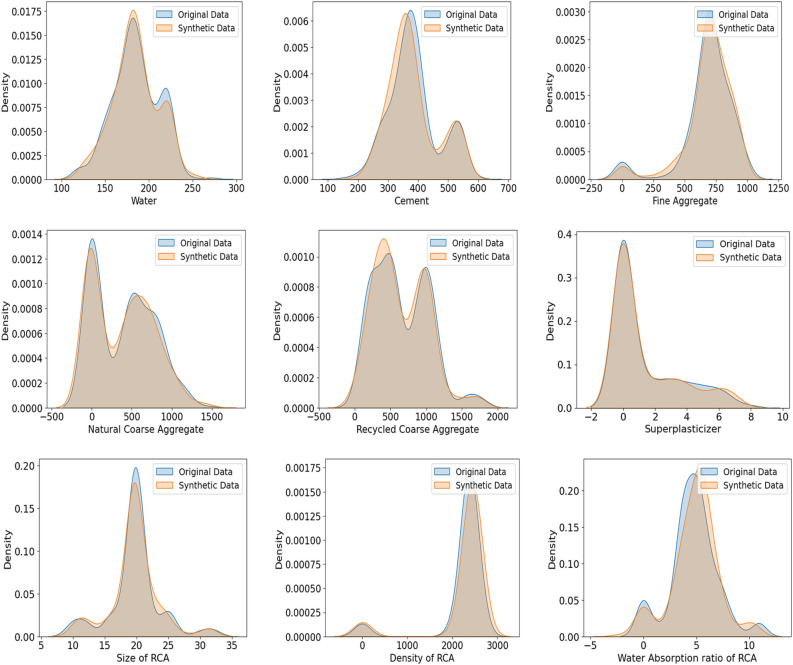
“The generator effectively imitates the real input parameters, as seen in similar distributions of real and synthetic data.”
§ Optimizing compressive strength prediction using adversarial learning and hybrid regularization > Discussion
plainstates an association- Asserted: passes — The authors put it forward as true.
- Checkable: passes — It can be checked against evidence.
- Load-bearing: unclear — It is unclear whether the paper’s conclusions depend on it.
- Based: passes — The paper gives a reason why it holds.
25 more claims
Create a free account to see all 87 claims and to verify the 23 references still open.
- It may state two separate claims as one. 34
- Probably not a substantial claim. 30
- The quote only partly states this claim. 1
Self-check
Percentages, sums and reported differences re-computed from the paper’s own numbers.
Each contradiction between two passages listed here was confirmed by an independent check.
Rated minor: it would not touch a result — a value no result rests on, a p-value that stays on the same side of the significance level, or a conflict that is clerical, resolved elsewhere in the paper, or outside its own findings.
In the paper
§ Optimizing compressive strength prediction using adversarial learning and hybrid regularization > Methodology > Hybrid training
“ℓs is calculated on synthetic data S(x) generated by the discriminator D.”
§ Optimizing compressive strength prediction using adversarial learning and hybrid regularization > Methodology > Sequential training
“the synthetic loss ℓs for synthetic data S(x) generated by the generator.”
Rated minor: it would not touch a result — a value no result rests on, a p-value that stays on the same side of the significance level, or a conflict that is clerical, resolved elsewhere in the paper, or outside its own findings.
In the paper
§ Optimizing compressive strength prediction using adversarial learning and hybrid regularization > Methodology > Multivariate normal distribution
“μ≈N(μ,Σ/n) as d→∞, where n is the number of samples28.”
§ Optimizing compressive strength prediction using adversarial learning and hybrid regularization > Methodology > Multivariate normal distribution
“As n increases, the distribution of μ converges to f(X;μ,Σ).”
Citations
Cites
Akhtar, A., & Sarmah, A. K. (2018) · Journal of Cleaner Production · doi:10.1016/j.jclepro.2018.03.085 · Cited by 1,250 · cited 1×
“Studies have demonstrated that replacing up to 80% of NA with RCA can achieve the desired CS 7 .”
BackgroundGenerative Adversarial Networks (GANs): Challenges, Solutions, and Future Directions
Saxena, D., & Cao, J. (2022) · ACM Computing Surveys · doi:10.1145/3446374 · Cited by 689
A systematic review on overfitting control in shallow and deep neural networks
Bejani, M. M., & Ghatee, M. (2021) · Artificial Intelligence Review · doi:10.1007/s10462-021-09975-1 · Cited by 573
The Multivariate Normal Distribution
Tong, Y. L. (1990) · Springer Series in Statistics · doi:10.1007/978-1-4613-9655-0 · Cited by 431
de Andrade Salgado, F., & de Andrade Silva, F. (2022) · Journal of Building Engineering · doi:10.1016/j.jobe.2022.104452 · Cited by 390
Global Economic Prospects, June 2020
Bank, W. (2020) · doi:10.1596/978-1-4648-1553-9 · Cited by 297
A survey on generative adversarial networks for imbalance problems in computer vision tasks
Sampath, V., Maurtua, I., Aguilar Martín, J. J., & Gutierrez, A. (2021) · Journal of Big Data · doi:10.1186/s40537-021-00414-0 · Cited by 259
Ahmad, A., Chaiyasarn, K., Farooq, F., Ahmad, W., Suparp, S., & Aslam, F. (2021) · Buildings · doi:10.3390/buildings11080324 · Cited by 211
Karim, R., Islam, M. H., Datta, S. D., & Kashem, A. M. (2023) · Case Studies in Construction Materials · doi:10.1016/j.cscm.2023.e02828 · Cited by 171
Methods to improve microstructural properties of recycled concrete aggregate: A critical review
Tam, V. W. Y., Wattage, H., Le, K. N., Buteraa, A., & Soomro, M. (2021) · Construction and Building Materials · doi:10.1016/j.conbuildmat.2020.121490 · Cited by 160
Das, P., & Kashem, A. M. (2023) · Case Studies in Construction Materials · doi:10.1016/j.cscm.2023.e02723 · Cited by 114
Tam, V. W. Y., Butera, A., Le, K. N., Silva, L. C. F. D., & Evangelista, A. C. J. (2022) · Construction and Building Materials · doi:10.1016/j.conbuildmat.2022.126689 · Cited by 114
Pakzad, S. S., Roshan, N., & Ghalehnovi, M. (2023) · Scientific Reports · doi:10.1038/s41598-023-30606-y · Cited by 92
Wu, J., Zhang, Y., Zhu, P., Feng, J., & Hu, K. (2018) · Journal of Wuhan University of Technology-Mater. Sci. Ed. · doi:10.1007/s11595-018-1873-1 · Cited by 79
Arshad, S., Sharif, M. B., Irfan-ul-Hassan, M., Khan, M., & Zhang, J.-L. (2020) · Arabian Journal for Science and Engineering · doi:10.1007/s13369-020-04769-z · Cited by 78
Pan, C., Poddar, A., Mukherjee, R., & Ray, A. K. (2022) · Biomedical Signal Processing and Control · doi:10.1016/j.bspc.2022.103666 · Cited by 70
Kashem, A. M., & Das, P. (2023) · Asian Journal of Civil Engineering · doi:10.1007/s42107-023-00707-0 · Cited by 66
Statistical modeling methods: challenges and strategies
Henley, S. S., Golden, R. M., & Kashner, T. M. (2020) · Biostatistics & Epidemiology · doi:10.1080/24709360.2019.1618653 · Cited by 65
Sanjeev, J., & Sai Nitesh, K. J. N. (2020) · Materials Today: Proceedings · doi:10.1016/j.matpr.2020.03.208 · Cited by 54
Bu, L., Du, G., & Hou, Q. (2021) · Materials · doi:10.3390/ma14143921 · Cited by 54
Joshi, D. A., Menon, R., Jain, R. K., & Kulkarni, A. V. (2023) · Expert Systems with Applications · doi:10.1016/j.eswa.2023.120925 · Cited by 51
A dynamic multi-objective optimization evolutionary algorithm with adaptive boosting
Peng, H., Xiong, J., Pi, C., Zhou, X., & Wu, Z. (2024) · Swarm and Evolutionary Computation · doi:10.1016/j.swevo.2024.101621 · Cited by 45
Artificial neural network based prediction of postthrombolysis intracerebral hemorrhage and death
Chung, C.-C., Chan, L., Bamodu, O. A., Hong, C.-T., & Chiu, H.-W. (2020) · Scientific Reports · doi:10.1038/s41598-020-77546-5 · Cited by 43
Data driven models for compressive strength prediction of concrete at high temperatures
Akbari, M., & Deligani, V. J. (2020) · Frontiers of Structural and Civil Engineering · doi:10.1007/s11709-019-0593-8 · Cited by 37
Convolutional Neural Networks With Dynamic Regularization
Wang, Y., Bian, Z.-P., Hou, J., & Chau, L.-P. (2021) · IEEE Transactions on Neural Networks and Learning Systems · doi:10.1109/tnnls.2020.2997044 · Cited by 36
Paul, S., Das, P., Kashem, A. M., & Islam, N. (2023) · Asian Journal of Civil Engineering · doi:10.1007/s42107-023-00847-3 · Cited by 36
El Khattabi, M.-Z., El Jai, M., Lahmadi, Y., Oughdir, L., & Rahhali, M. (2024) · Arabian Journal for Science and Engineering · doi:10.1007/s13369-023-07741-9 · Cited by 31
Chen, M., Zhou, K., & Liu, D. (2024) · Energy · doi:10.1016/j.energy.2023.130218 · Cited by 20
Chula model for sustainable municipal solid waste management in university canteens
Sukma, P., Srinok, K., Papong, S., & Supakata, N. (2022) · Heliyon · doi:10.1016/j.heliyon.2022.e10975 · Cited by 20
Murari, A., Rossi, R., Spolladore, L., Lungaroni, M., Gaudio, P., & Gelfusa, M. (2023) · Artificial Intelligence Review · doi:10.1007/s10462-023-10591-4 · Cited by 15
A multivariate modified skew-normal distribution
Mondal, S., Arellano-Valle, R. B., & Genton, M. G. (2023) · Statistical Papers · doi:10.1007/s00362-023-01397-1 · Cited by 14
Wang, J., Zhang, R., Wang, C., Chen, H., Xu, S., Li, Y., Yang, Y., & Ling, M. T. (2024) · Journal of Materials Engineering and Performance · doi:10.1007/s11665-024-09172-5 · Cited by 5
Comparing Conventional and Deep Feature Models for Classifying Fundus Photography of Hemorrhages
Aziz, T., Charoenlarpnopparut, C., & Mahapakulchai, S. (2022) · Journal of Healthcare Engineering · doi:10.1155/2022/7387174 · Cited by 4
Self-citation
Cited by
Yildizel, S. A., Karalar, M., Aksoylu, C., Althaqafi, E., Beskopylny, A. N., Stel’makh, S. A., Shcherban’, E. M., Umiye, O. A., & Özkılıç, Y. O. (2025) · Scientific Reports · doi:10.1038/s41598-025-12782-1 · Cited by 5
A Comprehensive Study on Concrete Produced with Recycled Concrete Aggregate (RCA)
ALTUNCI, Y. T. (2026) · Buildings · doi:10.3390/buildings16091776 · Cited by 2
Kumar, P. P., Krishna, T. J., Murali, K., Shivani, C., & Rao, N. K. (2026) · Discover Concrete and Cement · doi:10.1007/s44416-026-00105-0 · Cited by 1
Farouk, A. I. B., Abdulrahman, S., Al-Osta, M. A., Al-Dulaijan, S. U., Mohaisen, K. O., Haruna, S. I., Ibrahim, Y. E., & Abba, S. I. (2026) · Discover Concrete and Cement · doi:10.1007/s44416-026-00117-w
“On the tabular side, GAN-based augmentation has improved compressive-strength prediction under limited data, including UHPC and FRP-confined concrete strength, with adversarial learning strategies that reduce overfitting and enhance generalization [24, 25].”
Li, Y., Song, J.-F., Fang, B., Wang, T., Shen, T., & Wang, Z. (2026) · AI in Civil Engineering · doi:10.1007/s43503-026-00098-6
Metadata
- Authors
- Aziz, T., Aziz, H., Mahapakulchai, S., & Charoenlarpnopparut, C.
- Affiliations
- Thammasat University (TH)
- Kasetsart University (TH)
- Corresponding author
- Aziz, Tamoor
- Charoenlarpnopparut, Chalie
- Venue
- Scientific Reports
- Published
- 2024-08-07
- Volume
- 14
- Issue
- 1
- Pages
- 18338-18338
- ISSN
- 2045-2322 (ISSN-L)
- PMC
- PMC11306558
- OpenAlex
- W4401393196
- Cited by
- 10
- References
- 33
- Citations by year
- 2026: 9 · 2025: 1
- FWCI
- 1.35
- Type
- journal article
- Language
- en
- Open access
- gold
- doi.org
- Licence
- cc-by-nc-nd
- creativecommons.org/licenses/by-nc-nd/4.0 (tdm)
- creativecommons.org/licenses/by-nc-nd/4.0 (vor)
- Locations
- Scientific Reports (publishedVersion, cc-by-nc-nd)
- PubMed Central (publishedVersion, cc-by-nc-nd)
- PubMed (publishedVersion)
- DOAJ (DOAJ: Directory of Open Access Journals) (submittedVersion)
- Funders
- Thammasat University (TUPD13/2566)
- Topics
- Physical Sciences › Engineering › Building and Construction › Recycled Aggregate Concrete Performance
- Physical Sciences › Engineering › Civil and Structural Engineering › Innovative concrete reinforcement materials
- Physical Sciences › Engineering › Civil and Structural Engineering › Concrete and Cement Materials Research
- Keywords
- compressive strength prediction, recycled aggregate concrete, generative adversarial networks, synthetic data generation, hybrid regularization, adversarial training, limited training data, overfitting, sensitivity analysis, recycled coarse aggregate, superplasticizer, sustainable construction, waste recycling in construction
About these checks
Registry, retraction, Cites and statistics results are computed, not judged, with one exception: a printed reference that no index lists is read once by a model before it counts as a citation error. Claims are extracted by a model and kept only when their quote appears verbatim in the text; each cited source is then checked, with a model’s help, for whether it says what the claim relies on. Those verdicts can be wrong — read the claim’s quote and the cited source before relying on one.
A language model drew the claims from the paper on 2026-11-27, under version 3 of the claim definition (model deepseek-v4.1-flash, prompt extract-v3).
A second model labelled each claim on 2026-11-27 (model jev-1.13-20260917, definition revision gold-guideline-v0.2).
Statistics and arithmetic are recomputed, not judged.
Confidence bands are shown only for fields calibrated on our annotated test set. None is calibrated yet, so no band is shown.
What counts as a claim ›How we measure confidence ›How we check this ›
Are you an author, or do you see a problem with this page? Request a review
Data sources
Bibliographic data: Semantic Scholar, OpenAlex, Crossref.
Contains information from the Semantic Scholar Academic Graph Datasets, made available under the ODC Attribution License (ODC-BY 1.0).
Semantic Scholar’s data is described in: Kinney, R., et al. (2023). The Semantic Scholar Open Data Platform. arXiv:2301.10140.
