

Text classification models for assessing the completeness of randomized controlled trial publications based on CONSORT reporting guidelines
Open accessPublished version of a preprint
The DOI matches its Crossref record; 66 of the 67 references it cites were found in a registry or an index; 20 of the 34 sources its claims cite were checked for support.
Abstract
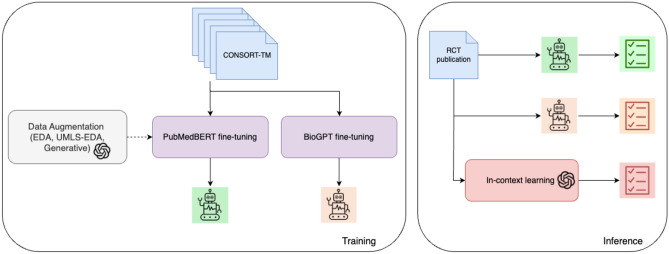
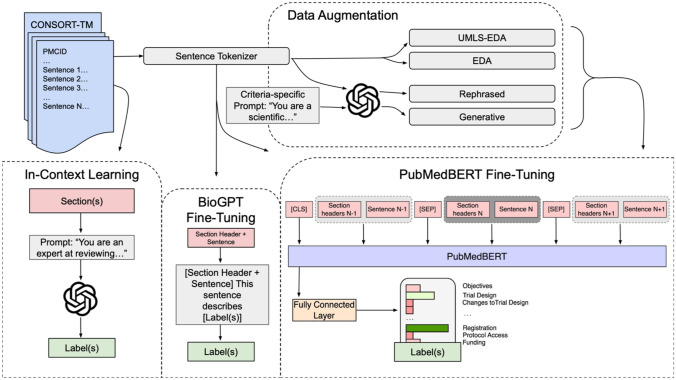
Complete and transparent reporting of randomized controlled trial publications (RCTs) is essential for assessing their credibility. We aimed to develop text classification models for determining whether RCT publications report CONSORT checklist items. Using a corpus annotated with 37 fine-grained CONSORT items, we trained sentence classification models (PubMedBERT fine-tuning, BioGPT fine-tuning, and in-context learning with GPT-4) and compared their performance. We assessed the impact of data augmentation methods (Easy Data Augmentation (EDA), UMLS-EDA, text generation and rephrasing with GPT-4) on model performance. We also fine-tuned section-specific PubMedBERT models (e.g., Methods) to evaluate whether they could improve performance compared to the single full model. We performed 5-fold cross-validation and report precision, recall, F 1 score, and area under curve (AUC). Fine-tuned PubMedBERT model that uses the sentence along with the surrounding sentences and section headers yielded the best overall performance (sentence level: 0.71 micro-F 1 , 0.67 macro-F 1 ; article-level: 0.90 micro-F 1 , 0.84 macro-F 1 ). Data augmentation had limited positive effect. BioGPT fine-tuning and GPT-4 in-context learning exhibited suboptimal results. Methods-specific model improved recognition of methodology items, other section-specific models did not have significant impact. Most CONSORT checklist items can be recognized reasonably well with the fine-tuned PubMedBERT model but there is room for improvement. Improved models can underpin the journal editorial workflows and CONSORT adherence checks.
Overview
CoChat Summary
TL;DR
This study develops and evaluates text classification models to recognize all CONSORT checklist items in randomized controlled trial publications. A fine-tuned PubMedBERT model using surrounding sentences and section headers performed best, while data augmentation and generative models gave limited benefit.
Key findings
- The best PubMedBERT model achieved sentence-level 0.71 micro-F1 and 0.67 macro-F1, with balanced precision and recall (0.72 and 0.71, respectively).
- At article level, the same model reached 0.92 micro-F1 and 0.87 macro-F1 under article (ANY) evaluation, and 0.90 micro-F1 and 0.84 macro-F1 under the stricter article (1+) evaluation.
- Data augmentation had limited positive effect: for the best-performing model, F1 remained 0.71 across original and augmented settings, and differences were not statistically significant.
- BioGPT fine-tuning and GPT-4 in-context learning underperformed the best PubMedBERT model; GPT-4 zero-shot scored 0.51 F1, one-shot 0.48 F1, and five-shot 0.46 F1. Methods-specific training improved recognition of methodology items (0.79 F1 vs. 0.75 F1 for the full model), but other section-specific models had limited impact.
Methods
- Used the CONSORT-TM corpus of 50 RCT publications, containing 10,709 sentences, 4,845 annotated sentences, and 5,246 labels across 37 fine-grained CONSORT items; excluded Background (2a) and focused on 36 items, with items 1a and 1b handled by simple rules.
- Trained sentence classification models via PubMedBERT fine-tuning, BioGPT fine-tuning, and GPT-4 in-context learning; tested input representations including section headers, surrounding sentences, and sentence position, plus data augmentation with EDA, UMLS-EDA, and GPT-4.
- Evaluated with group 5-fold cross-validation, reporting precision, recall, F1, macro-F1, and AUC; GPT-4 in-context learning was evaluated on a randomly sampled test set of 10 articles.
Limitations
- The paper states the dataset is small, consists of XML articles from PubMed Central that may not fully represent RCT literature, and contains limited data for infrequently reported CONSORT items; data augmentation had minimal effect.
- The paper states generative model exploration was limited and calls for more systematic prompting strategies; it also notes the work only recognizes sentences reporting CONSORT items, not whether reporting is adequate or adherent.
- Evident from the text: GPT-4 in-context learning was tested on only 10 articles due to cost, BioGPT fine-tuning used only the target sentence, and section-specific model comparisons were inconclusive, with label confusion between closely related items such as 17a/17b/18 and 12a/12b.
Model-written summary. Check it against the paper before relying on it.
Integrity signals
Registry
Cites
Statistics
Figures
Verification
Claims the paper makes
14 Valid · 2 Not valid · 9 Not checked · 81 Own results and interpretations
The cited sources support only part of this claim — read each source’s verdict below.
In the paper
“A BioBERT-based model44 outperformed rule-based and traditional machine learning approaches.”
§ Text classification models for assessing the completeness of randomized controlled trial publications based on CONSORT reporting guidelines > Related work > Text classification in RCT articles
What the sources say
- Partly supportedcites [44] Lee, J. et al. BioBERT: A pre-trained biomedical language representation model for biomedical text mining. Bioinformatics. 36 (4), 1234–1240 (2020). 31501885 PMC7703786 sourceExperimental — accuracy not yet measured
Section 4.3 reports that BioBERT outperformed previous state-of-the-art models on several biomedical named-entity recognition datasets. It does not report recognizing CONSORT methodology items or a comparison with rule-based approaches; those specifics are not supported by this paper. (LLM, conf=0.86)
plainstates a cause- Asserted: passes — The authors put it forward as true.
- Checkable: passes — It can be checked against evidence.
- Load-bearing: passes — The paper’s conclusions depend on it.
- Based: passes — The paper gives a reason why it holds.
- Partly supported
The cited sources support only part of this claim — read each source’s verdict below.
In the paper
“CONSORT implementation, where RCT submissions are scrutinized by journal editors for compliance before peer review, has been shown to improve reporting quality16,17.”
§ Text classification models for assessing the completeness of randomized controlled trial publications based on CONSORT reporting guidelines > Introduction
What the sources say
- Partly supportedcites [16] Hopewell, S., Ravaud, P., Baron, G. & Boutron, I. Effect of editors’ implementation of CONSORT guidelines on the reporting of abstracts in high impact medical journals: Interrupted time series analysis. BMJ. 344, 4178 (2012). PMC3382226 22730543 sourceExperimental — accuracy not yet measured
The Discussion reports improved reporting of randomized-trial abstracts in journals that actively implemented CONSORT for Abstracts. But the Methods (Interventions) describes emails asking authors to revise abstracts at the manuscript revision stage, or assistant-editor changes near the end of the editorial process—not editor scrutiny of submissions before peer review. (LLM, conf=0.90)
- Not checked — no full text of the sourcecites [17] Pandis, N., Shamseer, L., Kokich, V. G., Fleming, P. S. & Moher, D. Active implementation strategy of CONSORT adherence by a dental specialty journal improved randomized clinical trial reporting. J. Clin. Epidemiol. 67 (9), 1044–1048 (2014). 24837296 source
plainstates a cause- Asserted: passes — The authors put it forward as true.
- Checkable: passes — It can be checked against evidence.
- Load-bearing: passes — The paper’s conclusions depend on it.
- Based: passes — The paper gives a reason why it holds.
- Partly supported
The sources with a verdict support this claim; the rest weren’t checked yet, have no full text we could read, or their verdicts aren’t rated yet.
In the paper
“While they have been endorsed by many high impact journals10, adherence to reporting guidelines remains inadequate2,11,12.”
§ Text classification models for assessing the completeness of randomized controlled trial publications based on CONSORT reporting guidelines > Introduction
What the sources say
- Supportedcites [10] Shamseer, L., Hopewell, S., Altman, D. G., Moher, D. & Schulz, K. F. Update on the endorsement of CONSORT by high impact factor journals: A survey of journal “instructions to authors” in 2014. Trials. 17 (1), 301 (2016). 27343072 PMC4921029 source
Citation 10 is attached to the statement that many high-impact journals endorse reporting guidelines, not to the subsequent claim about inadequate adherence, which has separate citations. The Discussion reports that 13 of 15 general medical journals in the high-impact sample endorse CONSORT, and the Conclusions state that many journals now endorse it. (LLM, conf=0.93)
- Not checked — no full text of the sourcecites [2] Glasziou, P. et al. Reducing waste from incomplete or unusable reports of biomedical research. The Lancet. 383 (9913), 267–276 (2014). 24411647 source
- Not checked — no full text of the sourcecites [11] Samaan, Z. et al. A systematic scoping review of adherence to reporting guidelines in health care literature. J. Multidisciplinary Healthcare. 6, 169-88 (2013). PMC3649856 23671390
- Supportedcites [12] Jin, Y. et al. Does the medical literature remain inadequately described despite having reporting guidelines for 21 years?–A systematic review of reviews: An update. J. Multidiscip. Healthc. 11, 495–510 (2018). 30310289 PMC6166749 source
The paper’s Conclusion states that current adherence to reporting guidelines in the medical literature is suboptimal. In the citing sentence, the endorsement claim is attached to citation 10; this source is cited for the inadequate-adherence claim. (LLM, conf=0.94)
plain- Asserted: passes — The authors put it forward as true.
- Checkable: passes — It can be checked against evidence.
- Load-bearing: passes — The paper’s conclusions depend on it.
- Based: passes — The paper gives a reason why it holds.
- Supported
The cited sources support only part of this claim — read each source’s verdict below.
In the paper
“systematic studies of current practices show poor reporting even in well-conducted RCTs12–14.”
§ Text classification models for assessing the completeness of randomized controlled trial publications based on CONSORT reporting guidelines > Introduction
What the sources say
- Partly supportedcites [12] Jin, Y. et al. Does the medical literature remain inadequately described despite having reporting guidelines for 21 years?–A systematic review of reviews: An update. J. Multidiscip. Healthc. 11, 495–510 (2018). 30310289 PMC6166749 sourceExperimental — accuracy not yet measured
The Results and Conclusion (pages not provided) report that adherence to reporting guidelines in the medical literature remains suboptimal, supporting the poor-reporting point. The paper discusses RCT reporting, but our copy does not establish that the poorly reported RCTs were well conducted; that qualification is unsupported. (LLM, conf=0.82)
- Partly supportedcites [13] Moher, D. et al. Explanation and Elaboration: Updated guidelines for reporting parallel group randomised trials. BMJ. 2010, 340 (2010). PMC2844943 20332511 sourceExperimental — accuracy not yet measured
The “Incomplete and inaccurate reporting” section cites multiple reviews and gives examples of poor RCT reporting. It does not establish that the poorly reported trials were well conducted, so that qualification is unsupported. (LLM, conf=0.84)
- Partly supportedcites [14] Turner L, Shamseer L, Altman D, Weeks L, Peters J, Kober T, et al. Consolidated standards of reporting trials (CONSORT) and the completeness of reporting of randomised controlled trials (RCTs) published in medical journals. Cochrane Database Syst. Rev. 2012; (11). PMC7386818 23152285 sourceExperimental — accuracy not yet measured
The Background states that evidence of suboptimal RCT reporting has accumulated, and the Results report that completeness of reporting was not optimal. The paper does not establish that the poorly reported RCTs were well conducted; the Results caution that reporting may not reflect actual conduct. The indexed passages provide section labels but no page numbers. (LLM, conf=0.86)
plain- Asserted: passes — The authors put it forward as true.
- Checkable: passes — It can be checked against evidence.
- Load-bearing: passes — The paper’s conclusions depend on it.
- Based: passes — The paper gives a reason why it holds.
- Partly supported
The cited sources support only part of this claim — read each source’s verdict below.
In the paper
“The effect of data augmentation on PubMedBERT fine-tuning was minimal, which is consistent with our previous findings22.”
§ Text classification models for assessing the completeness of randomized controlled trial publications based on CONSORT reporting guidelines > Discussion > Data augmentation
What the sources say
- Partly supportedcites [22] Hoang L, Jiang L, Kilicoglu H. Investigating the impact of weakly supervised data on text mining models of publication transparency: a case study on randomized controlled trials. In: AMIA Annual Symposium Proceedings. vol. 2022. American Medical Informatics Association; 2022. p. 254. PMC9285178 35854729 sourceExperimental — accuracy not yet measured
The Classification results (p. 6) report that UMLS-EDA data augmentation produced only a small performance gain. However, the Introduction (p. 2) identifies the model as BioBERT-based, not PubMedBERT; the source therefore does not establish the claimed result for PubMedBERT fine-tuning. (LLM, conf=0.88)
plain- Asserted: passes — The authors put it forward as true.
- Checkable: passes — It can be checked against evidence.
- Load-bearing: unclear — It is unclear whether the paper’s conclusions depend on it.
- Based: passes — The paper gives a reason why it holds.
- Partly supported
43 more claims
Create a free account to see all 106 claims and every source verdict.
- Probably not a substantial claim. 31
- It may state two separate claims as one. 32
- The quote only partly states this claim. 1
Claims other papers make about this one
Each is checked against this paper’s own text: does it say what the citing paper says it does?
The source backs part of the claim, not all of it — or backs it for a different population, condition or comparison.
In the citing paper
“Although used more frequently in the past, the 15 publications published between 2017 and now that use this approach alongside other architectures such as LLM, 148 Transformer, 33,37 -39,148,156,174 conditional random fields (CRF), 40,156 use it with SVM 41 or other binary classifiers.”
From Data extraction methods for systematic review (semi)automation: Update of a living systematic review (2025) · cites this paper as [148]
Experimental — accuracy not yet measuredThe check wasn’t confident either way, so it gives no verdict — never disputed.
In the citing paper
“but fine-tuning was used less frequently than zero-shot prompting with 13 papers or k-shot prompting in two.”
From Data extraction methods for systematic review (semi)automation: Update of a living systematic review (2025) · cites this paper as [148]
Experimental — accuracy not yet measured
Self-check
Percentages, sums and reported differences re-computed from the paper’s own numbers.
Each contradiction between two passages listed here was confirmed by an independent check.
Rated minor: it would not touch a result — a value no result rests on, a p-value that stays on the same side of the significance level, or a conflict that is clerical, resolved elsewhere in the paper, or outside its own findings.
In the paper
§ Text classification models for assessing the completeness of randomized controlled trial publications based on CONSORT reporting guidelines > Discussion > Error analysis
“The labels shown are Outcomes (6a), Outcome Results (17a), Binary Outcome Results (17b), and Ancillary Analyses (18).”
§ Text classification models for assessing the completeness of randomized controlled trial publications based on CONSORT reporting guidelines > Discussion > Error analysis
“| Some CONSORT items are missed | Patients were directed to fix the adhesive ring with the hole over the verruca and to squeeze a little ointment into the hole and directly on to the verruca | [‘11a’, ‘6a’] | [‘6a’] |”
Citations
Cites
Vaswani, A., Shazeer, N., Parmar, N., Uszkoreit, J., Jones, L., Gomez, A. N., Kaiser, L., & Polosukhin, I. (2017) · arXiv · doi:10.48550/arxiv.1706.03762 · Cited by 120,404
The PRISMA 2020 statement: An updated guideline for reporting systematic reviews
Page, M. J., McKenzie, J. E., Bossuyt, P. M., Boutron, I., Hoffmann, T. C., Mulrow, C. D., Shamseer, L., Tetzlaff, J. M., Akl, E. A., Brennan, S. E., et al. (2021) · BMJ · doi:10.1136/bmj.n71 · Cited by 108,283
BERT: Pre-training of Deep Bidirectional Transformers for Language Understanding
Devlin, J., Chang, M.-W., Lee, K., & Toutanova, K. (2018) · arXiv · doi:10.48550/arxiv.1810.04805 · Cited by 73,173
BERT: Pre-training of Deep Bidirectional Transformers for Language Understanding
Devlin, J., Chang, M.-W., Lee, K., & Toutanova, K. (2019) · Proceedings of the 2019 Conference of the North American Chapter of the Association for Computational Linguistics: Human Language Technologies, Volume 1 (Long and Short Papers) · doi:10.18653/v1/n19-1423 · Cited by 54,325 · cited 1×
“In this study, we leveraged the text generation capabilities of LLMs to improve the quality of data augmentation and compared it to simpler approaches we explored in previous work (EDA 24 , UMLS-EDA 25 ).”
MethodLanguage Models are Few-Shot Learners
Brown, T. B., Mann, B., Ryder, N., Subbiah, M., Kaplan, J., Dhariwal, P., Neelakantan, A., Shyam, P., Sastry, G., Askell, A., et al. (2020) · arXiv · doi:10.48550/arxiv.2005.14165 · Cited by 23,372 · cited 1×
“Generative large language models (LLMs) based on Transformer architecture 45 (e.g., GPT family 46,47 , PaLM 48 , LLaMA 49 ) have shown remarkable language generation capabilities and are increasingly applied to NLP tasks in the general domain 50 and in the biomedical domain 51,52 .”
MethodCONSORT 2010 Statement: updated guidelines for reporting parallel group randomised trials
the CONSORT Group, Schulz, K. F., Altman, D. G., & Moher, D. (2010) · BMC Medicine · doi:10.1186/1741-7015-8-18 · Cited by 13,371
CONSORT 2010 Statement: updated guidelines for reporting parallel group randomised trials
Schulz, K. F., Altman, D. G., Moher, D., & for the CONSORT Group (2010) · BMJ · doi:10.1136/bmj.c332 · Cited by 9,329
Moher, D., Hopewell, S., Schulz, K. F., Montori, V., Gotzsche, P. C., Devereaux, P. J., Elbourne, D., Egger, M., & Altman, D. G. (2010) · BMJ · doi:10.1136/bmj.c869 · Cited by 8,883 · cited 1×
“Item descriptions used for the generative prompt were adapted from Moher et al. 13 .”
MethodSPIRIT 2013 Statement: Defining Standard Protocol Items for Clinical Trials
Chan, A.-W., Tetzlaff, J. M., Altman, D. G., Laupacis, A., Gøtzsche, P. C., Krleža-Jerić, K., Hróbjartsson, A., Mann, H., Dickersin, K., Berlin, J. A., et al. (2013) · Annals of Internal Medicine · doi:10.7326/0003-4819-158-3-201302050-00583 · Cited by 7,363
BioBERT: a pre-trained biomedical language representation model for biomedical text mining
Lee, J., Yoon, W., Kim, S., Kim, D., Kim, S., So, C. H., & Kang, J. (2020) · Bioinformatics · doi:10.1093/bioinformatics/btz682 · Cited by 7,218 · cited 2×
“In prior work on CONSORT methodology reporting 21,22 , we fine-tuned the BioBERT model 44 .”
MethodNote on the Sampling Error of the Difference Between Correlated Proportions or Percentages
McNemar, Q. (1947) · Psychometrika · doi:10.1007/bf02295996 · Cited by 4,754 · cited 1×
“To observe whether different input representations and data augmentation approaches led to statistically significant differences in model performances compared to the baseline, we used McNemar’s test 62 adopting the approach outlined by Gillick and Cox 63 .”
MethodThe unified medical language system (UMLS): integrating biomedical terminology
Bodenreider, O. (2004) · Nucleic Acids Research · doi:10.1093/nar/gkh061 · Cited by 4,356
Avoidable waste in the production and reporting of research evidence
Chalmers, I., & Glasziou, P. (2009) · The Lancet · doi:10.1016/s0140-6736(09)60329-9 · Cited by 2,208
Domain-specific language model pretraining for biomedical natural language processing
Gu, Y., Tinn, R., Cheng, H., Lucas, M., Usuyama, N., Liu, X., Naumann, T., Gao, J., & Poon, H. (2022) · ACM Transactions on Computing for Healthcare · doi:10.1145/3458754 · Cited by 2,170
CONSORT 2010 statement: Updated guidelines for reporting parallel group randomised trials
Schulz, K. F., Altman, D. G., & Moher, D. (2010) · Journal of Pharmacology and Pharmacotherapeutics · doi:10.4103/0976-500x.72352 · Cited by 2,165
EDA: Easy Data Augmentation Techniques for Boosting Performance on Text Classification Tasks
Wei, J., & Zou, K. (2019) · Proceedings of the 2019 Conference on Empirical Methods in Natural Language Processing and the 9th International Joint Conference on Natural Language Processing (EMNLP-IJCNLP) · doi:10.18653/v1/d19-1670 · Cited by 1,911 · cited 7×
“UMLS-EDA 25 is an adaptation of EDA that additionally uses synonym replacement based on the UMLS 60 .”
MethodInfluentialToward expert-level medical question answering with large language models
Singhal, K., Tu, T., Gottweis, J., Sayres, R., Wulczyn, E., Amin, M., Hou, L., Clark, K., Pfohl, S. R., Cole-Lewis, H., et al. (2025) · Nature Medicine · doi:10.1038/s41591-024-03423-7 · Cited by 1,734
von Elm, E., Altman, D. G., Egger, M., Pocock, S. J., Gøtzsche, P. C., Vandenbroucke, J. P., & Initiative, F. T. S. (2007) · Bulletin of the World Health Organization · doi:10.2471/blt.07.045120 · Cited by 1,632
Reducing waste from incomplete or unusable reports of biomedical research
Glasziou, P., Altman, D. G., Bossuyt, P., Boutron, I., Clarke, M., Julious, S., Michie, S., Moher, D., & Wager, E. (2014) · The Lancet · doi:10.1016/s0140-6736(13)62228-x · Cited by 1,319
A call for transparent reporting to optimize the predictive value of preclinical research
Landis, S. C., Amara, S. G., Asadullah, K., Austin, C. P., Blumenstein, R., Bradley, E. W., Crystal, R. G., Darnell, R. B., Ferrante, R. J., Fillit, H., et al. (2012) · Nature · doi:10.1038/nature11556 · Cited by 1,196
BioGPT: generative pre-trained transformer for biomedical text generation and mining
Luo, R., Sun, L., Xia, Y., Qin, T., Zhang, S., Poon, H., & Liu, T.-Y. (2022) · Briefings in Bioinformatics · doi:10.1093/bib/bbac409 · Cited by 1,150 · cited 5×
“We used a fine-tuning formulation similar to that proposed in Luo et al. 23 for document classification.”
MethodInfluentialHuang, W., Takebayashi, N., Qi, Y., & Hickerson, M. J. (2011) · BMC Bioinformatics · doi:10.1186/1471-2105-12-1 · Cited by 951
Turner, L., Shamseer, L., Altman, D. G., Weeks, L., Peters, J., Kober, T., Dias, S., Schulz, K. F., Plint, A. C., & Moher, D. (2012) · Cochrane Database of Systematic Reviews · doi:10.1002/14651858.mr000030.pub2 · Cited by 740
Some statistical issues in the comparison of speech recognition algorithms
Gillick, L., & Cox, S. J. (2003) · International Conference on Acoustics, Speech, and Signal Processing · doi:10.1109/icassp.1989.266481 · Cited by 636
Simera, I., Moher, D., Hirst, A., Hoey, J., Schulz, K. F., & Altman, D. G. (2010) · BMC Medicine · doi:10.1186/1741-7015-8-24 · Cited by 590
Opportunities and Challenges for ChatGPT and Large Language Models in Biomedicine and Health
Tian, S., Jin, Q., Yeganova, L., Lai, P.-T., Zhu, Q., Chen, X., Yang, Y., Chen, Q., Kim, W., Comeau, D. C., et al. (2023) · Briefings in Bioinformatics · doi:10.1093/bib/bbad493 · Cited by 359 · cited 6×
“Generative large language models (LLMs) based on Transformer architecture 45 (e.g., GPT family 46,47 , PaLM 48 , LLaMA 49 ) have shown remarkable language generation capabilities and are increasingly applied to NLP tasks in the general domain 50 and in the biomedical domain 51,52 .”
BackgroundMethodInfluentialTowards Expert-Level Medical Question Answering with Large Language Models
Singhal, K., Tu, T., Gottweis, J., Sayres, R., Wulczyn, E., Hou, L., Clark, K., Pfohl, S., Cole-Lewis, H., Neal, D., et al. (2023) · arXiv · doi:10.48550/arxiv.2305.09617 · Cited by 338
RobotReviewer: evaluation of a system for automatically assessing bias in clinical trials
Marshall, I. J., Kuiper, J., & Wallace, B. C. (2016) · Journal of the American Medical Informatics Association · doi:10.1093/jamia/ocv044 · Cited by 317 · cited 2×
“Other research has focused on automating risk of bias assessment using text classification 35–37 and rhetorical classification of medical abstracts (e.g., Objective, Methods) 38–40 .”
MethodReproducible Research Practices and Transparency across the Biomedical Literature
Iqbal, S. A., Wallach, J. D., Khoury, M. J., Schully, S. D., & Ioannidis, J. P. A. (2016) · PLOS Biology · doi:10.1371/journal.pbio.1002333 · Cited by 310
Answering Clinical Questions with Knowledge-Based and Statistical Techniques
Demner-Fushman, D., & Lin, J. (2007) · Computational Linguistics · doi:10.1162/coli.2007.33.1.63 · Cited by 296 · cited 2×
“Most NLP research on RCT publications has focused on classifying sentences using the PICO framework (Population, Intervention, Comparator, Outcome) to aid the systematic review process and evidence-based medicine 27–34 .”
MethodHopewell, S., Ravaud, P., Baron, G., & Boutron, I. (2012) · BMJ · doi:10.1136/bmj.e4178 · Cited by 235
Nye, B., Li, J. J., Patel, R., Yang, Y., Marshall, I., Nenkova, A., & Wallace, B. (2018) · Proceedings of the 56th Annual Meeting of the Association for Computational Linguistics (Volume 1: Long Papers) · doi:10.18653/v1/p18-1019 · Cited by 224 · cited 1×
“…methods in early work 27,42 to (semi-)supervised machine learning methods in later work 28,31,35,43 , including deep learning approaches of the recent years 32–34 We presented CONSORT-TM, a corpus which represents the most comprehensive annotation of RCT characteristics, to our knowledge 21 .”
MethodChen, Q., Hu, Y., Peng, X., Xie, Q., Jin, Q., Gilson, A., Singer, M. B., Ai, X., Lai, P.-T., Wang, Z., et al. (2025) · Nature Communications · doi:10.1038/s41467-025-56989-2 · Cited by 219 · cited 1×
“In the biomedical domain, fine-tuned BioGPT 23 has shown superior performance to BERT-based models in document classification, while the performance of the GPT models in zero-or one-shot settings has been found to trail that of fine-tuned BERT models 53 .”
MethodAutomatic classification of sentences to support Evidence Based Medicine.
Kim, S. N., Martinez, D., Cavedon, L., & Yencken, L. (2011) · BMC Bioinformatics · doi:10.1186/1471-2105-12-s2-s5 · Cited by 214 · cited 1×
“Research on other key characteristics is less common, although methods have been reported for identifying study design 29,30,41 , sample size 28,37,41 , statistical methods 42 , and limitations 43 .”
MethodPutting ChatGPT’s Medical Advice to the (Turing) Test: Survey Study
Nov, O., Singh, N., & Mann, D. (2023) · JMIR Medical Education · doi:10.2196/46939 · Cited by 198 · cited 1×
“GPT-4 can generate fluent, human-like text, even about complex topics like medicine 58 .”
BackgroundA systematic scoping review of adherence to reporting guidelines in health care literature
Thabane, L., Samaan, Mbuagbaw, L., Kosa, S., Debono, B., Dillenburg, Zhang, Fruci, V., Dennis, & Bawor (2013) · Journal of Multidisciplinary Healthcare · doi:10.2147/jmdh.s43952 · Cited by 192
ExaCT: automatic extraction of clinical trial characteristics from journal publications
Kiritchenko, S., de Bruijn, B., Carini, S., Martin, J., & Sim, I. (2010) · BMC Medical Informatics and Decision Making · doi:10.1186/1472-6947-10-56 · Cited by 188 · cited 2×
“Research on other key characteristics is less common, although methods have been reported for identifying study design 29,30,41 , sample size 28,37,41 , statistical methods 42 , and limitations 43 .”
MethodShamseer, L., Hopewell, S., Altman, D. G., Moher, D., & Schulz, K. F. (2016) · Trials · doi:10.1186/s13063-016-1408-z · Cited by 168
(2016) · PubMed · Cited by 134
Jin, Y., Sanger, N., Shams, I., Luo, C., Shahid, H., Li, G., Bhatt, M., Zielinski, L., Bantoto, B., Wang, M., et al. (2018) · Journal of Multidisciplinary Healthcare · doi:10.2147/jmdh.s155103 · Cited by 134
(2013) · Dove Medical Press (Taylor and Francis Group) · Cited by 122
Pretrained Language Models for Sequential Sentence Classification
Cohan, A., Beltagy, I., King, D., Dalvi, B., & Weld, D. (2019) · Proceedings of the 2019 Conference on Empirical Methods in Natural Language Processing and the 9th International Joint Conference on Natural Language Processing (EMNLP-IJCNLP) · doi:10.18653/v1/d19-1383 · Cited by 112 · cited 1×
“It consists of three sentences (preceding, target, trailing) delimited by special [SEP] tokens and prepended by the [CLS] classification head, following earlier work 56,57 .”
MethodPandis, N., Shamseer, L., Kokich, V. G., Fleming, P. S., & Moher, D. (2014) · Journal of Clinical Epidemiology · doi:10.1016/j.jclinepi.2014.04.001 · Cited by 92 · cited 1×
“While active implementation of CONSORT in the peer review process has been shown to improve reporting quality, additional time requirements for the editorial staff and longer peer review process have also been noted 17 .”
BackgroundTrialstreamer: A living, automatically updated database of clinical trial reports
Marshall, I. J., Nye, B., Kuiper, J., Noel-Storr, A., Marshall, R., Maclean, R., Soboczenski, F., Nenkova, A., Thomas, J., & Wallace, B. C. (2020) · Journal of the American Medical Informatics Association · doi:10.1093/jamia/ocaa163 · Cited by 83 · cited 3×
“Most error cases involved sentences predicted to report a CONSORT item different from the original label (37.2% of errors).”
BackgroundMethodInfluentialIs the future of peer review automated?
Schulz, R., Barnett, A., Bernard, R., Brown, N. J. L., Byrne, J. A., Eckmann, P., Gazda, M. A., Kilicoglu, H., Prager, E. M., Salholz-Hillel, M., et al. (2022) · BMC Research Notes · doi:10.1186/s13104-022-06080-6 · Cited by 80
Self-citationHierarchical Neural Networks for Sequential Sentence Classification in Medical Scientific Abstracts
Jin, D., & Szolovits, P. (2018) · Proceedings of the 2018 Conference on Empirical Methods in Natural Language Processing · doi:10.18653/v1/d18-1349 · Cited by 69
Neural Networks for Joint Sentence Classification in Medical Paper Abstracts
Dernoncourt, F., Lee, J. Y., & Szolovits, P. (2017) · Proceedings of the 15th Conference of the European Chapter of the Association for Computational Linguistics: Volume 2, Short Papers · doi:10.18653/v1/e17-2110 · Cited by 68 · cited 1×
“Other research has focused on automating risk of bias assessment using text classification 35–37 and rhetorical classification of medical abstracts (e.g., Objective, Methods) 38–40 .”
MethodMachine learning to assist risk-of-bias assessments in systematic reviews
Millard, L. A., Flach, P. A., & Higgins, J. P. (2016) · International Journal of Epidemiology · doi:10.1093/ije/dyv306 · Cited by 65
Identifying scientific artefacts in biomedical literature: The Evidence Based Medicine use case.
Hassanzadeh, H., Groza, T., & Hunter, J. (2014) · Journal of Biomedical Informatics · doi:10.1016/j.jbi.2014.02.006 · Cited by 62 · cited 1×
“Research on other key characteristics is less common, although methods have been reported for identifying study design 29,30,41 , sample size 28,37,41 , statistical methods 42 , and limitations 43 .”
MethodImproving reference prioritisation with PICO recognition.
Brockmeier, A. J., Ju, M., Przybyła, P., & Ananiadou, S. (2019) · BMC Medical Informatics and Decision Making · doi:10.1186/s12911-019-0992-8 · Cited by 62
Biomedical text mining for research rigor and integrity: tasks, challenges, directions
Kilicoglu, H. (2017) · Briefings in Bioinformatics · doi:10.1093/bib/bbx057 · Cited by 61
Weissgerber, T., Riedel, N., Kilicoglu, H., Labbé, C., Eckmann, P., ter Riet, G., Byrne, J., Cabanac, G., Capes-Davis, A., Favier, B., et al. (2021) · Nature Medicine · doi:10.1038/s41591-020-01203-7 · Cited by 57
UMLS-based data augmentation for natural language processing of clinical research literature
Kang, T., Perotte, A., Tang, Y., Ta, C., & Weng, C. (2021) · Journal of the American Medical Informatics Association · doi:10.1093/jamia/ocaa309 · Cited by 55
Advancing PICO element detection in biomedical text via deep neural networks.
Jin, D., & Szolovits, P. (2020) · Bioinformatics · doi:10.1093/bioinformatics/btaa256 · Cited by 41 · cited 2×
“…methods in early work 27,42 to (semi-)supervised machine learning methods in later work 28,31,35,43 , including deep learning approaches of the recent years 32–34 We presented CONSORT-TM, a corpus which represents the most comprehensive annotation of RCT characteristics, to our knowledge 21 .”
MethodScientific Discourse Tagging for Evidence Extraction
Li, X., Burns, G., & Peng, N. (2021) · Conference of the European Chapter of the Association for Computational Linguistics · doi:10.18653/v1/2021.eacl-main.218 · Cited by 36 · cited 1×
“Other research has focused on automating risk of bias assessment using text classification 35–37 and rhetorical classification of medical abstracts (e.g., Objective, Methods) 38–40 .”
MethodA retrospective cohort study of structured abstracts in MEDLINE, 1992–2006
Ripple, A. M., Mork, J. G., Knecht, L. S., & Humphreys, B. L. (2011) · Journal of the Medical Library Association : JMLA · doi:10.3163/1536-5050.99.2.009 · Cited by 34 · cited 1×
“, we check whether the abstract starts with a structured abstract header included in the list developed by the National Library of Medicine 61 .”
BackgroundToward assessing clinical trial publications for reporting transparency
Kilicoglu, H., Rosemblat, G., Hoang, L., Wadhwa, S., Peng, Z., Malički, M., Schneider, J., & ter Riet, G. (2021) · Journal of Biomedical Informatics · doi:10.1016/j.jbi.2021.103717 · Cited by 34
Hsu, W. W. Y., Speier, W. F., & Taira, R. K. (2012) · PubMed · Cited by 30
GPT for RCTs?: Using AI to determine adherence to reporting guidelines
Wrightson, J. G., Blazey, P., Moher, D., Khan, K. M., & Ardern, C. L. (2023) · doi:10.1101/2023.12.14.23299971 · Cited by 24 · cited 1×
“5 to check RCT reports on sports medicine and exercise science for adherence with 9 CONSORT checklist items, reporting accuracy in the range of 70–100% 54 .”
BackgroundGPT for RCTs? Using AI to determine adherence to clinical trial reporting guidelines
Wrightson, J. G., Blazey, P., Moher, D., Khan, K. M., & Ardern, C. L. (2025) · BMJ Open · doi:10.1136/bmjopen-2024-088735 · Cited by 23
Methodology reporting improved over time in 176,469 randomized controlled trials
Kilicoglu, H., Jiang, L., Hoang, L., Mayo-Wilson, E., Vinkers, C. H., & Otte, W. M. (2023) · Journal of Clinical Epidemiology · doi:10.1016/j.jclinepi.2023.08.004 · Cited by 19 · cited 3×
“In practical use cases, such as guideline adherence checks and large-scale reporting analyses 15 , the user of such a model is likely to be interested in whether the model identifies the reported and missing checklist items for a given article and provides justification for the reported items.”
BackgroundMethodInfluentialSelf-citationPan, F., Canim, M., Glass, M., Gliozzo, A., & Fox, P. (2021) · Proceedings of the 59th Annual Meeting of the Association for Computational Linguistics and the 11th International Joint Conference on Natural Language Processing: System Demonstrations · doi:10.18653/v1/2021.acl-demo.24 · Cited by 17 · cited 1×
“It consists of three sentences (preceding, target, trailing) delimited by special [SEP] tokens and prepended by the [CLS] classification head, following earlier work 56,57 .”
MethodAutomatic recognition of self-acknowledged limitations in clinical research literature
Kilicoglu, H., Rosemblat, G., Malički, M., & ter Riet, G. (2018) · Journal of the American Medical Informatics Association · doi:10.1093/jamia/ocy038 · Cited by 15
Self-citationMethodological information extraction from randomized controlled trial publications: a pilot study.
Hoang, L., Guan, Y., & Kilicoglu, H. (2022) · PubMed Central · Cited by 10
Self-citationHoanga, L., Jiang, L., & Kilicoglu, H. (2022) · PubMed Central · Cited by 7
Self-citationHoang, L., Jiang, L., & Kilicoglu, H. (2021) · doi:10.1101/2021.09.14.21263586 · Cited by 5 · cited 5×
“Apart from sentences reporting Interpretation (22), false negatives involved sentences that describe how outcomes were assessed or interventions were administered, as opposed to what the outcomes and interventions were.”
BackgroundMethodResultInfluentialSelf-citation
Research works printed but not linked: 8
- Radford, A. et al. Language models are unsupervised multitask learners. OpenAI blog. 1 (8), 9 (2019).
- Chowdhery A, Narang S, Devlin J, Bosma M, Mishra G, Roberts A, et al. PaLM: Scaling language modeling with pathways. arXiv preprint arXiv:220402311. 2022.
- Touvron H, Lavril T, Izacard G, Martinet X, Lachaux MA, Lacroix T, et al. LLaMA: Open and efficient foundation language models. arXiv preprint arXiv:230213971. 2023.
- Zhao WX, Zhou K, Li J, Tang T, Wang X, Hou Y, et al. A survey of large language models. arXiv preprint arXiv:230318223. 2023.
- Chen Q, Du J, Hu Y, Keloth VK, Peng X, Raja K, et al. Large language models in biomedical natural language processing: benchmarks, baselines, and recommendations. arXiv preprint arXiv:230516326. 2023.
- Dai H, Liu Z, Liao W, Huang X, Cao Y, Wu Z, et al. AugGPT: Leveraging ChatGPT for text data augmentation. arXiv preprint arXiv:230213007. 2023.
- Wu C, Zhang X, Zhang Y, Wang Y, Xie W. PMC-LLaMA: Further finetuning LLaMA on medical papers. arXiv preprint arXiv:230414454. 2023.
- Tang R, Han X, Jiang X, Hu X. Does synthetic data generation of LLMs help clinical text mining? arXiv preprint arXiv:230304360. 2023.
Cited by
Data extraction methods for systematic review (semi)automation: a living systematic review
Schmidt, L., Olorisade, B. K., McGuinness, L. A., Thomas, J., & Higgins, J. P. T. (2021) · F1000Research · doi:10.12688/f1000research.51117.1 · Cited by 106
Data extraction methods for systematic review (semi)automation: Update of a living systematic review
Schmidt, L., Finnerty Mutlu, A. N., Elmore, R., Olorisade, B. K., Thomas, J., & Higgins, J. P. T. (2025) · F1000Research · doi:10.12688/f1000research.51117.3 · Cited by 27
Srinivasan, A., Berkowitz, J. S., Friedrich, N. A., Kivelson, S., & Tatonetti, N. P. (2025) · JAMA Network Open · doi:10.1001/jamanetworkopen.2025.29418 · Cited by 37
Schmidt, L., Campbell, F., Craig, D., Walker, V. R., Rooney, A. A., Schmitt, C., Härtung, T., & Thomas, J. (2025) · Evidence-Based Toxicology · doi:10.1080/2833373x.2025.2546791 · Cited by 13
Navigating blinding challenges in complex intervention trials: insights from a UK researcher survey
Yonis, A., Dean, S. G., Warren, F. C., Taylor, R. S., Levack, W., & Hay‐Smith, J. (2025) · Trials · doi:10.1186/s13063-025-09223-9 · Cited by 15
“While blinding is widely recognised as a methodological challenge across RCTs of all intervention types, the particular multi-component features of complex interventions present substantial barriers for researchers [16–18].”
Metadata
- Authors
- Jiang, L., Lan, M., Menke, J. D., Vorland, C. J., & Kilicoglu, H.
- Affiliations
- University of Illinois Urbana-Champaign (US)
- Indiana University Bloomington (US)
- Venue
- Scientific Reports
- Published
- 2024-09-17
- Volume
- 14
- Issue
- 1
- Pages
- 21721-21721
- ISSN
- 2045-2322 (ISSN-L)
- PMC
- PMC11408668
- OpenAlex
- W4402620497
- Semantic Scholar
- ab96116d5cfe04a9f17620b522fde647a084c238
- Cited by
- 18
- References
- 67
- Citations by year
- 2026: 2 · 2025: 16
- FWCI
- 5.01
- Type
- journal article
- Language
- en
- Open access
- gold
- doi.org
- Licence
- cc-by
- creativecommons.org/licenses/by/4.0 (tdm)
- creativecommons.org/licenses/by/4.0 (vor)
- Locations
- Scientific Reports (publishedVersion, cc-by)
- medRxiv (acceptedVersion, cc-by-nc)
- PubMed Central (publishedVersion, cc-by)
- PubMed (publishedVersion)
- PubMed Central (submittedVersion, cc-by-nc)
- DOAJ (DOAJ: Directory of Open Access Journals) (submittedVersion)
- Funders
- National Institutes of Health (R01LM014079)
- Topics
- Social Sciences › Decision Sciences › Statistics, Probability and Uncertainty › Meta-analysis and systematic reviews
- Physical Sciences › Computer Science › Artificial Intelligence › Topic Modeling
- Health Sciences › Medicine › Health Informatics › Biomedical Text Mining and Ontologies
- Keywords
- randomized controlled trials, text classification, reporting completeness, PubMedBERT, BioGPT, data augmentation, trial reporting quality, journal editorial workflow
About these checks
Registry, retraction, Cites and statistics results are computed, not judged, with one exception: a printed reference that no index lists is read once by a model before it counts as a citation error. Claims are extracted by a model and kept only when their quote appears verbatim in the text; each cited source is then checked, with a model’s help, for whether it says what the claim relies on. Those verdicts can be wrong — read the claim’s quote and the cited source before relying on one.
The claim verdicts this report counts are experimental: their accuracy is not yet measured.
A language model drew the claims from the paper on 2026-10-02, under version 3 of the claim definition (model deepseek-v4.1-flash, prompt extract-v3).
A second model labelled each claim on 2026-10-02 (model jev-1.13-20260917, definition revision gold-guideline-v0.2).
Cited sources are checked with a language model’s help (gpt-6-sol).
Statistics and arithmetic are recomputed, not judged.
Confidence bands are shown only for fields calibrated on our annotated test set. None is calibrated yet, so no band is shown.
What counts as a claim ›How we measure confidence ›How we check this ›
Are you an author, or do you see a problem with this page? Request a review
Data sources
Bibliographic data: Semantic Scholar, OpenAlex, Crossref.
Contains information from the Semantic Scholar Academic Graph Datasets, made available under the ODC Attribution License (ODC-BY 1.0).
Semantic Scholar’s data is described in: Kinney, R., et al. (2023). The Semantic Scholar Open Data Platform. arXiv:2301.10140.
