

Testing AI on language comprehension tasks reveals insensitivity to underlying meaning
Open accessThe DOI matches its Crossref record; 73 of the 73 references it cites were found in a registry or an index.
Abstract
Large Language Models (LLMs) are recruited in applications that span from clinical assistance and legal support to question answering and education. Their success in specialized tasks has led to the claim that they possess human-like linguistic capabilities related to compositional understanding and reasoning. Yet, reverse-engineering is bound by Moravec's Paradox, according to which easy skills are hard. We systematically assess 7 state-of-the-art models on a novel benchmark. Models answered a series of comprehension questions, each prompted multiple times in two settings, permitting one-word or open-length replies. Each question targets a short text featuring high-frequency linguistic constructions. To establish a baseline for achieving human-like performance, we tested 400 humans on the same prompts. Based on a dataset of n = 26,680 datapoints, we discovered that LLMs perform at chance accuracy and waver considerably in their answers. Quantitatively, the tested models are outperformed by humans, and qualitatively their answers showcase distinctly non-human errors in language understanding. We interpret this evidence as suggesting that, despite their usefulness in various tasks, current AI models fall short of understanding language in a way that matches humans, and we argue that this may be due to their lack of a compositional operator for regulating grammatical and semantic information.
Overview
The claims and statistics of this paper haven’t been checked yet.
Free: it reads the open-access text and checks the first 5 claims that cite a source we can check. Create a free account to check every claim.
Integrity signals
Registry
Cites
Statistics
Figures
Verification
Claims the paper makes
The claims and statistics of this paper haven’t been checked yet.
Free: it reads the open-access text and checks the first 5 claims that cite a source we can check. Create a free account to check every claim.
Claims other papers make about this one
Each is checked against this paper’s own text: does it say what the citing paper says it does?
The source backs part of the claim, not all of it — or backs it for a different population, condition or comparison.
In the citing paper
“Specifically, LLMs generate text in a randomised way depending on statistical probability instead of trying to produce semantically meaningful content as done by human educators (Zhao et al., 2023; Dentella et al., 2024).”
From Towards reliable generative AI-driven scaffolding: Reducing hallucinations and enhancing quality in self-regulated learning support (2026) · cites this paper as Dentella et al., 2024
Experimental — accuracy not yet measured
Self-check
Percentages, sums and reported differences re-computed from the paper’s own numbers.
The self-check needs the paper’s full text.
Citations
Cites
Fitting Linear Mixed-Effects Models Using lme4
Bates, D., Mächler, M., Bolker, B., & Walker, S. (2015) · Journal of Statistical Software · doi:10.18637/jss.v067.i01 · Cited by 86,835
lmerTest Package: Tests in Linear Mixed Effects Models
Kuznetsova, A., Brockhoff, P. B., & Christensen, R. H. B. (2017) · Journal of Statistical Software · doi:10.18637/jss.v082.i13 · Cited by 24,346
Language Models are Few-Shot Learners
Brown, T. B., Mann, B., Ryder, N., Subbiah, M., Kaplan, J., Dhariwal, P., Neelakantan, A., Shyam, P., Sastry, G., Askell, A., et al. (2020) · arXiv · doi:10.48550/arxiv.2005.14165 · Cited by 23,372
Grice, H. P. (1975) · Speech Acts · doi:10.1163/9789004368811_003 · Cited by 23,221
Proceedings of the 24th international conference on Machine learning
(2007) · doi:10.1145/1273496 · Cited by 11,630
On the Dangers of Stochastic Parrots: Can Language Models Be Too Big? 🦜
Bender, E. M., Gebru, T., McMillan-Major, A., & Shmitchell, S. (2021) · Proceedings of the 2021 ACM Conference on Fairness, Accountability, and Transparency · doi:10.1145/3442188.3445922 · Cited by 6,988 · cited 1×
“Limited information: While the sentence “John read to himself, Anthony and Franck” implies John read aloud to others, it doesn’t clarify if Franck was one of the recipients or just present during the reading.”
On The Language Instinct: (412952005-009)
Pinker, S., & American Psychological Association (1994) · PsycEXTRA Dataset · doi:10.1037/e412952005-009 · Cited by 5,646
The faculty of language: what is it, who has it, and how did it evolve?
Hauser, M. D., Chomsky, N., & Fitch, W. T. (2002) · Science · doi:10.1126/science.298.5598.1569 · Cited by 5,189
LLaMA: Open and Efficient Foundation Language Models
Touvron, H., Lavril, T., Izacard, G., Martinet, X., Lachaux, M.-A., Lacroix, T., Rozière, B., Goyal, N., Hambro, E., Azhar, F., et al. (2023) · arXiv · doi:10.48550/arxiv.2302.13971 · Cited by 4,602
Training language models to follow instructions with human feedback
Ouyang, L., Wu, J., Jiang, X., Almeida, D., Wainwright, C. L., Mishkin, P., Zhang, C., Agarwal, S., Slama, K., Ray, A., et al. (2022) · arXiv · doi:10.48550/arxiv.2203.02155 · Cited by 4,208
Large language models encode clinical knowledge
Singhal, K., Azizi, S., Tu, T., Mahdavi, S. S., Wei, J., Chung, H. W., Scales, N., Tanwani, A., Cole-Lewis, H., Pfohl, S., et al. (2023) · Nature · doi:10.1038/s41586-023-06291-2 · Cited by 4,083 · cited 3×
“For instance, LLMs can reach high accuracy in answering medical questions 3 and are believed to be ready for testing in real-world simulations 67 .”
Large Language Models Encode Clinical Knowledge
Singhal, K., Azizi, S., Tu, T., Mahdavi, S. S., Wei, J., Chung, H. W., Scales, N., Tanwani, A., Cole-Lewis, H., Pfohl, S., et al. (2022) · arXiv · doi:10.48550/arxiv.2212.13138 · Cited by 4,083
A large annotated corpus for learning natural language inference
Bowman, S. R., Angeli, G., Potts, C., & Manning, C. D. (2015) · Proceedings of the 2015 Conference on Empirical Methods in Natural Language Processing · doi:10.18653/v1/d15-1075 · Cited by 3,377 · cited 1×
“Based on their success in various applied tasks, featured in a wide array of testing benchmarks [see e.g., 12–19 ], LLMs have been linked with human-like capabilities such as advanced reasoning (OpenAI on ChatGTP and GPT-4 20 ), understanding across modalities (Google on Gemini 21 ), and common…”
A Broad-Coverage Challenge Corpus for Sentence Understanding through Inference
Williams, A., Nangia, N., & Bowman, S. (2018) · Proceedings of the 2018 Conference of the North American Chapter of the Association for Computational Linguistics: Human Language Technologies, Volume 1 (Long Papers) · doi:10.18653/v1/n18-1101 · Cited by 3,342
Sparks of Artificial General Intelligence: Early experiments with GPT-4
Bubeck, S., Chandrasekaran, V., Eldan, R., Gehrke, J., Horvitz, E., Kamar, E., Lee, P., Lee, Y. T., Li, Y., Lundberg, S., et al. (2023) · arXiv · doi:10.48550/arxiv.2303.12712 · Cited by 1,526
Climbing towards NLU: On Meaning, Form, and Understanding in the Age of Data
Bender, E. M., & Koller, A. (2020) · Proceedings of the 58th Annual Meeting of the Association for Computational Linguistics · doi:10.18653/v1/2020.acl-main.463 · Cited by 1,082 · cited 2×
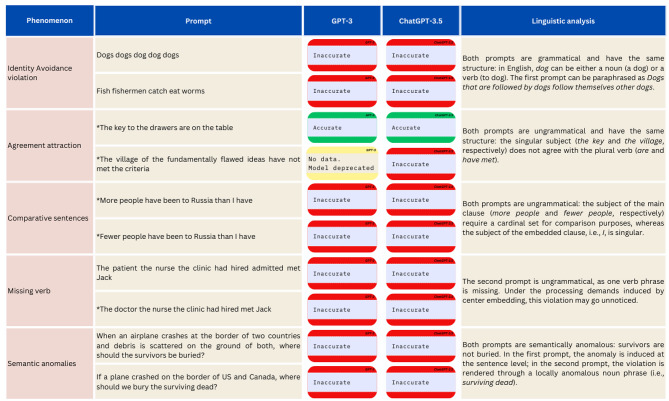
“We list the grammaticality judgments (i.e., judgments about whether a prompt complies with or deviates from the language patterns that the model has internalized) of two frontier LLMs on linguistic prompts that are less frequent in day-to-day language and, consequently, are considerably less likely…”
SuperGLUE: A Stickier Benchmark for General-Purpose Language Understanding Systems
Wang, A., Pruksachatkun, Y., Nangia, N., Singh, A., Michael, J., Hill, F., Levy, O., & Bowman, S. R. (2019) · arXiv · doi:10.48550/arxiv.1905.00537 · Cited by 1,051
XNLI: Evaluating Cross-lingual Sentence Representations
Conneau, A., Rinott, R., Lample, G., Williams, A., Bowman, S., Schwenk, H., & Stoyanov, V. (2018) · Proceedings of the 2018 Conference on Empirical Methods in Natural Language Processing · doi:10.18653/v1/d18-1269 · Cited by 915
HellaSwag: Can a Machine Really Finish Your Sentence?
Zellers, R., Holtzman, A., Bisk, Y., Farhadi, A., & Choi, Y. (2019) · Proceedings of the 57th Annual Meeting of the Association for Computational Linguistics · doi:10.18653/v1/p19-1472 · Cited by 830
Augmenting large language models with chemistry tools
M. Bran, A., Cox, S., Schilter, O., Baldassari, C., White, A. D., & Schwaller, P. (2024) · Nature Machine Intelligence · doi:10.1038/s42256-024-00832-8 · Cited by 794
LaMDA: Language Models for Dialog Applications
Thoppilan, R., De Freitas, D., Hall, J., Shazeer, N., Kulshreshtha, A., Cheng, H.-T., Jin, A., Bos, T., Baker, L., Du, Y., et al. (2022) · arXiv · doi:10.48550/arxiv.2201.08239 · Cited by 778
Beyond the Imitation Game: Quantifying and extrapolating the capabilities of language models
Srivastava, A., Rastogi, A., Rao, A., Shoeb, A. A. M., Abid, A., Fisch, A., Brown, A. R., Santoro, A., Gupta, A., Garriga-Alonso, A., et al. (2022) · arXiv · doi:10.48550/arxiv.2206.04615 · Cited by 569
What BERT Is Not: Lessons from a New Suite of Psycholinguistic Diagnostics for Language Models
Ettinger, A. (2020) · Transactions of the Association for Computational Linguistics · doi:10.1162/tacl_a_00298 · Cited by 511 · cited 1×
“…have the following characteristics: (a) sentences are affirmative (i.e., contain no negation, which is known to negatively impact LLM performance 29 ), (b) they are linked through coordination, (c) either 3 or 5 human entities are featured in each prompt, all identified by proper names (i.e.,…”
Ghafouri, V., Agarwal, V., Zhang, Y., Sastry, N. R., Such, J., & Suárez‐Tangil, G. (2023) · ACM International Conference on Information and Knowledge Management (CIKM) · doi:10.1145/3583780.3614777 · Cited by 484
Social IQa: Commonsense Reasoning about Social Interactions
Sap, M., Rashkin, H., Chen, D., Le Bras, R., & Choi, Y. (2019) · Proceedings of the 2019 Conference on Empirical Methods in Natural Language Processing and the 9th International Joint Conference on Natural Language Processing (EMNLP-IJCNLP) · doi:10.18653/v1/d19-1454 · Cited by 473
How Computational Modeling Can Force Theory Building in Psychological Science
Guest, O., & Martin, A. E. (2021) · Perspectives on Psychological Science · doi:10.1177/1745691620970585 · Cited by 460
Are Transformers universal approximators of sequence-to-sequence functions?Preprint
Yun, C., Bhojanapalli, S., Rawat, A. S., Reddi, S. J., & Kumar, S. (2019) · arXiv (Cornell University) · doi:10.48550/arxiv.1912.10077 · Cited by 414
Leveraging large language models for predictive chemistry
Jablonka, K. M., Schwaller, P., Ortega-Guerrero, A., & Smit, B. (2024) · Nature Machine Intelligence · doi:10.1038/s42256-023-00788-1 · Cited by 378 · cited 1×
“Yet , good performance in tasks that require memorizing specialized knowledge is not necessarily grounded in a solid understanding of language, such that LLMs may fail at comparatively easier tasks ( Moravecs paradox 6–8 ).”
WinoGrande: an adversarial winograd schema challenge at scale
Sakaguchi, K., Bras, R. L., Bhagavatula, C., & Choi, Y. (2021) · Communications of the ACM · doi:10.1145/3474381 · Cited by 356
Dissociating language and thought in large language models
Mahowald, K., Ivanova, A. A., Blank, I. A., Kanwisher, N., Tenenbaum, J. B., & Fedorenko, E. (2024) · Trends in Cognitive Sciences · doi:10.1016/j.tics.2024.01.011 · Cited by 345
The debate over understanding in AI’s large language models
Mitchell, M., & Krakauer, D. C. (2023) · Proceedings of the National Academy of Sciences · doi:10.1073/pnas.2215907120 · Cited by 340 · cited 1×
“…in providing accurate and stable answers in a simple comprehension task as suggesting that the models lack a real understanding of language: they produce words that are like semantic black-boxes, approximating the surface statistics of language and the more ‘automatic’ aspects of parsing 54 .”
Measuring Massive Multitask Language Understanding
Hendrycks, D., Burns, C., Basart, S., Zou, A., Mazeika, M., Song, D., & Steinhardt, J. (2020) · arXiv · doi:10.48550/arxiv.2009.03300 · Cited by 291
jsPsych: Enabling an Open-Source Collaborative Ecosystem of Behavioral Experiments
de Leeuw, J. R., Gilbert, R. A., & Luchterhandt, B. (2023) · Journal of Open Source Software · doi:10.21105/joss.05351 · Cited by 285
Good-enough linguistic representations and online cognitive equilibrium in language processing
Karimi, H., & Ferreira, F. (2016) · Quarterly Journal of Experimental Psychology · doi:10.1080/17470218.2015.1053951 · Cited by 248
DROP: A Reading Comprehension Benchmark Requiring Discrete Reasoning Over Paragraphs
Dua, D., Wang, Y., Dasigi, P., Stanovsky, G., Singh, S., & Gardner, M. (2019) · arXiv · doi:10.48550/arxiv.1903.00161 · Cited by 238
Systematic analysis of ChatGPT, Google search and Llama 2 for clinical decision support tasks
Sandmann, S., Riepenhausen, S., Plagwitz, L., & Varghese, J. (2024) · Nature Communications · doi:10.1038/s41467-024-46411-8 · Cited by 212
Symbols and mental programs: a hypothesis about human singularity
Dehaene, S., Al Roumi, F., Lakretz, Y., Planton, S., & Sablé-Meyer, M. (2022) · Trends in Cognitive Sciences · doi:10.1016/j.tics.2022.06.010 · Cited by 189
ChatGPT has entered the classroom: how LLMs could transform education
Extance, A. (2023) · Nature · doi:10.1038/d41586-023-03507-3 · Cited by 175
Pietroski, P. M. (2018) · Oxford Scholarship Online · doi:10.1093/oso/9780198812722.001.0001 · Cited by 170
Learning and Evaluating General Linguistic Intelligence
Yogatama, D., d’Autume, C. D. M., Connor, J. T., Kočiský, T., Chrzanowski, M., Kong, L., Lazaridou, A., Wang, L., Yu, L., Dyer, C., et al. (2019) · arXiv (Cornell University) · doi:10.48550/arxiv.1901.11373 · Cited by 144
Evaluating large language models as agents in the clinic
Mehandru, N., Miao, B. Y., Almaraz, E. R., Sushil, M., Butte, A. J., & Alaa, A. (2024) · npj Digital Medicine · doi:10.1038/s41746-024-01083-y · Cited by 143 · cited 1×
“For instance, LLMs can reach high accuracy in answering medical questions 3 and are believed to be ready for testing in real-world simulations 67 .”
Jiang, A. Q., Sablayrolles, A., Roux, A., Mensch, A., Savary, B., Bamford, C., Chaplot, D. S., Casas, D. D. L., Hanna, E. B., Bressand, F., et al. (2024) · arXiv · doi:10.48550/arxiv.2401.04088 · Cited by 143
Why AI is harder than we think
Mitchell, M. (2021) · Proceedings of the Genetic and Evolutionary Computation Conference · doi:10.1145/3449639.3465421 · Cited by 129
ChemCrow: Augmenting large-language models with chemistry tools
Bran, A. M., Cox, S., Schilter, O., Baldassari, C., White, A. D., & Schwaller, P. (2023) · arXiv · doi:10.48550/arxiv.2304.05376 · Cited by 122
Language models align with human judgments on key grammatical constructions
Hu, J. C. W., Mahowald, K., Lupyan, G., Ivanova, A. A., & Lévy, R. (2024) · Proceedings of the National Academy of Sciences · doi:10.1073/pnas.2400917121 · Cited by 118
The Falcon Series of Open Language Models
Almazrouei, E., Alobeidli, H., Alshamsi, A., Cappelli, A., Cojocaru, R., Debbah, M. A., Goffinet, É., Hesslow, D., Launay, J., Malartic, Q., et al. (2023) · arXiv (Cornell University) · doi:10.48550/arxiv.2311.16867 · Cited by 113
Reclaiming AI as a Theoretical Tool for Cognitive Science
van Rooij, I., Guest, O., Adolfi, F., de Haan, R., Kolokolova, A., & Rich, P. (2024) · Computational Brain & Behavior · doi:10.1007/s42113-024-00217-5 · Cited by 97
McCoy, R. T., Yao, S., Friedman, D., Hardy, M. D., & Griffiths, T. L. (2024) · Proceedings of the National Academy of Sciences · doi:10.1073/pnas.2322420121 · Cited by 96
Shortcut Learning of Large Language Models in Natural Language Understanding
Du, M., He, F., Zou, N., Tao, D., & Hu, X. (2024) · Communications of the ACM · doi:10.1145/3596490 · Cited by 94 · cited 1×
“While this issue was ignored for the purposes of coding in the one-word setting, because we wanted to give the models the benefit of the doubt, it further showcases how LLMs’ outputs are sensitive to the meaning of prompts only in a superficial manner 61 .”
On Logical Inference over Brains, Behaviour, and Artificial Neural Networks
Guest, O., & Martin, A. E. (2023) · Computational Brain & Behavior · doi:10.1007/s42113-022-00166-x · Cited by 93
Language acquisition: do children and language models follow similar learning stages?
Evanson, L., Lakretz, Y., & King, J. R. (2023) · Findings of the Association for Computational Linguistics: ACL (Findings of ACL) · doi:10.18653/v1/2023.findings-acl.773 · Cited by 82
Moravec, H. (1999) · Scientific American · doi:10.1038/scientificamerican1299-124 · Cited by 70
A resource-rational model of human processing of recursive linguistic structure
Hahn, M., Futrell, R., Levy, R., & Gibson, E. (2022) · Proceedings of the National Academy of Sciences · doi:10.1073/pnas.2122602119 · Cited by 67
Dentella, V., Günther, F., & Leivada, E. (2023) · Proceedings of the National Academy of Sciences · doi:10.1073/pnas.2309583120 · Cited by 67 · cited 3×
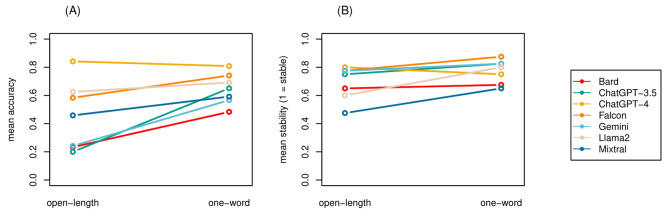
“Following previous research that has suggested that LLMs fail to be stable in their answers to a question prompted repeatedly 31 , we prompted each comprehension question multiple times to assess the stability of answers.”
Self-citationLarge languages, impossible languages and human brains
Moro, A., Greco, M., & Cappa, S. F. (2023) · Cortex · doi:10.1016/j.cortex.2023.07.003 · Cited by 61
A three layer neural network can represent any multivariate function
Ismailov, V. E. (2023) · Journal of Mathematical Analysis and Applications · doi:10.1016/j.jmaa.2023.127096 · Cited by 60
Prompting is not a substitute for probability measurements in large language models
Hu, J., & Levy, R. (2023) · Proceedings of the 2023 Conference on Empirical Methods in Natural Language Processing · doi:10.18653/v1/2023.emnlp-main.306 · Cited by 60 · cited 1×
“Some have argued that judgment prompting is not a suitable methodology for assessing LLMs, because this is (putatively) a metalinguistic skill that LLMs do not necessarily possess 24,46 .”
On Hate Scaling Laws For Data-SwampsPreprint
Birhane, A., Prabhu, V. U., Han, S., & Boddeti, V. N. (2023) · arXiv.org · doi:10.48550/arxiv.2306.13141 · Cited by 48
Eighteen-month-old infants represent nonlocal syntactic dependencies
Perkins, L., & Lidz, J. L. (2021) · Proceedings of the National Academy of Sciences · doi:10.1073/pnas.2026469118 · Cited by 42
Large language models as tax attorneys: a case study in legal capabilities emergence
Nay, J. J., Karamardian, D., Lawsky, S. B., Tao, W., Bhat, M., Jain, R., Lee, A. T., Choi, J. H., & Kasai, J. (2024) · Philosophical Transactions of the Royal Society A: Mathematical, Physical and Engineering Sciences · doi:10.1098/rsta.2023.0159 · Cited by 40
DALLE-2 is Seeing Double: Flaws in Word-to-Concept Mapping in Text2Image Models
Rassin, R., Ravfogel, S., & Goldberg, Y. (2022) · Proceedings of the Fifth BlackboxNLP Workshop on Analyzing and Interpreting Neural Networks for NLP · doi:10.18653/v1/2022.blackboxnlp-1.28 · Cited by 39
PIQA: Reasoning about Physical Commonsense in Natural Language
Bisk, Y., Zellers, R., Le bras, R., Gao, J., & Choi, Y. (2020) · Proceedings of the AAAI Conference on Artificial Intelligence · doi:10.1609/aaai.v34i05.6239 · Cited by 37
Language model acceptability judgements are not always robust to context
Sinha, K., Gauthier, J., Mueller, A., Misra, K., Fuentes, K., Lévy, R., & Williams, A. (2023) · Proceedings of the conference - Association for Computational Linguistics. Meeting · doi:10.18653/v1/2023.acl-long.333 · Cited by 33
Leivada, E., Marcus, G., Günther, F., & Murphy, E. (2026) · Philosophical Transactions of the Royal Society A Mathematical Physical and Engineering Sciences · doi:10.1098/rsta.2025.0008 · Cited by 32
Self-citationLeivada, E., Günther, F., & Dentella, V. (2024) · Proceedings of the National Academy of Sciences · doi:10.1073/pnas.2406752121 · Cited by 19
Self-citationWords: Syntactic structures and pragmatic meanings
Carston, R. (2022) · Synthese · doi:10.1007/s11229-022-03861-1 · Cited by 16
Udandarao, V., Prabhu, A., Ghosh, A., et al. (2024) · arXiv (Cornell University) · doi:10.48550/arxiv.2404.04125 · Cited by 7
FABLES: Evaluating faithfulness and content selection in book-length summarization
Kim, Y., Chang, Y., Karpinska, M., Garimella, A., Manjunatha, V., Lo, K., Goyal, T., & Iyyer, M. (2024) · arXiv · doi:10.48550/arxiv.2404.01261 · Cited by 4 · cited 1×
“However, as the results obtained in this work demonstrate alongside a consistent body of evidence (Rassin et al., 2022; Dentella et al., 2023; Leivada et al., 2023; Kim et al., 2024; Murphy et al., 2024), coherent, sophisticated, and refined outputs amount to patchwork in disguise.”
Does GPT-4 surpass human performance in linguistic pragmatics?Preprint
Bojić, L., Kovačević, P. S., & Čabarkapa, M. (2023) · arXiv (Cornell University) · doi:10.48550/arxiv.2312.09545 · Cited by 4
Language acquisition: do children and language models follow similar learning stages?Preprint
Evanson, L., Lakretz, Y., & King, J.-R. (2023) · arXiv (Cornell University) · doi:10.48550/arxiv.2306.03586 · Cited by 3
Slack, E., & Taylor, Z. (2024) · Springer eBooks · doi:10.1007/978-3-031-41283-7_6 · Cited by 2
A Comparative Investigation of Compositional Syntax and Semantics in DALL-E 2Preprint
Murphy, E., de Villiers, J., & Morales, S. L. (2024) · arXiv (Cornell University) · doi:10.48550/arxiv.2403.12294
Self-citationOpenAI, Achiam, J., Adler, S., Agarwal, S., Ahmad, L., Akkaya, I., Aleman, F. L., Almeida, D., Altenschmidt, J., Altman, S., et al. (2023) · arXiv · doi:10.48550/arxiv.2303.08774
Research works printed but not linked: 4
- Moravec, H. Mind Children (Harvard University Press, 1988).
- Piantadosi, S. T. & Hill, F. Meaning without reference in large language models. Proceedings of the 36th Conference on Neural Information Processing Systems (2022).
- Leivada, E., Murphy, E. & Marcus, G. DALL-E 2 fails to reliably capture common syntactic processes. SSHO 8, 100648 (2023).
- Beguš, G., Dąbkowski, M. & Rhodes, R. Large linguistic models: analyzing theoretical linguistic abilities of LLMs. arXiv 2305.00948 (2023). · arXiv
Cited by
A large-scale comparison of human-written versus ChatGPT-generated essays
Herbold, S., Hautli-Janisz, A., Heuer, U., Kikteva, Z., & Trautsch, A. (2023) · Scientific Reports · doi:10.1038/s41598-023-45644-9 · Cited by 338
Reclaiming AI as a Theoretical Tool for Cognitive Science
van Rooij, I., Guest, O., Adolfi, F., de Haan, R., Kolokolova, A., & Rich, P. (2024) · Computational Brain & Behavior · doi:10.1007/s42113-024-00217-5 · Cited by 97
Dentella, V., Günther, F., & Leivada, E. (2023) · Proceedings of the National Academy of Sciences · doi:10.1073/pnas.2309583120 · Cited by 67
Self-citationPrompting is not a substitute for probability measurements in large language models
Hu, J., & Levy, R. (2023) · Proceedings of the 2023 Conference on Empirical Methods in Natural Language Processing · doi:10.18653/v1/2023.emnlp-main.306 · Cited by 60
“For example, Dentella et al. (2023) prompt GPT-3 to produce grammaticality judgments of infrequent linguistic constructions, and conclude that the model “show[s] a critical lack of understanding even of high-frequency words” (p. 1).”
BackgroundMethodInfluentialAlbedah, F. (2025) · Language Teaching Research Quarterly · doi:10.32038/ltrq.2025.49.13 · Cited by 56
Metadata
- Authors
- Dentella, V., Günther, F., Murphy, E., Marcus, G., & Leivada, E.
- Affiliations
- University of Pavia (IT)
- Humboldt-Universität zu Berlin (DE)
- The University of Texas Health Science Center at Houston (US)
- New York University (US)
- Institució Catalana de Recerca i Estudis Avançats (ES)
- Corresponding author
- Dentella, Vittoria
- Venue
- Scientific Reports
- Published
- 2024-11-14
- Volume
- 14
- Issue
- 1
- Pages
- 28083-28083
- ISSN
- 2045-2322 (ISSN-L)
- PMC
- PMC11564762
- OpenAlex
- W4404349757
- Cited by
- 54
- References
- 55
- Citations by year
- 2026: 28 · 2025: 25 · 2024: 1
- FWCI
- 7.95
- Type
- journal article
- Language
- en
- Open access
- gold
- doi.org
- Licence
- cc-by-nc-nd
- creativecommons.org/licenses/by-nc-nd/4.0 (tdm)
- creativecommons.org/licenses/by-nc-nd/4.0 (vor)
- Locations
- Scientific Reports (publishedVersion, cc-by-nc-nd)
- PubMed Central (publishedVersion, cc-by-nc-nd)
- PubMed (publishedVersion)
- Dipòsit Digital de Documents de la UAB (Universitat Autònoma de Barcelona) (submittedVersion, cc-by-nc-nd)
- DOAJ (DOAJ: Directory of Open Access Journals) (submittedVersion, cc-by-sa)
- OSF Preprints (OSF Preprints) (submittedVersion)
- Funders
- European Commission (HORIZON2020, 945413)
- Universitat Rovira i Virgili (945413)
- Topics
- Physical Sciences › Computer Science › Artificial Intelligence › Topic Modeling
- Physical Sciences › Computer Science › Artificial Intelligence › Natural Language Processing Techniques
- Social Sciences › Arts and Humanities › Language and Linguistics › Syntax, Semantics, Linguistic Variation
- Keywords
- large language models, language comprehension, compositional semantics, human-AI comparison, semantic understanding, compositional reasoning
- MeSH terms
- Artificial Intelligence, Female, Humans, Language, Linguistics, Semantics, Comprehension
About these checks
Registry, retraction, Cites and statistics results are computed, not judged, with one exception: a printed reference that no index lists is read once by a model before it counts as a citation error. Claims are extracted by a model and kept only when their quote appears verbatim in the text; each cited source is then checked, with a model’s help, for whether it says what the claim relies on. Those verdicts can be wrong — read the claim’s quote and the cited source before relying on one.
Statistics and arithmetic are recomputed, not judged.
Confidence bands are shown only for fields calibrated on our annotated test set. None is calibrated yet, so no band is shown.
What counts as a claim ›How we measure confidence ›How we check this ›
Are you an author, or do you see a problem with this page? Request a review
Data sources
Bibliographic data: Semantic Scholar, OpenAlex, Crossref.
Contains information from the Semantic Scholar Academic Graph Datasets, made available under the ODC Attribution License (ODC-BY 1.0).
Semantic Scholar’s data is described in: Kinney, R., et al. (2023). The Semantic Scholar Open Data Platform. arXiv:2301.10140.
