

The DOI matches its Crossref record; the references it cites are not checked yet.
Cognate reflex prediction as hypothesis test for a genealogical relation between the Panoan and Takanan language families
Open accessAbstract
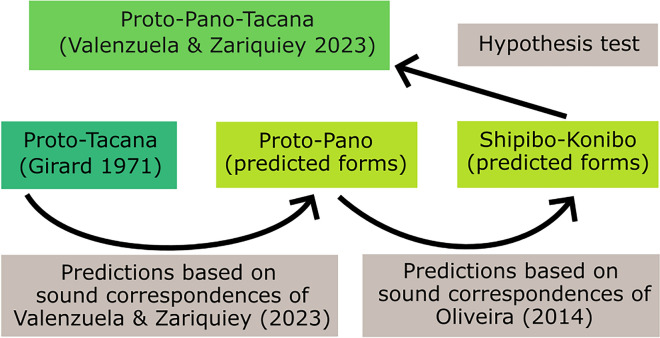
We present a novel approach for testing genealogical relations between language families. Our method, which has previously only been applied to closely related languages, makes predictions for cognate reflexes based on the regularity of proposed sound correspondences between language families that are hypothesized to be related. We test the hypothesis about a genealogical relation between Panoan and Takanan, two linguistic families of the Amazon. The workflow contributes to new ideas of hypothesis testing in historical linguistics and can likely be transferred to other language families. We predict 206 cognate reflexes from Shipibo-Konibo, a Panoan language, from independently proposed Proto-Takanan reconstructions and test our predictions in elicitation sessions with speakers of the language. We found 21 correct predictions from the core-set, as well as another 20 correct predictions from the extended set of predictions. In addition to confirming the previously established sound correspondence patterns, we find further evidence for additional patterns that suggest the reconstruction of three new phonemes for Proto-Pano-Takanan. Protocol registration: The stage 1 protocol for this Registered Report was accepted in principle on 06/05/24. The protocol, as accepted by the journal, can be found at: https://doi.org/10.17605/OSF.IO/FGBM7 .
Overview
The claims and statistics of this paper haven’t been checked yet.
Run the check — free, no account needed. It reads the open-access text and checks the sources it cites.
Integrity signals
Registry
Cites
Statistics
Figures
Verification
Claims the paper makes
The claims and statistics of this paper haven’t been checked yet.
Run the check — free, no account needed. It reads the open-access text and checks the sources it cites.
Self-check
Percentages, sums and reported differences re-computed from the paper’s own numbers.
The self-check needs the paper’s full text.
Citations
The citation lists haven’t been fetched yet
References 39 · Cited by 4
Research works printed but not linked: 40
- Hammarström, H. Linguistic diversity and language evolution. J. Lang. Evol. 1, 19–29. https://doi.org/10.1093/jole/lzw002 (2016). · DOI
- Skirgård, H. et al. Grambank reveals the importance of genealogical constraints on linguistic diversity and highlights the impact of language loss. Sci. Adv. 9. https://doi.org/10.1126/sciadv.adg6175 (2023). · DOI
- Greenberg, J. H. The general classification of Central and South American languages. In Wallace, A. F. C. (ed.) Men and cultures: Selected Papers of the Fifth International Congress of Anthropological and Ethnological Sciences, 791–794, https://doi.org/10.9783/9781512819526-121 (University of Pennsylvania Press, Philadelphia, 1960). · DOI
- Greenberg, J. H. Language in the Americas (Stanford University Press, Stanford, 1987).
- Kaufman, T. Language history in South America: What we know and how to know more. In Payne, D. L. (ed.) Amazonian linguistics: Studies in lowland South American languages, 13–67 (University of Texas Press, Austin, 1990). · DOI
- Jolkesky, M. P. d. V. Estudo arqueo-ecolinguístco das terras tropicais Sul-Americanas. Ph.D. thesis, Universidade de Brasília, Brasília (2016).
- Bodt, T. A. & List, J.-M. Reflex prediction: A case study of Western Kho-Bwa. Diachronica 39, 1–38. https://doi.org/10.1075/dia.20009.bod (2022). · DOI
- List, J.-M., Vylomova, E., Forkel, R., Hill, N. & Cotterell, R. The SIGTYP 2022 shared task on the prediction of cognate reflexes. In Vylomova, E., Ponti, E. & Cotterell, R. (eds.) Proceedings of the 4th Workshop on Research in Computational Linguistic Typology and Multilingual NLP, 52–62, https://doi.org/10.18653/v1/2022.sigtyp-1.7 (Association for Computational Linguistics, Seattle, Washington, 2022). · DOI
- Valenzuela, P. & Zariquiey, R. Language classification in Western Amazonia: Advances in favor of the Pano-Takana Hypothesis. LIAMES: Línguas Indígenas Americanas 23, e023002. https://doi.org/10.20396/liames.v23i00.8670150 (2023). · DOI
- Osthoff, H. & Brugmann, K. Morphologische Untersuchungen auf dem Gebiete der indogermanischen Sprachen Vol. 1 (Hirzel, Leipzig, 1878).
- Anttila, R. An Introduction to Historical and Comparative Linguistics (The Macmillan Company, New York, 1972).
- Fox, A. Linguistic Reconstruction: An Introduction to Theory and Method (Oxford University Press, Oxford, 1995). · DOI
- Durie, M. & Ross, M. The Comparative Method Reviewed: Regularity and Irregularity in Language Change (Oxford University Press, New York, Oxford, 1996).
- Trask, R. L. The Dictionary of Historical and Comparative Linguistics (Edinburgh University Press, 2000). · DOI
- Oliveira, S. C. S. d. Contribuições para a reconstrução do Protopáno. Ph.D. thesis, Universidade de Brasília, Brasília (2014).
- Girard, V. Proto-Takanan Phonology (University of California Press, Berkeley, Los Angeles, London, 1971).
- Fleck, D. W. Panoan languages and linguistics. Anthropological Papers of the American Museum of Natural History99, https://doi.org/10.5531/sp.anth.0099 (2013). · DOI
- Bodt, T., Hill, N. & List, J.-M. Prediction experiment for missing words in Kho-Bwa language data, https://doi.org/10.17605/OSF.IO/EVCBP (2018). · DOI
- Bodt, T. A. & List, J.-M. Testing the predictive strength of the comparative method: An ongoing experiment on unattested words in western kho-bwa languages. Papers Hist. Phonol. 4, 22–44. https://doi.org/10.2218/pihph.4.2019.3037 (2019). · DOI
- Rzymski, C. et al. The Database of Cross-Linguistic Colexifications, reproducible analysis of cross- linguistic polysemies. Sci. Data 7, 1–12. https://doi.org/10.1038/s41597-019-0341-x. https://clics.clld.org (2020). · DOI
- Blevins, J. & Sproat, R. Statistical evidence for the proto-indo-european-euskarian hypothesis: A word-list approach integrating phonotactics. Diachronica 38, 506–564. https://doi.org/10.1075/dia.19014.ble (2021). · DOI
- Baxter, W. H. & Manaster Ramer, A. Beyond lumping and splitting: Probabilistic issues in historical linguistics. In Renfrew, C., McMahon, A. & Trask, L. (eds.) Time depth in historical linguistics, 167–188 (McDonald Institute for Archaeological Research, Cambridge, 2000).
- Greenhill, S. J., Atkinson, Q. D., Meade, A. & Gray, R. D. The shape and tempo of language evolution. Proc. R. Soc. B Biol. Sci. 277, 2443–2450. https://doi.org/10.1098/rspb.2010.0051 (2010). · DOI
- Lathrap, D. W. Aboriginal Occupation and Changes in River Channel on the Central Ucayali. Peru. Am. Antiquity 33, 62–79 (1968). · DOI · Paper page
- Oswalt, R. L. The detection of remote linguistic relationships. Comput. Stud. Hum. Verb. Behav. 3, 117–129 (1970).
- Kessler, B. The significance of word lists (CSLI Publications, Stanford, 2001).
- Ringe, D. A. On calculating the factor of chance in language comparison. Trans. Am. Philos. Soc. 82, 1. https://doi.org/10.2307/1006563 (1992). · DOI
- Harvey, M. & Mailhammer, R. Reconstructing remote relationships: Proto-australian noun class prefixation. Diachronica 34, 470–515. https://doi.org/10.1075/dia.15032.har (2017). · DOI
- Kassian, A. S., Starostin, G., Zhivlov, M. & Spirin, S. A. Calibrated weighted permutation test detects ancient language connections in the circumpolar area (chukotian-nivkh and yukaghir-samoyedic)*. J. Hist. Ling.[SPACE]https://doi.org/10.1075/jhl.00014.kas (2023). · DOI
- Wagenmakers, E.-J. A practical solution to the pervasive problems of p values. Psychon. Bull. Rev. 14, 779–804. https://doi.org/10.3758/bf03194105 (2007). · DOI · Paper page
- Roettger, T. B., Winter, B. & Baayen, H. Emergent data analysis in phonetic sciences: Towards pluralism and reproducibility. J. Phon. 73, 1–7. https://doi.org/10.1016/j.wocn.2018.12.001 (2019). · DOI
- List, J.-M., Hill, N., Forkel, R. & Blum, F. Representing and computing uncertainty in phonological reconstruction. In Proceedings of the 4th Workshop on Computational Approaches to Historical Language Change, https://doi.org/10.18653/v1/2023.lchange-1.3 (Association for Computational Linguistics, 2023). · DOI
- Dockum, R. & Bowern, C. Language documentation and description. In Austin, P. K. (ed.) Language Documentation and Description, 35–54 (EL Publishing, London, 2018).
- List, J.-M. Investigating the impact of sample size on cognate detection. Journal of Language Relationship11, 91–102, https://doi.org/10.31826/jlr-2014-110111 (2014). · DOI
- Forkel, R. et al. Cross-Linguistic Data Formats, advancing data sharing and re-use in comparative linguistics. Sci. Data 5, 1–10. https://doi.org/10.1038/sdata.2018.205 (2018). · DOI
- Blum, F. & Barrientos, C. A New Dataset with Phonological Reconstructions in CLDF. Comput. Assist. Lang. Compar. Pract. 6. https://doi.org/10.58079/m6lx (2023). · DOI
- Blum, F., Barrientos, C., Zariquiey, R. & List, J.-M. A comparative wordlist for investigating distant relations among languages in Lowland South America. Sci. Data 11. https://doi.org/10.1038/s41597-024-02928-7 (2024). · DOI
- List, J.-M., Hill, N. W., Blum, F. & Juárez, C. Grouping sounds into evolving units for the purpose of historical language comparison. Open Research Europe4, 31, https://doi.org/10.12688/openreseurope.16839.2 (2024). · DOI
- List, J.-M. et al. Lexibank, a public repository of standardized wordlists with computed phonological and lexical features. Sci. Data 9, 1–16. https://doi.org/10.1038/s41597-022-01432-0 (2022). · DOI
- Blevins, J. & Wedel, A. Inhibited sound change: An evolutionary approach to lexical competition. Diachronica 26, 143–183. https://doi.org/10.1075/dia.26.2.01ble (2009). · DOI
Metadata
- Authors
- Blum, F., Barrientos, C., Ingunza, A., & List, J.-M.
- Affiliations
- University of Passau (DE)
- Max Planck Institute for Evolutionary Anthropology (DE)
- Pontificia Universidad Católica del Perú (PE)
- Corresponding author
- Blum, Frederic
- Venue
- Scientific Reports
- Published
- 2024-12-24
- Volume
- 14
- Issue
- 1
- Pages
- 30636-30636
- ISSN
- 2045-2322 (ISSN-L)
- PMC
- PMC11668889
- OpenAlex
- W4405734125
- Cited by
- 4
- References
- 39
- Citations by year
- 2026: 1 · 2025: 3
- FWCI
- 6.27
- Type
- journal article
- Language
- en
- Open access
- gold
- doi.org
- Locations
- Scientific Reports (publishedVersion, cc-by)
- PubMed Central (publishedVersion, cc-by)
- PubMed (publishedVersion)
- DOAJ (DOAJ: Directory of Open Access Journals) (submittedVersion)
- Funders
- Max Planck Institute for Evolutionary Anthropology
- Topics
- Social Sciences › Arts and Humanities › Language and Linguistics › Linguistics and language evolution
- Social Sciences › Cultural Studies › Language and cultural evolution
- Social Sciences › Arts and Humanities › Language and Linguistics › Historical Linguistics and Language Studies
- Keywords
- Panoan languages, Shipibo-Konibo, sound correspondences, language family classification, historical phonology, Amazonian languages
- MeSH terms
- Female, Humans, Language, Linguistics, Male
About these checks
Registry, retraction, Cites and statistics results are computed, not judged, with one exception: a printed reference that no index lists is read once by a model before it counts as a citation error. Claims are extracted by a model and kept only when their quote appears verbatim in the text; each cited source is then checked, with a model’s help, for whether it says what the claim relies on. Those verdicts can be wrong — read the claim’s quote and the cited source before relying on one.
Statistics and arithmetic are recomputed, not judged.
Confidence bands are shown only for fields calibrated on our annotated test set. None is calibrated yet, so no band is shown.
What counts as a claim ›How we measure confidence ›How we check this ›
Are you an author, or do you see a problem with this page? Request a review
How to cite
Cite CoChat for the checks on this page, and the paper for its own findings.
- This page
- CoChat. (2026). Citation check: Cognate reflex prediction as hypothesis test for a genealogical relation between the Panoan and Takanan language families. https://app.cochat.ai/papers/10.1038/s41598-024-82515-3
- The paper
- Blum, F., Barrientos, C., Ingunza, A., & List, J.-M. (2024). Cognate reflex prediction as hypothesis test for a genealogical relation between the Panoan and Takanan language families. Scientific Reports. https://doi.org/10.1038/s41598-024-82515-3
