

Surgical frequency analysis of patients clustered according to postoperative pain trajectory: a retrospective study
Open accessPublished version of a preprint
The DOI matches its Crossref record; 25 of the 25 references it cites were found in a registry or an index.
Abstract
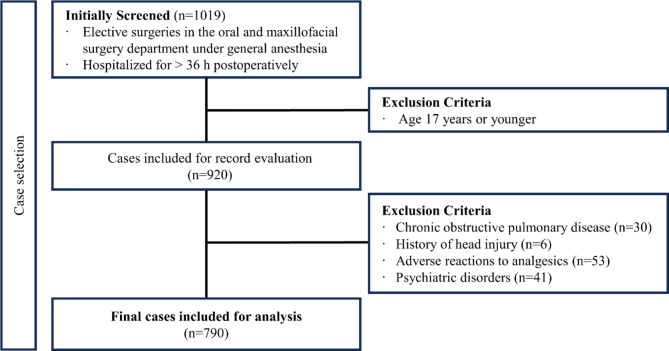
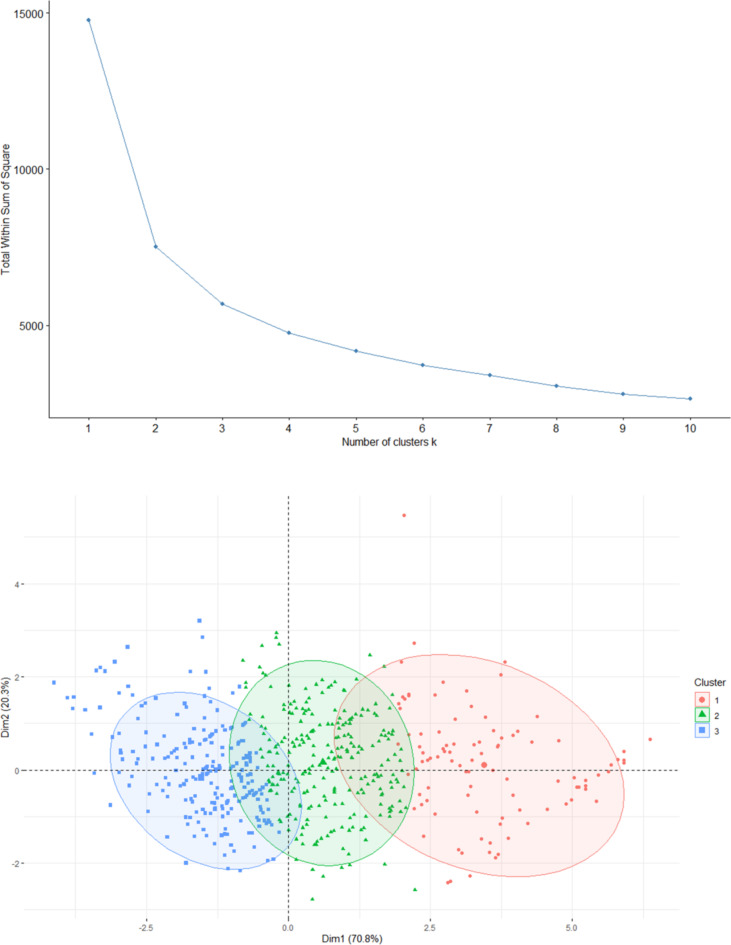
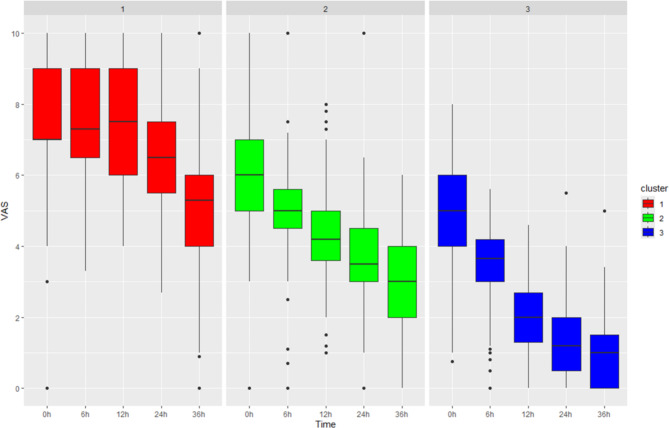
Oropharyngeal and orthognathic surgeries cause more postoperative pain than simple dental procedures. The lack of detailed pain pattern analysis after dental surgeries makes pain management challenging. We assessed postoperative pain patterns in patients undergoing various dental surgeries, categorized based on changing pain levels, and identified the most frequent surgical procedures within each pain pattern cluster. Patients aged 18 years and older undergoing elective oral and maxillofacial surgeries under general anesthesia and hospitalized for > 36 h were included. Exclusion criteria were COPD, head injury, adverse drug reactions, substance misuse, severe metabolic disorders, infections, or psychiatric conditions. We retrospectively analyzed previously collected postoperative visual analog scale (VAS) data at 0, 6, 12, 24, and 36 h postoperatively from 790 patients undergoing various dental surgeries under general anesthesia using k-means clustering to identify pain patterns. Surgery type, duration, and patient-controlled analgesia were analyzed for three pain clusters. Cluster 1 had high prolonged initial pain (VAS 7.43 ± 1.62), mostly involving extensive oropharyngeal cancer surgeries. Cluster 2 experienced moderate pain initially (VAS 5.95 ± 1.44), steadily declining, typically involving orthognathic surgeries. Cluster 3 reported moderate initial pain (VAS 5.21 ± 1.49) that decreased rapidly. Extensive procedures were common in Cluster 1, whereas simpler excisions were prevalent in Cluster 3. Postoperative pain varies significantly according to the extent and invasiveness of surgery. Identifying specific pain trajectories based on detailed surgical assessments can enhance preemptive pain management and aid clinicians in predicting and managing postoperative pain.
Overview
The claims and statistics of this paper haven’t been checked yet.
Free: it reads the open-access text and checks the first 5 claims that cite a source we can check. Create a free account to check every claim.
Integrity signals
Registry
Cites
Statistics
Figures
Verification
Claims the paper makes
The claims and statistics of this paper haven’t been checked yet.
Free: it reads the open-access text and checks the first 5 claims that cite a source we can check. Create a free account to check every claim.
Self-check
Percentages, sums and reported differences re-computed from the paper’s own numbers.
The self-check needs the paper’s full text.
Citations
Cites
Yang, M. M. H., Hartley, R. L., Leung, A. A., Ronksley, P. E., Jetté, N., Casha, S., & Riva-Cambrin, J. (2019) · BMJ Open · doi:10.1136/bmjopen-2018-025091 · Cited by 414
Pain Management: Part 1: Managing Acute and Postoperative Dental Pain
Becker, D. E. (2010) · Anesthesia Progress · doi:10.2344/0003-3006-57.2.67 · Cited by 160
Outpatient versus inpatient thyroidectomy: A systematic review and meta‐analysis
Lee, D. J., Chin, C. J., Hong, C. J. H., Perera, S., & Witterick, I. (2017) · Head & Neck · doi:10.1002/hed.24934 · Cited by 82
Miroshnychenko, A., Ibrahim, S., Azab, M., Roldán, Y., Martinez, J. P. D., Tamilselvan, D., He, L., Little, J. W., Urquhart, O., Tampi, M. P., et al. (2023) · Journal of Dental Research · doi:10.1177/00220345221139230 · Cited by 64
Mullin, S., Żola, J., Lee, R., Hu, J., MacKenzie, B., Brickman, A., Anaya, G., Sinha, S., Li, A., & Elkin, P. L. (2021) · Journal of Biomedical Informatics · doi:10.1016/j.jbi.2021.103889 · Cited by 62
Mundell, B. F., Gates, M. J., Kerezoudis, P., Alvi, M. A., Freedman, B. A., Nassr, A. N., Hohmann, S. F., & Bydon, M. (2018) · Journal of Neurosurgery Spine · doi:10.3171/2018.4.spine1864 · Cited by 57
Cicconetti, A., Bartoli, A., Ripari, F., & Ripari, A. (2004) · Oral Surgery Oral Medicine Oral Pathology Oral Radiology and Endodontology · doi:10.1016/j.tripleo.2003.08.032 · Cited by 48
Pain management following dental trauma and surgical procedures
Malamed, S. F. (2023) · Dental Traumatology · doi:10.1111/edt.12840 · Cited by 46
Moussa, N., & Ogle, O. E. (2021) · Oral and Maxillofacial Surgery Clinics of North America · doi:10.1016/j.coms.2021.08.014 · Cited by 32
Advancing Postoperative Pain Management in Oral Cancer Patients: A Systematic Review
Inchingolo, A. M., Dipalma, G., Inchingolo, A. D., Palumbo, I., Guglielmo, M., Morolla, R., Mancini, A., & Inchingolo, F. (2024) · Pharmaceuticals · doi:10.3390/ph17040542 · Cited by 24
Enhanced recovery after orthognathic surgery: a retrospective comparison study of 56 patients
Wahlstrom, D., Toscano, C., & Havard, D. B. (2023) · British Journal of Oral and Maxillofacial Surgery · doi:10.1016/j.bjoms.2023.01.001 · Cited by 22
Outpatient Hysterectomy versus Inpatient Hysterectomy: A Systematic Review and Meta-analysis
Ellinides, A., Manolopoulos, P. P., Hajymiri, M., Sergentanis, T. Ν., Trompoukis, P., & Ntourakis, D. (2021) · Journal of Minimally Invasive Gynecology · doi:10.1016/j.jmig.2021.06.012 · Cited by 20
Doğan, S. D., Yurtseven, Ş., & Arslan, S. (2023) · Journal of PeriAnesthesia Nursing · doi:10.1016/j.jopan.2023.07.013 · Cited by 19
Abel, K. M. V., Sauer, A. B., Kruthiventi, S. C., Weingarten, T. N., Noel, D. B., Price, D. L., Kasperbauer, J. L., Janus, J. R., Olsen, K. D., & Moore, E. J. (2022) · The Journal of Laryngology & Otology · doi:10.1017/s0022215121004734 · Cited by 10
Identifying Patients Vulnerable to Inadequate Pain Resolution After Cardiac Surgery
Kelly, I., Fields, K. G., Sarin, P., Pang, A. Y., Sigurdsson, M. I., Shernan, S. K., Fox, A. A., Body, S. C., & Muehlschlegel, J. D. (2022) · Seminars in Thoracic and Cardiovascular Surgery · doi:10.1053/j.semtcvs.2022.08.010 · Cited by 9
New Approaches to Pain Management
Ogle, O. E. (2020) · Dental Clinics of North America · doi:10.1016/j.cden.2019.12.001 · Cited by 8
Pain management after third molar extractions in adolescents: a qualitative study
Mitchell, S. G., Truitt, A. R., Davin, L. M., & Rindal, D. B. (2022) · BMC Pediatrics · doi:10.1186/s12887-022-03261-x · Cited by 8
Patil, S. M., Jadhav, A. A., Bhola, N., Hingnikar, P., Kshirsagar, K., & Patil, D. (2022) · Journal of Dental Anesthesia and Pain Medicine · doi:10.17245/jdapm.2022.22.2.145 · Cited by 8
Current and emerging COX inhibitors for treating postoperative pain following oral surgery
Pergolizzi, J. V., Breve, F., Magnusson, P., LeQuang, J. A., & Varassi, G. (2022) · Expert Opinion on Pharmacotherapy · doi:10.1080/14656566.2022.2161364 · Cited by 8
Santos, E. C., Huller, D., Brigola, S., Ferreira, M. D., Pochapski, M. T., & dos Santos, F. A. (2023) · Journal of Dental Anesthesia and Pain Medicine · doi:10.17245/jdapm.2023.23.5.245 · Cited by 8
Anaesthesia, pain and recovery profiles in children following dental extractions
Akl, N., Sommerfield, A., Slevin, L., Drake‐Brockman, T. F. E., Wong, S., Winters, J. C., von Ungern-Sternberg, B. S., & Sommerfield, D. L. (2020) · Anaesthesia and Intensive Care · doi:10.1177/0310057x20942532 · Cited by 7
Pain Severity Scale: A Methodology for Classifying Postoperative Pain Severity by Surgical Procedure
Hitt, J. M., Lee, R., & Elkin, P. L. (2022) · Surgery Open Science · doi:10.1016/j.sopen.2023.02.003 · Cited by 7
Verma, J., Verma, S., & Margasahayam, S. V. (2022) · Journal of Dental Anesthesia and Pain Medicine · doi:10.17245/jdapm.2022.22.5.377 · Cited by 6
Pre-emptive analgesia efficacy of piroxicam versus tramadol in oral surgery
Muthuluri, T., Chandrupatla, S. G., Rajan, R., Reddy, V. V., Jhawar, D. K., & Potturi, A. (2022) · Journal of Dental Anesthesia and Pain Medicine · doi:10.17245/jdapm.2022.22.6.443 · Cited by 5
Jawahar Babu., S., Jayakumar, N. K., & Siroraj, P. (2023) · Journal of Dental Anesthesia and Pain Medicine · doi:10.17245/jdapm.2023.23.3.163 · Cited by 3
Research works printed but not linked: 1
- Hurley, R. W., Elkassabany, N. M. & Wu, C. L. in Miller’s Anesthesia, 9th ed. (ed Ronald D. Miller) Ch. 2614–2638.e5, (Elsevier, 2019).
Metadata
- Authors
- Tartar, Q. A., Park, K. N., Seo, K.-S., & Karm, M.-H.
- Affiliations
- Seoul National University (KR)
- Corresponding author
- Seo, Kwang-Suk
- Karm, Myong-Hwan
- Venue
- Scientific Reports
- Published
- 2025-01-04
- Volume
- 15
- Issue
- 1
- Pages
- 809-809
- ISSN
- 2045-2322 (ISSN-L)
- PMC
- PMC11700160
- OpenAlex
- W4406061189
- Cited by
- 6
- References
- 25
- Citations by year
- 2026: 2 · 2025: 4
- FWCI
- 5.64
- Type
- journal article
- Language
- en
- Open access
- gold
- doi.org
- Licence
- cc-by-nc-nd
- creativecommons.org/licenses/by-nc-nd/4.0 (tdm)
- creativecommons.org/licenses/by-nc-nd/4.0 (vor)
- Locations
- Scientific Reports (publishedVersion, cc-by-nc-nd)
- Research Square (acceptedVersion, cc-by)
- PubMed Central (publishedVersion, cc-by-nc-nd)
- PubMed (publishedVersion)
- DOAJ (DOAJ: Directory of Open Access Journals) (submittedVersion, cc-by-sa)
- Seoul National University Open Repository (Seoul National University) (submittedVersion)
- Funders
- Seoul National University
- Topics
- Health Sciences › Medicine › Anesthesiology and Pain Medicine › Anesthesia and Pain Management
- Health Sciences › Medicine › Anesthesiology and Pain Medicine › Pain Management and Opioid Use
- Health Sciences › Medicine › Pediatrics, Perinatology and Child Health › Pediatric Pain Management Techniques
- Keywords
- postoperative pain, pain trajectories, dental surgery, oropharyngeal surgery, orthognathic surgery, maxillofacial surgery, general anesthesia, patient-controlled analgesia, surgical invasiveness
- MeSH terms
- Adult, Aged, Anesthesia, General, Female, Humans, Male, Middle Aged, Pain Measurement, Pain, Postoperative, Postoperative Pain, Retrospective Studies, Analgesia, Patient-Controlled, Oral Surgical Procedures, Young Adult, Pain Management
About these checks
Registry, retraction, Cites and statistics results are computed, not judged, with one exception: a printed reference that no index lists is read once by a model before it counts as a citation error. Claims are extracted by a model and kept only when their quote appears verbatim in the text; each cited source is then checked, with a model’s help, for whether it says what the claim relies on. Those verdicts can be wrong — read the claim’s quote and the cited source before relying on one.
Statistics and arithmetic are recomputed, not judged.
Confidence bands are shown only for fields calibrated on our annotated test set. None is calibrated yet, so no band is shown.
What counts as a claim ›How we measure confidence ›How we check this ›
Are you an author, or do you see a problem with this page? Request a review
Data sources
Bibliographic data: Semantic Scholar, OpenAlex, Crossref.
Contains information from the Semantic Scholar Academic Graph Datasets, made available under the ODC Attribution License (ODC-BY 1.0).
Semantic Scholar’s data is described in: Kinney, R., et al. (2023). The Semantic Scholar Open Data Platform. arXiv:2301.10140.
