

The DOI matches its Crossref record; 87 of the 87 references it cites were found in a registry or an index.
Comprehensive bioinformatics analysis reveals prognostic significance and immunological roles of WNT gene family in breast cancer
Open accessPublished version of a preprint
Abstract
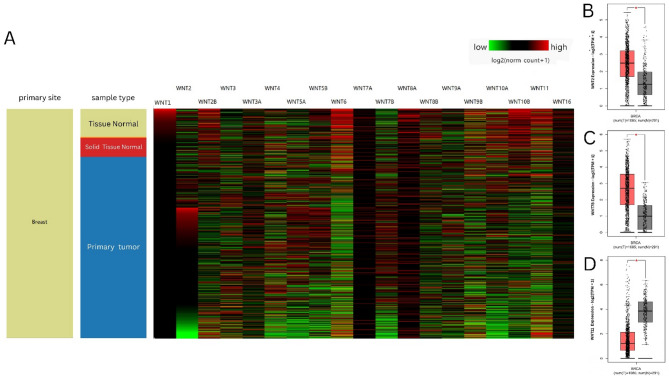
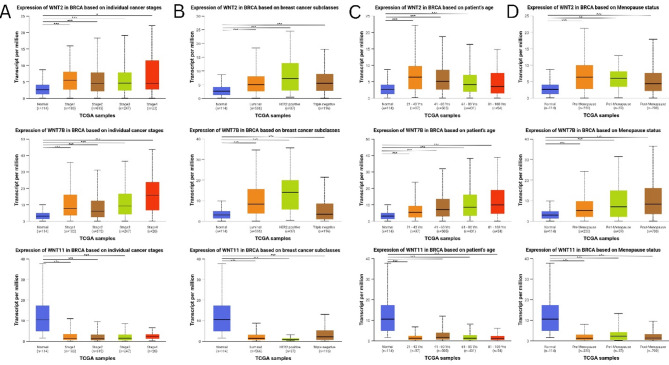
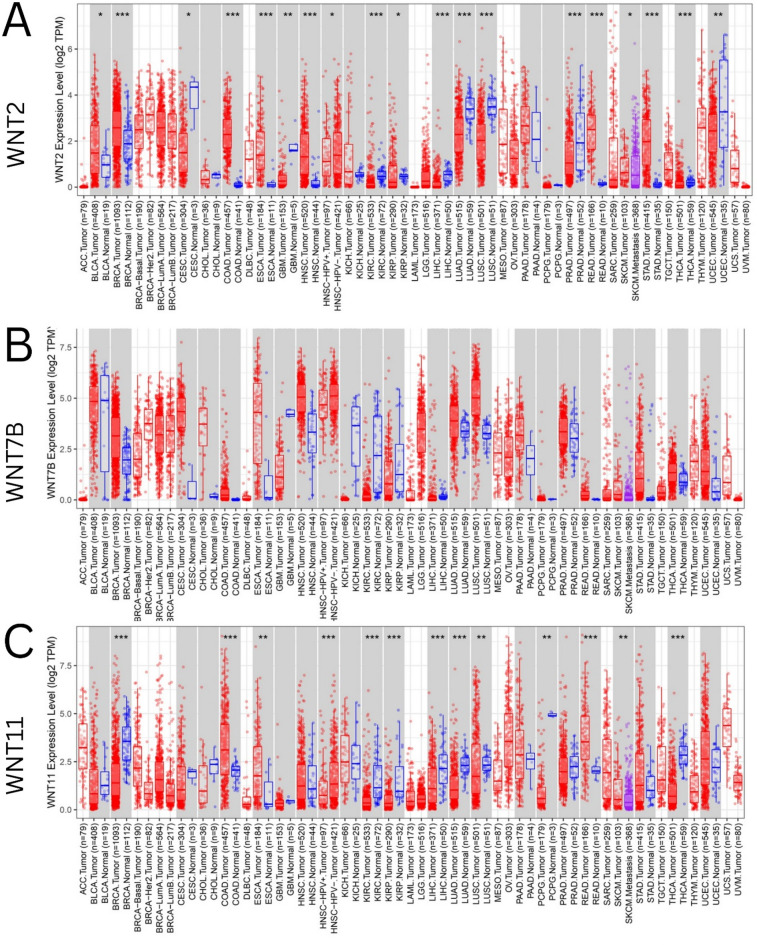
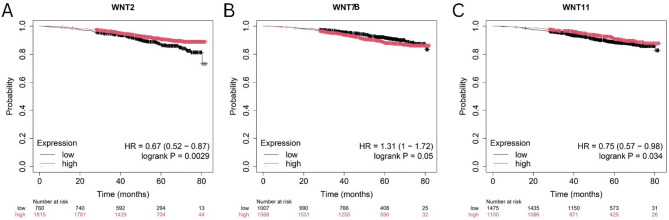
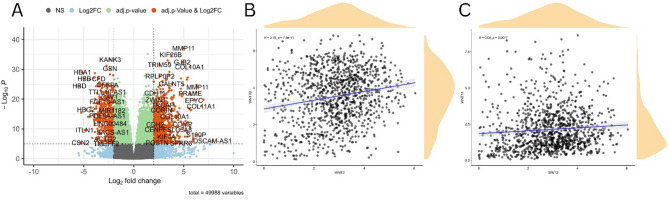
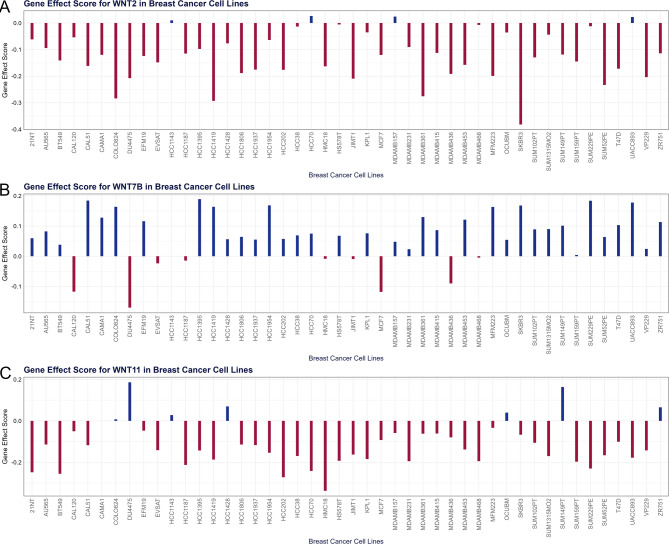
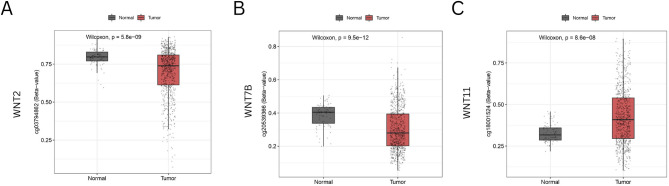
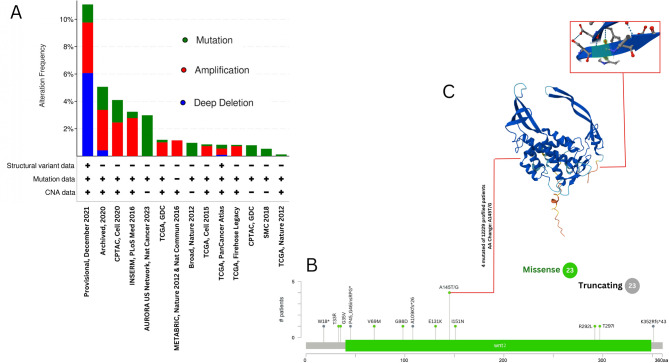
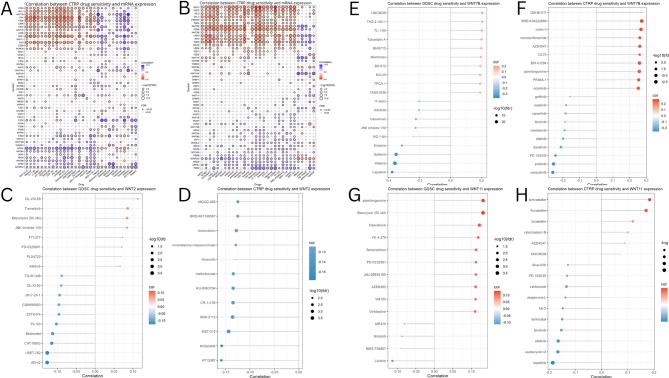
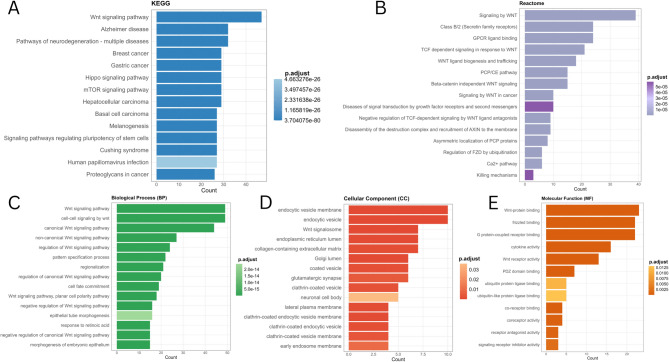
Breast cancer (BRCA) is one of the most commonly diagnosed cancers and the leading cause of cancer-related deaths among women worldwide. Previous studies have shown that the WNT (wingless type) gene family plays a role in the development of various cancers. However, comprehensive analysis of WNTs in BRCA remains largely unexplored. In this study, we examined the expression patterns, clinical relevance, and survival outcomes associated with the WNT family and identified key prognostic WNTs. We further investigated genetic alterations, DNA methylation, and drug sensitivity using cBioPortal, SMART, and GSCA databases. Data from GEO and DepMap were used for validation. Our findings revealed that while WNT2 and WNT7B were significantly upregulated and WNT11 was downregulated, WNT2 paradoxically correlated with favorable prognosis despite its oncogenic overexpression. Amplification was the most common type of alteration among the key WNTs selected for analysis and was correlated with immune infiltration and immunotherapy-related biomarkers. Functional enrichment analysis uncovered a novel connection between WNT signaling and neurodegenerative pathways. Furthermore, co-expression and drug sensitivity analyses revealed that WNTs influence the efficacy of multiple anti-cancer agents, offering potential targets for precision oncology. This study provides novel insights into the multifaceted role of WNT genes in BRCA, identifying them as promising prognostic indicators and immunotherapeutic targets that warrant further clinical exploration.
Overview
The claims and statistics of this paper haven’t been checked yet.
Run the check — free, no account needed. It reads the open-access text and checks the sources it cites.
Integrity signals
Registry
Cites
Statistics
Figures
Verification
Claims the paper makes
The claims and statistics of this paper haven’t been checked yet.
Run the check — free, no account needed. It reads the open-access text and checks the sources it cites.
Self-check
Percentages, sums and reported differences re-computed from the paper’s own numbers.
The self-check needs the paper’s full text.
Citations
Cites
Moderated estimation of fold change and dispersion for RNA-seq data with DESeq2
Love, M. I., Huber, W., & Anders, S. (2014) · Genome Biology · doi:10.1186/s13059-014-0550-8 · Cited by 95,106
Cytoscape: A software Environment for integrated models of biomolecular interaction networks
Shannon, P., Markiel, A., Ozier, O., Baliga, N. S., Wang, J. T., Ramage, D., Amin, N., Schwikowski, B., & Ideker, T. (2003) · Genome Research · doi:10.1101/gr.1239303 · Cited by 51,888
Highly accurate protein structure prediction with AlphaFold
Jumper, J., Evans, R., Pritzel, A., Green, T., Figurnov, M., Ronneberger, O., Tunyasuvunakool, K., Bates, R., Žídek, A., Potapenko, A., et al. (2021) · Nature · doi:10.1038/s41586-021-03819-2 · Cited by 43,764
Bray, F., Laversanne, M., Sung, H., Ferlay, J., Siegel, R. L., Soerjomataram, I., & Jemal, A. (2024) · CA: a cancer journal for clinicians · doi:10.3322/caac.21834 · Cited by 27,064
clusterProfiler 4.0: A universal enrichment tool for interpreting omics data
(2021) · doi:10.1016/j.xinn.2021.100141 · Cited by 12,455
R: A Language for Data Analysis and Graphics
Ihaka, R., & Gentleman, R. (1996) · Journal of Computational and Graphical Statistics · doi:10.1080/10618600.1996.10474713 · Cited by 11,220
Szklarczyk, D., Kirsch, R., Koutrouli, M., Nastou, K., Mehryary, F., Hachilif, R., Gable, A. L., Fang, T., Doncheva, N. T., Pyysalo, S., et al. (2023) · Nucleic Acids Research · doi:10.1093/nar/gkac1000 · Cited by 9,726
TIMER2.0 for analysis of tumor-infiltrating immune cells
Li, T., Fu, J., Zeng, Z., Cohen, D., Li, J., Chen, Q., Li, B., & Liu, X. S. (2020) · Nucleic Acids Research · doi:10.1093/nar/gkaa407 · Cited by 5,390
GEPIA2: an enhanced web server for large-scale expression profiling and interactive analysis
Tang, Z., Kang, B., Li, C., Chen, T., & Zhang, Z. (2019) · Nucleic Acids Research · doi:10.1093/nar/gkz430 · Cited by 5,318
Visualizing and interpreting cancer genomics data via the Xena platform
Goldman, M. J., Craft, B., Hastie, M., Repečka, K., McDade, F., Kamath, A., Banerjee, A., Luo, Y., Rogers, D., Brooks, A. N., et al. (2020) · Nature Biotechnology · doi:10.1038/s41587-020-0546-8 · Cited by 4,481
Research works printed but not linked: 2
- Current State of Breast Cancer Diagnosis, Treatment, and Theranostics. https://www.mdpi.com/1999-4923/13/5/723. · DOI · Paper page
- Miller, J. R. The Wnts. Genome Biol. 3, REVIEWS3001 (2002).
Metadata
- Authors
- Fariha, F. T. J., Fuad, M., Saha, C. S., Hossen, S., & Hossain, M. J.
- Affiliations
- Jagannath University (BD)
- Corresponding author
- Hossain, Md. Jubayer
- ORCID
- Hossain, Md. Jubayer
- Venue
- Scientific Reports
- Published
- 2025-10-03
- Volume
- 15
- Issue
- 1
- Pages
- 34490-34490
- ISSN
- 2045-2322 (ISSN-L)
- PMC
- PMC12494856
- OpenAlex
- W4414778764
- Cited by
- 1
- References
- 87
- Citations by year
- 2025: 1
- FWCI
- 0.30
- Type
- journal article
- Language
- en
- Open access
- gold
- doi.org
- Licence
- cc-by
- creativecommons.org/licenses/by/4.0 (tdm)
- creativecommons.org/licenses/by/4.0 (vor)
- Locations
- Scientific Reports (publishedVersion, cc-by)
- Research Square (acceptedVersion, cc-by)
- Europe PMC (PubMed Central) (publishedVersion, cc-by)
- PubMed (publishedVersion)
- PubMed Central (publishedVersion, cc-by)
- DOAJ (DOAJ: Directory of Open Access Journals) (submittedVersion, cc-by-sa)
- Topics
- Life Sciences › Biochemistry, Genetics and Molecular Biology › Molecular Biology › Wnt/β-catenin signaling in development and cancer
- Life Sciences › Biochemistry, Genetics and Molecular Biology › Cancer Research › Breast Cancer Treatment Studies
- Health Sciences › Medicine › Oncology › Pancreatic and Hepatic Oncology Research
- Keywords
- Wnt gene family, breast cancer, prognostic factors, Wnt2, Wnt7b, Wnt11, gene amplification, DNA methylation, immune cell infiltration, immunotherapy response, drug sensitivity, Wnt signaling, precision oncology
- MeSH terms
- Breast Neoplasms, Female, Humans, Prognosis, Biomarkers, Tumor, Gene Expression Regulation, Neoplastic, DNA Methylation, Computational Biology, Gene Expression Profiling, Wnt Proteins, Wnt2 Protein, Wnt Signaling Pathway
About these checks
Registry, retraction, Cites and statistics results are computed, not judged, with one exception: a printed reference that no index lists is read once by a model before it counts as a citation error. Claims are extracted by a model and kept only when their quote appears verbatim in the text; each cited source is then checked, with a model’s help, for whether it says what the claim relies on. Those verdicts can be wrong — read the claim’s quote and the cited source before relying on one.
Statistics and arithmetic are recomputed, not judged.
Confidence bands are shown only for fields calibrated on our annotated test set. None is calibrated yet, so no band is shown.
What counts as a claim ›How we measure confidence ›How we check this ›
Are you an author, or do you see a problem with this page? Request a review
How to cite
Cite CoChat for the checks on this page, and the paper for its own findings.
- This page
- CoChat. (2026). Citation check: Comprehensive bioinformatics analysis reveals prognostic significance and immunological roles of WNT gene family in breast cancer. https://app.cochat.ai/papers/10.1038/s41598-025-13315-6
- The paper
- Fariha, F. T. J., Fuad, M., Saha, C. S., Hossen, S., & Hossain, M. J. (2025). Comprehensive bioinformatics analysis reveals prognostic significance and immunological roles of WNT gene family in breast cancer. Scientific Reports. https://doi.org/10.1038/s41598-025-13315-6
Data sources
Bibliographic data: Semantic Scholar, OpenAlex, Crossref.
Contains information from the Semantic Scholar Academic Graph Datasets, made available under the ODC Attribution License (ODC-BY 1.0).
Semantic Scholar’s data is described in: Kinney, R., et al. (2023). The Semantic Scholar Open Data Platform. arXiv:2301.10140.
