

Experimental study on the influence of recycled aggregate substitution rate on the mechanical properties of recycled aggregate concrete under sulfate erosion conditions
Open accessThe DOI matches its Crossref record; 22 of the 22 references it cites were found in a registry or an index; none of the 9 sources its claims cite is checked for support yet.
Abstract
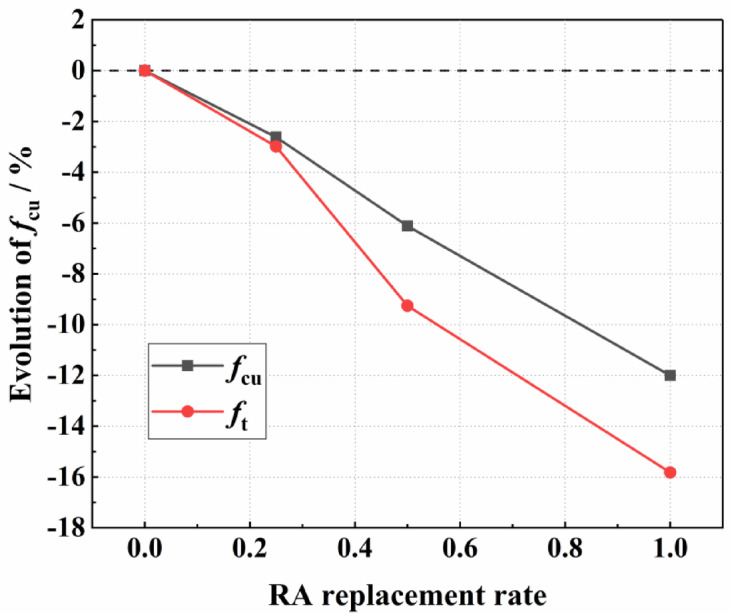
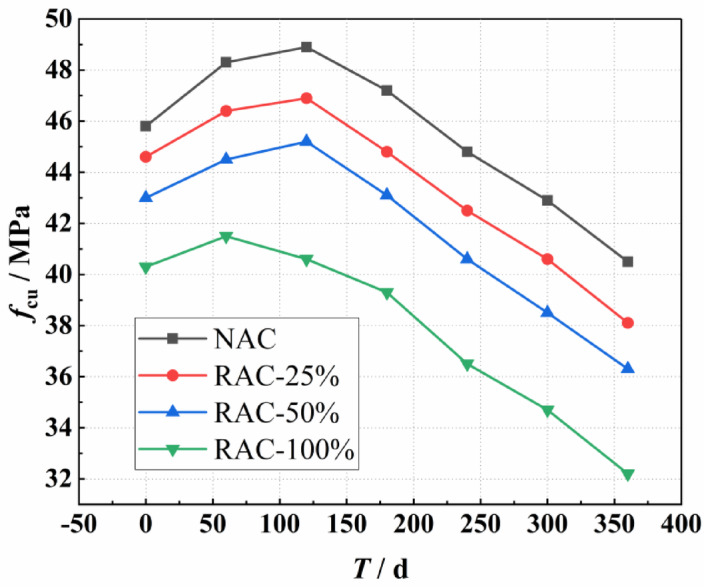
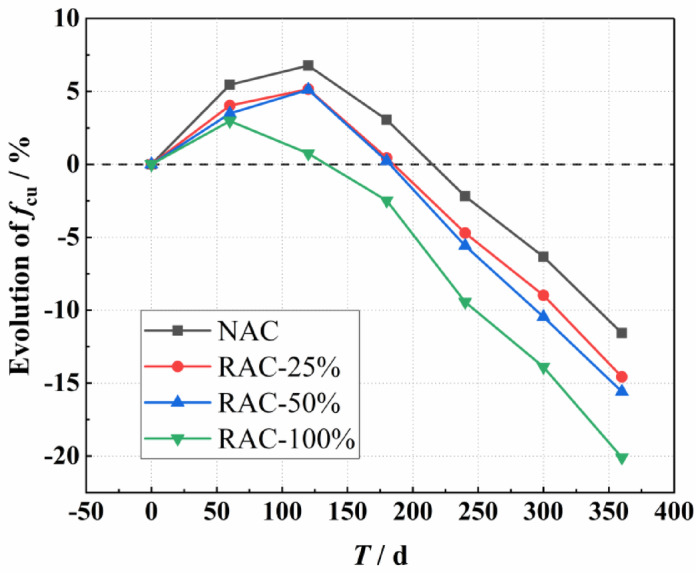
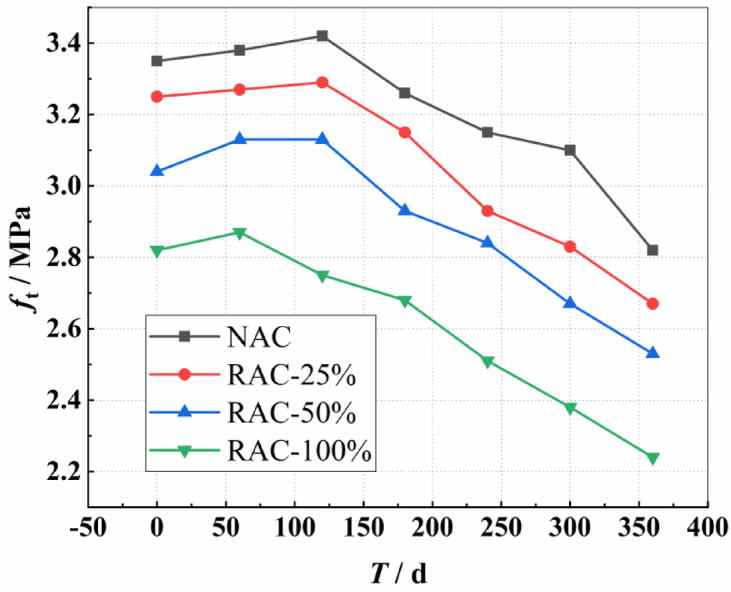
To investigate the degradation of recycled aggregate concrete (RAC) under sulfate attack, four groups of RAC cubic specimens (168 in total) were prepared. The influence of recycled coarse aggregate (RA) replacement ratio on the mechanical properties of RAC under sulfate exposure was analyzed. Strength degradation at different exposure durations was assessed, and microstructural changes were examined using scanning electron microscopy (SEM). The results show that: (1) both compressive and splitting tensile strengths decrease with increasing RA replacement ratio, with the reduction in splitting tensile strength being more pronounced; (2) the compressive strength initially increases slightly under sulfate exposure, then gradually declines, with higher RA replacement ratios accelerating the degradation; (3) the decrease in splitting tensile strength is slightly greater than that of compressive strength over time; and (4) this decline in splitting tensile strength becomes more significant as the RA replacement ratio increases. Based on the experimental data, predictive models were established for the degradation of compressive and splitting tensile strengths at various sulfate exposure ages, incorporating the effect of RA replacement. These models effectively characterize the strength deterioration behavior of RAC under prolonged sulfate immersion.
Overview
CoChat Summary
TL;DR
This experimental study shows that increasing recycled coarse aggregate (RA) replacement reduces RAC compressive and splitting tensile strengths, and under 5% Na₂SO₄ immersion RAC first gains then loses strength, with faster degradation at higher RA contents. Predictive degradation models for compressive and splitting tensile strengths were fitted using RA replacement ratio and sulfate exposure age.
Key findings
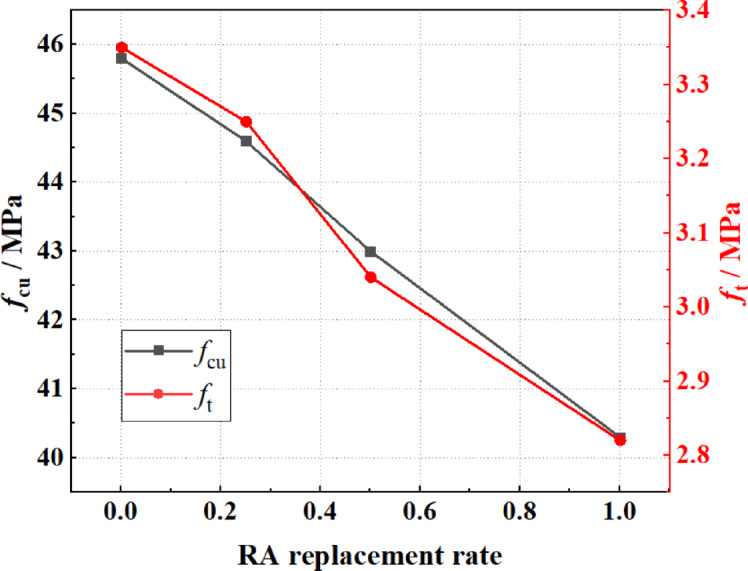
- Under uneroded conditions, both strengths decrease as RA replacement increases; at 100% RA, compressive strength is 5.5 MPa lower and splitting tensile strength is 0.53 MPa lower than NAC. The difference in decline rates between splitting tensile and compressive strengths is 0.36% at 25% RA, 3.14% at 50% RA, and 3.8% at 100% RA.
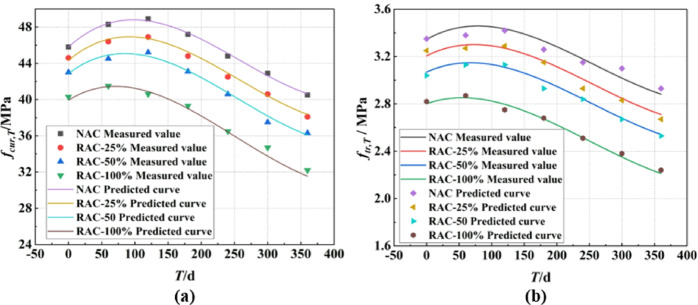
- Under sulfate exposure, compressive strength initially rises then declines. Peak compressive strength increases by 6.3%, 5.2%, 5.1%, and 3.0% at RA replacement rates of 0%, 25%, 50%, and 100%, respectively; peak occurs around 120 days for RA below 50% but at 60 days for 100% RA. By 360 days, compressive strength decreases by 11.6%, 14.5%, 15.6%, and 20.1% for 0%, 25%, 50%, and 100% RA.
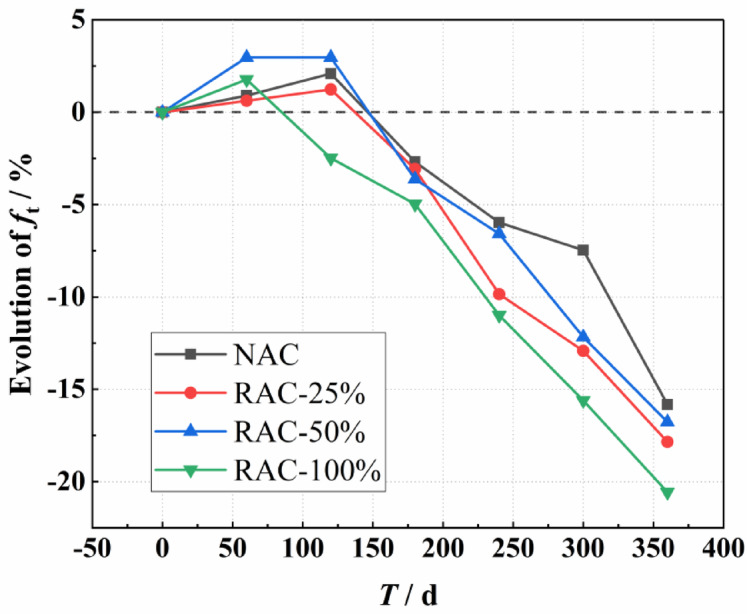
- Splitting tensile strength follows a similar pattern but with smaller early gains and larger later losses. Peak splitting tensile strength increases by 2.1%, 1.2%, 2.96%, and 1.8% for 0%, 25%, 50%, and 100% RA; at 360 days, splitting tensile strength decreases by 12.5%, 12.8%, 17.8%, and 16.8%, respectively. The conclusion states full RA replacement gives compressive and splitting tensile strength losses of 20.1% and 21.6% after 360 days.
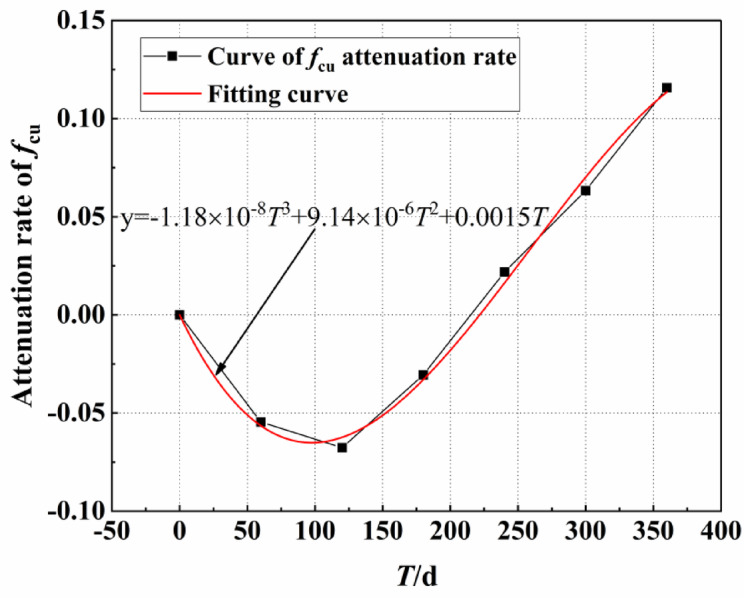
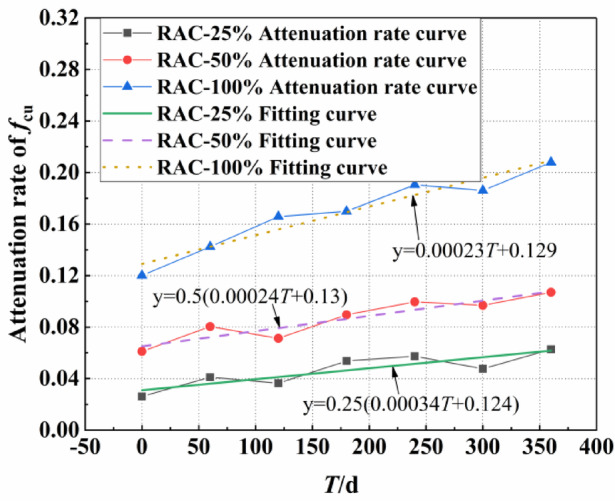
- Degradation models were established: β = −1.18×10⁻⁸T³ + 9.14×10⁻⁶T² − 0.0015T; γ = 1 − r(2.67×10⁻⁴T + 0.128); φ = 1.2×10⁻⁵Tr − 0.00016T − 0.072r + 1; fcur,T = fcu,0(1−β)γ; ftr,T = 0.19φ fcur,T^0.75.
Methods
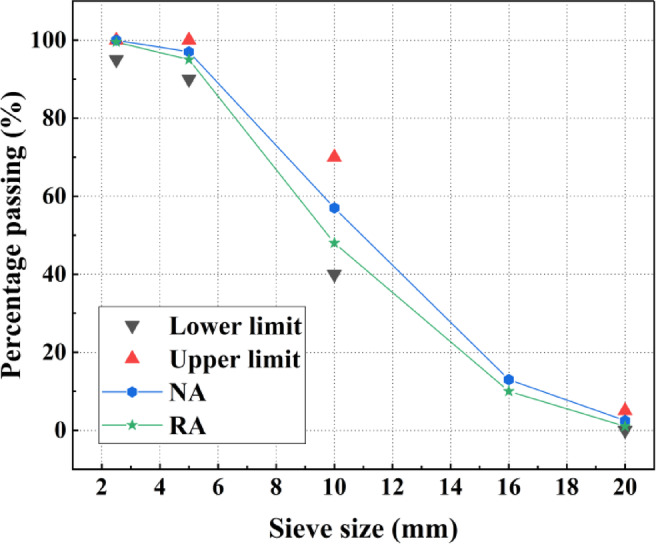
- One NAC control and three RAC mixes with RA substitution rates of 25%, 50%, and 100% were prepared; 42 specimens per mix, 168 total. Mixes used P.O. 42.5 cement, river sand with fineness modulus 2.56, RA from crushed C35 concrete beams sized 5–20 mm, and a water-to-cement ratio of 0.48 with additional water for RA absorption.
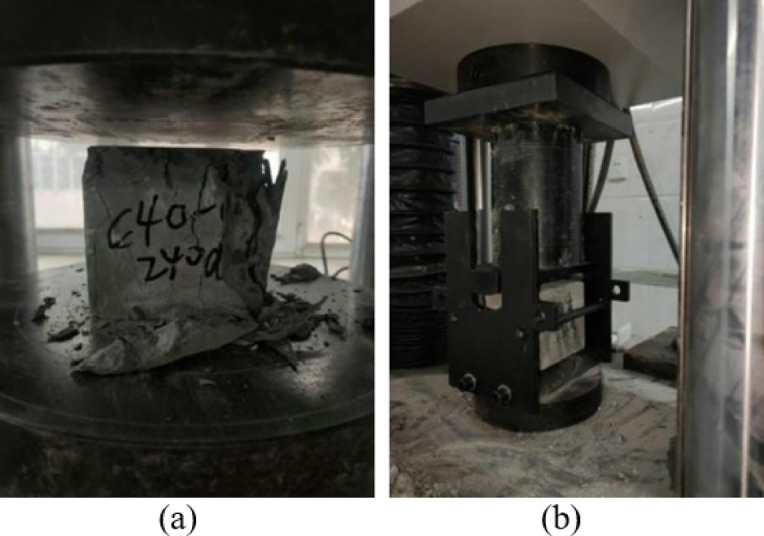
- After 28 days standard curing, six specimens per group were tested uneroded for baseline compressive and splitting tensile strengths. Remaining specimens were immersed in 5% Na₂SO₄ solution and tested at 60, 120, 180, 240, 300, and 360 days.
- Mechanical testing was supplemented by SEM analysis of the interfacial transition zone and internal microstructure. Strength data were fitted with nonlinear and linear regressions to develop degradation models incorporating RA replacement ratio and erosion age.
Limitations
- The paper states future research could explore different types of recycled aggregates and coupled deterioration mechanisms, such as sulfate erosion combined with freeze-thaw cycles.
- Evident from the text: only one RA source (crushed C35 laboratory beams), one sulfate concentration (5% Na₂SO₄), and full immersion exposure were tested; no other aggregate types or coupled mechanisms were experimentally examined.
- Evident from the text: the 360-day splitting tensile strength loss for 100% RA is reported as 16.8% in the results section but as 21.6% in the conclusion, an internal inconsistency.
Model-written summary. Check it against the paper before relying on it.
Integrity signals
Registry
Cites
Statistics
Figures
Verification
Claims the paper makes
0 Valid · 0 Not valid · 4 Not checked · 77 Own results and interpretations
A result the paper reports from its own data — it cites no other source for it, so there is none to check. The quote shows it is in the paper.
In the paper
“A degradation model for compressive and splitting tensile strengths of RAC under sulfate immersion, incorporating the effect of RA replacement ratio, was established.”
§ Experimental study on the influence of recycled aggregate substitution rate on the mechanical properties of recycled aggregate concrete under sulfate erosion conditions > Conclusion
plainstates an association- Asserted: passes — The authors put it forward as true.
- Checkable: passes — It can be checked against evidence.
- Load-bearing: passes — The paper’s conclusions depend on it.
- Based: passes — The paper gives a reason why it holds.
A result the paper reports from its own data — it cites no other source for it, so there is none to check. The quote shows it is in the paper.
In the paper
“with the increase of RA substitution rate, the compressive strength decay rate of specimens at the same erosion age is approximately directly proportional to the RA substitution rate, r.”
§ Experimental study on the influence of recycled aggregate substitution rate on the mechanical properties of recycled aggregate concrete under sulfate erosion conditions > Predictive modeling of RAC intensity in sulfate erosion environments > Prediction of compressive strength decay in RAC
hedgedstates an associationn = 3- Asserted: passes — The authors put it forward as true.
- Checkable: passes — It can be checked against evidence.
- Load-bearing: passes — The paper’s conclusions depend on it.
- Based: passes — The paper gives a reason why it holds.
A result the paper reports from its own data — it cites no other source for it, so there is none to check. The quote shows it is in the paper.
In the paper
“with higher RA replacement ratios accelerating the degradation”
- Also stated in: § Deterioration pattern of RAC strength with erosion age · plain
“In the later stages of erosion, the rate of compressive strength reduction accelerates with increasing RA substitution rate.”
§ Experimental study on the influence of recycled aggregate substitution rate on the mechanical properties of recycled aggregate concrete under sulfate erosion conditions > Abstract
plainstates a cause- Asserted: passes — The authors put it forward as true.
- Checkable: passes — It can be checked against evidence.
- Load-bearing: passes — The paper’s conclusions depend on it.
- Based: passes — The paper gives a reason why it holds.
- Also stated in: § Deterioration pattern of RAC strength with erosion age · plain
A result the paper reports from its own data — it cites no other source for it, so there is none to check. The quote shows it is in the paper.
In the paper
“with the increase in erosion age, the compressive strength decay rate of specimens with all three RA substitution rates generally increases linearly.”
§ Experimental study on the influence of recycled aggregate substitution rate on the mechanical properties of recycled aggregate concrete under sulfate erosion conditions > Predictive modeling of RAC intensity in sulfate erosion environments > Prediction of compressive strength decay in RAC
plainstates a causen = 3- Asserted: passes — The authors put it forward as true.
- Checkable: passes — It can be checked against evidence.
- Load-bearing: passes — The paper’s conclusions depend on it.
- Based: passes — The paper gives a reason why it holds.
A result the paper reports from its own data — it cites no other source for it, so there is none to check. The quote shows it is in the paper.
In the paper
“the decay rate of RAC splitting tensile strength is slightly greater than that of compressive strength as the RA substitution rate and erosion age increase.”
§ Experimental study on the influence of recycled aggregate substitution rate on the mechanical properties of recycled aggregate concrete under sulfate erosion conditions > Predictive modeling of RAC intensity in sulfate erosion environments > Prediction of splitting tensile strength decay in RAC
plainstates a cause- Asserted: passes — The authors put it forward as true.
- Checkable: passes — It can be checked against evidence.
- Load-bearing: passes — The paper’s conclusions depend on it.
- Based: passes — The paper gives a reason why it holds.
44 more claims
Create a free account to see all 81 claims and to verify the 9 references still open.
- It may state two separate claims as one. 31
- The quote only partly states this claim. 1
- Probably not a substantial claim. 2
Self-check
Percentages, sums and reported differences re-computed from the paper’s own numbers.
Each contradiction between two passages listed here was confirmed by an independent check.
Rated major: it would touch a result — a value a result rests on, reported and recomputed p-values on opposite sides of the significance level, two passages that conflict with no sign which is right, or a cited work retracted before this paper was published.
In the paper
§ Experimental study on the influence of recycled aggregate substitution rate on the mechanical properties of recycled aggregate concrete under sulfate erosion conditions > Conclusion
“After 360 days of sulfate exposure, specimens with full RA replacement show compressive and splitting tensile strength losses of 20.1% and 21.6%, respectively.”
§ Experimental study on the influence of recycled aggregate substitution rate on the mechanical properties of recycled aggregate concrete under sulfate erosion conditions > Analysis of test results > Deterioration pattern of RAC strength with erosion age
“When the erosion age reached 360 days, the splitting tensile strengths of RAC with RA substitution rates of 0%, 25%, 50%, and 100% decreased by 12.5%, 12.8%, 17.8%, and 16.8%, respectively.”
Rated minor: it would not touch a result — a value no result rests on, a p-value that stays on the same side of the significance level, or a conflict that is clerical, resolved elsewhere in the paper, or outside its own findings.
In the paper
§ Experimental study on the influence of recycled aggregate substitution rate on the mechanical properties of recycled aggregate concrete under sulfate erosion conditions > Predictive modeling of RAC intensity in sulfate erosion environments > Prediction of compressive strength decay in RAC
“Nonlinear fitting of the data in Fig. 11 yields the following expression for calculating β”
§ Experimental study on the influence of recycled aggregate substitution rate on the mechanical properties of recycled aggregate concrete under sulfate erosion conditions > Analysis of test results > Microstructural analysis of RAC under sulfate erosion
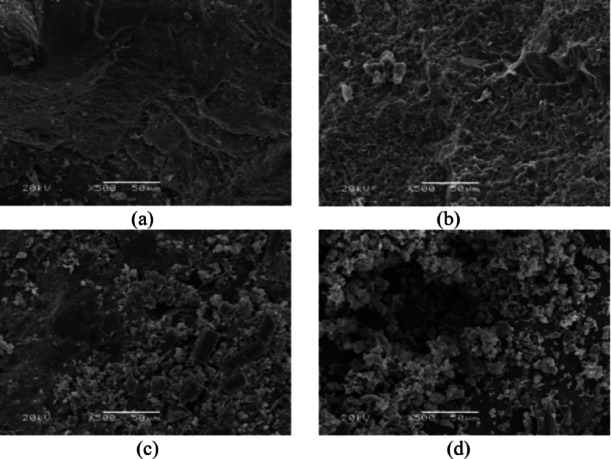
“Figure: Fig. 11 SEM maps within the RAC for different RA replacement rates (erosion age 360d). (a) NAC, (b) RAC-25%, (c) RAC-50%, (d) RAC-100%.”
Rated minor: it would not touch a result — a value no result rests on, a p-value that stays on the same side of the significance level, or a conflict that is clerical, resolved elsewhere in the paper, or outside its own findings.
In the paper
§ Experimental study on the influence of recycled aggregate substitution rate on the mechanical properties of recycled aggregate concrete under sulfate erosion conditions > Conclusion
“However, the greater the RA replacement ratio, the smaller the strength gain and the earlier the peak strength occurs.”
§ Experimental study on the influence of recycled aggregate substitution rate on the mechanical properties of recycled aggregate concrete under sulfate erosion conditions > Analysis of test results > Deterioration pattern of RAC strength with erosion age
“As shown in Fig. 9, compared to the uneroded specimens, the peak splitting tensile strength of RAC with RA substitution rates of 0%, 25%, 50%, and 100% increased by 2.1%, 1.2%, 2.96%, and 1.8%, respectively.”
Rated minor: it would not touch a result — a value no result rests on, a p-value that stays on the same side of the significance level, or a conflict that is clerical, resolved elsewhere in the paper, or outside its own findings.
In the paper
§ Experimental study on the influence of recycled aggregate substitution rate on the mechanical properties of recycled aggregate concrete under sulfate erosion conditions > Analysis of test results > Deterioration pattern of RAC strength with erosion age
“By the time the immersion age reaches 360 days, the compressive strength decreases by 11.6%, 14.5%, 15.6%, and 20.1% for specimens with RA substitution rates of 0%, 25%, 50%, and 100%, respectively, compared to the uneroded specimens.”
§ Experimental study on the influence of recycled aggregate substitution rate on the mechanical properties of recycled aggregate concrete under sulfate erosion conditions > Analysis of test results > Deterioration pattern of RAC strength with erosion age
“When the erosion age reached 360 days, the splitting tensile strengths of RAC with RA substitution rates of 0%, 25%, 50%, and 100% decreased by 12.5%, 12.8%, 17.8%, and 16.8%, respectively.”
Cited works that were retracted
Works this paper cites that were later retracted, from the retraction notices publishers deposit. Major when the notice came out before this paper was published.
Rated major: it would touch a result — a value a result rests on, reported and recomputed p-values on opposite sides of the significance level, two passages that conflict with no sign which is right, or a cited work retracted before this paper was published.
In the paper
“Devi, S. C. & Khan, R. A. Influence of graphene oxide on sulfate attack and carbonation of concrete containing recycled concrete aggregate. Constr. Build. Mater., 250 (2020).”
Cited work 10.1016/j.conbuildmat.2020.118883 · retracted 2020-07-30 · notice 10.1016/j.conbuildmat.2020.118883 · this paper published 2025-08-11
Citations
Cites
1 retracted
Devi, S. C., & Khan, R. A. (2020) · Construction and Building Materials · doi:10.1016/j.conbuildmat.2020.118883 · Cited by 95
RetractedZhang, H., Xiao, J., Tang, Y., Duan, Z., & Poon, C. S. (2022) · Cement and Concrete Composites · doi:10.1016/j.cemconcomp.2022.104527 · Cited by 253
Xiao, Q. H., Cao, Z. Y., Guan, X., Li, Q., & Liu, X. L. (2019) · Construction and Building Materials · doi:10.1016/j.conbuildmat.2019.06.060 · Cited by 143
Compressive strength assessment of sulfate-attacked concrete by using sulfate ions distributions
Cheng, H., Liu, T., Zou, D., & Zhou, A. (2021) · Construction and Building Materials · doi:10.1016/j.conbuildmat.2021.123550 · Cited by 133
Xiao, Q. H., Li, Q., Cao, Z. Y., & Tian, W. Y. (2019) · Construction and Building Materials · doi:10.1016/j.conbuildmat.2018.12.066 · Cited by 110
Sun, J., & Chen, Z. (2018) · Powder Technology · doi:10.1016/j.powtec.2018.07.041 · Cited by 104
Zhang, H., Ji, T., & Liu, H. (2020) · Construction and Building Materials · doi:10.1016/j.conbuildmat.2020.118675 · Cited by 98
Sulfate attack resistance of recycled aggregate concrete with NaOH-solution-treated crumb rubber
Li, Y., Yang, X., Lou, P., Wang, R., Li, Y., & Si, Z. (2021) · Construction and Building Materials · doi:10.1016/j.conbuildmat.2021.123044 · Cited by 81
Xie, F., Li, J., Zhao, G., Wang, C., Wang, Y., & Zhou, P. (2021) · Construction and Building Materials · doi:10.1016/j.conbuildmat.2021.123771 · Cited by 78
Wang, K., Guo, J., Yang, L. H., Zhang, P., & Xu, H. (2022) · Construction and Building Materials · doi:10.1016/j.conbuildmat.2022.127143 · Cited by 69
Cited by
Yılmaz, Y., Çakmak, T., & Ustabaş, İ. (2025) · Scientific Reports · doi:10.1038/s41598-025-23515-9 · Cited by 6
Ahmad, S. S. E., Ahmed, S. A., Elshami, A. A., & Elmenshawy, Y. (2026) · Infrastructures · doi:10.3390/infrastructures11020068 · Cited by 3
Durability and Microstructural Performance of Self-Compacting Concrete Made with Recycled Aggregates
Nadour, Y., Boulekbache, B., Hamrat, M., Bouziadi, F., Belabbas, O., & Amziane, S. (2026) · Transportation Research Record Journal of the Transportation Research Board · doi:10.1177/03611981261447266 · Cited by 3
Elmasry, A. M., Ismail, M. K., Farahat, A. M., & Elansary, A. A. (2025) · Scientific Reports · doi:10.1038/s41598-025-29810-9 · Cited by 2
Okweto, S. L. A., & Abuodha, S. O. (2026) · Emerging technologies and engineering journal. · doi:10.53898/etej2026321
Jantarachot, K., Ketkam, N., Thongchart, S., & Thepjunthra, W. (2026) · Next Materials · doi:10.1016/j.nxmate.2026.104004
Metadata
- Authors
- Fu, Y., Zhao, Q., Sun, Q., Chen, S., Shi, H., Zhang, F., & Bai, C.
- Affiliations
- Xi'an University of Architecture and Technology (CN)
- Corresponding author
- Fu, Yan
- Venue
- Scientific Reports
- Published
- 2025-08-11
- Volume
- 15
- Issue
- 1
- Pages
- 29405-29405
- ISSN
- 2045-2322 (ISSN-L)
- PMC
- PMC12340065
- OpenAlex
- W4413109382
- Cited by
- 7
- References
- 22
- Citations by year
- 2026: 5 · 2025: 2
- FWCI
- 1.98
- Type
- journal article
- Language
- en
- Open access
- gold
- doi.org
- Licence
- cc-by-nc-nd
- creativecommons.org/licenses/by-nc-nd/4.0 (tdm)
- creativecommons.org/licenses/by-nc-nd/4.0 (vor)
- Locations
- Scientific Reports (publishedVersion, cc-by-nc-nd)
- PubMed Central (publishedVersion, cc-by-nc-nd)
- PubMed (publishedVersion)
- DOAJ (DOAJ: Directory of Open Access Journals) (submittedVersion)
- Topics
- Physical Sciences › Engineering › Building and Construction › Recycled Aggregate Concrete Performance
- Physical Sciences › Engineering › Civil and Structural Engineering › Concrete and Cement Materials Research
- Physical Sciences › Engineering › Civil and Structural Engineering › Concrete Corrosion and Durability
- Keywords
- recycled aggregate concrete, recycled coarse aggregate, sulfate attack, strength degradation, compressive strength, splitting tensile strength, microstructural changes, durability
About these checks
Registry, retraction, Cites and statistics results are computed, not judged, with one exception: a printed reference that no index lists is read once by a model before it counts as a citation error. Claims are extracted by a model and kept only when their quote appears verbatim in the text; each cited source is then checked, with a model’s help, for whether it says what the claim relies on. Those verdicts can be wrong — read the claim’s quote and the cited source before relying on one.
A language model drew the claims from the paper on 2026-11-27, under version 3 of the claim definition (model deepseek-v4.1-flash, prompt extract-v3).
A second model labelled each claim on 2026-11-27 (model jev-1.13-20260917, definition revision gold-guideline-v0.2).
Statistics and arithmetic are recomputed, not judged.
Confidence bands are shown only for fields calibrated on our annotated test set. None is calibrated yet, so no band is shown.
What counts as a claim ›How we measure confidence ›How we check this ›
Are you an author, or do you see a problem with this page? Request a review
Data sources
Bibliographic data: Semantic Scholar, OpenAlex, Crossref.
Contains information from the Semantic Scholar Academic Graph Datasets, made available under the ODC Attribution License (ODC-BY 1.0).
Semantic Scholar’s data is described in: Kinney, R., et al. (2023). The Semantic Scholar Open Data Platform. arXiv:2301.10140.
