

The DOI matches its Crossref record; 3 of the 3 references it cites were found in a registry or an index.
Reduced serum iron levels predict poor prognosis in pulmonary mucormycosis patients: a prospective, case‒control study
Open accessPublished version of a preprint
Abstract
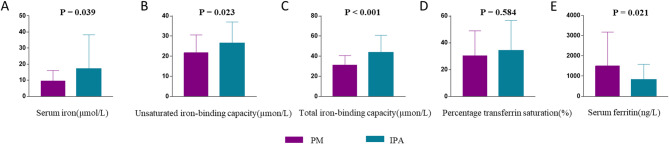
Pulmonary mucormycosis (PM) and invasive pulmonary aspergillosis (IPA) are both invasive pulmonary fungal infections with similar clinical manifestations. Few studies have focused on the expression of serum iron in patients with PM and IPA. A prospective, case‒control study was conducted between January 2023 and December 2024. Patients diagnosed with PM or IPA were assigned to the PM group or the IPA group, respectively. Clinical data were recorded for all enrolled patients. Serum iron, serum ferritin, unsaturated iron-binding capacity (UIBC), total iron-binding capacity (TIBC), and percentage transferrin saturation levels were determined via an automatic biochemical detector. A total of 58 patients with PM and 49 patients with IPA were enrolled. Nine patients in the PM group and one patient in the IPA group died during hospitalization. The serum iron, UIBC, and TIBC levels in the PM group were significantly lower than those in the IPA group (all p < 0.05). The serum ferritin level was significantly greater in the PM group than in the IPA group (p = 0.021). Binary logistic regression analysis revealed that only the TIBC level was an independent risk factor for PM [OR (95% CI) = 0.892 (0.839-0.947), p < 0.001]. Cox proportional hazards regression analysis revealed that the serum iron concentration [HR (95% CI) = 0.872 (0.784-0.969); p = 0.011] was an independent predictor of mortality risk in PM patients. Lower TIBC levels at admission were associated with a greater risk of PM, and reduced serum iron levels predict poor prognosis in patients with PM. Using IPA patients as controls, we preliminarily revealed aberrant iron metabolism in PM patients.Trial registration: ClinicalTrials.gov ID NCT06495905, Date of registration July 11, 2024 (retrospectively registered).
Overview
The claims and statistics of this paper haven’t been checked yet.
Run the check — free, no account needed. It reads the open-access text and checks the sources it cites.
Integrity signals
Registry
Cites
Statistics
Figures
Verification
Claims the paper makes
The claims and statistics of this paper haven’t been checked yet.
Run the check — free, no account needed. It reads the open-access text and checks the sources it cites.
Self-check
Percentages, sums and reported differences re-computed from the paper’s own numbers.
The self-check needs the paper’s full text.
Citations
Cites
Global incidence and mortality of severe fungal disease
Denning, D. W. (2024) · The Lancet Infectious Diseases · doi:10.1016/s1473-3099(23)00692-8 · Cited by 1,640 · cited 1×
“Assuming that in invasive pulmonary fungal infections, the incidence rates of PM and IPA were P 0 = 0.10 and P 1 = 0.70, respectively 9 .”
InfluentialIron in infection and immunity
Cassat, J. E., & Skaar, E. P. (2013) · Cell Host & Microbe · doi:10.1016/j.chom.2013.04.010 · Cited by 1,214
Regulation of cellular iron metabolism
Wang, J., & Pantopoulos, K. (2011) · Biochemical Journal · doi:10.1042/bj20101825 · Cited by 986
Research works printed but not linked: 26
- Muthu, V. et al. Has the mortality from pulmonary mucormycosis changed over time? A systematic review and meta-analysis. Clin. Microbiol. Infect. 27 (4), 538–549. https://doi.org/10.1016/j.cmi.2020.12.035 (2021). · DOI
- Pardo, E. et al. Invasive pulmonary aspergillosis in critically ill patients with hematological malignancies. Intensive Care Med. 45 (12), 1732–1741. https://doi.org/10.1007/s00134-019-05789-6 (2019). · DOI
- Alqarihi, A., Kontoyiannis, D. P. & Ibrahim, A. S. Mucormycosis in 2023: an update on pathogenesis and management. Front. Cell. Infect. Microbiol. 21, 13: 1254919. https://doi.org/10.3389/fcimb.2023.1254919 (2023). · DOI
- Tanwar, M. et al. Comprehensive review on the virulence factors and therapeutic strategies with the aid of artificial intelligence against mucormycosis. ACS Infect. Dis. 10 (5), 1431–1457. https://doi.org/10.1021/acsinfecdis.4c00082 (2024). · DOI
- Haas, H. Iron: a key nexus in the virulence of Aspergillus fumigatus. Front. Microbiol. 3, 28. https://doi.org/10.3389/fmicb.2012.00028 (2012). · DOI · Paper page
- Alqarihi, A. et al. GRP78 and integrins play different roles in host cell invasion during mucormycosis. mBio 11 (3), e01087–e01020. https://doi.org/10.1128/mBio.01087-20 (2020). · DOI
- Pathakumari, B., Liang, G. & Liu, W. Immune defense to invasive fungal infections: A comprehensive review. Biomed. Pharmacother. 130, 110550. https://doi.org/10.1016/j.biopha.2020.110550 (2020). · DOI
- Alexander, B. D. et al. Guidance on imaging for invasive pulmonary aspergillosis and mucormycosis: from the imaging working group for the revision and update of the consensus definitions of fungal disease from the EORTC/MSGERC. Clin. Infect. Dis. 72 (Suppl 2), S79–S88. https://doi.org/10.1093/cid/ciaa1855 (2021). · DOI
- Skiada, A., Pavleas, I. & Drogari-Apiranthitou, M. Epidemiology and diagnosis of mucormycosis: an update. J. Fungi (Basel). 6 (4), 265. https://doi.org/10.3390/jof6040265 (2020). · DOI
- Barker, K. R. et al. A practical workflow for the identification of aspergillus, fusarium, mucorales by MALDI-TOF MS: database, medium, and incubation optimization. J. Clin. Microbiol. 60 (12), e0103222. https://doi.org/10.1128/jcm.01032-22 (2022). · DOI
- Zhang, M. et al. Pulmonary artery pseudoaneurysm caused by pulmonary mucormycosis. Am. J. Respir Crit. Care Med. 209 (7), 879–880 (2024). · DOI
- Singh, A. et al. Lactoferrin, a potential iron-chelator as an adjunct treatment for mucormycosis - A comprehensive review. Int. J. Biol. Macromol. 187, 988–998. https://doi.org/10.1016/j.ijbiomac.2021.07.156 (2021). · DOI
- Happacher, I. et al. Fungal siderophore metabolism with a focus on Aspergillus fumigatus: impact on biotic interactions and potential translational applications. Essays Biochem. 67 (5), 829–842. https://doi.org/10.1042/EBC20220252 (2023). · DOI
- Nicolás, F. E. et al. Mucorales species and macrophages. J. Fungi (Basel). 6 (2), 94. https://doi.org/10.3390/jof6020094 (2020). · DOI
- Stanford, F. A. et al. Expression patterns in reductive iron assimilation and functional consequences during phagocytosis of lichtheimia corymbifera, an emerging cause of mucormycosis. J. Fungi (Basel). 7 (4), 272. https://doi.org/10.3390/jof7040272 (2021). · DOI
- Kumar, H. M. et al. Serum iron indices in COVID-19-associated mucormycosis: A case–control study. Mycoses 65 (1), 120–127. https://doi.org/10.1111/myc.13391 (2022). · DOI
- Dp, I., Yadhav Ml, K. & Gs, C. Is serum ferritin an early marker for COVID-19-Associated mucormycosis?? Cureus. ; 15(3): e36734. (2023). https://doi.org/10.7759/cureus.36734 · DOI
- Pai, V. et al. Rhino-orbito-cerebral mucormycosis: pictorial review. Insights Imaging. 12 (1), 167. https://doi.org/10.1186/s13244-021-01109-z (2021). · DOI
- Paidisetty, P. et al. Changing trend of risk factors of mucormycosis including diabetes, acidosis, and serum iron in the second wave of COVID-19. Indian J. Microbiol. 62 (4), 602–609. https://doi.org/10.1007/s12088-022-01038-5 (2022). · DOI
- Billesbølle, C. B. et al. Structure of hepcidin-bound Ferroportin reveals iron homeostatic mechanisms. Nature 586 (7831), 807–811. https://doi.org/10.1038/s41586-020-2668-z (2020). · DOI · Paper page
- Pasricha, S. R. et al. Iron deficiency. Lancet 16 (10270), 233–248. https://doi.org/10.1016/S0140-6736(20)32594-0 (2021). · DOI · Paper page
- Ueda, T. et al. Serum iron: a new predictor of adverse outcomes independently from serum hemoglobin levels in patients with acute decompensated heart failure. Sci. Rep. 11 (1), 2395. https://doi.org/10.1038/s41598-021-82063-0 (2021). · DOI
- Shu, J. et al. Elevated serum iron level is a predictor of prognosis in ICU patients with acute kidney injury. BMC Nephrol. 21 (1), 303. https://doi.org/10.1186/s12882-020-01965-9 (2020). · DOI
- Yang, Y., Li, Y. & Chen, Z. Impact of low serum iron on treatment outcome of PD-1 inhibitors in advanced gastric cancer. BMC Cancer. 23 (1), 1095. https://doi.org/10.1186/s12885-023-11620-9 (2023). · DOI
- Lan, P. et al. Preoperative iron status is a prognosis factor for stage II and III colorectal cancer. Int. J. Clin. Oncol. 26 (11), 2037–2045. https://doi.org/10.1007/s10147-021-01995-9 (2021). · DOI
- Lan, P. et al. High serum iron level is associated with increased mortality in patients with sepsis. Sci. Rep. 8 (1), 11072. https://doi.org/10.1038/s41598-018-29353-2 (2018). · DOI
Metadata
- Authors
- Luo, Q., He, X., Xu, J., Li, L., Zhao, L., & Mu, X.
- Affiliations
- Beijing Tsinghua Chang Gung Hospital (CN)
- Corresponding author
- Mu, Xiangdong
- Venue
- Scientific Reports
- Published
- 2025-08-19
- Volume
- 15
- Issue
- 1
- Pages
- 30395-30395
- ISSN
- 2045-2322 (ISSN-L)
- PMC
- PMC12365034
- OpenAlex
- W4413329062
- Cited by
- 1
- References
- 3
- Citations by year
- 2026: 1
- FWCI
- 0.77
- Type
- journal article
- Language
- en
- Open access
- gold
- doi.org
- Licence
- Locations
- Scientific Reports (publishedVersion, cc-by-nc-nd)
- Research Square (acceptedVersion, cc-by)
- PubMed Central (publishedVersion, cc-by-nc-nd)
- PubMed (publishedVersion)
- DOAJ (DOAJ: Directory of Open Access Journals) (submittedVersion, cc-by-sa)
- Funders
- Beijing Hospitals Authority Clinical Medicine Development of special funding support (ZLRK202323)
- Topics
- Health Sciences › Medicine › Infectious Diseases › Antifungal resistance and susceptibility
- Health Sciences › Medicine › Infectious Diseases › Fungal Infections and Studies
- Health Sciences › Medicine › Hematology › Iron Metabolism and Disorders
- Keywords
- pulmonary mucormycosis, invasive pulmonary aspergillosis, serum iron, total iron binding capacity, serum ferritin, iron metabolism, prognostic factors, mortality risk, invasive pulmonary fungal infection
- MeSH terms
- Adult, Aged, Female, Ferritins, Humans, Iron, Lung Diseases, Fungal, Male, Middle Aged, Mucormycosis, Prognosis, Prospective Studies, Risk Factors, Biomarkers, Case-Control Studies, Invasive Pulmonary Aspergillosis
About these checks
Registry, retraction, Cites and statistics results are computed, not judged, with one exception: a printed reference that no index lists is read once by a model before it counts as a citation error. Claims are extracted by a model and kept only when their quote appears verbatim in the text; each cited source is then checked, with a model’s help, for whether it says what the claim relies on. Those verdicts can be wrong — read the claim’s quote and the cited source before relying on one.
Statistics and arithmetic are recomputed, not judged.
Confidence bands are shown only for fields calibrated on our annotated test set. None is calibrated yet, so no band is shown.
What counts as a claim ›How we measure confidence ›How we check this ›
Are you an author, or do you see a problem with this page? Request a review
How to cite
Cite CoChat for the checks on this page, and the paper for its own findings.
- This page
- CoChat. (2026). Citation check: Reduced serum iron levels predict poor prognosis in pulmonary mucormycosis patients: a prospective, case‒control study. https://app.cochat.ai/papers/10.1038/s41598-025-15186-3
- The paper
- Luo, Q., He, X., Xu, J., Li, L., Zhao, L., & Mu, X. (2025). Reduced serum iron levels predict poor prognosis in pulmonary mucormycosis patients: a prospective, case‒control study. Scientific Reports. https://doi.org/10.1038/s41598-025-15186-3
