

Deep learning with leagues championship algorithm based intrusion detection on cybersecurity driven industrial IoT systems
Open accessThe DOI matches its Crossref record; 30 of the 30 references it cites were found in a registry or an index.
Abstract
The Internet of Things (IoT) presents significant advantages to day-to-day life across a wide range of application domains, including healthcare automation, transportation, and smart environments. However, owing to the constraints of limited resources and computation abilities, IoT networks are subject to different cyber-attacks. Incorporating IDS into the cybersecurity-driven IIoT process contains cautious deployment, planning, and progressing management. Cybersecurity is crucial for the protection of sensitive data, safeguarding the privacy of users, and securing important substructures from malicious activities attempting unauthorized access or triggering interferences. Cyberattack detection performs a vital role in this defense scheme, employing advanced technologies like deep learning (DL) for analysing digital activities in real time. With the help of recognizing and responding to possible cyber-attacks quickly, cyberattack detection not only mitigates risks but reinforces the overall flexibility of the digital ecosystem against developing security challenges. This study presents a League Championship Algorithm Feature Selection with Optimal Deep Learning based Cyberattack Detection (CLAFS-ODLCD) technique for securing the digital ecosystem. The CLAFS-ODLCD technique focuses on the recognition and classification of cyberattacks in the IoT infrastructure. To achieve this, the CLAFS-ODLCD method utilizes the linear scaling normalization (LSN) approach for data pre-processing. Furthermore, the CLAFS-ODLCD method employs the CLAFS approach to choose optimal feature subset. Moreover, the detection and classification of the cyberattacks are accomplished by implementing the stacked sparse autoencoder (SSAE) approach. Finally, the hunger games search (HGS) optimizer is employed for optimum hyperparameter selection. The empirical analysis of the CLAFS-ODLCD method is examined under the WSN-DS dataset. The comparison study of the CLAFS-ODLCD method portrayed a superior accuracy value of 99.48% over existing models.
Overview
CoChat Summary
TL;DR
The paper proposes CLAFS-ODLCD, a pipeline combining LSN normalization, League Championship Algorithm feature selection, stacked sparse autoencoder classification, and hunger games search hyperparameter tuning for intrusion detection in IIoT/IoT systems. On the WSN-DS dataset it reports up to 99.48% average accuracy and 1.09 s computational time, outperforming compared models.
Key findings
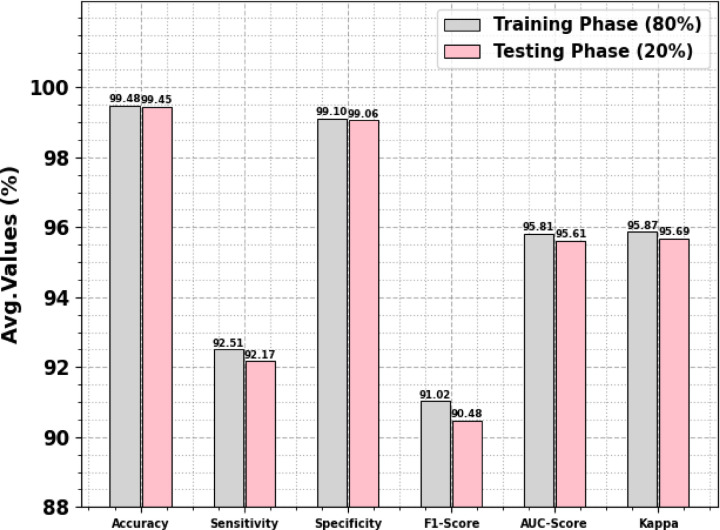
- On WSN-DS with 80% training and 20% testing, CLAFS-ODLCD reports averages of 99.48%, 92.51%, 99.10%, 91.02%, 95.81%, and Kappa of 95.87%; with 20% testing it reports 99.45%, 92.17%, 99.06%, 90.48%, 95.61%, and Kappa of 95.69%.
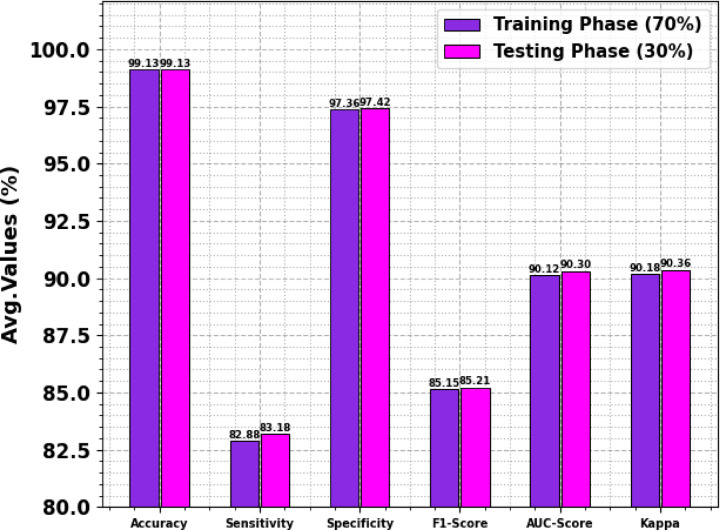
- With 70% training and 30% testing, it reports averages of 99.13%, 82.88%, 97.36%, 85.15%, 90.12%, and Kappa of 90.18%; with 30% testing it reports 99.13%, 83.18%, 97.42%, 85.21%, 90.30%, and Kappa of 90.36%.
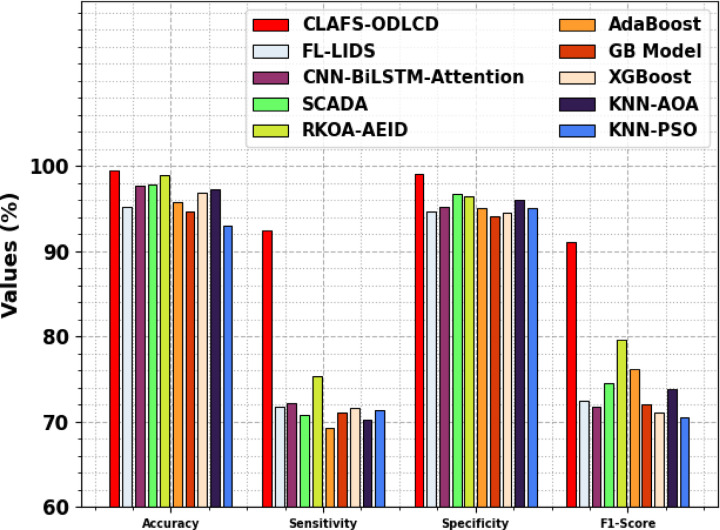
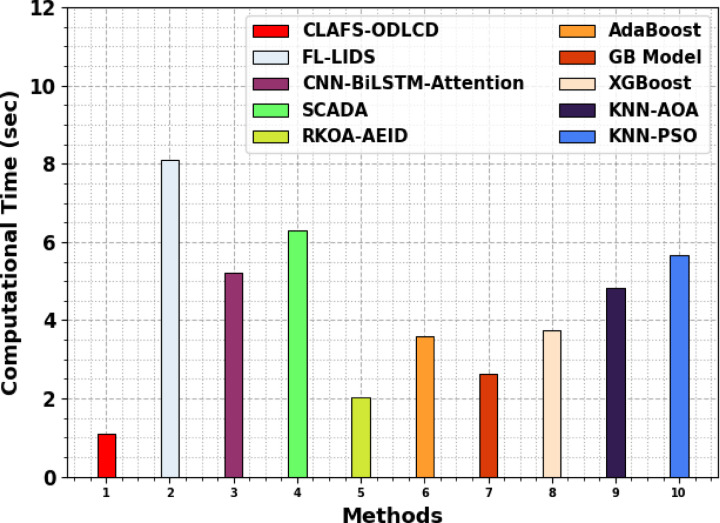
- In comparison, the method reaches a maximal 99.48%, 92.51%, 99.10%, and 91.02%, and completes tasks in 1.09 s versus FL-LIDS at 8.09 s, CNN-BiLSTM-Attention at 5.22 s, and SCADA at 6.31 s, reducing computational overhead by approximately 70 to 85 percent.
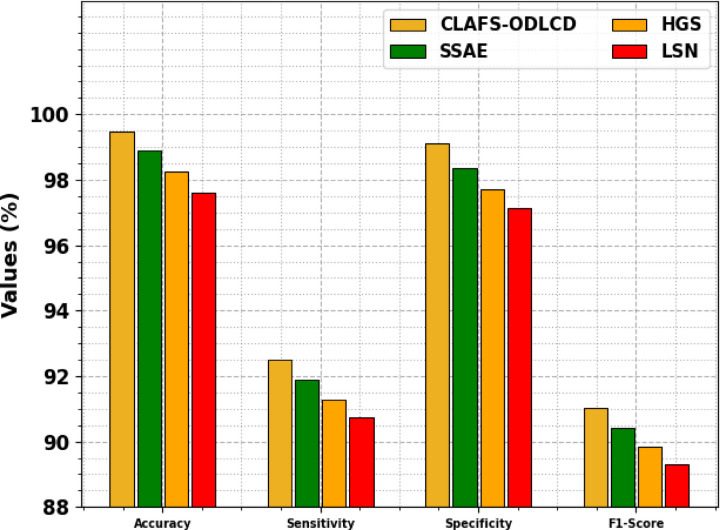
- Ablation results show the full CLAFS-ODLCD at 99.48%, 92.51%, 99.10%, and 91.02%; SSAE at 98.91%, 91.89%, 98.35%, and 90.43%; HGS at 98.26%, 91.29%, 97.70%, and 89.85%; and LSN at 97.61%, 90.75%, 97.12%, and 89.32%.
Methods
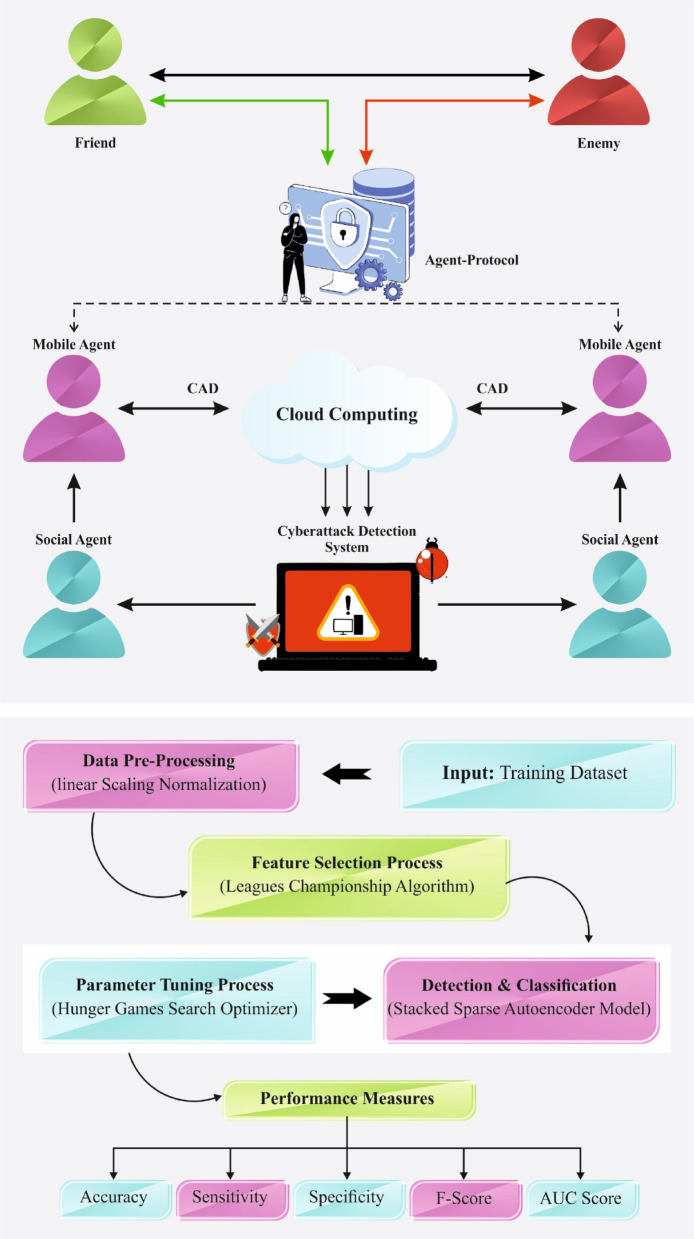
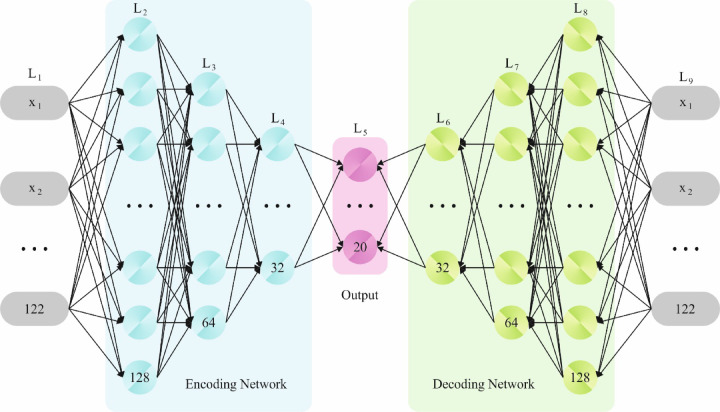
- The proposed CLAFS-ODLCD technique uses LSN-based data normalization, CLA-based feature selection, SSAE-based classification, and HGS-based hyperparameter tuning.
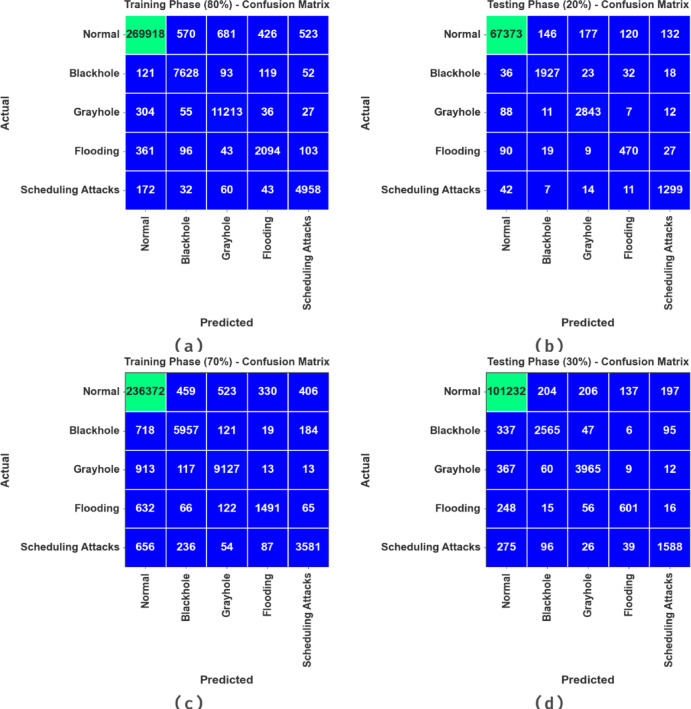
- Validation uses the WSN-DS dataset with 374,661 samples and 5 classes, evaluated under 80%TRAPH:20%TESPH and 70%TRAPH:30%TESPH splits; implementation runs on Python 3.6.5 with an i5-8600k CPU, 4GB GPU, 16GB RAM, 250GB SSD, and 1TB HDD, using a 0.01 learning rate, ReLU, 50 epochs, 0.5 dropout, and batch size 5.
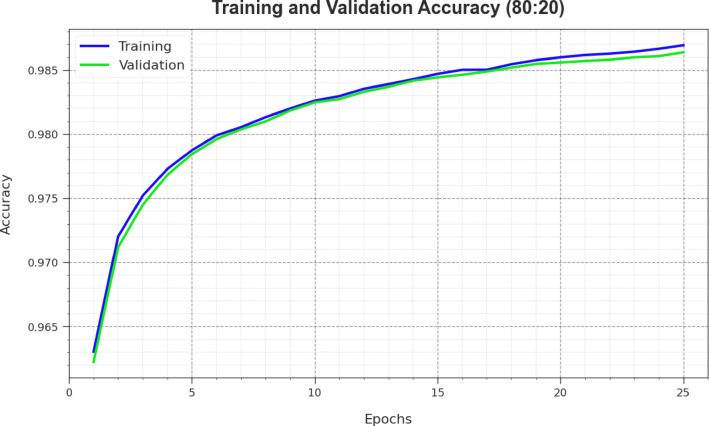
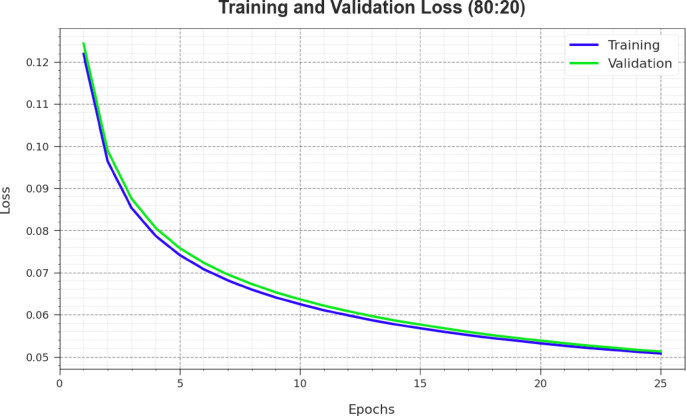
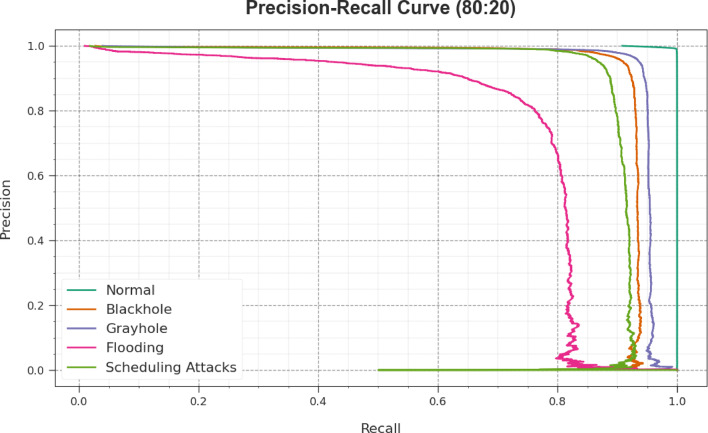
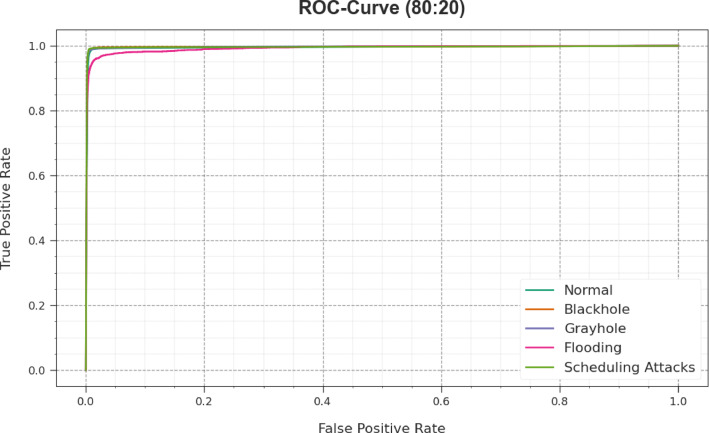
- Main analyses include confusion matrices, training/validation accuracy and loss curves, PR and ROC curves, comparison with existing models, computational time comparison, and an ablation study.
Limitations
- The paper does not explicitly state limitations of the proposed CLAFS-ODLCD method.
- Evident from the text: validation is limited to the WSN-DS dataset, with no cross-dataset or real IIoT deployment validation reported.
- Evident from the text: several metric labels and equations/tables are incomplete in the provided text, making some reported averages hard to map to named metrics; the paper also notes general challenges for existing models such as computational complexity, scalability, adaptability, and interpretability, but does not test these for its own method.
Model-written summary. Check it against the paper before relying on it.
Integrity signals
Registry
Cites
Statistics
Figures
Verification
Claims the paper makes
0 Valid · 0 Not valid · 0 Not checked · 29 Own results and interpretations
A result the paper reports from its own data — it cites no other source for it, so there is none to check. The quote shows it is in the paper.
In the paper
“The ablation study results show that the CLAFS-ODLCD method achieves an of 99.48%, of 92.51%, of 99.10%, and an of 91.02%.”
§ Deep learning with leagues championship algorithm based intrusion detection on cybersecurity driven industrial IoT systems > Result analysis
plain- Asserted: passes — The authors put it forward as true.
- Checkable: passes — It can be checked against evidence.
- Load-bearing: passes — The paper’s conclusions depend on it.
- Based: passes — The paper gives a reason why it holds.
A result the paper reports from its own data — it cites no other source for it, so there is none to check. The quote shows it is in the paper.
In the paper
“With 70%TRAPH, the CLAFS-ODLCD methodology reaches an average of 99.13%, of 82.88%, of 97.36%, of 85.15%, of 90.12%, and Kappa of 90.18%, appropriately.”
§ Deep learning with leagues championship algorithm based intrusion detection on cybersecurity driven industrial IoT systems > Result analysis
plain- Asserted: passes — The authors put it forward as true.
- Checkable: passes — It can be checked against evidence.
- Load-bearing: passes — The paper’s conclusions depend on it.
- Based: passes — The paper gives a reason why it holds.
A result the paper reports from its own data — it cites no other source for it, so there is none to check. The quote shows it is in the paper.
In the paper
“Lastly, LSN attains an of 97.61%, of 90.75%, of 97.12%, and an of 89.32%.”
§ Deep learning with leagues championship algorithm based intrusion detection on cybersecurity driven industrial IoT systems > Result analysis
plain- Asserted: passes — The authors put it forward as true.
- Checkable: passes — It can be checked against evidence.
- Load-bearing: passes — The paper’s conclusions depend on it.
- Based: passes — The paper gives a reason why it holds.
A result the paper reports from its own data — it cites no other source for it, so there is none to check. The quote shows it is in the paper.
In the paper
“SSAE records an of 98.91%, of 91.89%, of 98.35%, and of 90.43%.”
§ Deep learning with leagues championship algorithm based intrusion detection on cybersecurity driven industrial IoT systems > Result analysis
plain- Asserted: passes — The authors put it forward as true.
- Checkable: passes — It can be checked against evidence.
- Load-bearing: passes — The paper’s conclusions depend on it.
- Based: passes — The paper gives a reason why it holds.
A result the paper reports from its own data — it cites no other source for it, so there is none to check. The quote shows it is in the paper.
In the paper
“The comparison study of the CLAFS-ODLCD method portrayed a superior accuracy value of 99.48% over existing models.”
- Also stated in: § Result analysis · plain
“Although the RKOA-AEID technique has gained reasonable performance, the CLAFS-ODLCD method reaches greater performance with a maximal of 99.48%, of 92.51%, of 99.10%, and of 91.02%.”
§ Deep learning with leagues championship algorithm based intrusion detection on cybersecurity driven industrial IoT systems > Abstract
plainstates a cause- Asserted: passes — The authors put it forward as true.
- Checkable: passes — It can be checked against evidence.
- Load-bearing: passes — The paper’s conclusions depend on it.
- Based: passes — The paper gives a reason why it holds.
- Rests on an assumption not shown here.
- Also stated in: § Result analysis · plain
11 more claims
Create a free account to see all 29 claims and every source verdict.
- It may state two separate claims as one. 9
- Probably not a substantial claim. 6
Citations
Cites
Deep learning enabled intrusion detection system for Industrial IOT environment
Nandanwar, H., & Katarya, R. (2024) · Expert Systems with Applications · doi:10.1016/j.eswa.2024.123808 · Cited by 223
A long short-term memory based approach for detecting cyber attacks in IoT using CIC-IoT2023 dataset
Jony, A. I., & Arnob, A. K. B. (2024) · Journal of Edge Computing · doi:10.55056/jec.648 · Cited by 173
DDoS attack detection and mitigation using deep neural network in SDN environment
Hnamte, V., Najar, A. A., Nhung-Nguyen, H., Hussain, J., & Sugali, M. N. (2024) · Computers & Security · doi:10.1016/j.cose.2023.103661 · Cited by 164
Nandanwar, H., & Katarya, R. (2023) · International Journal of Information Security · doi:10.1007/s10207-023-00787-8 · Cited by 119
Mafarja, M., Thaher, T., Al-Betar, M. A., Too, J., Awadallah, M. A., Abu Doush, I., & Turabieh, H. (2023) · Applied Intelligence · doi:10.1007/s10489-022-04427-x · Cited by 91
Malik, V., Mittal, R., Mavaluru, D., Narapureddy, B. R., Goyal, S. B., Martin, J., Srinivasan, K., & Mittal, A. (2023) · IEEE Access · doi:10.1109/access.2023.3293529 · Cited by 84
Nandanwar, H., & Katarya, R. (2025) · Computers & Electrical Engineering · doi:10.1016/j.compeleceng.2025.110161 · Cited by 82
Bhandari, G., Lyth, A., Shalaginov, A., & Grønli, T.-M. (2023) · Electronics · doi:10.3390/electronics12020298 · Cited by 79
Vijayakumar, K. P., Pradeep, K., Balasundaram, A., & Prusty, M. R. (2023) · Processes · doi:10.3390/pr11041072 · Cited by 66
A Systematic Analysis of Enhancing Cyber Security Using Deep Learning for Cyber Physical Systems
Gaba, S., Budhiraja, I., Kumar, V., Martha, S., Khurmi, J., Singh, A., Singh, K. K., Askar, S. S., & Abouhawwash, M. (2024) · IEEE Access · doi:10.1109/access.2023.3349022 · Cited by 62
Research works printed but not linked: 3
- Abou-Elasaad, M. M., Sayed, S. G. & El-Dakroury, M. M. Securing the future: Real-time intrusion detection in IIoT smart grids through innovative AI solutions. J. Cybersecur. Inf. Manag. 15(2), 208 (2025).
- Qureshi, S. et al. An Adaptive multi-layer architecture for IoT-based IDPS for attacks using deep learning method. Int. J. Netw. Secur. 24(5), 815–827 (2022).
- Padmapriya, V. & Srivenkatesh, M. iot network-based cyber attack mitigation in digital twin with multi-level key management using enhanced KNN Model. Int. J. Intell. Syst. Appl. Eng. 12(14s), 49–62 (2024).
Cited by
Intrusion Detection System for Cybersecurity Using Supervised and Unsupervised Models on CIC-IDS2017
Sharma, V., & Kumar, M. (2025) · IEEE International Conference on Innovate for Humanitarian: Tech Solutions for Global Challenge (ICIH) · doi:10.1109/icih67754.2025.11609046
Metadata
- Authors
- Alotaibi, S. S., & Alghamdi, T. A.
- Affiliations
- Umm al-Qura University (SA)
- Corresponding author
- Alotaibi, Saud S.
- Venue
- Scientific Reports
- Published
- 2025-08-19
- Volume
- 15
- Issue
- 1
- Pages
- 30296-30296
- ISSN
- 2045-2322 (ISSN-L)
- PMC
- PMC12365083
- OpenAlex
- W4413304082
- Semantic Scholar
- 20d0c4fe1050eba2ea770732c1a76750d0ef452f
- Cited by
- 2
- References
- 28
- Citations by year
- 2026: 1 · 2025: 1
- FWCI
- 0.84
- Type
- journal article
- Language
- en
- Open access
- gold
- doi.org
- Licence
- cc-by
- creativecommons.org/licenses/by/4.0 (tdm)
- creativecommons.org/licenses/by/4.0 (vor)
- Locations
- Scientific Reports (publishedVersion, cc-by)
- PubMed Central (publishedVersion, cc-by)
- PubMed (publishedVersion)
- DOAJ (DOAJ: Directory of Open Access Journals) (submittedVersion, cc-by-sa)
- Topics
- Physical Sciences › Computer Science › Computer Networks and Communications › Network Security and Intrusion Detection
- Physical Sciences › Computer Science › Information Systems › Internet of Things and AI
- Physical Sciences › Computer Science › Artificial Intelligence › Artificial Immune Systems Applications
- Keywords
- intrusion detection, Industrial Internet of Things, cyberattack detection, league championship algorithm, feature selection, stacked sparse autoencoder, Hunger Games Search, hyperparameter optimization, WSN-DS dataset, Internet of Things security
About these checks
Registry, retraction, Cites and statistics results are computed, not judged, with one exception: a printed reference that no index lists is read once by a model before it counts as a citation error. Claims are extracted by a model and kept only when their quote appears verbatim in the text; each cited source is then checked, with a model’s help, for whether it says what the claim relies on. Those verdicts can be wrong — read the claim’s quote and the cited source before relying on one.
A language model drew the claims from the paper on 2026-10-11, under version 3 of the claim definition (model deepseek-v4.1-flash, prompt extract-v3).
A second model labelled each claim on 2026-10-11 (model jev-1.13-20260917, definition revision gold-guideline-v0.2).
Statistics and arithmetic are recomputed, not judged.
Confidence bands are shown only for fields calibrated on our annotated test set. None is calibrated yet, so no band is shown.
What counts as a claim ›How we measure confidence ›How we check this ›
Are you an author, or do you see a problem with this page? Request a review
How to cite
Cite CoChat for the checks on this page, and the paper for its own findings.
- This page
- CoChat. (2026). Citation check: Deep learning with leagues championship algorithm based intrusion detection on cybersecurity driven industrial IoT systems. https://app.cochat.ai/papers/10.1038/s41598-025-15464-0
- The paper
- Alotaibi, S. S., & Alghamdi, T. A. (2025). Deep learning with leagues championship algorithm based intrusion detection on cybersecurity driven industrial IoT systems. Scientific Reports. https://doi.org/10.1038/s41598-025-15464-0
Data sources
Bibliographic data: Semantic Scholar, OpenAlex, Crossref.
Contains information from the Semantic Scholar Academic Graph Datasets, made available under the ODC Attribution License (ODC-BY 1.0).
Semantic Scholar’s data is described in: Kinney, R., et al. (2023). The Semantic Scholar Open Data Platform. arXiv:2301.10140.
