

The impact of fly ash and slag on the microscopic interface of recycled concrete and its destruction evolution
Open accessThe DOI matches its Crossref record; 53 of the 53 references it cites were found in a registry or an index; none of the 32 sources its claims cite is checked for support yet.
Abstract
The interfacial transition zones in recycled concrete are the main factors affecting their durability and strength. The interfacial transition zones (ITZS) in recycled concrete are the main factors affecting durability and strength, yet their response to combined use of fly ash and slag remains insufficiently understood. This study investigates the influence of different replacement levels of recycled aggregate, fly ash, and slag on ITZS properties through both microscopic and macroscopic testing, combined with numerical simulation of the failure process. The results show that the minimal ITZS effect occurred when the recycled aggregate content was 40% and slag content was 10%, under which the compressive strength reached 32.8 MPa and the splitting tensile strength reached 3.21 MPa, representing reductions of only 4.5% and 5.2% compared with ordinary concrete, respectively. Microscopic observations revealed that cracks initiate predominantly in porous ITZS regions and propagate inward, a process well captured by the cohesive zone model simulations. These findings indicate that a balanced combination of recycled aggregate, fly ash, and slag can achieve mechanical performance comparable to conventional concrete, offering a viable approach to promote sustainable utilization of industrial by-products in structural applications. Specifically, under these conditions, the compressive strength reached 32.8 MPa and the splitting tensile strength reached 3.21 MPa, representing reductions of only 4.5% and 5.2% compared with ordinary concrete, respectively. These results indicate that partial substitution of recycled aggregate combined with moderate slag content can produce concrete with mechanical performance comparable to that of conventional concrete, while promoting sustainable use of industrial by-products in structural applications. In addition, the failure of recycled concrete was demonstrated based on microscopic results, from which the failure of recycled concrete was found to be a gradual failure from the outside to the inside. The failure zone first appeared in the interfacial transition zones with large porosities and large area, where internal cracks were generated and gradually spread. Structural failure occurred after the cracks had penetrated.
Overview
CoChat Summary
TL;DR
This study combined macro/micro testing and cohesive zone simulation to assess how recycled aggregate, fly ash, and slag affect the interfacial transition zones (ITZS) and failure of recycled concrete. It reports that a 40% recycled aggregate + 10% slag mix minimized ITZS effects, reaching 32.8 MPa compressive and 3.21 MPa splitting tensile strength, only 4.5% and 5.2% below ordinary concrete.
Key findings
- The minimal ITZS effect occurred at 40% recycled aggregate and 10% slag, with compressive strength 32.8 MPa and splitting tensile strength 3.21 MPa, reductions of only 4.5% and 5.2% versus ordinary concrete.
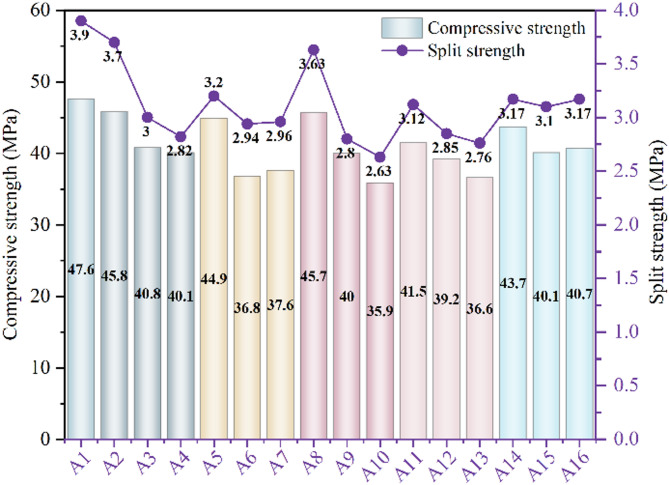
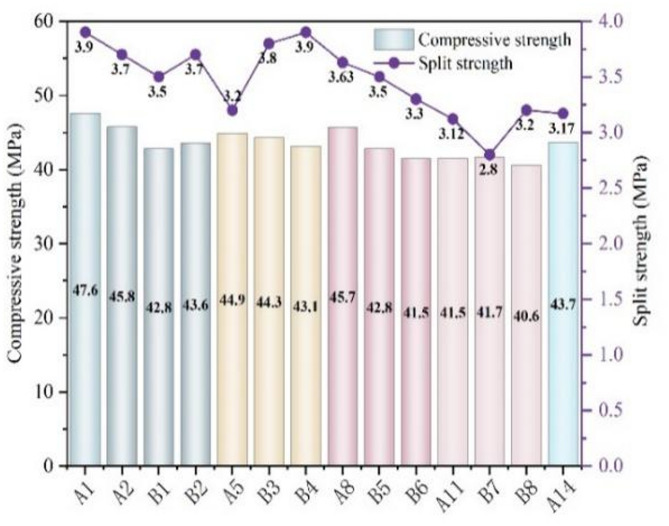
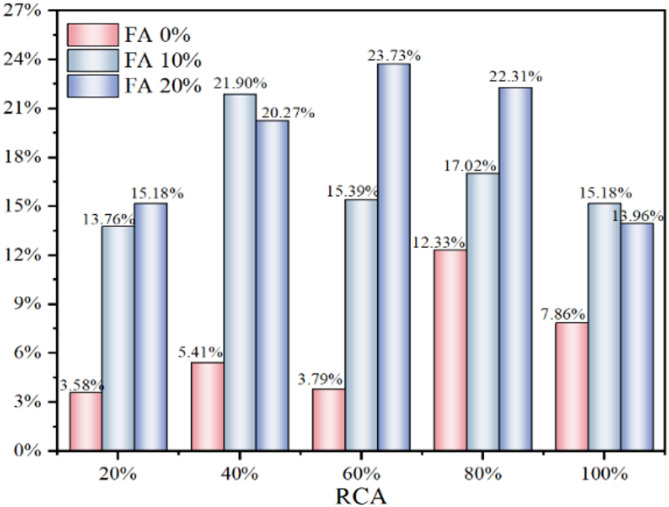
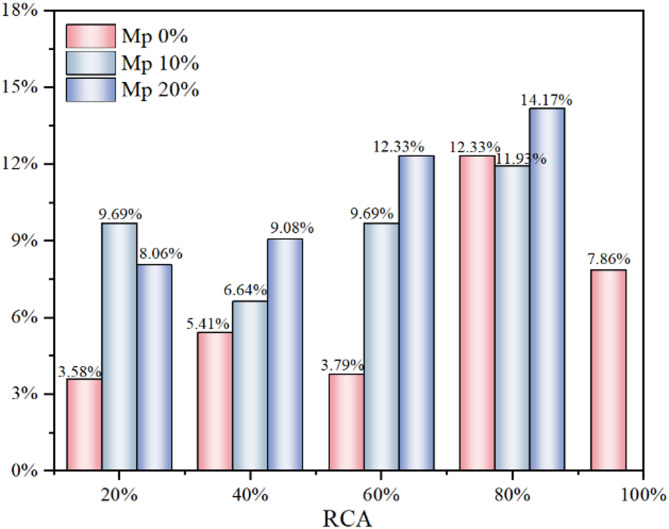
- With increasing fly ash content and recycled aggregate replacement rate, compressive and splitting strength decreased; recycled aggregate replacement caused compressive strength fluctuation between 3.78% and 12.82%. Fly ash at 10% affected strength change by 15.76%–22.69%, at 20% by 14.50%–24.58%; slag at 10% affected 6.93%–12.39%, at 20% 8.40%–14.71%.
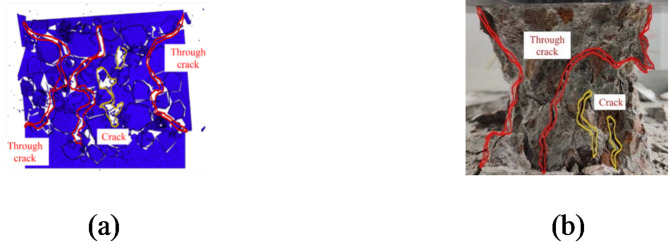
- Microscopic observations and cohesive zone model simulations showed cracks initiate predominantly in porous ITZS regions and propagate inward; failure is gradual from outside to inside, with failure zones connecting into penetrating cracks. Crack widths averaged 0.35–0.50 mm for 100% recycled aggregate with high fly ash, versus 0.15–0.25 mm for 40% recycled aggregate with slag.
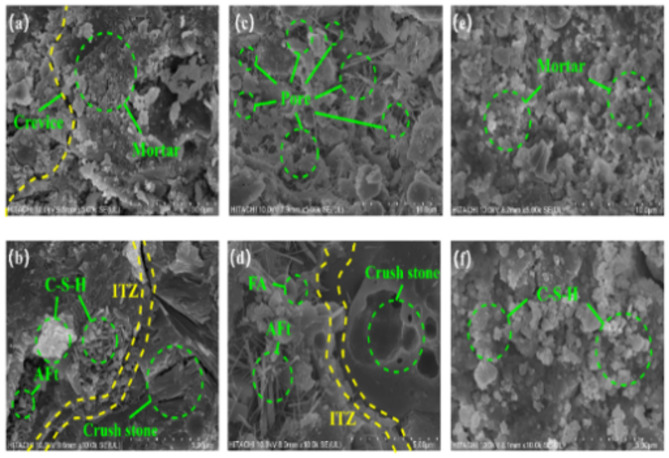
- Fly ash and slag reduce cement hydration, decreasing C-S-H gel formation and increasing ITZS porosity, with fly ash having a greater effect than slag.
Methods
- Two-factor mix design with 24 groups: slag and fly ash replacement rates of 0%, 10%, and 20%; recycled aggregate replacement rates of 0%, 20%, 40%, 60%, 80%, and 100%; fixed water-binder ratio 0.44, sand ratio 32.7%, and water 166 kg/m³. Materials included P·O32.5 ordinary Portland cement, Class I fly ash, S95 slag, natural river sand, and natural/recycled coarse aggregate.
- Compressive strength tested on 100 × 100 × 100 mm cubes at 28 days at 0.5 MPa/s; splitting tensile strength on 100 mm diameter × 200 mm cylinders; optical microscopy and SEM at 15 kV; following GB/T 50081-2019 and GB/T 50080-2016.
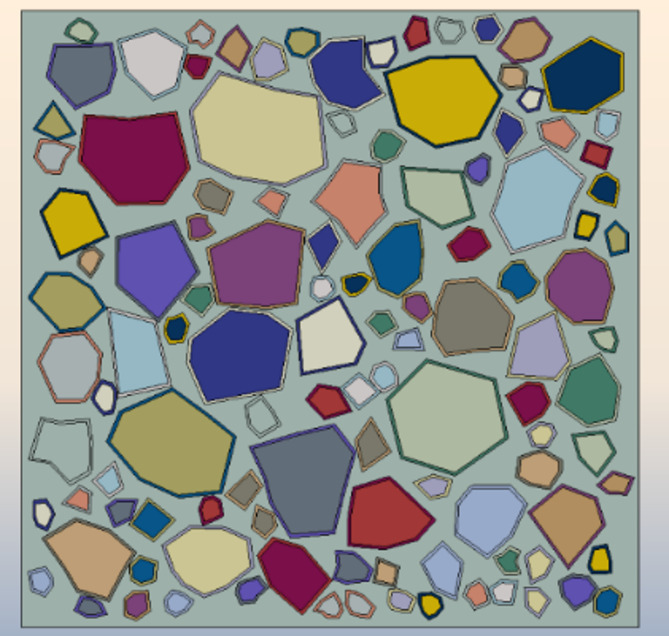
- Cohesive zone model implemented in ABAQUS to simulate crack initiation and propagation in multiple ITZS, using a random polygonal aggregate model of 100 × 100 × 100 mm, aggregate volume fraction 60%, maximum particle size <20 mm, minimum 5 mm, and a 2 mm old mortar layer; parameters calibrated from experiments.
Limitations
- Stated: controlled laboratory conditions, fixed water-binder ratio, and limited mechanical performance indicators; environmental exposure effects, long-term durability, and large-scale structural behavior were not evaluated; future work should explore wider replacement levels and additional durability parameters.
- Evident: Table 3 rows B6–B8 appear malformed/duplicated, leaving some mix proportions unclear; some ITZS optima differ between Results and Conclusion/Abstract (e.g., fly ash least ITZS influence at 100% recycled aggregate and 20% fly ash in Conclusion vs Results stating 20% recycled aggregate with 10% fly ash had negligible effect).
Model-written summary. Check it against the paper before relying on it.
Integrity signals
Registry
Cites
Statistics
Figures
Verification
Claims the paper makes
0 Valid · 0 Not valid · 20 Not checked · 73 Own results and interpretations
A result the paper states — it cites no source for it, so there is none to check. The quote shows it is in the paper.
In the paper
“Structural failure occurred after the cracks had penetrated.”
§ The impact of fly ash and slag on the microscopic interface of recycled concrete and its destruction evolution > Abstract
plainstates a cause- Asserted: passes — The authors put it forward as true.
- Checkable: passes — It can be checked against evidence.
- Load-bearing: unclear — It is unclear whether the paper’s conclusions depend on it.
- Based: passes — The paper gives a reason why it holds.
A result the paper reports from its own data — it cites no other source for it, so there is none to check. The quote shows it is in the paper.
In the paper
“with an increase in the fly ash content and recycled aggregate replacement rate, the compressive and splitting strength decreased”
§ The impact of fly ash and slag on the microscopic interface of recycled concrete and its destruction evolution > Results > Macro strength analysis
plainstates a causen = 3- Asserted: passes — The authors put it forward as true.
- Checkable: passes — It can be checked against evidence.
- Load-bearing: passes — The paper’s conclusions depend on it.
- Based: passes — The paper gives a reason why it holds.
A result the paper reports from its own data — it cites no other source for it, so there is none to check. The quote shows it is in the paper.
In the paper
“When the replacement amount of fly ash is 10% and the recycled aggregate is mixed simultaneously, it can be calculated according to the strength change that fly ash can affect the strength change of recycled concrete by 15.76%~22.69%.”
§ The impact of fly ash and slag on the microscopic interface of recycled concrete and its destruction evolution > Results > Macro strength analysis
plainstates a causen = 3- Asserted: passes — The authors put it forward as true.
- Checkable: passes — It can be checked against evidence.
- Load-bearing: passes — The paper’s conclusions depend on it.
- Based: passes — The paper gives a reason why it holds.
A result the paper reports from its own data — it cites no other source for it, so there is none to check. The quote shows it is in the paper.
In the paper
“under which the compressive strength reached 32.8 MPa”
§ The impact of fly ash and slag on the microscopic interface of recycled concrete and its destruction evolution > Abstract
plainstates an association- Asserted: passes — The authors put it forward as true.
- Checkable: passes — It can be checked against evidence.
- Load-bearing: passes — The paper’s conclusions depend on it.
- Based: passes — The paper gives a reason why it holds.
None of the sources cited for this claim have been checked yet.
In the paper
“When the recycled aggregate is 40% and 100%, the compressive strength and splitting strength will be slightly improved with increasing fly ash content27,28.”
§ The impact of fly ash and slag on the microscopic interface of recycled concrete and its destruction evolution > Results > Macro strength analysis
What the sources say
- Not checked yetcites [27] Zhou, C. & Chen, Z. Mechanical properties of recycled concrete made with different types of coarse aggregate. Constr. Build. Mater. 134, 497–506. 10.1016/j.conbuildmat.2016.12.163 (2017). source
- Not checked yetcites [28] Shi, X. S. et al. Mechanical properties and microstructure analysis of fly Ash geopolymeric recycled concrete. J. Hazard. Mater. 237, 20–29. 10.1016/j.jhazmat.2012.07.070 (2012). 22954605 source
plainstates a cause- Asserted: passes — The authors put it forward as true.
- Checkable: passes — It can be checked against evidence.
- Load-bearing: passes — The paper’s conclusions depend on it.
- Based: passes — The paper gives a reason why it holds.
47 more claims
Create a free account to see all 93 claims and to verify the 30 references still open.
- It may state two separate claims as one. 36
- The quote only partly states this claim. 1
- Probably not a substantial claim. 10
Self-check
Percentages, sums and reported differences re-computed from the paper’s own numbers.
Each contradiction between two passages listed here was confirmed by an independent check.
Rated major: it would touch a result — a value a result rests on, reported and recomputed p-values on opposite sides of the significance level, two passages that conflict with no sign which is right, or a cited work retracted before this paper was published.
In the paper
§ The impact of fly ash and slag on the microscopic interface of recycled concrete and its destruction evolution > Experimental > Mix design
“In the 24 groups of the two-factor mix design, the water-binder ratio was fixed at 0.44, the sand ratio was 32.7% according to experience, and the water consumption was fixed at 166 kg/m3.”
§ The impact of fly ash and slag on the microscopic interface of recycled concrete and its destruction evolution > Experimental > Methods
“| A3 | 20% | 10% | 0 | 38 | 0 | 240 | 959 | 582 | 377 | 166 |”
Rated minor: it would not touch a result — a value no result rests on, a p-value that stays on the same side of the significance level, or a conflict that is clerical, resolved elsewhere in the paper, or outside its own findings.
In the paper
§ The impact of fly ash and slag on the microscopic interface of recycled concrete and its destruction evolution > Abstract
“The failure zone first appeared in the interfacial transition zones with large porosities and large area, where internal cracks were generated and gradually spread.”
§ The impact of fly ash and slag on the microscopic interface of recycled concrete and its destruction evolution > Simulation and destruction > Destruction analysis
“Failure first occurred in the ITZS, which had large outer pores and small areas.”
Rated minor: it would not touch a result — a value no result rests on, a p-value that stays on the same side of the significance level, or a conflict that is clerical, resolved elsewhere in the paper, or outside its own findings.
In the paper
§ The impact of fly ash and slag on the microscopic interface of recycled concrete and its destruction evolution > Introduction
“Chen et al.14 investigated the particle characteristics of supplementary cementitious materials, which directly affect workability and hydration.”
§ The impact of fly ash and slag on the microscopic interface of recycled concrete and its destruction evolution > References
“14. Nukah, P. D., Abbey, S. J., Booth, C. A. & Nounu, G. Mapping and synthesizing the viability of cement replacement materials via a systematic review and meta-analysis.”
Rated minor: it would not touch a result — a value no result rests on, a p-value that stays on the same side of the significance level, or a conflict that is clerical, resolved elsewhere in the paper, or outside its own findings.
In the paper
§ The impact of fly ash and slag on the microscopic interface of recycled concrete and its destruction evolution > Results > Microscopic results and analysis
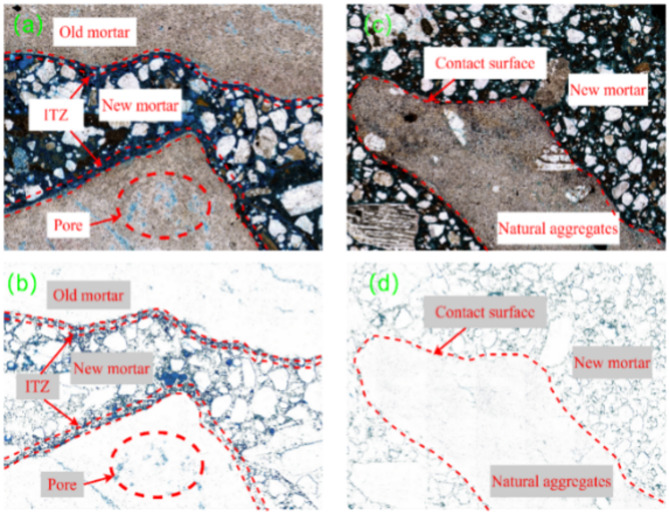
“Figure 6c shows the recycled concrete test block under the conditions of full replacement of recycled aggregate and 20% fly ash content.”
§ The impact of fly ash and slag on the microscopic interface of recycled concrete and its destruction evolution > Experimental > Methods
“| A4 | 20% | 20% | 0 | 75 | 0 | 240 | 959 | 582 | 377 | 166 |”
Rated minor: it would not touch a result — a value no result rests on, a p-value that stays on the same side of the significance level, or a conflict that is clerical, resolved elsewhere in the paper, or outside its own findings.
In the paper
§ The impact of fly ash and slag on the microscopic interface of recycled concrete and its destruction evolution > Experimental > Mix design
“In this study, the replacement rates of slag and fly ash were 0%, 10%, and 20%, respectively, and the replacement rates of recycled aggregate were 0%, 20%, 40%, 60%, 80%, and 100%26–29.”
§ The impact of fly ash and slag on the microscopic interface of recycled concrete and its destruction evolution > Experimental > Methods
“| A1 | 0% | 0% | 0 | 0 | 0 | 0 | 1199 | 582 | 377 | 166 | | A2 | 20% | 0% | 0 | 0 | 0 | 240 | 959 | 582 | 377 | 166 | | A3 | 20% | 10% | 0 | 38 | 0 | 240 | 959 | 582 | 377 | 166 |”
1 more finding
Create a free account to see every finding of this check.
Citations
Cites
Silva, R. V., de Brito, J., & Dhir, R. K. (2014) · Construction and Building Materials · doi:10.1016/j.conbuildmat.2014.04.117 · Cited by 1,229
Nerella, V. N., Hempel, S., & Mechtcherine, V. (2019) · Construction and Building Materials · doi:10.1016/j.conbuildmat.2019.01.235 · Cited by 605
Influence of Fly Ash as Cement Replacement on the Properties of Recycled Aggregate Concrete
Kou, S. C., Poon, C. S., & Chan, D. (2007) · Journal of Materials in Civil Engineering · doi:10.1061/(asce)0899-1561(2007)19:9(709 · Cited by 494
Zareei, S. A., Ameri, F., Dorostkar, F., & Ahmadi, M. (2017) · Case Studies in Construction Materials · doi:10.1016/j.cscm.2017.05.001 · Cited by 476
Bai, G., Zhu, C., Liu, C., & Liu, B. (2020) · Construction and Building Materials · doi:10.1016/j.conbuildmat.2019.117978 · Cited by 436
Yu, K.-Q., Zhu, W.-J., Ding, Y., Lu, Z.-D., Yu, J.-T., & Xiao, J.-Z. (2019) · Cement and Concrete Research · doi:10.1016/j.cemconres.2019.105813 · Cited by 295
Mechanical properties and microstructure analysis of fly ash geopolymeric recycled concrete
Shi, X. S., Collins, F. G., Zhao, X. L., & Wang, Q. Y. (2012) · Journal of Hazardous Materials · doi:10.1016/j.jhazmat.2012.07.070 · Cited by 268
Random aggregate model for mesoscopic structures and mechanical analysis of fully-graded concrete
Ma, H., Xu, W., & Yun-cheng, L. (2016) · Computers & Structures · doi:10.1016/j.compstruc.2016.09.005 · Cited by 250
Mechanical properties of recycled concrete made with different types of coarse aggregate
Zhou, C., & Chen, Z. (2017) · Construction and Building Materials · doi:10.1016/j.conbuildmat.2016.12.163 · Cited by 240
Self-citationMacro- and micro- properties of multi-recycled aggregate concrete
Thomas, C., de Brito, J., Cimentada, A. I., & Sainz-Aja, J. A. (2019) · Journal of Cleaner Production · doi:10.1016/j.jclepro.2019.118843 · Cited by 228
You, F., Hu, D., Zhang, H., Guo, Z., Zhao, Y., Wang, B., & Yuan, Y. (2011) · Ecological Complexity · doi:10.1016/j.ecocom.2011.02.003 · Cited by 198
Kazemian, F., Rooholamini, H., & Hassani, A. (2019) · Construction and Building Materials · doi:10.1016/j.conbuildmat.2019.03.179 · Cited by 192
Zheng, Y., Zhuo, J., Zhang, P., & Ma, M. (2022) · Journal of Cleaner Production · doi:10.1016/j.jclepro.2022.133555 · Cited by 192
Adessina, A., Ben Fraj, A., Barthélémy, J.-F., Chateau, C., & Garnier, D. (2019) · Cement and Concrete Research · doi:10.1016/j.cemconres.2019.105900 · Cited by 192
Nuaklong, P., Wongsa, A., Boonserm, K., Ngohpok, C., Jongvivatsakul, P., Sata, V., Sukontasukkul, P., & Chindaprasirt, P. (2021) · Journal of Building Engineering · doi:10.1016/j.jobe.2021.102403 · Cited by 165
Güneyisi, E., Gesoğlu, M., Kareem, Q., & İpek, S. (2014) · Materials and Structures · doi:10.1617/s11527-014-0517-y · Cited by 159
Mohammed, S. I., & Najim, K. B. (2019) · Structures · doi:10.1016/j.istruc.2019.09.010 · Cited by 142
Majhi, R. K., & Nayak, A. N. (2020) · Journal of Cleaner Production · doi:10.1016/j.jclepro.2020.120188 · Cited by 140
Kumar, P., & Singh, N. (2020) · Journal of Building Engineering · doi:10.1016/j.jobe.2020.101491 · Cited by 131
Xi, X., Zheng, Y., Zhuo, J., Zhang, P., Golewski, G. L., & Du, C. (2024) · Construction and Building Materials · doi:10.1016/j.conbuildmat.2024.138867 · Cited by 120
Xi, X., Zheng, Y., Zhuo, J., Zhang, P., Golewski, G. L., & Du, C. (2024) · Journal of Building Engineering · doi:10.1016/j.jobe.2024.110998 · Cited by 103
Modeling of phase interfaces during pre-critical crack growth in concrete
Asahina, D., Landis, E. N., & Bolander, J. E. (2011) · Cement and Concrete Composites · doi:10.1016/j.cemconcomp.2011.01.007 · Cited by 96
Golewski, G. L. (2024) · Materials · doi:10.3390/ma17174230 · Cited by 88
Fan, J., & Zhang, B. (2021) · Construction and Building Materials · doi:10.1016/j.conbuildmat.2021.124334 · Cited by 81
Editorial: Fabrication and properties of concrete containing industrial waste
Wang, L., Zhang, P., Golewski, G. L., & Junfeng, G. (2023) · Frontiers in Materials · doi:10.3389/fmats.2023.1169715 · Cited by 79
Majhi, R. K., Nayak, A. N., & Mukharjee, B. B. (2020) · Construction and Building Materials · doi:10.1016/j.conbuildmat.2020.119882 · Cited by 72
Sun, J., Zhang, Z., & Hou, G. (2020) · Powder Technology · doi:10.1016/j.powtec.2020.07.084 · Cited by 70
Xiao, Q., wu, Z., Qiu, J., Dong, Z., & Shi, S. (2022) · Construction and Building Materials · doi:10.1016/j.conbuildmat.2022.129120 · Cited by 65
Erdem, S., Hanbay, S., & Güler, Z. (2018) · Construction and Building Materials · doi:10.1016/j.conbuildmat.2018.03.197 · Cited by 62
Kasyap, S. S., Li, S., & Senetakis, K. (2020) · Construction and Building Materials · doi:10.1016/j.conbuildmat.2020.121509 · Cited by 41
Bai, W., Li, W., Guan, J., Wang, J., & Yuan, C. (2020) · Materials · doi:10.3390/ma13173765 · Cited by 39
Sunayana, S., & Barai, S. V. (2021) · Construction and Building Materials · doi:10.1016/j.conbuildmat.2021.122322 · Cited by 38
Xu, Z., Huang, Z., Liu, C., Deng, X., Hui, D., Deng, Y., Zhao, M., & Qin, L. (2021) · REVIEWS ON ADVANCED MATERIALS SCIENCE · doi:10.1515/rams-2021-0050 · Cited by 38
Numerical modelling of plastic–damage response and crack propagation in RAC under uniaxial loading
Li, W., Luo, Z., Sun, Z., Hu, Y., & Duan, W. H. (2018) · Magazine of Concrete Research · doi:10.1680/jmacr.17.00042 · Cited by 36
Erdem, S., Gürbüz, E., & Uysal, M. (2018) · Journal of Cleaner Production · doi:10.1016/j.jclepro.2018.04.089 · Cited by 33
Full-scale sustainable structural concrete containing high proportions of by-products and waste
Santamaría, A., Revilla‐Cuesta, V., Skaf, M., & Romera, J. M. (2023) · Case Studies in Construction Materials · doi:10.1016/j.cscm.2023.e02142 · Cited by 33
He, H., Sandeep, C. S., & Senetakis, K. (2019) · Construction and Building Materials · doi:10.1016/j.conbuildmat.2019.03.106 · Cited by 30
Arulrajah, A., Baghban, H., Narsilio, G. A., Horpibulsuk, S., & Leong, M. (2020) · Transportation Geotechnics · doi:10.1016/j.trgeo.2020.100356 · Cited by 29
Revilla‐Cuesta, V., Serrano-López, R., Espinosa, A. B., Ortega‐López, V., & Skaf, M. (2023) · Buildings · doi:10.3390/buildings13123100 · Cited by 28
Characterization of surface mechanical properties of various aggregates from micro scale using AFM
Chen, Y., Hou, Y., Ji, X., Zou, H., Dai, C., & Chen, B. (2021) · Construction and Building Materials · doi:10.1016/j.conbuildmat.2021.122847 · Cited by 27
Tang, Z., Li, W., Peng, Q., Tam, V. W. Y., & Wang, K. (2022) · Journal of Sustainable Cement-Based Materials · doi:10.1080/21650373.2021.1897706 · Cited by 24
López-Ausín, V., Revilla‐Cuesta, V., Skaf, M., & Ortega‐López, V. (2024) · Powder Technology · doi:10.1016/j.powtec.2024.119396 · Cited by 24
Mesoscopic numerical analysis of dynamic tensile fracture of recycled concrete
Ying, L., Peng, Y., & Kamel, M. M. A. (2020) · Engineering Computations · doi:10.1108/ec-05-2019-0214 · Cited by 20
Fiol, F., Revilla‐Cuesta, V., Skaf, M., Thomas, C., & Manso, J. M. (2023) · Structural Concrete · doi:10.1002/suco.202200963 · Cited by 19
Majhi, R. K., Nayak, A. N., & Swain, R. B. (2021) · Construction and Building Materials · doi:10.1016/j.conbuildmat.2021.124907 · Cited by 13
3‐D base force element method on meso‐damage analysis for recycled concrete
Ying, L., Peng, Y., & Kamel, M. M. A. (2022) · Structural Concrete · doi:10.1002/suco.202000125 · Cited by 13
Li, R., Hou, H., Hu, D., & Zou, Y. (2021) · Energies · doi:10.3390/en14165039 · Cited by 9
Wei, Y., Chai, J., Qin, Y., & Xu, Z. (2022) · European Journal of Environmental and Civil Engineering · doi:10.1080/19648189.2021.1934551 · Cited by 8
Deng, L., Liu, J., Huang, C., Yang, S., Huang, J., & Wu, C. (2025) · Frontiers in Built Environment · doi:10.3389/fbuil.2025.1602817 · Cited by 5
Pablos, J. M., Sichieri, E. P., & Zago, M. S. D. A. (2012) · Key engineering materials · doi:10.4028/www.scientific.net/kem.517.611 · Cited by 5
Wallis, S., Lemckert, C., Hardy, R., & Berry, T.-A. (2020) · WIT transactions on ecology and the environment · doi:10.2495/wm200161 · Cited by 4
Zhang, Y., Lin, X., Zhou, J., Sun, H. H., & Ding, Z. Y. (2021) · Journal of Physics Conference Series · doi:10.1088/1742-6596/1865/3/032013 · Cited by 4
Xiao, Q., wu, Z., Qiu, J., Dong, Z., & Shi, S. (2022) · doi:10.2139/ssrn.4184139 · Cited by 1
Research works printed but not linked: 6
- Sabău, M., Bompa, D. V. & Silva, L. F. O. Comparative carbon emission assessments of recycled and natural aggregate concrete: environmental influence of cement content. Geosci. Front. 12 (6), 101235. 10.1016/j.gsf.2021 (2021). · doi:10.1016/j.gsf.2021
- Golewski, G. L. Using digital image correlation to evaluate fracture toughness and crack propagation in the mode I testing of concretes involving fly Ash and synthetic nano-SiO 2. Mater. Res. Express. 11 (9), 095504. 10.1088/2053-1591/ad7df2 (2024). · doi:10.1088/2053-1591/ad7df2
- Golewski, G. L. Investigating the effect of using three Pozzolans (including the nanoadditive) in combination on the formation and development of cracks in concretes using non-contact measurement method. Adv. Nano Res. 16 (3), 217–229. 10.12989/anr.2024.16.3.217 (2024). · doi:10.12989/anr.2024.16.3.217
- Bai, W. et al. Study on mechanical properties and damage mechanism of recycled concrete containing silica fume in freeze–thaw environment. Constr. Build. Mater. 375, 130872. 10.1016/j.conbuildmat.2023 (2023). · doi:10.1016/j.conbuildmat.2023
- Xie, T., Gholampour, A. & Ozbakkaloglu, T. Toward the development of sustainable concretes with recycled concrete aggregates: comprehensive review of studies on mechanical properties. J. Mater. Civ. Eng. 30 (9), 04018211. 10.1061/(asce)mt.19435533.0002304 (2018). · doi:10.1061/(asce)mt.19435533.0002304
- Abdalkader, A. & Elzaroug, O. Hardened properties of recycled aggregate concrete incorporating pulverised fly Ash. AL-Mukhtar J. Eng. Res. 1 (4), 62–67 (2021).
Cited by
Alloy Design Strategies for High-Entropy Alloys (HEAs)
Borode, A. O., Tshephe-Borode, T. S., & Olubambi, P. A. (2026) · Engineering materials · doi:10.1007/978-3-032-27627-8_3
Jończy, I. (2026) · Journal of Engineering and Applied Science · doi:10.1186/s44147-026-01134-z
Yang, H., Lam, J. F. I., Chen, H., Xu, Y., & Li, C. (2026) · Theoretical and Applied Fracture Mechanics · doi:10.1016/j.tafmec.2026.105835
Kilatto, S. S., & Li, S. (2026) · Construction and Building Materials · doi:10.1016/j.conbuildmat.2026.147993
Altamiranda, J. E., & García, J. A. (2026) · Construction and Building Materials · doi:10.1016/j.conbuildmat.2026.148527
Metadata
- Authors
- Chen, C., Wei, Z., Zhang, J., Chen, Z., & Zhang, F.
- Affiliations
- Guangxi University (CN)
- Liuzhou Railway Vocational Technical College (CN)
- Xi'an University of Technology (CN)
- Venue
- Scientific Reports
- Published
- 2026-03-02
- Volume
- 16
- Issue
- 1
- Pages
- 9565
- ISSN
- 2045-2322 (ISSN-L)
- PMC
- PMC13009516
- OpenAlex
- W7133228241
- Semantic Scholar
- 82ef7123e6ff7df6e082a53f6388ca6b13382377
- Cited by
- 5
- References
- 52
- Citations by year
- 2026: 5
- FWCI
- 8.69
- Type
- journal article
- Language
- en
- Open access
- gold
- doi.org
- Licence
- cc-by-nc-nd
- creativecommons.org/licenses/by-nc-nd/4.0 (tdm)
- creativecommons.org/licenses/by-nc-nd/4.0 (vor, 21 d)
- Locations
- Scientific Reports (publishedVersion, cc-by-nc-nd)
- PubMed Central (publishedVersion, cc-by-nc-nd)
- PubMed (publishedVersion)
- DOAJ (DOAJ: Directory of Open Access Journals) (submittedVersion)
- Funders
- Guangxi University young and middle-aged research basic ability improvement project (2023KY1451)
- Topics
- Physical Sciences › Engineering › Building and Construction › Recycled Aggregate Concrete Performance
- Physical Sciences › Engineering › Civil and Structural Engineering › Concrete and Cement Materials Research
- Physical Sciences › Engineering › Building and Construction › Materials Engineering and Processing
- Keywords
- recycled aggregate concrete, interfacial transition zone, fly ash, slag, recycled aggregate, compressive strength, splitting tensile strength, crack propagation, cohesive zone model, failure mechanisms, industrial by-product utilization, porosity
About these checks
Registry, retraction, Cites and statistics results are computed, not judged, with one exception: a printed reference that no index lists is read once by a model before it counts as a citation error. Claims are extracted by a model and kept only when their quote appears verbatim in the text; each cited source is then checked, with a model’s help, for whether it says what the claim relies on. Those verdicts can be wrong — read the claim’s quote and the cited source before relying on one.
A language model drew the claims from the paper on 2026-11-27, under version 3 of the claim definition (model deepseek-v4.1-flash, prompt extract-v3).
A second model labelled each claim on 2026-11-27 (model jev-1.13-20260917, definition revision gold-guideline-v0.2).
Statistics and arithmetic are recomputed, not judged.
Confidence bands are shown only for fields calibrated on our annotated test set. None is calibrated yet, so no band is shown.
What counts as a claim ›How we measure confidence ›How we check this ›
Are you an author, or do you see a problem with this page? Request a review
Data sources
Bibliographic data: Semantic Scholar, OpenAlex, Crossref.
Contains information from the Semantic Scholar Academic Graph Datasets, made available under the ODC Attribution License (ODC-BY 1.0).
Semantic Scholar’s data is described in: Kinney, R., et al. (2023). The Semantic Scholar Open Data Platform. arXiv:2301.10140.
