

AI-powered knowledge organization: a next-generation approach to library classification using DeepSeek-R1
Open accessThe DOI matches its Crossref record; 13 of the 13 references it cites were found in a registry or an index.
Abstract
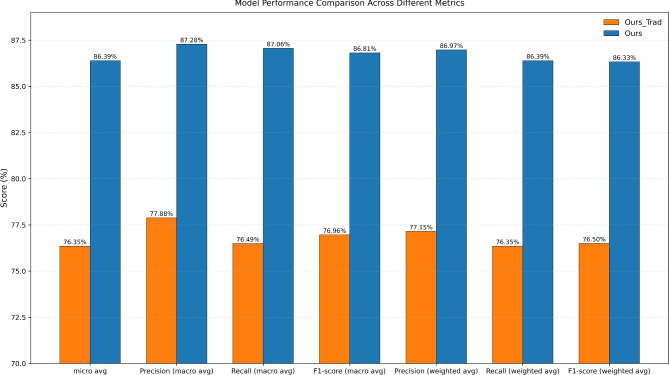
With the advancement of information technology, libraries have shifted from traditional physical services to an integrated "offline + online" model, becoming digital hubs in the national public cultural service system. However, current book classification still relies primarily on manual efforts, which suffers from inefficiency and inconsistent standards, making it difficult to meet the growing demand for processing massive volumes of books. Leveraging the latest developments in artificial intelligence, this paper proposes an automatic book classification algorithm based on the DeepSeek-R1-Distill model to improve classification accuracy and efficiency. Experimental results demonstrate that the algorithm achieves an average F1-score of over 87% in a 21-category Chinese book classification task, validating its effectiveness. Future work could explore the integration of more advanced large language models and domain-adaptive pre-training strategies to further advance classification capabilities. This research contributes a novel technical pathway toward intelligent book classification and underscores the significant potential of large language models in library and information science, offering both theoretical insights and practical value for the evolution of next-generation knowledge organization systems.
Overview
The claims and statistics of this paper haven’t been checked yet.
Free: it reads the open-access text and checks the first 5 claims that cite a source we can check. Create a free account to check every claim.
Integrity signals
Registry
Cites
Statistics
Figures
Verification
Claims the paper makes
The claims and statistics of this paper haven’t been checked yet.
Free: it reads the open-access text and checks the first 5 claims that cite a source we can check. Create a free account to check every claim.
Self-check
Percentages, sums and reported differences re-computed from the paper’s own numbers.
The self-check needs the paper’s full text.
Citations
Cites
Breiman, L. (2001) · Machine Learning · doi:10.1023/a:1010933404324 · Cited by 133,538
Hochreiter, S., & Schmidhuber, J. (1997) · Neural Computation · doi:10.1162/neco.1997.9.8.1735 · Cited by 102,318
BERT: Pre-training of Deep Bidirectional Transformers for Language Understanding
Devlin, J., Chang, M.-W., Lee, K., & Toutanova, K. (2019) · Proceedings of the 2019 Conference of the North American Chapter of the Association for Computational Linguistics: Human Language Technologies, Volume 1 (Long and Short Papers) · doi:10.18653/v1/n19-1423 · Cited by 54,325 · cited 3×
“…by ELMo 10 , which transfers knowledge by extracting fixed language feature vectors; the other is the fine-tuning approach represented by BERT 11 , which adapts to downstream tasks by adding task-specific classification layers on top of the model and jointly optimizing the entire model’s…”
Distributed Representations of Words and Phrases and their Compositionality
Mikolov, T., Sutskever, I., Chen, K., Corrado, G., & Dean, J. (2013) · arXiv · doi:10.48550/arxiv.1310.4546 · Cited by 24,533 · cited 1×
“Traditional approaches relied on statistical text representation methods including Bag-of-Words (BoW) 5 , TF-IDF 6 , Chi-square feature selection 7 and Word2Vec embeddings 8 .”
Nearest neighbor pattern classification
Cover, T., & Hart, P. (1967) · IEEE Transactions on Information Theory · doi:10.1109/tit.1967.1053964 · Cited by 16,936 · cited 2×
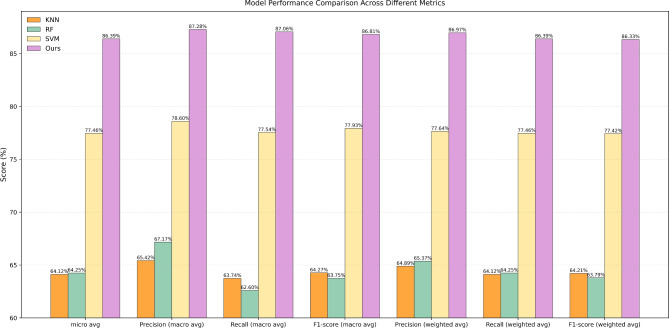
“5, KNN and RF exhibited the lowest performance, with average metrics around 65%.”
Convolutional Neural Networks for Sentence Classification
Kim, Y. (2014) · Proceedings of the 2014 Conference on Empirical Methods in Natural Language Processing (EMNLP) · doi:10.3115/v1/d14-1181 · Cited by 14,831 · cited 1×
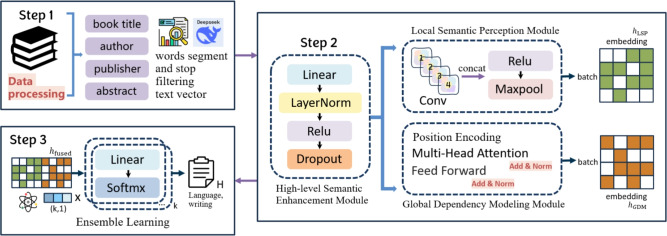
“Inspired by the TextCNN architecture, the model employs a multi-scale 1D temporal convolutional network with parallel convolutional kernels of sizes {1,2,3,4}, corresponding to uni-gram through quad-gram feature extraction capabilities 17 .”
Deep Contextualized Word Representations
Peters, M., Neumann, M., Iyyer, M., Gardner, M., Clark, C., Lee, K., & Zettlemoyer, L. (2018) · Proceedings of the 2018 Conference of the North American Chapter of the Association for Computational Linguistics: Human Language Technologies, Volume 1 (Long Papers) · doi:10.18653/v1/n18-1202 · Cited by 11,983 · cited 3×
“Despite these advancements, several challenges remain in effectively adapting these technologies to library classification tasks: (i) the limited representational capacity of conventional text encoding methods and (ii) earlier NLP pre-trained models (ELMo and BERT) often suffer from a lack of broad, generalizable know…”
Graph Convolutional Networks for Text Classification
Yao, L., Mao, C., & Luo, Y. (2019) · Proceedings of the AAAI Conference on Artificial Intelligence · doi:10.1609/aaai.v33i01.33017370 · Cited by 1,983
Understanding bag-of-words model: a statistical framework
Zhang, Y., Jin, R., & Zhou, Z.-H. (2010) · International Journal of Machine Learning and Cybernetics · doi:10.1007/s13042-010-0001-0 · Cited by 1,384 · cited 1×
“Traditional approaches relied on statistical text representation methods including Bag-of-Words (BoW) 5 , TF-IDF 6 , Chi-square feature selection 7 and Word2Vec embeddings 8 .”
Deep Pyramid Convolutional Neural Networks for Text Categorization
Johnson, R., & Zhang, T. (2017) · Proceedings of the 55th Annual Meeting of the Association for Computational Linguistics (Volume 1: Long Papers) · doi:10.18653/v1/p17-1052 · Cited by 823 · cited 1×
“Recurrent Neural Networks (RNNs) introduced sequential processing capabilities 12 , while Convolutional Neural Networks (CNNs) excelled at capturing local text patterns 13 .”
Research works printed but not linked: 6
- Hong, Ma. Analysis of revision features in the fifth edition of Chinese library classification. J. Taiyuan Normal Univ. (Social Science Edition) 15 (6), 126–128 (2016).
- Tao, Ouyang. Research on Automatic Chinese Book Classification Based on Pre-trained Models [D]. Yunnan Normal University, 10.27459/d.cnki.gynfc.2023.002035. (2023). · doi:10.27459/d.cnki.gynfc.2023.002035
- Vaswani, Ashish, et al. Attention Is All You Need. Adv. Neural Inf. Process. Syst. (2017).
- Wei, Wei, Zheng, Zeng, Lei, Liu. The Breakthrough of DeepSeek: Innovation Paradigms, Challenges, and Countermeasures in China’s AI Industry [J/OL]. Economic Review,1-13[2025-04-21]. http://kns.cnki.net/kcms/detail/22.1054.F.20250417.2118.002.html.
- Johnson, Rie, & Zhang, Tong. Deep Pyramid Convolutional Neural Networks for Text Categorization. In Proceedings of the 55th Annual Meeting of the Association for Computational Linguistics (Volume 1: Long Papers), pages 562–570, Vancouver, Canada. Association for Computational (2017). · DOI · Paper page
- VASWANI, A., SHAZEER, N., PARMAR, N., USZKOREIT, J., JONES, L., GOMEZ, A. N., KAISER, Ł., & POLOSUKHIN, I.: Attention is all you need, Proceedings of the 31st International Conference on Neural Information Processing Systems, Curran Associates Inc., Long Beach, California, USA, pp. 6000–6010, (2017).
Cited by
Research on Large Language Model-Based Bibliographic Cataloging Agent in the CNMARC Context
Tan, Z., Yang, X., Chen, Q., & Chen, T. (2026) · Publications · doi:10.3390/publications14010019 · Cited by 2
“…approach based on generative large models, researchers conducted experiments on hierarchical document classification and subject indexing, demonstrating that fine‑tuned models can significantly improve performance in multi‑level classification tasks(Feng, 2025; Luo & Liu, 2025; Z. Hu et al., 2025).”
Reshi, A. A., Lone, Y. R., Ayub, T., & Gul, S. (2026) · Journal of Librarianship and Information Science · doi:10.1177/09610006261442170
Dai, T., Luo, J., Shou, T., Wu, J., Xie, X., Xu, X., Zhu, N., & Ye, J. (2026) · Humanities and Social Sciences Communications · doi:10.1057/s41599-026-08605-x
Maculan, B. C. M. D. S., Soares, F. M., & Marques, F. B. (2026) · Advances in Knowledge Representation · doi:10.5281/zenodo.22099611
Steele, G., Wilkinson, K., Milenkovic, V., Sze, W. Y., & Wray, D. (2026) · Journal of the Australian Library and Information Association · doi:10.1080/24750158.2026.2721755
Metadata
- Authors
- Feng, N.
- Affiliations
- Henan University of Science and Technology (CN)
- Corresponding author
- Feng, Na
- Venue
- Scientific Reports
- Published
- 2025-11-03
- Volume
- 15
- Issue
- 1
- Pages
- 38394-38394
- ISSN
- 2045-2322 (ISSN-L)
- PMC
- PMC12583460
- OpenAlex
- W4415787866
- Cited by
- 3
- References
- 12
- Citations by year
- 2026: 3
- FWCI
- 1.20
- Type
- journal article
- Language
- en
- Open access
- gold
- doi.org
- Licence
- cc-by-nc-nd
- creativecommons.org/licenses/by-nc-nd/4.0 (tdm)
- creativecommons.org/licenses/by-nc-nd/4.0 (vor)
- Locations
- Scientific Reports (publishedVersion, cc-by-nc-nd)
- Europe PMC (PubMed Central) (publishedVersion, cc-by-nc-nd)
- PubMed (publishedVersion)
- DOAJ (DOAJ: Directory of Open Access Journals) (submittedVersion, cc-by-sa)
- Funders
- Henan Provincial Science and Technology Research Project (No. 252102520024)
- Topics
- Physical Sciences › Computer Science › Artificial Intelligence › Text and Document Classification Technologies
- Physical Sciences › Computer Science › Artificial Intelligence › Topic Modeling
- Physical Sciences › Computer Science › Information Systems › Library Science and Information Systems
- Keywords
- library classification, DeepSeek-R1, large language models, knowledge organization systems, domain-adaptive pretraining
About these checks
Registry, retraction, Cites and statistics results are computed, not judged, with one exception: a printed reference that no index lists is read once by a model before it counts as a citation error. Claims are extracted by a model and kept only when their quote appears verbatim in the text; each cited source is then checked, with a model’s help, for whether it says what the claim relies on. Those verdicts can be wrong — read the claim’s quote and the cited source before relying on one.
Statistics and arithmetic are recomputed, not judged.
Confidence bands are shown only for fields calibrated on our annotated test set. None is calibrated yet, so no band is shown.
What counts as a claim ›How we measure confidence ›How we check this ›
Are you an author, or do you see a problem with this page? Request a review
How to cite
Cite CoChat for the checks on this page, and the paper for its own findings.
- This page
- CoChat. (2026). Citation check: AI-powered knowledge organization: a next-generation approach to library classification using DeepSeek-R1. https://app.cochat.ai/papers/10.1038/s41598-025-22272-z
- The paper
- Feng, N. (2025). AI-powered knowledge organization: a next-generation approach to library classification using DeepSeek-R1. Scientific Reports. https://doi.org/10.1038/s41598-025-22272-z
Data sources
Bibliographic data: Semantic Scholar, OpenAlex, Crossref.
Contains information from the Semantic Scholar Academic Graph Datasets, made available under the ODC Attribution License (ODC-BY 1.0).
Semantic Scholar’s data is described in: Kinney, R., et al. (2023). The Semantic Scholar Open Data Platform. arXiv:2301.10140.
